


9,99 €
Mehr erfahren.
- Herausgeber: Nell Goddin
- Kategorie: Krimi
- Sprache: Englisch
A man so despised, everyone who met him wanted to kick him downstairs.
Or worse.
News of Bernard's murder brings cheers throughout the Dordogne. A dysfunctional family, feuding neighbors, disgruntled business associates: Molly and Ben are up to their eyeballs with potential perpetrators.
With a wedding to plan, Molly's up against a tight deadline, yet the list of suspects keeps getting longer.
And then there's the shadowy figure stalking her through the streets of Castillac...
Das E-Book können Sie in Legimi-Apps oder einer beliebigen App lesen, die das folgende Format unterstützen:
Veröffentlichungsjahr: 2019
Ähnliche


















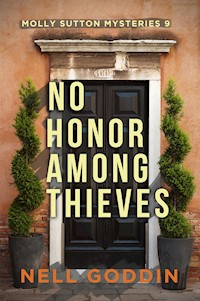
No Honor Among Thieves
Molly Sutton Mysteries 9
Nell Goddin
Beignet Books
Copyright © 2018 by Nell Goddin
All rights reserved.
No part of this book may be reproduced in any form or by any electronic or mechanical means, including information storage and retrieval systems, without written permission from the author, except for the use of brief quotations in a book review.
Want a free short story? Click HERE!
Contents
Part I
Chapter 1
Chapter 2
Chapter 3
Chapter 4
Chapter 5
Chapter 6
Chapter 7
Chapter 8
Chapter 9
Chapter 10
Chapter 11
Part II
Chapter 12
Chapter 13
Chapter 14
Chapter 15
Chapter 16
Chapter 17
Chapter 18
Chapter 19
Chapter 20
Chapter 21
Chapter 22
Chapter 23
Chapter 24
Chapter 25
Part III
Chapter 26
Chapter 27
Chapter 28
Chapter 29
Chapter 30
Chapter 31
Chapter 32
Chapter 33
Chapter 34
Chapter 35
Chapter 36
Part IV
Chapter 37
Chapter 38
Chapter 39
Chapter 40
Chapter 41
Chapter 42
Chapter 43
Chapter 44
Also by Nell Goddin
Glossary
Acknowledgments
About the Author
I
1
2007
Bernard Petit knew perfectly well that he did not have many friends and his family mostly despised him. Nor did he fool himself into believing he was popular with any of the people he’d done business with over the years, in a variety of importing deals that were not quite illegal, most of the time. But Bernard did not find out until one particularly cold and starless evening in November just how deep the animosity went.
After polishing off a passable dinner of lamb shank and lentils the housekeeper had prepared and left for him to warm up, Bernard wiped his mouth and wandered away from the dinner table to stand at one of the floor-to-ceiling windows in the living room. He gazed out to the backyard, his eyes moving distractedly over the familiar territory.
That deal he was working on was not going well. That damned Stephane Burnette didn’t know a good opportunity when it jumped up and smacked him right in his insipid face. Bernard clenched his fists, remembering last week’s meeting with Burnette, during which the other man made such agreeable murmurs while Bernard spoke that it surely seemed Burnette was ready to sign on the dotted line. But no, the little weasel demurred at the last minute, and Bernard was left without the investment he had not only hoped for, but thought was practically, as hunters might say, firmly in the bag.
Bernard’s stomach felt vaguely upset, and he rubbed a hand over his belly as he stared outside. Bergerac was in the midst of an unusual cold snap. By a spotlight he had installed for security reasons, he could see the bare pollarded tulip tree at the end of the yard, and the outline of an old yew his neighbor continually asked that he cut down.
He most certainly had not cut it down and had no intention of doing so, though he himself had no particular love for the tree. Bernard was not in the habit of acquiescing just because a person got it in his head to ask him a favor. He waited, always, to see what he might get out of it, with general goodwill not exactly a prized asset.
With a sour expression, he drifted from the window into his study. Alaina, his former wife, had used it as a sewing room and it still had an extravagantly feminine wallpaper: pink bouquets of roses and peonies, twirling ribbons, and what looked to be fairies perched among all the frou-frou. He made a mental note, for the hundredth time, to hire a decorator to fix things up more appropriately for a single man living alone. It wasn’t that Bernard was a procrastinator, far from it—but the expense always stopped him in the end.
He sat heavily in his chair, at his desk, facing a window that looked onto the street. It was after ten o’clock, and cold enough that no one was out walking just for the fun of it. He saw a man in a dark overcoat hurry along across the street; no one Bernard recognized.
Things aren’t good, he muttered to himself, putting his elbows on his desk instead of opening the file he had intended to have a look at. I need to make some sort of change. But what kind of change—I have no idea.
Bernard Petit was experiencing, for once in his life, a shred of desire for a better life than the one he’d been leading. You could not really say that he was facing his demons, or taking comprehensive stock of himself. But he did, in his final breath, have at least one moment of realizing that his life was rather empty, along with a flicker of desire for something better.
In the next instant, all was darkness, and Bernard slumped forward on his desk, the back of his head bashed in by someone he had not heard enter his house, so wrapped up had he been in these baby steps of reckoning, this faint yearning for a more meaningful life.
2
At a corner table at the Café de la Place, Ben bit off a corner of his croissant and leaned back in his chair to look at Molly. “Well, is this some kind of trick question? You look as beautiful as ever. If you’ve changed something, hell if I can see what.” He smiled, hiding his worry that he had just managed to insult her.
But Molly, bless her heart, was not all that easy to insult. She swooped her head one way and another, then fluffed her hair up with her hands, the red curls bouncing up and springing into the air. “I went to a salon! I usually don’t splurge on haircuts, since why bother, really, it just grows back in two seconds and I’ve never gotten the trick of styling it anyway.”
Ben peered at her hair, then reached a hand over and tucked a springy bit behind one of Molly’s ears. “It looks lovely. As always.”
Molly tipped her head back and laughed. Ben’s sincerity was one of his charms, no doubt, but it also amused her. “Well, the hairdresser put in layers and this and that, and I’m feeling altogether glamorous this morning. Too bad we’re not having breakfast on the Champs Elysées. Anyway, what have we got going on? It’s been ages since we had a decent case to sink our teeth into.”
“Alas, a dearth of murders in Castillac,” said Ben, sipping his coffee.
“Too bad,” said Molly, equally deadpan. “Maybe we should plan our wedding, if we’ve got nothing else pressing? It’s only weeks away, after all.”
Ben took a deep breath. He was intent on marrying his expat Bostonian, but the actual wedding planning filled him with something approaching dread. “Molly, I don’t want to give you the wrong idea—you know I’ve been looking forward to being your husband almost since I met you.”
Molly beamed.
“But weddings—”
“Simon!” called Molly, half-standing up from the table and waving.
Simon Valette, a recent client, was coming through the door with his two young daughters. Fashionable as ever, he wore a very nicely-cut sport coat with a silk scarf. He waved back at Molly and had a word with Pascal, the handsome waiter, before coming over to Molly and Ben’s table.
“Bonjour Molly, Ben,” he said, and the three kissed cheeks.
“Join us?” said Molly.
“Oh no, we need to be off! We just came by to pick up Elise—her mother is home with the flu and we are charged with walking her the three blocks to school.”
“She could walk by herself,” said Chloë. “Grownups always think children are so helpless but we’re not.”
Giselle put a hand on her younger sister’s shoulder and smiled shyly at Molly.
“I wish the two of you could play hooky with me today,” she said to them.
“Molly!” said Simon. “I have enough trouble getting them out the door without your bad influence!”
“How is Camille?” asked Ben.
Simon shrugged. “You know how it is. For some people, life is a struggle.”
Chloë had broken away and was shadowing Pascal as he brought breakfast to a party of six seated by the window. Young Elise appeared and Simon waved to her. “Onward!” he said with a wink, and Molly and Ben watched him leave with the three girls trooping behind.
“Wonder if he’s bored in Castillac,” said Ben.
“Why? We seem to find enough to do. I’m just glad the girls seem to be doing okay. I worry about them.”
“I know you do. I’m glad they have you, even if you don’t see them very often. What if Simon made a mistake, moving his family to the provinces. I know he did it trying to be helpful—but think of what they gave up! A big-shot job in Paris with an enormous income, no doubt, along with a very swank apartment and a host of fancy friends. A whole fancy life, left behind. I can’t help wondering—does he regret it?”
Molly shrugged. “Who knows? Okay, so about the wedding…”
Ben put on his most pleasant face and tapped his fingertips on the edge of his chair. Molly was not fooled for one second, but enjoyed his discomfort in the way that lovers sometimes do when they know that after the teasing, big happiness awaits.
3
With a sigh, Sarah Berteau left her house, on a dingy back street of Bergerac, and made her way to Monsieur Petit’s, as she had done four mornings a week for a few months. It was sunny and cold, and she pulled on a pair of gloves as she walked, even though it was only a five-minute walk to the much nicer street where the Petit house was.
She had only begun with Petit when her husband Anthony lost his job. Sarah didn’t mind working—or at least, in principle she did not. Working for Monsieur Petit, however, had been no picnic, and she had no cause for optimism about the situation—or his moods—improving.
The streets were full of people hustling off to work or doing errands. They squinted into the sun, their shoulders hunched against the cold. Passing a pastry shop, she paused, tempted, but decided to press on to Petit’s and get the work over with. At least he did not require that she spend a certain number of hours at his house; she had only to perform the assigned tasks, after which she was free to go…though she had learned he did not tolerate even the tiniest cutting of a corner.
As she fumbled for the key, Sarah had no premonition of anything amiss. On her way to the kitchen, she did not glance in the direction of the study and did not see Petit’s body slumped over his desk.
He had failed to clear his dishes from the dining room table, which was unusual. The house seemed rather cold and she kept her coat on as she took his plate and wine glass to the sink in the kitchen.
Oh my, she thought, seeing a window open. Could I have left that open yesterday? The place had really needed airing, but I’m surprised Monsieur Petit did not close it later, it’s terribly cold in here.
Sarah went to the window and closed it. From the closet she took an apron, some rags and a duster, and, being a methodical sort of cleaner, followed her usual pattern of starting at one end of the downstairs and dusting each room in turn.
The living room was already nearly spotless, but she dusted it anyway.
Then to the hallway, and Monsieur Petit’s study.
She stood for a moment in the doorway. She opened her mouth to say something to him, even though it was quite apparent he was in no shape to answer. A pool of blood was on the floor under his chair and Sarah immediately considered how the stain would need to be addressed, and the quicker the better.
She closed her mouth. It was the strangest sensation, seeing her employer with his head caved in, obviously murdered; her eyes knew what they were seeing but her brain refused to make any meaning out of it.
And then, all at once, all her senses synchronized, and Sarah Berteau—for the first time in her life—let loose a terrified scream.
I don’t know why I’m screaming, she thought, taking a quick breath and screaming some more. Unless whoever whacked him in the head is still in the house?
She shut up in a hurry. Holding her breath, she peered both ways down the hall, her ear cocked.
Oh come on, she said to herself. They’ll be long gone by now. It’s not as though it just happened, either, anyone can see that. She went back to Monsieur Petit and looked him over, making sure he was dead though she was just being over-careful, then matter-of-factly pulled out her cell and called the gendarmerie.
“Âllo, bonjour,” she said, “This is Sarah Berteau. I’m at the house of my employer, Bernard Petit, on rue Lafayette. I wish to make a report…he is dead….yes, I’m quite certain…no, I am not a doctor, but I have eyes...all right, send whoever you like, I’m only making the report…yes…all right, I’ll stay here and let them in.”
Annoyed, she put her phone back in her apron pocket. She was not sure what to do next. Continue cleaning as though nothing had happened? It wasn’t as though Monsieur Petit was going to care one way or another. She passed through the living room and neatly arranged the throw pillows on the sofa, something Monsieur Petit had been particular about.
Sarah had not liked him. He had been disagreeable to work for: hard to please, ungrateful, dismissive. But nonetheless, she felt no gladness or relief in his death, and she paced around the house, nervous and still a little afraid, even after bravely checking the whole house from top to bottom and finding no one else there.
At last there was a rap on the front door and she trotted over to open it. “Whoever it is, they’re long gone,” she said, realizing when she laid eyes on the gendarme that what she was worried about was whether she had left that window open the day before—had, in essence, provided an easy way into the house for a murderer to do his dirty business.
Molly was fiddling around at her home, La Baraque, sipping a third cup of coffee and waiting for her friend and housecleaner Constance to show up. Constance was late, but their work wasn’t pressing and Molly didn’t mind.
When she heard a revving engine, Molly looked out to see Constance waving goodbye to her boyfriend, Thomas, as he flew out of the driveway on a new motorcycle. The young woman turned and ran to Molly’s door.
“Bonjour Molly,” she said, breathless, jumping inside the second Molly opened the door, and kissing her on both cheeks. “It’s cold as the devil out there!”
“Indeed,” said Molly. “Is that a new bike Thomas is riding?”
“Yes,” said Constance, with a grin. “He got a promotion, can you believe it?”
Molly couldn’t, actually, knowing Thomas’s work history to be a little on the sketchy side. “Glad to hear it,” she said.
“And what about your work,” said Constance. “I mean both kinds. Do you have anyone coming for Christmas—are there any repeaters, anyone interesting? And also, what about the detective biz? You and Ben got any irons in the fire?”
“Afraid not,” said Molly. She was happy enough just running the gîte business at La Baraque; now that the renovations were more-or-less complete, she made a decent income from it, and the guests coming and going made life pretty interesting. But for some people, “happy enough” doesn’t quite cut it, at least not all the time. Molly missed the excitement and challenge of solving difficult cases; cleaning the cottages before guests arrived was obviously not as thrilling, though satisfying in its own way.
“Too bad,” said Constance, who understood perfectly. “But hey, someone could get killed any day!”
“Great?” said Molly, laughing. “Okay, so I’ve already cleaned the pigeonnier and the annex. All we have left is the cottage, plus the living room here could use a vacuuming. What do you want to tackle first?”
“How about throwing some more logs in the stove? It’s freezing in here. And maybe we could have a cup of coffee before we get started? I want to hear all about the wedding plans.”
Molly shrugged. “Help yourself, I just made a fresh pot. As for wedding plans…we’re at zero so far.”
“What? No theme, no location, no nothing?”
“Correct,” said Molly, opening the fridge to get the cream. “It’s funny, or maybe not so funny since I’ve already been married once…I’m just not that invested in the actual wedding this time. I want it to be fun, obviously, and meaningful—I’m not saying I’m totally jaded or cynical, nothing like that. But I don’t really care very much about the details. As long as we have good food, good drink, and all our friends, that’s all that matters.”
“How spiritually advanced you are,” said Constance, with an exaggerated frown. “I see I’m going to have to twist your head back around to understanding that you’re throwing a wedding for crying out loud and expectations are high. You’re not allowed to let us all down with a half-baked party, Molly Sutton! And also by the way, it just occurred to me—are you changing your name to Dufort?”
Molly paused, surprised that she’d never even considered it. “I…I don’t know. I guess I’ll talk to Ben about it. I didn’t change my name when I married Donny. Just not something I ever thought much about.”
“Oh, you’re so modern. And I don’t mean that in a good way.”
Molly laughed. She was suddenly feeling peckish and was about to offer to make a hearty breakfast before they got to work, when her cell buzzed. She picked up her phone and looked at the screen, a text from her close friend Lawrence:
Bernard Petit found dead in his house. Wasn’t he a client of Ben’s?
Molly stared at the words. A very pleasant little tingle was spreading through her body at the prospect of a new case, though as usual it was only a prospective case so far. Quickly she texted Ben to let him know. She remembered that Petit had grown children—maybe Ben could get somewhere with them?
“Molly?” said Constance.
“It’s nothing. At least, well, it might be something. Tell me this, though: what connection does Lawrence have that he finds everything out before I do? It’s been driving me mad for years.”
Constance just smiled. “So somebody got offed? Hopefully no one we like?”
“You’re very cavalier about murder, Constance.”
“You’re one to talk. So who is it?”
“Bernard Petit, from Bergerac. Though as far as we know, he wasn’t offed, as you so charmingly put it. According to Lawrence, he was found dead in his house. Most likely natural causes.”
“Didn’t know him. But I’ve heard of him. Because people love to talk about people they don’t like.”
“True enough,” said Molly. “Well, shall we get to it?”
They collected buckets and mop, dusters and dustpans, and got over to the cottage.
“Almighty Lord Jesus!” said Constance.
“Have you suddenly got religion?”
“It’s freezing in here, Molls. If anyone’s showing up today, you better jack this heat up!”
“Yeah, yeah,” said Molly, who had a constitutional aversion to spending money on heating bills. As she adjusted the thermostat, her cell buzzed again, another text from Lawrence.
Head bashed in
“Oh!” said Molly, and showed the screen to Constance.
“Now we’re talking!” said Constance. “I’m not going to feel even a little bit bad. Everyone—and I mean everyone—thought he was a massive jerk. You get what you pay for!”
Molly paused for a moment, then shook her head. “I think I see what you mean. Though maybe while you’re wishing people dead you could offer up a prayer for their souls at the same time.”
“Bernard Petit had no soul. Have you heard a word I said?”
Molly tossed Constance a rag. “Wipe down the bathroom, will you? I’ll dust. As usual there’s like three inches of dust from these stone walls.”
Constance disappeared into the bathroom and Molly heard her spraying cleaner all over everything. “Where are they from?” Constance called out.
“Virginia. And New York City.”
“Ah!”
“Someday, Constance, we will take a trip there together. Though I’m afraid it will never live up to your expectations.”
“Are you kidding? New York? Of course it will. Sweet Mary and Joseph!”
Molly ducked her head into the bathroom. “What?”
“Look at what your guests left behind,” said Constance, pointing into the cabinet under the sink.
Perched next to a bottle of floor cleaner was a fat roll of bills. Molly plucked it out and slipped off the elastic band.
“Fifties,” she said, eyes big. “There must be a few thousand euros here. What in the world?”
Constance was practically drooling. “If, uh, if you’re at a loss about what to do with it,” she said, patting Molly on the shoulder. “I’ve got a few ideas. And you know, when it comes to ideas, mine are super-ultra-good.”
Molly flipped through the bills to make sure the fifties weren’t just on the ends of the wad. Nope, it looked to be all fifties, through and through.
Curious.
The Donalds had stayed in the cottage last, having left only the day before. They were an unassuming couple, not given to chit-chat.
“The Donalds?” said Molly, incredulous.
“Those two little mice? Well, just goes to show—you never know about people.”
“True enough,” said Molly. “You never know.”
4
Ben wasted no time after hearing from Molly about Petit. He had been visiting with his friend Rémy at his organic farm, who was taking advantage of the cold weather to enjoy a bit of leisure. Rémy waved goodbye from the doorway as Ben sped off down the twisty road on his way to Bergerac, trying to remember everything he could about the Petits.
The case Petit hired him for had ended inconclusively. Petit claimed someone had been stealing from him, and Ben had dutifully set up video cameras and beefed up overall security but never found the culprit.
Ben wasn’t entirely sure there was a culprit. First of all, the items missing were a bit strange: pillowcases and shoe trees, not exactly the sorts of things that make burglars’ eyes light up. So Ben had guessed that whoever was doing it was trying to get under Petit’s skin, gaslight him, make him feel persecuted—all of which seemed to work, more or less, though as far as Ben knew, there had been no more thefts, which seemed to satisfy Petit well enough (though he complained—often—about Ben’s failure to identify the thief, he did pay the fee without complaint). Ben had written in the file that it was possible Petit had made the whole thing up, though he had no evidence or any kind of motivation for Petit to do such a thing.
Petit’s children were grown, both at university, a son and a daughter. Petit had not spoken of them warmly and Ben thought the relationships were strained. Same with the ex-wife; the divorce was fairly recent, if Ben remembered correctly.
The Petit house was not quite grand, but close to it, a solidly-built upper-middle class house, the color of terra cotta with a slate roof. It was three stories high with a garden in back, on one of Bergerac’s nicer streets. Had Petit left any sort of estate? Was there a will? Were the children to divide everything? And how about business associates? What line of work was he in? Ben couldn’t quite remember, if Petit had ever told him. Ben knew Petit to be an annoying jackass…maybe he was worse than that, maybe he had finally screwed over the wrong person. So often, thought Ben, everything devolves to money. He guessed that whatever had happened to Bernard Petit, money would turn out to be the largest part of it.
Seeing a blue and white police car in front of Petit’s house, Ben parked down the block and walked with his head down and hands jammed in his pockets, the frigid wind tearing down the street and hurting his face. He saw a white van, too, and was glad he arrived before the body was taken away.
Of course, Ben Dufort was a private citizen, no longer Chief of the Castillac gendarmerie for years now. But he was old friends with nearly every cop who worked in the area, with Bergerac no exception.
“Bonjour, Enzo,” he said with a grin, when the officer opened the door.
“Ben!” said Enzo, waving him in. “How is everything? You show up to every murder within two hundred kilometers, eh?”
Ben shrugged and asked after Enzo’s wife and children.
“They are superb,” said Enzo. “I’d show you some pictures but you know how fussy—” he jerked his head to the side, to indicate where his boss was, just as the boss rounded the corner.
“Ah, Benjamin!” said Léo Lagasse, a big man who had been a detective in Bergerac since forever. The two friends kissed cheeks. “Haven’t seen you in an age. What have been up to, besides sniffing around murders that don’t concern you?” He smiled widely, showing a gray tooth on one side. The skin on his face had patches of red, pink, and white, giving him a colorful but not healthy appearance.
“Petit was my client not long ago. Thought I might be of some assistance.”
“Uh huh. Sure you did.” Lagasse grinned, not fooled for a second. “Buy me lunch and I might toss you a few crumbs. But it’s gotta be at La Grenouille. I’m famished,” he said, patting his belly with a woeful expression though it was only nine in the morning.
Ben nodded. “I’ll call for a reservation. May I see the body?”
“By all means. Reservations are rare as hen’s teeth, as I don’t have to tell you. Their classic sauce espagnole is sublime. You’ve had it? It’s the sort of dish you have dreams about afterward. And I don’t mean dreams of dyspepsia either.”
“I’ve only eaten there once, actually. Years ago.”
Lagasse looked shocked. “Who are you? Have you forgotten that an excellent meal is the highest achievement man can hope for? The pinnacle of human existence?”
“Been busy,” said Ben, smirking.
Lagasse just shook his head. “In there,” he said, pointing down the hall. “It’s a messy one.”
Ben took a deep breath to prepare himself, never having developed the thick skin of some in law enforcement, who could arrive at a murder scene or a terrible accident and take the whole thing in stride. To Ben, the pain of the deceased and the deceased’s friends and relatives was all too close and could not be pushed away. This tendency—some might call it sentimental, but it was not—both hindered and helped him in his investigative work.
He turned the corner to the study, his eyes going straight to Petit and his poor head. Blood spattered the elaborate toile wallpaper, and Ben immediately saw the heavy glass ashtray on the floor, presumably the murder weapon. He crouched down to look from a different perspective, careful not to enter the room. Backing up, he returned to Lagasse near the front door.
“I’m waiting on forensics, they’ll take pictures before we touch anything. You saw the ashtray?”
“Couldn’t miss it. With any luck you’ll get some good prints.”
“I don’t expect to be lucky. Never do. Makes for less disappointment. Now La Grenouille? That never disappoints. Perhaps that is the quality that puts the finishing touch on its perfection, the absolute reliability of its pleasures. Can’t say the same about most things, I’m afraid. Certainly not most people.”
Dufort shrugged, feeling a little impatient with Lagasse’s chatter. “Petit has two children, grown. I might have their contact information but not with me. Also, an ex-wife who does not live in the area. Travels a lot, according to Petit.”
“From what I know about him, everyone around him wanted to keep their distance as much as possible. So it’s no surprise his family’s not living close by.”
“Ah, it’s a different world these days,” said Dufort. “People are so much more mobile than they used to be. I wouldn’t necessarily make anything of it.”
Lagasse raised his bushy eyebrows way up.” Oh, you wouldn’t, eh? Going to start instructing me on what to make of what, in my own investigation?”
Ben wasn’t sure whether his friend was joking. “Just thinking out loud, Léo, don’t get your diapers in a twist.”
Lagasse let out a belly laugh, causing Enzo to jump. “Okay, old fart, I want you gone before the techs get here. Don’t need anybody grumbling about my letting civilians into the crime scene.”
“Did you get the video from the cameras?”
“Oh, you know all about the cameras, eh? Well, somebody bashed them in as thoroughly as Petit’s head.”
“That’s a shame. Any day all right for that lunch? Reservations are really that hard to get?”
“Very. Rare as unicorn penises. Just let me know the soonest you can get one, I’ll be there.”
Ben laughed, nodded to Enzo, and went out to the street.
It was nowhere near lunchtime, but he knew a place over near the cathedral that sold the most delicious salted caramels. He thought they might be the perfect thing to chew on while he reviewed the scant facts of the Petit case, in the hope of turning up some ideas about who had murdered the unpleasant man…and how he could get hired to solve the crime.
Cocktail hour found Ben and Molly at La Baraque. Molly was on her second kir, Ben drank beer, and they munched on potato chips and salted peanuts while talking over the new murder.
“So if Petit got his head cracked open with a glass ashtray, can we assume the ashtray was Petit’s and the murderer just picked it up when he got there?”
“I think that’s fair.”
“The ashtray was definitely the weapon?”
“Looked like it. It was on the floor near the body, and the wound was unquestionably made with something heavy, not a fist. I suppose the killer could have taken the weapon with him—or her—but I should be able to find out from Léo when I take him to lunch. It’s the sort of information he’ll delight in holding over my head to torment me, but eventually he’ll tell me.”
“Okay, good. So…is it possible the murder was unplanned? Who goes to murder someone and doesn’t take a weapon? Or chooses an ashtray to bring? Neither of those options sound at all likely.”
“As you’re fond of reminding me, ‘unlikely’ does not mean ‘impossible.’”
Molly smirked at him but nodded in agreement. They sipped their drinks. Ben ate another handful of chips. “I would say,” he said, “that there is a decent chance it was unplanned—someone was visiting, there was an argument that went really wrong—except that Petit was sitting at his desk with his back to the hall. If tension was that high, do you think he’d have done that, turned his back to the other person, putting himself in such a vulnerable position? Seems like if someone was in your house who was so angry he was about to murder you, you’d want to face front.”
“Maybe the murderer wasn’t angry.”
“Huh,” said Ben, who was often surprised at the way Molly was able to keep herself from making the sort of assumptions other people made without realizing it. “I guess when you see someone looking like Petit did—it wasn’t pleasant, I can tell you—you wonder how a person could do it unless they were in a blind rage.”
Molly shrugged. “Could be. But it could also be, I don’t know, someone who was just being careful to hit hard enough to get the job done. Could even be a murder-for-hire, with no connection to Petit at all, for all we know.”
“I doubt Castillac is crawling with hit men.”
“You never know,” said Molly. “Tell me about his kids. Who, what, where—everything you know.”
“Unfortunately, not much. Their names are Franck and Laurine. Petit did not suspect them for the thefts he hired me for. Franck, I believe, lives in Bordeaux and goes to the university there. Laurine…I had to check my notes…she lives in Paris, works in the fashion industry. A booker for a modeling agency.”
“Are they coming to Bergerac?”
“I would assume so, but if Lagasse had spoken to them, he wasn’t telling me.”
“Tell me about Lagasse. I just have the vaguest sense about him. Something of a gourmand?”
“Very much so. He has real talent as an investigator—he’s like you that way. Can see human behavior without sentiment, without jumping to conclusions. He would probably have risen to a top job, could be in Paris, a very big cheese.”
Molly waited. “And why didn’t he?” she said finally, impatient.
“He’s…I guess you could say he’s a man who’s ruled by his appetites. His outsized appetites. He adores food, as all Frenchmen do, of course. But with him, it’s a little extreme. He has a reputation for allowing the enjoyment of a meal to come before almost everything. Sometimes, in the course of an investigation, you have to be nimble, be willing to have a ham and cheese on baguette for lunch because something you’re doing requires speed. But Léo—he’s not going to make those concessions.
“And then there’s the matter of the women.”
“Ah! Now the story’s getting interesting!”
Ben smiled. “He’s had more affairs than your average detective, I’ll just put it that way. And he’s not especially careful to avoid consorting with the wives of people who could make his life difficult.”
Molly nodded. “I look forward to meeting him,” she said, with a twinkle in her eye.
Ben laughed. “Not your type, I don’t think—though you do have some things in common, so there’s that. But I’ve noticed that your taste in men runs to a quieter type, more thoughtful, not so much the life of the party.”
Molly leaned over to Ben and kissed him, tasting the salt on his lips. It was true that the wedding itself was not taking up much of her attention, but Ben as her husband? That was an idea she could get behind with enthusiasm.
“Do you think we should put off the wedding, in case we get hired for the Petit murder?”
Ben kissed her back, unhurried and loving.
“I do not,” he said. “On December 5th, I’m going to marry you, Molly Sutton, and I don’t care if we’ve got a murderer stashed in the cottage and nothing but broken potato chips to serve our guests.”
She grinned so hard it felt like her face would break, hugged him tight, then got up to look in the refrigerator to see about dinner.
5
Paul-Henri, junior officer of the Castillac gendarmerie, put his phone into the front pocket of his jacket and heaved a deep sigh. Ninette over at the épicerie had called to say Malcolm Barstow had shoplifted again. To Paul-Henri, this meant searching all over the village trying to find the boy, who was a master at hiding when he put his mind to it, as well as explaining to the chief, who was relatively new to Castillac, the complicated situation that was the Barstow family. Add to that placating Ninette, who in the phone call had sounded at her wit’s end.
He went to the bathroom in order to check his uniform before going out: all buttons were at a high polish and sewed on tight; no lint, stain, or stray pet hair marred the fabric; his hair was neatly combed and there was nothing between his teeth. Satisfied, he left the station and went first to the épicerie to get the whole story from Ninette.
“It’s just ridiculous!” she blurted out, before he even got inside the door. “Excuse me, bonjour Paul-Henri. I lose my manners when it comes to those Barstows! They are a blemish on our village, I tell you!”
“Calm down, please, Ninette. Tell me exactly what happened.”
“He came in not an hour ago. And you know as well as I do how that goes, Paul-Henri! The boy sidles up this aisle and down another, hands in his pockets. Flashes me a sunny smile, don’t you know, like butter wouldn’t melt in his mouth.”
Ninette crossed her arms with a flourish and Paul-Henri waited patiently for the rest of the story.
“And then Madame Tessier came in for some mineral water. She always has to have Perrier in glass bottles, you know, never the plastic. And she—she got to talking—”
“As Madame Tessier does,” said Paul-Henri under his breath.
“And she was telling me about the Valettes and how Camille barely ever leaves the house anymore, and anyway while we were having that conversation, somehow Malcolm slipped past her and before I could get a word out, he was out the door and gone! Pockets bulging! I ran outside to give chase but he was nowhere to be seen. Like a phantom when he wants to be, that one. The rotten little thief!”
Paul-Henri took a deep breath. “Can you tell me what was stolen?”
“Of course I can’t! I just told you, he slipped out the door like an eel, and I didn’t have any chance to stop him and see what was in his pockets! He bumped right into Madame Tessier, too, like she was nothing but a piece of furniture in his way.”
“So you cannot tell me a single thing that was missing? Is it possible the boy had bulging pockets before he entered the store?”
“You know he didn’t! Whose side are you on, Paul-Henri? I guess I need to speak to Chief Charlot, then.” She glared at him. For a moment Paul-Henri thought she was on the verge of slapping him.
“Now, now, Ninette, seriously, chérie, getting this worked up isn’t good for your health. Of course we in the gendarmerie take any theft seriously, but in this instance, I’m afraid you are making more of a guess about a theft than presenting any evidence that—”
“Oh, I see. I see whose side you’re on. Just because that boy’s father is no good and the family never has a dime, you take pity on him. I’m not hard-hearted, I understand. Honestly, I do. But what about my family, Paul-Henri? What about the dimes we struggle to make ourselves—are we simply supposed to open the cash register when the Barstows come around, and let them help themselves?”
Paul-Henri was usually rather good with distraught women; he knew what soothing things to say, and how to make them believe he was on their side, which he was. But that morning, he was off his game, for some reason, and Ninette’s emotions threatened to swamp him entirely. After a few more futile attempts to calm her down, he decided the best course of action was to take his leave.
“All right then, thank you,” he said. “I’m glad you called and reported him, and I will talk to the Chief about the situation and also pay a visit to the Barstow home.” He was about to say he wanted to hear Malcolm’s side of the story, but wisely stopped himself.
Besides, it was true that Malcolm was a thief, everyone in Castillac knew that. And doubtless Ninette’s family, who owned the épicerie, suffered the most from his criminal actions.
“Adieu,” he said, turning for the door, and gratefully feeling the cold air on his face once he was free again.
Malcolm, meanwhile, was dealing with his own set of problems. He had dodged Ninette easily enough and made it to the shabby Barstow house, which they rented from a Bergerac resident who was something of a neglectful landlord. Repairs were not made in a timely fashion, or even at all, but on the other hand (luckily for the Barstows) the owner was so disorganized he did not always realize when they were late with a month’s payment.
Madame Barstow sat slumped in a chair in the kitchen, in front of the fire. Her health was poor and she spent more and more time in that chair, the housekeeping left to another day, meals not prepared, baths not taken, her eyes closed or unfocused, staring at the coals.
“Look what I got,” Malcolm said to her with a grin, pulling his hands out of his pockets. “You love these!” He held out small oval cans of tinned anchovies. “I didn’t get any lettuce but I can go find some this afternoon. You could make that salad dressing, you know, with the Parmesan and anchovy paste, the one we all love so much.”




