


1,99 €
Mehr erfahren.
- Herausgeber: Quickie Classics
- Kategorie: Gesellschafts- und Liebesromane
- Sprache: Englisch
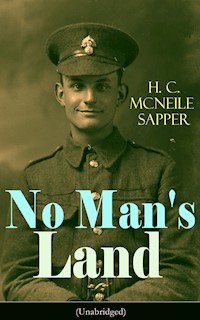
In "No Man's Land: A WW1 Saga," readers are invited into a profoundly evocative anthology capturing the tumultuous landscapes of World War I with an array of narratives ranging from poignant reflections to gritty realism. This collection stands as a testament to the era's complexity, weaving tales that encapsulate the varied human experiences from the front lines to the home front. The works within exhibit a spectrum of literary styles that echo the multifaceted nature of war—its horror, heroism, and humanity. The included pieces, though unnamed here, are remarkable for their intensity and insight, challenging readers to engage deeply with the intricacies of a world forever changed by conflict. Bringing together voices such as that of H. C. McNeile, known for his authentic representation of wartime experiences, the anthology serves as a confluence of perspectives that highlight the shared and divergent experiences of soldiers and civilians alike. As participants and chroniclers of a significant historical period, these authors infuse their narratives with a compelling immediacy and cultural resonance that mirror the sensibilities of the time. Engaging with these works opens the door to understanding the societal impacts of WWI through the lens of those who lived it. "No Man's Land" offers an invaluable resource for anyone interested in World War I, providing an in-depth examination of themes that remain relevant to this day. Readers are encouraged to explore the anthology for its rich tapestry of perspectives, its educational merits, and the dialogues it opens about sacrifice, identity, and the resilience of the human spirit amidst upheaval. This collection is not only an exploration of the past but a bridge to conversations about our present and future. Quickie Classics summarizes timeless works with precision, preserving the author's voice and keeping the prose clear, fast, and readable—distilled, never diluted. Enriched Edition extras: Introduction · Synopsis · Historical Context · Brief Analysis · 4 Reflection Q&As · Editorial Footnotes.
Das E-Book können Sie in Legimi-Apps oder einer beliebigen App lesen, die das folgende Format unterstützen:
Veröffentlichungsjahr: 2026
Ähnliche











No Man's Land (Summarized Edition)
Table of Contents
Introduction
Between the scraped lip of the trench and the churned void beyond, this book measures how far human nerve can stretch before it breaks. No Man's Land, by H. C. McNeile, writing as Sapper, is war fiction from the Western Front, composed during the First World War. Blending frontline immediacy with taut suspense, it offers episodes from patrols, dugouts, and the shattered ground that gives the book its name. What emerges is the felt experience of men negotiating an industrial battlefield where skill, chance, and discipline contend hour by hour.
Composed as a sequence of short stories or sketches rather than a single continuous narrative, the volume belongs to the tradition of World War I frontline fiction. McNeile had served as an officer in the Royal Engineers, and his pen name nods to that branch; the book thus carries an engineer's attention to mines, wiring parties, listening posts, camouflage, and the practical grammar of survival. First published during the war years, it speaks in the present tense of the era it depicts, showing routine and risk as inseparable for soldiers holding the line.
Readers encounter recurring types—a seasoned sapper, a young subaltern, a wry company sergeant, a visiting staff officer—without the book insisting on a single protagonist. The narration moves swiftly, often in close third person, with laconic humor interrupting sudden violence and the long tedium between signals, shells, and footsteps in the dark. Technical talk is braided with sensory detail—mud, wire, scent of cordite, the weight of responsibility. The tone is unsentimental and alert, sometimes sardonic, favoring action and inference over overt moralizing, and it sustains tension by focusing on small decisions whose consequences expand in a heartbeat.
At its center is the paradox of cohesion amid fracture: how men maintain order where the ground itself has been destroyed. Courage appears less as spectacle than as steadiness—holding a post, checking a fuse, venturing into the cratered waste and returning with information. The title's territory becomes a moral and psychological figure, the place where training confronts fear and where self-preservation intersects with duty. The stories avoid easy heroics and easy despair; they trace the fragile economies of trust between ranks and services, and the way professionalism, habit, and black humor shore up resolve against unpredictable machinery and weather.
Another persistent concern is knowledge—who knows, when they know it, and how that knowledge is won. Patrols, observation, sound, and soil become instruments as vital as rifles, and the stakes are measured in minutes and yards. The book attends to the limits of command, the improvisations of small groups, and the uneasy fit between the neatness of plans and the mess of ground truth. It notices class and rank as facts of service while emphasizing competence over posture, and it observes how modern war compresses civilization and peril into the same dugout, making judgment under pressure the essential craft.
For contemporary readers, No Man's Land matters for how it renders uncertainty and teamwork under sustained risk. Its attention to logistics, communication, and the psychology of night operations speaks beyond its period to any profession where incomplete information and high stakes collide. The book also records a historical sensibility: attitudes toward class, nation, and the enemy that reflect its time and may read as dated or uncomfortable today. Approached critically, that texture is valuable, revealing pressures that shaped decisions, loyalties, and myths in an era when technology outran doctrine and ordinary people learned to navigate the resulting fractures.
To read it now is to inhabit a granular, ground-level chronicle of a landscape and a mindset, written with compressed energy by someone who knew the tools and tasks involved. The collection offers suspense without sensationalism and pathos without sentimentality, inviting readers to listen for a sapper's footsteps, feel the calculations behind a whispered order, and sense the cost of returning safely to the parapet. Its enduring power lies in the balance of technical acuity and human particularity, showing how, in a place defined by vacancy, character and craft became reliable shelter.
Synopsis
No Man's Land, published in 1917 by H. C. McNeile under the pen name "Sapper," gathers wartime short stories drawn from his service with the Royal Engineers. Written and issued while the conflict still raged, the collection presents a mosaic of the Western Front, balancing brisk action with matter-of-fact observation. Each piece stands alone yet echoes others through recurrent settings and concerns: dugouts, wire, mud, and the anxious strip between opposing lines. The book's throughline is less a single plot than a sustained encounter with frontline routine and risk, where minor decisions carry mortal weight and character is tested under unremitting strain.
Early tales situate readers inside a forward trench, tracing the rhythms of stand-to, sentry duty, and the constant contest with mud, water, and collapse. New officers and seasoned non-commissioned men navigate cramped dugouts, ration parties, and the dead time between bombardments. The emphasis falls on practical choices-where to place a post, when to risk a message runner-rather than grand strategy, establishing a vantage from which the battlefield's vastness feels intimate. McNeile's focus on routine sets up the collection's broader arc: courage emerges incrementally, through repeated exposure to danger, while fear and weariness are acknowledged as ordinary companions of endurance.
A central seam follows night patrols and trench raids that venture into the blasted strip the title names. Scouts feel their way through wire and shell holes, timing movement to the rise and fall of flares and artillery. Objectives are modest-reconnoitre a sap, seize an identification mark, test an enemy post-yet the stakes are immediate and absolute. The stories highlight the peculiar etiquette of such work, from whispered signals to the refusal to waste noise, and they observe the aftermath with restraint. Tactical success or failure matters, but the moral focus lies on steadiness, improvisation, and how men carry fear.
As a serving engineer, McNeile devotes attention to technical war underground and behind the parapet. Episodes describe the tension of mining and counter-mining, listening for picks through clay, and the calculated violence of charges laid beneath positions. Other vignettes show the labor that sustains a line: repairing communications, wiring parties in front of the trench, and the careful placing of explosives or bridges under observation. The sappers' work is depicted as both skilled craft and constant exposure, where a stray sound or spark can be decisive. This focus clarifies the interdependence of infantry and engineers in a battlefield built from earth.
Interwoven are portraits of leadership and fellowship under pressure. Young subalterns learn to trust experienced sergeants; experienced men weigh duty against the attrition of months at the front. Mess-room banter and trench humor offer brief reprieve without disguising loss. Rear-area interludes-billets, rest camps, supply depots-appear as necessary pauses that never feel secure. Medical posts and casualty clearing stations enter the frame with a functional clarity, registering the transition from action to aftermath without sentimentality. Through these perspectives the book sketches a social world of ranks and roles, unified by dependence on one another and an insistence on doing the job.
The enemy is rendered through encounters rather than introspection: snipers who wait, patrols that counter-move, guns that search the front with methodical fire. Some pieces turn on deception, intelligence gathering, or the sudden appearance of a ruse, reflecting the period's fascination with cunning as much as force. The portrayal aligns with wartime British attitudes, emphasizing determination and ruthlessness across the line while reserving sympathy for one's own. This framing underscores the moral clarity the stories assume, even as they acknowledge ambiguity at the level of chance and mistake. The result is a battlefield seen through contact, test, and response.
Stylistically the collection favors speed, clipped description, and the compression of experience into decisive moments, often ending on a hard-earned equilibrium rather than revelation. Its cumulative effect is to render trench warfare as an environment of continual, managed risk in which character is demonstrated by steadiness more than bravado. Read today, No Man's Land stands as a contemporaneous record by a front-line officer, revealing both the immediacy of the fighting and the beliefs that shaped British wartime storytelling. Without depending on a final twist, it leaves a durable impression of courage, fatigue, and the lethal geography between the lines.
Historical Context
Herman Cyril McNeile, an officer in the British Army's Royal Engineers, wrote under the pen name "Sapper" while serving on the Western Front in the First World War. His collection No Man's Land appeared in 1917, drawing on experiences in Northern France and Flanders where the British Expeditionary Force held trench lines opposite the German Army. The setting spans forward trenches, communication lines, and the devastated strip between them known as no man's land. Institutions central to the backdrop include the War Office, the Royal Engineers, and the press that serialized frontline sketches, giving civilian readers a direct yet constrained window onto industrialized warfare.
By 1915-1917 the Western Front had solidified into deep, mutually supporting trench systems extending from the North Sea to the Swiss frontier. Barbed wire, strongpoints, and overlapping machine-gun fire produced a defensive stalemate in which attrition dominated strategy. British sectors in Flanders and Picardy endured relentless artillery, mud, and routine rotations between front line, support, and rest areas. Pivotal episodes shaping this environment included the Second Battle of Ypres (1915), when gas was first used on a large scale, and the Somme offensive (1916), which brought unprecedented casualties. These conditions frame the short episodes of patrols, bombardments, and brief, violent contact.
McNeile's perspective reflects the work of the Royal Engineers, whose field companies built and repaired trenches, laid and cut wire, constructed bridges, and sited strongpoints under fire. Specialized Tunnelling Companies, organized from 1915, drove mines and counter-mines beneath enemy lines—a clandestine war of listening posts, camouflets, and massive charges culminating, for example, at Messines Ridge in 1917. Engineers also handled water supply, road maintenance, and, through the Royal Engineers Signal Service, much of the communications infrastructure. This technical, problem-solving culture—practical, improvisational, and often conducted at night—shapes the collection's emphasis on small teams whose survival depends on craft, discipline, and quiet courage.
Frontline routine included night patrols across no man's land, trench raids to seize prisoners or documents, and relentless sniping. Artillery dominated operations, with barrages timed to support advances and counter-battery fire seeking to suppress enemy guns. The British refined the creeping barrage in 1916, coordinated with infantry movement. New weapons appeared: the Mills bomb became the standard grenade; Lewis guns increased mobile firepower; trench mortars harassed dugouts; and tanks entered combat in 1916, later massed at Cambrai in 1917. These tactical developments inform scenes of sudden action, uncertainty, and adaptation, emphasizing initiative at platoon and section level amid mechanized shock.
Writing during the war meant navigating censorship under the Defence of the Realm Act (1914) and War Office regulations. Officers were required to avoid identifiable operational detail and often adopted pseudonyms; McNeile's "Sapper" signalled his corps and preserved security. His stories first reached many readers through newspapers such as the Daily Mail, which carried popular frontline sketches while adhering to restrictions on casualty reporting and military criticism. This press environment shaped the tone—vivid but restrained—of accounts meant to inform and sustain morale. The resulting narratives blend technical accuracy with discretion, foregrounding soldiers' conduct rather than strategic debate or sensational disclosure.
The British Army that populates the book shifted markedly during 1914-1917. The small pre-war Regular Army was supplemented by Territorials and a vast volunteer force raised by Lord Kitchener, including locally recruited "Pals" battalions. After heavy losses, the Military Service Acts of 1916 introduced conscription, bringing a broader cross-section of society into uniform. Officers were disproportionately drawn from public schools and universities, while experienced non-commissioned officers anchored discipline and training. Dominions troops served alongside British units on the Western Front. These realities underpin portrayals of camaraderie across class lines, the weight of leadership at company level, and the learning curve of the citizen army.
Environmental and medical realities define the backdrop. Chemical warfare escalated from chlorine in 1915 to phosgene and mustard gas by 1917, prompting continual improvements in respirators and anti-gas discipline. Casualties moved through a standardized chain from regimental aid posts to casualty clearing stations and base hospitals. Troops contended with shell shock, lice, rats, waterlogged trenches, and ration fatigue, with periodic leave and letters home as crucial reliefs. Engineers and infantry fought the terrain itself—collapsed dugouts, flooded saps, shattered roads—where success often hinged on maintenance and logistics. Such details ground the narrative in the practical hardships that conditioned morale and decision-making.




