


12,99 €
Mehr erfahren.
- Herausgeber: Nick Hern Books
- Kategorie: Poesie und Drama
- Sprache: Englisch
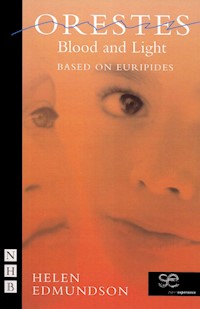
An explosive retelling of the most savage and powerful of ancient myths - the story of avenging siblings, Electra and Orestes - premiered by Shared Experience Theatre Company. As children, Orestes and his sister, Electra, were sent far away, banished by their own mother. Years later, the city must vote to determine their future, as they stand trial for her murder. Some say the killing should be met with banishment and that the cycle of revenge must be stopped. Others want blood... Exploring the tragedy of human relationships set against the backdrop of war, Helen Edmundson's play Orestes: Blood and Light is based on Euripides' Electra. The play was first staged by Shared Experience at the Yvonne Arnaud Theatre, Guildford, in September 2006, before touring.
Das E-Book können Sie in Legimi-Apps oder einer beliebigen App lesen, die das folgende Format unterstützen:
Veröffentlichungsjahr: 2015
Ähnliche










Helen Edmundson
ORESTES
BLOOD AND LIGHT
Based on
Euripides
NICK HERN BOOKS
London
www.nickhernbooks.co.uk
Contents
Title Page
Original Production
Foreword
Characters
Orestes
About the Author
Copyright and Performing Rights Information
This version of Orestes was first performed by Shared Experience Theatre Company at the Yvonne Arnaud Theatre, Guildford, on 14 September 2006; and subsequently at Dublin Theatre Festival; Warwick Arts Centre; The Lowry, Salford; Liverpool Playhouse; Oxford Playhouse; and Tricycle Theatre, London. The cast was as follows:
MENELAOS
Tim Chipping
TYNDAREOS
Jeffery Kissoon
ELECTRA
Mairead McKinley
HELEN
Clara Onyemere
SLAVE
Claire Prempeh
ORESTES
Alex Robertson
Director
Nancy Meckler
Designer
Niki Turner
Lighting Designer
Peter Harrison
Composer
Peter Salem
Company Movement
Liz Ranken
Foreword
When Nancy Meckler first gave me Euripides’ version of Orestes to read, I was puzzled by it. It is structurally flawed and tonally inconsistent. Although classed as a tragedy, its ending, in which a god descends and puts everything to rights, is a happy, if hollow, one. For these reasons it is rarely performed and often over-looked in discussions of his work, but the ideas contained within it are fascinating. The more we talked, the more I understood why Nancy was drawn to it. I understood the sad and frightening number of ways in which it is relevant to the current state of the world. When I began writing I was thinking as much about George Bush disregarding the views of the UN, and Tony Blair praying to God for guidance before invading Iraq, as I was about suicide bombers and religious extremists. I was thinking as much about honour killings amongst religious communities as about the loss of faith in the integrity of government and the impartiality of law.
As I wrote, I found the story allowed me to go even further. The way the characters use religion to justify their actions opened up into questions about the very nature of faith and the complex relationship between Man and his Gods, whilst Electra’s damaged, desperate heart speaks volumes about the personal, deep-rooted pain that underlies so many acts of violence, both on small and large scales.
I confess I have played fast and loose with the conventions of Greek theatre and with Euripides’ version of the story. I have abandoned the Chorus (who is not active or influential in the Euripides) in favour of the more subtle witness of the Slave. I have cut the character of Pylades to allow Electra her full role in the story and to allow myself to explore the extremities of her relationship with her brother. I have given Helen an intelligent, probing mind and allowed her and Klytemnestra some defence. I have chosen not to emulate the verse structure and metres of Euripides’ text, but to try to create a rhythmic, heightened language of my own.
In short, I have followed my instincts. I have kept what is useful to me and lost what is not in the hope of creating a drama which can speak freely, freshly and vitally to audiences today.
Helen Edmundson
Characters
ELECTRA
ORESTES
HELEN
SLAVE
MENELAOS
TYNDAREOS
SOLDIERS
ATTENDANTS
A forward slash (/) in the dialogue indicates that the next character begins speaking at that point. If the forward slash appears at the end of a character’s line of dialogue, it indicates that the character continues their next line of dialogue without a break.




