


2,99 €
Mehr erfahren.
- Herausgeber: Sebastian Mills
- Kategorie: Ratgeber
- Sprache: Englisch
UNLOCK YOUR TRUE POTENTIAL AND OVERCOME PROCRASTINATION WITH THIS TRANSFORMATIVE BOOK!
Are you tired of constantly procrastinating?
Do you struggle with poor time management, wavering focus, and diminishing motivation?
Are you ready to break free from the chains of bad habits, boost your productivity, and achieve your goals?
Imagine a life where you achieve your goals, increase your willpower, and manage your time effectively.
If that sounds like a dream come true, then "
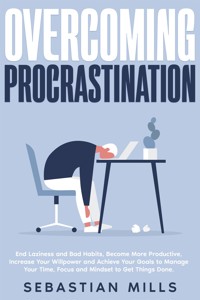
Overcoming Procrastination: End Laziness and Bad Habits, Become More Productive, Increase Your Willpower and Achieve Your Goals to Manage Your Time, Focus and Mindset to Get Things Done
" is for you!
This book guides you through understanding procrastination, identifying triggers, developing self-awareness, effective time management techniques, building willpower, fostering a positive mindset, building better habits, embracing mindfulness, and sustaining long-term productivity.
How, you ask? With this guide in your toolbox, you will:
- Gain a deep understanding of procrastination and its profound impact on your life.
- Identify the triggers that lead to procrastination and learn strategies to overcome them.
- Develop self-awareness and recognize the patterns and behaviors that hinder your productivity.
- Master effective time management techniques to prioritize tasks and eliminate distractions.
- Increase your willpower to stay focused and motivated towards achieving your goals.
- Cultivate a positive mindset that fosters productivity, resilience, and growth.
If you were to conquer your procrastination and manage your time effectively, how would that make you feel? Picture yourself breaking free from laziness and bad habits, harnessing your willpower, and embracing a focused mindset. Where would you be in terms of your goals?
With " Overcoming Procrastination", you will be able to take control of your time, increase your productivity, and make all your dreams come true!
Grab this book and start embracing a life of productivity and fulfillment today!
Das E-Book können Sie in Legimi-Apps oder einer beliebigen App lesen, die das folgende Format unterstützen:
Veröffentlichungsjahr: 2023
Ähnliche













Overcoming Procrastination
End Laziness and Bad Habits, Become More Productive, Increase Your Willpower and Achieve Your Goals to Manage Your Time, Focus and Mindset to Get Things Done.
Sebastian Mills
Copyright ©️ 2023 by Sebastian Mills
All rights reserved.
It is not legal to reproduce, duplicate, or transmit any part of this document in either electronic means or in printed format. Recording of this publication is strictly prohibited and any storage of this document is not allowed unless with written permission from the publisher except for the use of brief quotations in a book review.
Contents
Introduction
It’s Monday morning, and time is running out. You’re frantically working on a task before the 8 a.m. deadline while inwardly berating yourself for not starting earlier.
What led to this? Why did you lose focus? What happened?
Well, there were the hours that you wasted reading emails all over again and monitoring social media, the unnecessary "preparation,” the coffee breaks, and the hours spent on other work that you might have safely left for to next week.
Sounds familiar? In that case, you are not alone!
If you’re reading this, you probably struggle with procrastination, or you’re trying to help someone else who does. You’ve probably tried to fight procrastination in the past and failed.
The majority of us fall into the trap of procrastination. In fact, research shows that 95% of us procrastinate things to some extent. Knowing you’re not alone may be comforting, but realizing how much it might limit you can be sobering.
Laziness and procrastination are sometimes conflated, yet they are very different.
Procrastination is an active process - you actively opt to do something else to avoid finishing the task you know you should be doing. In contrast, being lazy denotes passivity, inactivity, and a refusal to take action.
Procrastination often involves delaying a challenging task in favor of a simpler or more enjoyable one. But this task may be more crucial.
Nevertheless, giving in to this urge might have unfavorable consequences. For instance, even minor procrastination may cause us to feel guilty or ashamed. We might produce less as a result, which would keep us from accomplishing our goals.
Long-term procrastination can make us lose our enthusiasm for our work and our motivation, which in some cases can lead to despair and even the loss of our jobs.
Despite what most individuals may claim, procrastinating rarely involves being lazy. In reality, when we procrastinate, we often work really hard for a long time right before the deadline. Since laziness is the opponent of effort, it cannot be the reason we put in the effort. So, what causes us to procrastinate, and more importantly, how do we stop it?
Procrastination is the practice of needlessly delaying choices or actions. It is a widespread problem that can lead to a variety of problems, including lost opportunities and elevated stress.
This book offers comprehensive tips on how to overcome procrastination, which will help you in resolving this issue once and for all. It is based on research and includes a list of anti-procrastination techniques, tips on how to utilize them, and a methodical strategy you can use to beat procrastination.
Understanding Procrastination
While everyone occasionally puts things off, people who procrastinate often avoid challenging tasks. They put off tasks at work, at home, and in their personal relationships, which inevitably lowers their productivity and general well-being.
The first step in combating procrastination is to realize that you are doing it.
Instead of berating yourself for this extremely common problem, investigate its root cause. Finding the right strategy to manage and overcome your behavior depends on your ability to understand the root cause.
Just like everyone has varied strengths, everyone has different reasons for procrastinating. And even successful people can suffer from a propensity to put off dealing with challenging issues.
Does putting things off cause you to fall short of your potential? Then, stop making excuses and investigate the root of the problem.
What is Procrastination?
Procrastinating is when anything is put off or delayed until the last minute or after its due date. Some scholars define procrastination as "a type of self-regulation failure characterized by the willful postponement of tasks despite potentially negative consequences."
Contrary to popular belief, procrastination involves more than being lazy or lacking time management abilities. When it comes to putting things off, telling someone to "just do it" is ineffective. It's like encouraging a person suffering from serious depression to "cheer up."
Therefore, you can stop feeling bad about your propensity to procrastinate. Although it is a more serious issue, you can work to solve it.
The principal researcher in a study on procrastination, Joseph R. Ferrari, Ph.D., demonstrates how the practice is more like a sort of self-sabotage. Demotivating psychological elements, such as anxiety or a fear of failure, exceed one's ability to exercise self-control.
People will prefer to avoid a task entirely than take a chance on the humiliation of failing or making mistakes.




