


1,99 €
Mehr erfahren.
- Herausgeber: Quickie Classics
- Kategorie: Geisteswissenschaft
- Sprache: Englisch
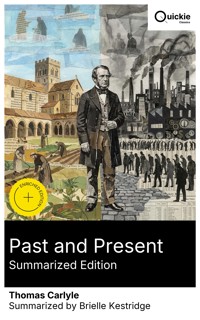
Past and Present (1843) juxtaposes Jocelin of Brakelond's chronicle of Abbot Samson at St Edmundsbury with the factories and poorhouses of industrial Britain. This genre-bending history-sermon indicts laissez-faire 'Cash Nexus' and Benthamite enumeration, railing at idle aristocracy while urging morally answerable 'Captains of Industry.' In Biblical cadences and satiric apostrophes, Carlyle uses medieval exemplum to probe the Condition-of-England question—labour, authority, and the spiritual poverty of a quantified age. Thomas Carlyle (1795–1881), a Scottish moralist steeped in Calvinist rigor and German idealism, turned from mathematics to letters to contest utilitarian orthodoxy. After Sartor Resartus and On Heroes, he crystallized a creed of duty and leadership. Reading medieval sources amid Chartist unrest and the 1842 strikes, he sought in monastic discipline a 'usable past'—elevating work as sacred and authority as service rather than mere property. Recommended to readers of Victorian studies, political theory, and management ethics, Past and Present remains a bracing corrective to complacent economics. Approach it for its thunderous prose and moral imagination—and for provocations that still press us to imagine institutions where labor, leadership, and justice cohere. Quickie Classics summarizes timeless works with precision, preserving the author's voice and keeping the prose clear, fast, and readable—distilled, never diluted. Enriched Edition extras: Introduction · Synopsis · Historical Context · Author Biography · Brief Analysis · 4 Reflection Q&As · Editorial Footnotes.
Das E-Book können Sie in Legimi-Apps oder einer beliebigen App lesen, die das folgende Format unterstützen:
Veröffentlichungsjahr: 2026
Ähnliche






Past and Present (Summarized Edition)
Table of Contents
Introduction
Between a medieval world animated by duty and a modern society governed by calculation, Thomas Carlyle’s Past and Present stages a stark confrontation that asks whether the engines of material progress can restore the moral energies they have helped to exhaust, whether leaders can be found who command service without exploitation and obedience without servility, and whether work—so often reduced to wages and mechanism—can again be lived as a sustaining vocation, binding persons to a common purpose rather than dissolving them into isolated competitors, distracted consumers, and administrators of systems whose power outruns the convictions that might justify it.
Published in 1843, in early Victorian Britain, Past and Present is a work of social criticism and historical meditation that juxtaposes the industrializing present with a reconstructed medieval past. Its historical scenes draw on the chronicle of the monk Jocelin of Brakelond and the abbey of Bury St Edmunds, while its contemporary reflections address the factories, poorhouses, and public discourse of Carlyle’s Britain. The result is neither a conventional history nor a straightforward treatise, but a hybrid book that uses the resources of one era to hold another to account, setting the nineteenth century under the moral scrutiny of the twelfth.
Readers encounter a voice at once prophetic and analytical, shifting from vivid narrative sketches of monastic life to impassioned addresses on the conditions of modern labor and governance. Carlyle writes in a highly rhetorical style—urgent, metaphor-rich, and rhythmically insistent—yet the prose also pauses for portraits, anecdotes, and pointed questions that keep the argument grounded. The book’s movement is deliberately comparative: it invites the reader to hold two social orders in mind, not to idealize either, but to feel the contrast between their animating principles. The experience is bracing, argumentative, and meditative, with momentum built through repetition and accumulating juxtapositions.
The past, as Carlyle presents it through Jocelin of Brakelond, centers on the governance of a great abbey and the figure of an abbot whose authority is tied to personal character and visible service. We see administration as a moral craft: decisions embedded in concrete responsibilities, scarcity addressed by reordering priorities, and labor understood as a communal task. The monastery becomes a microcosm of disciplined cooperation, where institutions aim to cultivate solidarity as much as to regulate. Carlyle’s purpose is not nostalgia for feudal privilege, but recovery of a vocabulary—duty, fidelity, stewardship—by which power, work, and belonging can be intelligible.
Against this backdrop, the present appears restless and powerful yet curiously impotent, rich in devices but poor in guidance. Carlyle examines a society fixated on measurable outputs, market competition, and administrative routines, noting how such habits can obscure basic questions of purpose and responsibility. He criticizes a politics that praises laissez-faire while tolerating dislocation, and a public philosophy that reduces value to utility while neglecting the formation of character. Factories, bureaucracies, and parliaments become sites where coordination is achieved without unity of ends. The critique is not anti-industry but anti-indifference, urging that productive energies be directed by credible, accountable leadership.
Several themes run through the book. Work is treated as a formative practice, bestowing dignity when joined to recognition and shared purpose. Authority is reconceived as an obligation borne for the common good, not a license to dominate. History supplies a repertoire of norms by which to evaluate present arrangements, revealing how institutions shape the souls they serve. The economy, though necessary, is insufficient as a moral horizon; commodity abundance cannot compensate for social distrust or exhausted meaning. Carlyle presses for a renewal of stewardship, education of character, and public speech that privileges truth-telling over flattery, even when such speech unsettles comfortable opinions.
The concerns remain recognizable: debates about the purpose of work, the demands of leadership, the costs of inequality, and the alienation that can accompany efficiency without community. Readers amid algorithmic management, precarious labor, and polarized politics will find an early diagnosis of how systems succeed technically while failing humanly. Past and Present matters less as a program than as a provocation, asking what kind of character our institutions reward and how prosperity might become solidarity. Its insistence that material progress needs moral direction does not date, and its method—using history as an ethical mirror—continues to illuminate contemporary dilemmas.
Synopsis
Past and Present (1843) by Thomas Carlyle is a work of social criticism that juxtaposes medieval monastic life with industrial Britain to diagnose what he calls the condition of England. Structured in four books—Proem, The Ancient Monk, The Modern Worker, and Horoscope—the volume moves from a statement of crisis, through an historical example, to an analysis of contemporary society and a forward-looking meditation. Carlyle’s method is comparative: he places a concrete narrative from the twelfth century beside his nineteenth-century present to test assumptions about progress, authority, work, and community. The resulting argument explores how moral purpose and competent leadership shape social order.
In the opening Proem, Carlyle assembles the symptoms of a modern malaise: the disconnection between rich and poor, the faith in market formulas, the spectacle of parliamentary debate without decisive guidance, and the unrest of labor. He frames a question rather than a program, asking how a nation might restore coherence when economic relations have crowded out human obligations. Freedom, he argues, needs structures of duty; prosperity requires more than the pursuit of gain. This first movement sets the criteria by which the rest of the book proceeds—work, authority, and spiritual seriousness—while insisting that diagnosis must precede remedy.
Book II turns to the Past through a specific source: the chronicle of Jocelin of Brakelond, a monk at the Abbey of St Edmundsbury in the late twelfth century. From this record Carlyle introduces Abbot Samson, whose election and governance furnish a sustained case study. The choice is deliberate. A monastery, in his presentation, is not merely pious retreat but an organized commonwealth with clear offices, shared labor, and binding rules. Samson emerges as a figure of practical capacity and moral weight, rising from relative obscurity to leadership amid institutional difficulty. The chronicle’s concrete incidents allow Carlyle to depict governance in action.
Through Samson’s tenure, Carlyle emphasizes qualities he finds lacking in his own day: discipline, accountability, and purposeful work. The Abbot enforces order among monks, repairs finances, asserts the abbey’s rights, and undertakes improvements that demand both courage and administrative skill. Conflicts are met with decision, resources are marshaled toward common ends, and office is treated as stewardship rather than privilege. The monastery’s economy is portrayed as inseparable from its ethic: agriculture, craft, and worship form a single framework of meaning. The narrative functions less as antiquarian detail than as an example of leadership that binds a community through shared duty.
Having drawn out the monastic example, Carlyle resists nostalgia. He does not propose to restore medieval institutions; instead, he extracts principles. The past is a mirror exposing how coherence arises when authority serves a genuine end, work is honored, and hierarchy is tethered to responsibility. This section insists that social stability is not an accident of custom but the product of character and organization. In the monastery, failure carries consequences, and success rewards service, not speculation. By isolating these patterns, Carlyle equips the reader with standards to measure the nineteenth-century present without claiming that eras are interchangeable or problems identical.
Book III returns to the Present, surveying the industrial landscape: crowded towns, mechanical production, volatile employment, and the spread of pauperism. Carlyle criticizes an economic creed that reduces relations to purchase and sale, leaving both employers and workers estranged. He treats political agitation and sporadic reforms as symptoms rather than cures, arguing that neither rhetoric nor punitive institutions can address the root disorder. The poor law and the workhouse system typify, for him, a spirit more concerned with administrative efficiency than human welfare. The barrier he sees is spiritual and organizational at once: society lacks governing purpose strong enough to coordinate its immense energies.
Against this vacuum, Carlyle advances a constructive emphasis on leadership and labor. He calls for an ethic in which those who direct enterprises accept responsibility for the people and purposes entrusted to them, and in which workers are recognized as participants in a shared undertaking, not mere units of exchange. Education, he suggests, must form competence and character, equipping individuals for useful service. Economic organization should be judged by the order and dignity it creates, not solely by profit. The envisaged renewal is neither sentimental nor purely legal; it depends on deliberate formation of trustworthy leaders and institutions capable of organizing work justly.
In the concluding Horoscope, Carlyle speculates soberly about futures opened by action or inaction. If society refuses moral reorientation, he warns, its technical power may intensify disorder. If it accepts the burdens of guidance, new forms of association might emerge in which authority and service are reconciled. He does not pretend to blueprint particular policies; instead, he argues for a criterion of statesmanship: to find and fit work for people, to reward merit, and to subordinate mechanism to meaning. The forecast is less prediction than exhortation, urging readers to choose an order where enterprise, law, and conscience work in concert.
Past and Present endures as a pointed meditation on modernity’s promises and perils. By counterposing a medieval case to an industrial present, Carlyle compels reconsideration of what constitutes progress. His central claim is that society cannot thrive on wealth and freedom alone; it requires shared purposes embodied in competent, accountable leadership and honorable work. Without dramatizing secrets or narrative surprises, the book presses a durable question: how can a complex nation cultivate institutions worthy of trust? Its lasting significance lies in framing economic life as a moral enterprise and inviting future readers to test their arrangements against that demanding measure.
Historical Context
Thomas Carlyle’s Past and Present appeared in London in 1843, early in Queen Victoria’s reign, when Britain stood as the foremost industrial power. The setting is the “Condition of England” crisis he had named in 1839: surging factories, crowded towns, and a political system reformed but unsettled. Parliament at Westminster grappled with social ills through commissions and reports, while the Church of England, municipal corporations, and Poor Law unions administered local life. Steam power, mechanized production, and a vast commercial network were reshaping work and authority. Carlyle frames his reflections against this concrete world of mills, markets, workhouses, and centralizing bureaucracy.
The decades before publication saw political and economic realignment. The Reform Act of 1832 broadened representation for the middle classes, and the Municipal Corporations Act of 1835 recast urban governance. At the same time, the Corn Laws—protective tariffs on grain—kept food prices high and became a national controversy. The Anti-Corn Law League, organized in 1838 by Richard Cobden and John Bright, campaigned for repeal in the name of free trade. Advocates of laissez-faire and the “Manchester School” promoted minimal state interference and market solutions. Carlyle’s book engages this ascendancy of political economy, scrutinizing its moral assumptions and social consequences.
Industrialization transformed daily life. The Liverpool and Manchester Railway opened in 1830, and railway building accelerated across the 1830s and 1840s, binding markets and labor mobility. Factory labor in textiles, iron, and coal expanded rapidly, drawing families into dense urban districts. Parliament responded with inquiries and limited reforms: the Factory Act of 1833 restricted child labor, and the Mines and Collieries Act of 1842 barred women and young boys from underground work. Official “Blue Books,” including the 1842 Children’s Employment Commission and Edwin Chadwick’s sanitary report, catalogued misery and hazards. Carlyle cites such evidence while disputing quantification as sufficient remedy.
The Poor Law Amendment Act of 1834 reorganized relief for the destitute, establishing unions and workhouses and instituting a “workhouse test” to deter casual aid. Influenced by Malthusian warnings against population growth outstripping resources, policymakers sought to curb parish expenditures and promote self-reliance. Implementation, especially in industrial districts, provoked demonstrations and political agitation, as families feared institutional separation and harsh discipline. The act replaced older wage supplements like the Speenhamland system. In this climate, Past and Present addresses the moral costs of treating poverty as a statistical or administrative matter, questioning whether deterrence alone could sustain social order.
Working-class mobilization shaped the book’s immediate backdrop. Chartism, launched with the People’s Charter in 1838, demanded six reforms including universal male suffrage and secret ballots. A mass petition was presented to Parliament in 1839, followed by the Newport Rising that autumn, and a second national petition and widespread strikes in 1842. These events revealed deep grievances over wages, hours, and representation. Carlyle had already treated the movement in Chartism (1839). Past and Present continues to engage those tensions, addressing suffering workers and cautious elites alike, while doubting that procedural changes alone—without leadership and duty—could resolve the nation’s crisis.
Carlyle’s historical foil came from Jocelin of Brakelond’s Latin chronicle of the Benedictine abbey at Bury St Edmunds, Suffolk, which covers the late twelfth century. A new edition by the Camden Society in 1840 brought Jocelin’s account to Victorian readers. It records the election and administration of Abbot Samson, noted for energetic governance and financial reform. Carlyle draws upon this monastic world—its vows, hierarchy, property management, and communal labor—to examine authority and obligation before modern capitalism. By juxtaposing medieval stewardship with contemporary industry, he probes how leadership, work, and faith once cohered, without proposing a return to feudal institutions.
The intellectual climate also informs the book. Utilitarianism, associated with Jeremy Bentham and James Mill, emphasized calculation of social utility and legislative rationalization. Thomas Malthus’s population theory shaped debates on welfare and labor. Free-trade economists argued that competitive markets would harmonize interests. Simultaneously, religious renewal stirred: the Oxford Movement sought to revive Anglican doctrine and authority, while Evangelical activism expanded philanthropy. Carlyle, steeped in German literature and having published Sartor Resartus and On Heroes and Hero-Worship, distrusted abstract systems. Past and Present presses for moral leadership and meaningful work, challenging the era’s confidence in mechanism, statistics, and expediency.




