



0,49 €
Mehr erfahren.
- Herausgeber: DigiCat
- Kategorie: Geisteswissenschaft
- Sprache: Englisch
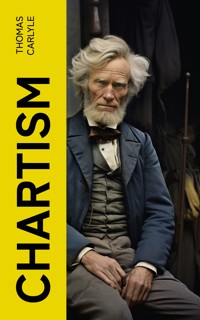
In "Chartism," Thomas Carlyle delves into the socio-political upheaval of early Victorian England, examining the Chartist movement's demands for electoral reform and workers' rights. Written in a passionate and impassioned style, the text serves as both a critique and a manifesto, blending historical analysis with vibrant rhetoric to engage the readership. Carlyle's exploration of the moral and social implications of industrialization reflects the complexities of his time, as he grapples with the stark inequalities wrought by the capitalist system and advocates for genuine social change amidst widespread despair and political disillusionment. Thomas Carlyle (1795-1881), a Scottish essayist and historian, was profoundly influenced by the tumultuous events of his era, including the rise of industrialism and the accompanying struggles of the working class. His personal experiences with poverty and the moral crises of the age are evident in his writings. The encounter with the Chartist movement, which sought to empower the disenfranchised, directly resonated with Carlyle's philosophical convictions concerning duty, labor, and the rights of individuals in society. "Chartism" is an essential read for those interested in the intersections of literature, politics, and social philosophy. The book not only enhances our understanding of 19th-century movements for reform but also serves as a timeless reminder of the power of collective action against systemic injustice. Carlyle's insightful observations resonate today, making this work a vital contribution to both historical and contemporary discussions on democracy and social justice. In this enriched edition, we have carefully created added value for your reading experience: - A succinct Introduction situates the work's timeless appeal and themes. - The Synopsis outlines the central plot, highlighting key developments without spoiling critical twists. - A detailed Historical Context immerses you in the era's events and influences that shaped the writing. - An Author Biography reveals milestones in the author's life, illuminating the personal insights behind the text. - A thorough Analysis dissects symbols, motifs, and character arcs to unearth underlying meanings. - Reflection questions prompt you to engage personally with the work's messages, connecting them to modern life. - Hand‐picked Memorable Quotes shine a spotlight on moments of literary brilliance. - Interactive footnotes clarify unusual references, historical allusions, and archaic phrases for an effortless, more informed read.
Das E-Book können Sie in Legimi-Apps oder einer beliebigen App lesen, die das folgende Format unterstützen:
Veröffentlichungsjahr: 2022
Ähnliche















Chartism
Table of Contents
Introduction
A restless nation listens to the rumble beneath its streets, unsure whether the tremor foretells patient reform or the sudden crack of revolt, while voices rise to name the disquiet, to measure it, and to demand that someone answer for it.
Thomas Carlyle’s Chartism, first published in 1839, confronts the British social crisis that surged in the wake of rapid industrialization and the political disappointments that followed the Reform Act of 1832. Written by a Scottish essayist and historian already known for intellectual audacity, the book examines the widespread agitation grouped under the banner of Chartism and treats it not as an aberration but as testimony to deeper national distress. Without narrating events as a historian would, Carlyle assumes the role of diagnostician, describing the conditions that produce unrest and urging serious attention to the grievances of laboring men and women.
The book holds classic status for the power of its style and the durability of its themes. Carlyle’s sentences marshal moral intensity, irony, and thunderous emphasis, forging a persuasive rhetoric that made social criticism feel urgent and public-spirited. He helped place the national debate about England’s social condition at the center of Victorian thought, marrying empirical observation to a fierce ethical demand for responsibility. The blend of prophetic indignation with sober analysis proved influential, demonstrating that literature could interrogate political economy and collective duty without dissolving into partisanship, thereby establishing a model for later, wide-reaching social critique.
Chartism’s impact radiated across nineteenth-century letters. By insisting that literature address work, poverty, governance, and the moral obligations of leadership, Carlyle helped prepare the ground for the Victorian social-problem novel and for the essays of cultural critics who followed. Writers such as Charles Dickens, Benjamin Disraeli, Elizabeth Gaskell, John Ruskin, and Matthew Arnold operated in a climate shaped by the questions Carlyle pressed into public view. They diverged from his prescriptions in various ways, yet they wrote under the pressure of his example: that artistic and intellectual life must reckon with the real conditions under which people labor and vote.
The historical context is essential. The People’s Charter of 1838 articulated a program of parliamentary reform—universal male suffrage, secret ballot, equal electoral districts, removal of property qualifications for members of Parliament, payment for members, and frequent elections—intended to secure representation for working people. Mass meetings, petitions, and public organization gave the movement visibility and momentum. Carlyle enters this scene less as a spokesman than as a critic of national complacency, arguing that the demands arise from lived hardship and that the prevailing frameworks for understanding social order are inadequate to the scale and complexity of the crisis.
Carlyle’s thinking challenges the era’s reliance on narrowly economic or utilitarian calculations to adjudicate public good. He argues that the health of a society cannot be assessed solely by profit, trade figures, or parliamentary arithmetic, and he treats social bonds, moral obligation, and leadership as indispensable realities. In his account, Chartism names a symptom that reveals a deeper malady: the fraying of trust between rulers and ruled, owners and workers, governors and governed. The book does not unfold as a legislative plan; it is an ethical summons that demands citizens and statesmen recognize the human consequences of industrial modernity.
The prose is famously vivid. Carlyle gathers statistics, anecdotes, and sharp portraits into a rhetoric of warning and conscience, switching from sardonic understatement to sweeping exhortation in a single page. He draws contrasts between abundance and misery, efficiency and neglect, to force attention to what polite society would prefer to overlook. The method resembles the orator’s art more than the bureaucrat’s memorandum: a cadence designed to rouse, to sting, and ultimately to persuade the reader that indifference is neither rational nor safe in a nation trembling with unmet needs.
Chartism also sits at a decisive moment in Carlyle’s career. It follows The French Revolution and precedes Past and Present and later pamphlets, linking his historical sense to a program of contemporary social reflection. The earlier immersion in revolutionary upheaval lends weight to his warnings; the later works expand and revise several themes first stated here. Yet Chartism remains distinctive for its concentrated focus on England’s immediate predicament and for its fusion of cultural criticism with an unembarrassed appeal to conscience and duty in public life.
The book’s structure advances by inquiry rather than storyline. Carlyle asks what facts are necessary to judge the condition of the nation, what responsibilities belong to those with power, and what forms of attention might restore legitimacy to public institutions. He is wary of quick fixes and suspicious of easy optimism, preferring to expose contradictions that polite discourse evades. The effect is bracing: a reader is moved not by sensational revelations but by the accumulation of arguments showing that a stable polity depends on justice, meaningful work, and a social imagination equal to the times.
When it appeared, Chartism fed a vigorous public conversation about representation, poverty, and authority. Its provocations were discussed in journals and drawing rooms, among politicians and reformers, and across the ascendant world of the press. While reactions varied, its long afterlife is clear: generations returned to it as a touchstone for Victorian social thought, as a key statement in the genealogy of British cultural criticism, and as an emblem of literature’s capacity to intervene in political life without dissolving into propaganda.
Readers today will find in these pages not a final doctrine but a disciplined restlessness that refuses to accept misery as inevitable or governance as mere calculation. The book rewards close attention to tone and argument alike: a performance of thinking in public, readably severe, skeptical of abstractions, and impatient with cant. It asks its audience to read the nation as carefully as one reads a text, to test facts against experience, and to imagine reforms guided by fairness as well as by efficiency.
The issues that animate Chartism remain strikingly contemporary: widening inequality, frayed trust in institutions, competing claims about expertise and representation, and the question of what leaders owe to those they govern. Carlyle’s work endures because it binds analysis to conscience, refusing to let technique eclipse responsibility. As a classic, it speaks across centuries without promising easy concord; its lasting appeal lies in the insistence that a decent society must hear the rumble underfoot, interpret it honestly, and act before tremor becomes fracture.
Synopsis
Chartism is a political and social essay by Thomas Carlyle, composed in the early Victorian period amid the rise of the British Chartist movement. Rather than narrating events, it examines national unrest and the demands for reform as a sign of deeper dislocation in industrial society. Carlyle’s purpose is diagnostic: to explain what the agitation means and how statesmen and citizens should respond. He addresses readers who might be tempted either to repress protest or to treat it as a passing inconvenience, urging sustained attention to underlying causes. The work moves from describing social conditions to critiquing prevailing assumptions, ending with proposals for practical reorientation.
The opening analysis frames Chartism as a symptom of what Carlyle calls the condition of England, a pervasive crisis marked by poverty, insecurity, and estrangement between classes. He foregrounds the everyday realities of industrial towns, where laborers experience irregular employment, meager wages, and fragile prospects. Political disturbance, in this account, arises not from mere agitation but from material hardship joined to a sense that traditional bonds have weakened. The argument insists that surface calm or prosperity statistics cannot settle the matter; the problem concerns the moral stability of the social order and the credibility of those entrusted with rule.
Carlyle then scrutinizes the era’s reliance on statistics and official reports. He acknowledges the value of facts yet argues that numerical summaries, taken alone, leave out qualitative truths about dignity, duty, and hope. The critique targets a narrow political economy that reduces social life to market exchange and assumes that if aggregate numbers improve, grievances must fade. For Carlyle, such reasoning mistakes the nature of the crisis, which is also ethical and institutional. He calls for inquiry that joins material evidence with judgment about leadership, education, and the fit between industrial arrangements and human well-being.
Turning to the People’s Charter, he outlines the movement’s principal demands—such as universal male suffrage, secret ballots, equal electoral districts, removal of property qualifications for Members of Parliament, payment for Members, and frequent parliaments. Carlyle neither embraces these points as a cure-all nor dismisses them as mere disorder. Instead, he contends that structural distress will persist if reforms address only voting mechanisms while leaving work, authority, and social cohesion untouched. Representation matters, he concedes, but the question remains whether altered forms of election can secure justice, order, and livelihood for those whose patience is most strained.
The essay next evaluates the conduct of the governing and propertied classes. Carlyle argues that leadership has drifted toward self-protection and a narrow pursuit of gain, while many who possess influence have neglected the duties that hold society together. He criticizes the assumption that market incentives alone can regulate relationships between owners and workers. In his account, this abdication of stewardship weakens trust and invites further conflict. The class problem thus appears not only as want among the poor but as a failure of direction among rulers, who must recognize that their legitimacy depends on tangible care for the commonwealth.
From this diagnosis follows a call for renewed authority grounded in competence and responsibility. Carlyle contends that government must act as a moral and practical guide, not merely an umpire of private interests. He doubts that enumerating abstract rights, without corresponding obligations and administration, will resolve the crisis. The essay presses for institutions that bind leaders and laborers in cooperative, law-governed relations, where justice is enforceable and work is organized with foresight. Political liberty is acknowledged, but it is depicted as insufficient unless joined to active governance willing to confront problems of employment, discipline, and public order.
Carlyle points toward remedies that combine moral purpose with administration. He emphasizes national education as essential to forming capable citizens and workers. He argues for deliberate organization of labor, so that employment is steadier and industry is guided rather than left to contingency. He also discusses emigration as a policy to relieve pressure where opportunities are scarce, provided it is planned humanely. These proposals illustrate a broader principle: a modern state should coordinate resources, knowledge, and authority to secure subsistence and dignity, rather than assume that unregulated competition will harmonize interests unaided.
The work’s tone stiffens into warning when considering the costs of delay. Carlyle maintains that temporary repression, soothing formulas, or optimistic forecasts will not repair mistrust. If rulers fail to recognize grievances and workers see only neglect, unrest may recur in new forms. He urges candor about the scale of the task and insists that partial measures, however necessary, will falter without a change in spirit. Reconciliation requires visible justice and competent direction, so that those most exposed to risk can perceive the state as guardian rather than antagonist, and order can rest on consent as well as enforcement.
In closing, Chartism argues that the nation’s stability depends on linking political forms to social care and moral purpose. The essay’s enduring significance lies in its challenge to complacency: it insists that a modern industrial society cannot be governed by mechanical rules alone, and that legitimacy requires more than formal representation. By reading agitation as a signal of unmet duties, Carlyle presses readers to reimagine leadership, labor, and law as mutually sustaining. The book thereby contributes a durable question to public debate: how should a complex economy be guided so that freedom, authority, and livelihood reinforce rather than undermine one another?
Historical Context
Thomas Carlyle’s Chartism appeared in Britain in 1839, at the dawn of the Victorian era that began with Queen Victoria’s accession in 1837. The country was a constitutional monarchy dominated by a Parliament elected on a narrow property franchise, with the Anglican Church and magistrates anchoring local authority. Industrial capitalism had transformed towns into production hubs, while old rural hierarchies strained under migration and market change. The 1832 Reform Act had altered representation but left most working men disenfranchised. In this setting of rapid industrialization and limited political voice, Carlyle addressed what he called the Condition-of-England question: how a modern, wealthy nation could contain such misery and discontent.
The immediate backdrop was the rise of Chartism, a mass movement named after the People’s Charter of 1838. Drafted by London artisans around the London Working Men’s Association and championed by figures like William Lovett and Feargus O’Connor, the Charter demanded six political reforms: universal male suffrage, secret ballot, equal electoral districts, annual Parliaments, payment of Members of Parliament, and abolition of property qualifications for MPs. Nationwide petitioning, mass meetings, and a network of local associations and newspapers turned Chartism into the first broadly based working-class political movement in Britain.
The 1832 Reform Act had raised expectations and then disappointed them. It abolished many rotten boroughs and redistributed seats, while modestly enlarging the franchise in towns and counties, chiefly benefiting the middle classes. Yet artisans and laborers remained excluded, and pocket borough influence persisted in new forms. The Municipal Corporations Act of 1835 further modernized local government without enfranchising most workers. Carlyle saw in the post-Reform settlement a society celebrating progress yet unable to integrate the majority into political life. Chartism, for him, was not simply agitation but a symptom of deeper structural and moral dislocation following partial reform.




