


Erhalten Sie Zugang zu diesem und mehr als 300000 Büchern ab EUR 5,99 monatlich.
- Herausgeber: IVP
- Kategorie: Religion und Spiritualität
- Sprache: Englisch
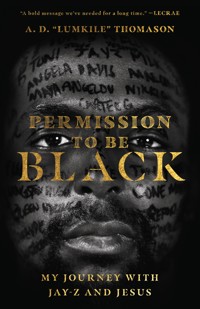
Embracing your Christian identity does not make you "soft." Embracing your Black identity does not make you less Christian. Throughout American history, Black people were not given the freedom to acknowledge their suffering. A. D. Thomason believes that the Holy Spirit brings freedom and liberation as we're able to name our pain, recognize its roots in history and society, and seek healing. While many saw a confident, six-foot-five Black man, A. D. "Lumkile" Thomason lived most of his life in fear and anguish, deeply wounded by encounters with violence, abandonment, and family tragedy. Hiding behind a tough exterior, Adam earned his "Black card" but felt joyless inside. Even traveling around the globe to play professional basketball could not resolve his despair. But in the art of Jay-Z, A. D. discovered stirring honesty that gave voice to his own expressions of longing. And in the gospel of Jesus, he experienced the healing and salvation that had long evaded him. Now through what he calls "kingdom therapy," he's figuring out how to redefine the Jay-Z and Jesus that make up his blackness. A. D. uses his artistry as a poet and storyteller to share how he confessed his internalized pain and embraced the liberating joy of Christ. He writes for millennials, emerging adults, and anyone else who's ready to acknowledge the reality of racial trauma and our need to confront it. A. D.'s powerful story gives you permission to be Black, to be Christian, and to be the person God has made you to be.
Sie lesen das E-Book in den Legimi-Apps auf:
Seitenzahl: 191
Veröffentlichungsjahr: 2021
Das E-Book (TTS) können Sie hören im Abo „Legimi Premium” in Legimi-Apps auf:
Ähnliche


















MY JOURNEY WITH JAY-Z AND JESUS
Contents
PREFACE
BEYOND OUR “FAMILY FEUD”
Everyone needs a chance to evolve.
/Heal·ing/ n. The process of making and becoming sound; to make well again; to restore to health.
My people are in trouble, and we don’t know it. We all chase after a goal that Solomon says is ever before us but that we rarely grasp. What is before us and what do we miss? The ability to be healthy. The health I’m referring to is not physical health; it’s internal, mental, and soul health. What we define as Blackness is, in a lot of ways, a result of trauma. Ignorance plays a big role too, ignorant of (1) the fact that we need to be healthy, (2) the tools we need to achieve healthiness, and (3) how to get these tools. As Jay-Z explains in “Family Feud,” “We are all screwed because we never had the tools.”
Why did I name this book Permission to Be Black: My Journey with Jay-Z and Jesus? Because I want to give you some insights (some would call them “cheat codes”)—the tools of mental, spiritual, and psychological liberation to release you from the pain of being screwed because you did not have the tools.
Why Jay-Z? Ha-ha, why not? On a serious note, I did not grow up as a Jay-Z fan or stan, but more a rap appreciator for what it did for my people, Black people. At a time when we needed a voice to express our emotions without violence in the ’70s and beyond, pioneers DJ Kool Herc, Kool DJ Dee, and Afrika Bambaataa brought what we know as hip-hop to life. This subcultural expression spread like fire to a main stage like none could predict. My number one MC will always be André Benjamin of Outkast fame. However, as a rap appreciator, in my humble opinion I believe that Jay-Z is the greatest rapper of all time.
I found solace in a lot of his lyrics, especially the songs expressing the burden of life in concrete jungles, like “Where I’m From.” On the other side of the spectrum were songs explaining why we don’t have emotions, like “Song Cry.” I even appreciated some of the more boastful songs indicating a need for celebration because of our pain, like “Encore.” Jay-Z spoke to my cultural story. God used him to keep me and many other Black men alive until we could appreciate Yeshua (Christ) without other folks’ cultural baggage.
Side note: In this book, I will use both “Jesus” and “Yeshua” as names for Christ. I call him “Yeshua” because that is his Jewish name. “Jesus,” though I have no problem saying it, is an imperfect transliteration into the English language. Mary would have called him “Yeshua.” So, in the words of “Coming to America,” “His momma named him Clay . . . Ima call him Clay.” But I digress.
Jay-Z gave words to my pains that my body knew I had but my mouth could not put into words. He spoke to places I was in, Black places, places I was ashamed to admit even after I became a follower of Christ who still needed healing. Jay-Z gave me permission to be Black when most Christian branches said the way I was created and the experiences that formed me—my Blackness—needed to be dissolved. Early on I became a closet Black man, so I read the books of Martin Luther King Jr., Frederick Douglass, Malcolm X, W. E. B. Du Bois, and Ida B. Wells. Alongside the books I listened to Jay-Z and others for affirmation. This was the affirmation that “evangelicalism” never understood or thought I needed.
EITHER THEY DON’T KNOW, OR THEY DON’T SHOW
One of the most famous lines in Black cinema is from Ice Cube’s character Doughboy in 1991’s Boyz n the Hood, when he says, “Either they don’t know, don’t show, or just don’t care about what’s going on . . . ”
I saw a post on Instagram of a Black woman encouraging the Black men who are living to rewrite the popular narrative. Indeed, based on depictions of us in entertainment—our historical forced placement on American soil as seed bearers, sexual steers, and violent gladiators (slave-on-slave fights are real)—we should be extinct.
I’m not going to say this next part eloquently. I’m exhausted from others’ expectations that we rewrite our supernatural stronghold past without a manual and without the freedom to express our personhood. This hurts. The undervaluing of Black men who are seeking redemption hurts. Our culture rails on those in prison, doesn’t encourage those who seek to rehabilitate themselves, doesn’t take history into account, and is cavalier toward those shouldering centuries’ worth of these unaddressed wounds. Rogue religious groups and gangs provide stronger community, a clear hierarchy, and a more consistent and supportive affirmation for a Black male than many people realize.
Strongholds didn’t start at our birth, and they certainly are not undone because of college degrees and successful careers. Let me give you some simple numbers that I hope will bring clarity to the unique situation of Black men.
According to the United States Demographics Profile of 2019, African Americans of the diaspora make up 12.6 percent (42.4 million) of America’s current population of 329 million. Take the percentage of Black men, which is right at 37 percent, out of that 12.6 percent, and you get roughly 15.7 million, if you do the math according to a New York Times article that talks about 1.5 million missing Black men and a nearly 20 percent gap ratio of more Black women to Black men (60 to 40). Of those 15.7 million Black men, one in three (33.3 percent, or 5.2 million) can expect to go to prison, according to the Center for American Progress and American Bureau of Justice (see also Ava DuVernay’s 13th). Which means that after you account for the African American population of males in prison, there are roughly 10 million Black men in society (3.2 percent). Now let us add some real-life “filters,” if you will, on this 3.2 percent from a historical account many ignore and some think has no bearing on the present.
In The Color of Law: A Forgotten History of How Our Government Segregated America, Richard Rothstein expounds on the intentional policy of government to create segregation between whites and Blacks:
Until the last quarter of the twentieth century, racially explicit policies of federal, state and local governments defined where whites and African Americans should live. Today’s residential segregation in the North, South, Midwest and West is not the unintended consequence of individual choices and of otherwise well-meaning law or regulation but of unhidden public policy that explicitly segregated every metropolitan area in the United States. The policy was so systematic and forceful that its effects endure to the present time. Without our government’s purposeful imposition of racial segregation, the other causes—private prejudice, white flight, real estate steering, bank redlining, income differences, and self-segregation—still would have existed but with far less opportunity of expression. Segregation by intentional government actions is not de facto. Rather, it is what courts call de jure: segregation by law and public policy.
This speaks only to residential hurdles for African Americans, which many don’t realize are a violation of the Thirteenth Amendment. We haven’t broached the conversation about broken homes and neighborhoods, lack of equal opportunity, high school and higher education issues, death by law enforcement, death by each other, homelessness, mental institutions, and absenteeism.
As you consider the different categories of obstacles African Americans, specifically Black men, have had to traverse in order to “make it,” the 3.2 percent figure above dwindles to an anemic one percent. These are the Black men who are alive, not imprisoned, of sound mind, and have the support system, unshakable faith, and equal resources to manifest their vision of redemption in society.
While I was writing this book, four catalytic events occurred that drive home the uniqueness of Black life and the one percent: the killings of Ahmaud Arbery and Breonna Taylor; whiteness weaponized by Central Park dog walker Amy Cooper, who lied and said an innocent Black man was harassing her; and the murder of George Floyd—I can’t breathe 2.0.
We need the soul-searching power of God’s Spirit to flow through his people to value our lives or we won’t make it.
Many do not see or understand this reality and it is maddening. Still we are expected to carry the weight and the expectations of the entire American population. We have to live as if we have the affirmation, resources, tools, acumen, and courage of a millennium-length legacy to thrive. We are dying off, physically and mentally. This expectation is crushing. It has and continues to destroy us.
I’ll say what many don’t have the words, and often courage, to say. We need the soul-searching power of God’s Spirit to flow through his people to value our lives or we won’t make it. We, Black men and women, need the permission to be Black, permission never granted to us in light of America’s history.
ACCESSING THE TOOLS
After I sat down with my therapist, Don, for the first time in the fall of 2017, I got up stunned. I left thinking, I am cheating on life with the tools and wisdom that just got dropped in my lap. I felt a kind of survivor’s guilt as I received this wisdom and insight into holistic health. I knew immediately what my community needed. I also realized they had no clue that these things existed, I didn’t either before I sat in Don’s chair. I thought about my brother and sister and our upbringing, about how my mom and dad’s lives could have been transformed if they’d had these tools. From that moment I began to see Don as my kingdom version of the Boyz n the Hood character Furious—a Yoda type guy. To me, he was Don Furious.
I thought my first session with Don Furious was a fluke, so I went back for a second one. Our first session may have been like a rookie batter homering his first three times at bat. There was no way Don Furious could nail it again, again, and again. However, every time I met with Don Furious, I walked away feeling overwhelmed with life and joy. But alongside the joy I also felt overwhelmed by grief because my people were being robbed. We were victims of circumstances that caused trauma, and we were living without the tools we needed for healing.
Session after session I consistently came home to my wife, Dawntoya, saying, “I feel like I am cheating on life with the wisdom and insight I get from this man.”
She would look and listen with this peculiar silence and say, “Adam, it cannot be as groundbreaking as you’re making it.”
I would stop her mid-thought with, “No, you don’t understand. It’s the book of Proverbs when I sit with Don Furious. Proverbs talks about wisdom that formed the world and how God consulted wisdom (her) as a master workman. Well, what he is telling me supersedes race, culture, class, people groups, hemispheres, and any other division you can think of.”
This is the Proverbs passage I had in mind:
“The LORD possessed me at the beginning of his work,
the first of his acts of old.
Ages ago I was set up,
at the first, before the beginning of the earth.
When there were no depths I was brought forth,
when there were no springs abounding with water.
Before the mountains had been shaped,
before the hills, I was brought forth,
before he had made the earth with its fields,
or the first of the dust of the world.
When he established the heavens, I was there;
when he drew a circle on the face of the deep,
when he made firm the skies above,
when he established the fountains of the deep,
when he assigned to the sea its limit,
so that the waters might not transgress his
command,
when he marked out the foundations of the earth,
then I was beside him, like a master workman,
and I was daily his delight,
rejoicing before him always,
rejoicing in his inhabited world
and delighting in the children of man.
“And now O sons, listen to me:
blessed are those who keep my ways.”
(Proverbs 8:22-32)
No lie, every time I finished a meeting with Don Furious, I felt alive and believed everyone needed this. How our heroes of old—Ida B. Wells, MLK, Malcolm, Harriet, Queen Nzinga, and others—would have lived a different life if they had the freedom to process their internal lives and feelings without using the historic Black approach of, “We just don’t talk about those things.” My community continues to erode because of our historic inability to talk about our problems. And again, we don’t know what tools we need to fix our problem or even where to find those tools.
For my entire life I felt that freedom didn’t exist for me. I had no freedom to express. I had no freedom to mourn. I had no freedom to discard the identity boxes imprisoning me and my people. Now, through Don Furious, God had given me insights—cheat codes, if you will—to redefine something I took as normal.
In case you’re wondering, cheat codes are the shortcuts and secret tricks used by video gamers to gain an advantage over their competitors and advance to higher levels. In my context, they were the tools and wisdom that the privileged used to navigate through life. Now I could do the same. In that process I also redefined my Blackness. I am now living a life I never thought was possible. I now live as an African of the diaspora who knows how to fight for a life of liberation. But it’s not easy. It can be exhausting, as those of us in this place are extremely rare. However, I write this book to share those insights, cheat codes, life hacks, and tools so my people won’t be screwed. So they can fight for and experience this liberation and freedom within the few to impact the many with a healthy mind, body, soul, psychology, and spirit.
THOUGHT PRIMER
I dare not speak for all people of the African diaspora, but my Blackness needs to be redefined. I believe wisdom is insight that transcends all stories and people groups, but opinions and cultural mores do not. What I received from Don Furious is wisdom, not cultural traditions or a biased perspective. If applied, it can change anyone’s life. This is God’s promise.
After sitting with Don Furious, I would reflect on Blackness and the mythical “Black card.” The Black card is the imaginary license we give or take away from Black folks after measuring their level of struggle to make it in the world. It’s based on skin hue, neighborhood, broken family narrative, and of course their knowledge of Black cultural icons, songs, and B movies. If you don’t understand the importance of Love Jones, why are we even friends? (Just kidding.)
We have lived a life of fragmented healing. It is a life lived outside the identity of our full story.
I realized that, as Black folks, we have never had a resource that spoke to our mental and social healing. We have never had a resource to extinguish the attacks on our manhood and womanhood. I would argue that we have lived a life of fragmented healing. It is a life lived outside the identity of our full story. The pastor did his or her best, but Don Furious taught me that the spiritual component of people is not the totality of our humanity. There are some things you simply cannot pray away. You need others to help you heal, and this is a gift from God. God is calling us out of this myopic way of processing healing. The new way requires a cultural “quintuple consciousness” (with apologies to Du Bois). God is calling us from compartmentalization to an integrated lifestyle. People are longing for a community that embraces our narrative while demonstrating what it means to be mentally, physically, spiritually, and psychologically healthy.
In the past, when Black people have sought after this type of holistic health, they have been shunned and accused of “acting white,” being sellouts, being “soft,” and so on. For many Black people, pursuing holistic wellness of the mind, body, narrative, psychology, and soul has defaulted to “praying and shouting” for deliverance. Others cry for help through acts of violence and territory protection. In reality we need unconditional love, “skin time” with someone of the opposite sex (who is not looking for sex), and a therapist who understands the kingdom of heaven and its importance in the healing process.
Internalized trauma gives off a mental stench we have become accustomed to smelling. It’s like the first time you smell chitlins in your grandma’s kitchen. Unless you enjoy this delicacy, your first reaction is probably to wonder why anyone would cook or eat something that smells like ten men defecated into a pot of boiling water. However, after a while the smell fades because your nose has adjusted to the odor; you’ve become “nose-blind.” I believe we as a people have become nose-blind to the horrid stench of internalized trauma, and it is time to get free.
The ability to love and be loved is possible only once someone has gone through the healing process of redemption and full restoration. Without this experience, we cannot understand internal health in its purest form. Healing gives us clarity that helps us communicate and understand how to love and be loved. What does this have to do with “the tools,” a new Black card, and Jay-Z? Glad you asked.
Let’s go back to Jay’s song “Family Feud” and the line, “We all screwed, cause we never had the tools.” When I heard this, I felt like I’d discovered the Lost City of Gold—better yet, vibranium. My people and I have been screwed for a very long time because we have never had the tools to get healing. I would even argue we didn’t know they existed.
This revelation was followed by grief and excitement. I needed to get this truth—these tools—to my people who were in need, and if that meant doing it the Killmonger way, so be it. (Sorry, T’Challa!)
As I talked with Don Furious, it became evident that the legacy handed down to me was a belief that if you ignored trauma, it would go away. But strongholds don’t go away. Some commonly used phrases related to this practice were: “There are some things you don’t talk about,” “You just endure,” “You just keep moving,” “Ain’t nobody got time for that,” or “Let go, and let God.” These phrases were used to uphold a false sense of strength in Blackness. Meanwhile, our bodies internalized the pain while Satan—a real enemy—mentally beat us to a bloody pulp. How? Burying the pain was seen as strength, and it was shameful to admit you needed to talk about the depression caused by trauma. This is what we called “healing.” If I didn’t break the cycle, this unhealthy practice would be my legacy as well.
Black people of the African diaspora in America are walking around wounded, in pain, and in need of healing. Why? Because while we describe our Blackness as a symbol of strength and gumption, it has become a symbol of pain and evidence that we don’t know what we don’t know. (We also tend to stigmatize anyone who demonstrates the slightest knowledge of the tools we need for healing.)
Why am I writing this book? We are seeing a first for the people of the African diaspora. In 2020, information and relationships are brought to our fingertips with a simple swipe and touch of the word “search.” Information is no longer hidden, and the identities that have long been ascribed to the people of the African diaspora, my ancestors, are seen for the stereotypes and mental prisons they are. I am writing this book to set us free, to talk about the diverse creations we are, and to call us out of fragmented living into wholeness. Yes, God communicates these promises in his Word. Unfortunately, the misapplication of his Word—by white folks historically and Black people culturally—leaves many believing God is powerless in certain areas. It’s why many of us used Jay-Z to get through life in addition to the church. Since we lack the tools to help us understand and apply the love of God to the full person, many believe God has no answers. God is not impotent. He does have all the answers. We were just schooled incorrectly, both culturally and spiritually.
Consider Daniel Patrick Moynihan’s controversial 1965 report commissioned by President Lyndon B. Johnson. Titled The Negro Family: The Case for National Action, the report has had far-reaching implications:
That the Negro American has survived at all is extraordinary––a lesser people might simply have died out, as indeed others have. . . . But it may not be supposed that the Negro American community has not paid a fearful price for the incredible mistreatment to which it has been subjected over the past three centuries.
President Johnson responded to this report by saying, “For this, most of all, white America must accept responsibility. It flows from centuries of oppression and persecution of the Negro man. It flows from the long years of degradation and discrimination, which have attacked his dignity and assaulted his ability to produce for his family.” I would add that it has assaulted his ability to emote for the ultimate health of his family.
Generational trauma is passed down. Black folks in America have been exposed to this trauma since we came over in boats, and we’re still feeling it today. As the saying goes, hurt people hurt people. However, if that’s so, the opposite can also be true. Healed people can heal people. Healthy people who heal from these wounds need to share the tools they used to break the cycle of trauma. Historically, most of these tools could be accessed only if you had enough money—what we called “white money” when I was growing up. But with the digitization of the world and allies rising across ethnic lines, these tools are now in our reach. Through them God is setting many of my people free.
Healed people can heal people.
I am writing this book to redefine Blackness and establish a new “Black card,” so to speak. Carriers of this card will no longer be ashamed of admitting that past traumas have hurt them. They will embrace the truth that it is healthy to learn how to understand trauma and heal from it. Trauma isn’t just war flashbacks. It’s having to raise your siblings because you were fatherless. It’s having to raise yourself because your mother was dealing with her own crises. It’s having a father who left you and your siblings at home while he roamed the streets looking for a fix. It’s being neglected because you were raised by a single parent who dealt with their trauma in silence. Aside from my own experiences, I’ve heard countless stories like this from others.




