


4,99 €
Mehr erfahren.
- Herausgeber: Spiral Publishing, Ltd.
- Kategorie: Fantasy und Science-Fiction
- Sprache: Englisch
A gripping adventure of new worlds and unknown alliances.
Hard work on an aqua-farm orbiting beyond Jupiter with her plurapod companion Les suits Seetha Deergathca just fine.
Calvin Seuma spends his days tending the fisher fleet on distant Ajar 12, working the seas with his plurapod friend Bel and aquatic Ajarans.
A strange harvest awaits. One with ancient and dangerous origins.
Can they survive a threat from light years beyond the range of humanity?
An excerpt from Plurapod Pathogen:
A Deadly Threat Out of Nowhere
“We need to figure out what happened,” Seetha said. “Did you get a chance to re-check the seaweed flats?”
“I did not. I will as soon as I can.”
“Not during rest days you won’t, Les. I’m sure you kept a sample of the spoiled seed. I’ll take it up to the main platform lab tomorrow.”
Cold, seaweed-scented water splashed along Seetha’s legs and back. Les held two of hir tentacle hands on the surface, ready to send more after it.
“Rest days apply to humans as well.”
“Don’t worry, I’ll rest. Besides, you’re impossible once you’re out of your routines. You fretting over empty growing space would drive me crazy.”
Les shifted from side to side in the tank, somehow managing not to slop water out. A plurapod version of pacing.
“Whatever this is may incubate and show up elsewhere later. As long as you do not spend all day working, I suppose that is acceptable.”
“Thank you for your approval, my dear Les. I’ll return as soon as possible, solution in hand.”
Das E-Book können Sie in Legimi-Apps oder einer beliebigen App lesen, die das folgende Format unterstützen:
Veröffentlichungsjahr: 2020
Ähnliche
















For Jason Kilgore
Who has been known to talk me into adventures
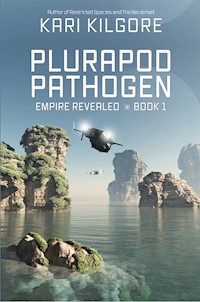
Plurapod Pathogen
Empire Revealed ⋇ Book 1
Kari Kilgore
Chapter 1
If Seetha tilted her head just right and squinted, the light on the water looked almost natural.
At an angle, and with a good bit less detail, rows of sunflower yellow lights overhead blended into one glittering reflection. She couldn’t see the edge of the aqua-farm on Porthiant Station this time of the day-cycle. The tide was even coming in, long and regular moss-green waves building up depth every minute.
Seetha propped her hands on her hips, palms slipping on the stiff, water-resistant white fabric. Hardly fashionable, but standard issue for humans on this level. She leaned back as far as she could, sighing when her spine and breastbone crackled. She leaned forward to brush her pruney fingertips on the textured plas-wood pier, weary muscles stretching all along her back.
She reached behind her head and squeezed the plastic clip loose, watching waves of chestnut brown hair slip free around her boots. Such an indulgence, her mother said, a mane on an aquaculture station orbiting between Jupiter and Saturn.
Seetha straightened as slowly as she could. A week of shipping out the harvest and bringing in seed for the next was catching up with her.
A cold, damp breeze, rich with brine and vegetal seaweed aromas, kicked up enough to push her hair behind her shoulders. Massive turbines at the distant rim of their tank helped the waves do their work. Technology convinced the creatures under the surface that night was different from day.
Could still be an Earth ocean, though. Especially if she squinted.
The water was barely two meters under her feet and rising fast. The circular dock stood at the center of a sprawling web of piers, intersecting paths like spokes of old Earth bicycle wheels across the water. The heavy salt content would never erode kilometers of tough plas-wood or even fade the bright yellow.
But the tide would cover Seetha’s way back home if she didn’t head out soon.
That or the gradually fading lights would dim enough to leave her wandering all night-cycle long. Machinery and engineering varied the tides on a natural Earth schedule, even without an orbiting satellite to pull the water. Seetha wished the designers had added waxing and waning moonlight anyway.
She sank cross-legged to the chill surface, groaning when her thigh muscles stretched as thoroughly as her back. Her growling stomach wouldn’t be satisfied with anything less than the traditional harvest feast, but she plucked a meal kit from her gear pack. Not much left in the shiny silver packet but seaweed crisps.
The flavor was pleasant enough, a perfect balance of salty and mineral earthiness, engineered with every nutrient a human needed. Seetha loved these as a girl, marveling at such a delicacy coming from space instead of the oceans of Earth. No matter where in the galaxy she’d roamed with her diplomat parents, these crisps were a reminder of home.
Living where this seaweed was grown, harvested, and processed—and constantly available—turned a treat into tedium.
Still, she crunched and chewed, watching the horizon. Her work partner Les got grumpy when Seetha took off early, though both were perfectly capable of getting home on their own. At nearly a billion kilometers beyond Earth orbit, friendship was everything. Even between species.
Seetha glanced up at a low rumble, detected more in her bones than her ears. Even after more than ten years and five levels below the solid metal surface, the habit persisted. No one on the station could see a massive interstellar transport arriving or leaving.
Each of the hundreds of growing stations orbiting between Jupiter and Saturn held a shipping, customs, and immigration platform close by. The vibration was probably the harvest pushing off, hitching a ride with some random diplomatic ship.
She told herself glancing up at something she couldn’t possibly see was a silly remnant of her Earth origins. Same as glancing down at similar rumbles from within the station. Movements from the pure water core were rare compared to transports, but her body always knew the difference.
Seetha wondered if human children born up here ever developed that location instinct. Not that she had plans or prospects in that department. She often thought Les, like all dual-gendered plurapods, had the better design for happiness. They didn’t even grow their sets of reproductive organs until they mated for life. Those bothersome organs caused humans no end of trouble no matter how much technology advanced.
An odd pattern of ripples caught Seetha’s attention. They ran from behind and to her left, cutting across the slow, regular tidal waves now a meter beneath her. Only Les’s restless, anxious drumming on the surface created such an irregular result on the highly regulated aqua-farm.
She stood, catching sight of her friend right away. Les had already surfaced three of hir limbs as ze approached the central dock. Two deep orange tentacles floated on the water, retracted to nearly as thick as Seetha’s thigh, leaving one to the back. Seven slender red appendages at the end of each twitched and vibrated nearly too fast for Seetha to follow.
Les couldn’t give hir agitated mood away the way humans so often did. Plurapods, like most ConSpace species, imitated their companions as best they could. With humans, that meant standing upright whenever possible and presenting a “face” to the world.
Even after over ten Earth-years working together, that face was as unreadable to Seetha as it was fascinating.
The broad central mass connecting Les’s seven limbs held around a dozen pseudopods, changing number, size, and location depending on what senses ze needed. They didn’t resemble any sort of Earth creature eyes, but Seetha always focused on the ones with the largest black tips.
In the center of the ever-changing sensory organs sat a shallow black pouch as long as Seetha’s two hands. Plurapods who routinely spoke to humans and other land species learned to cup water over their vocal organs.
Seetha had long ago gotten a permanent sensory implant to translate the trilling, musical tones. She quite liked the gold disc, only a few millimeters across, in front of her left ear. Even her mother agreed the implant was as lovely as her own traditional nose stud, and far more practical than an uncomfortable chunk of plastic shoved into her ear canal.
Seetha stepped to the edge of the dock, not sure if Les sensed her yet. When Les was distressed enough to drum the water like that, ze’d usually gotten hirself into quite a distracted state.
Before Seetha could decide to wave or to stay still and wait, Les extended one limb. The tentacle slowly thinned, the pebbly, dull surface smoothing out to flat and shiny. Les was still more than two meters from the dock when hir hand touched Seetha’s.
The central five fingers, tips crimson and loaded with more sensory cells than a human’s whole body, pressed against each of Seetha’s fingertips. The remaining two encircled her wrist, soft and cool. Seetha breathed in the rich cucumber and pepper scent of her closest companion for most of her adult life.
“Well met, Les.”
“Well met, Seetha. Thank you for waiting.”
Seetha waited for Les to break contact before she grabbed her gear pack. Her long family history of ConSpace diplomacy taught her to be courteous, even if she had no desire to continue that exceedingly social line of work. Body-straining labor that helped feed billions of humans and plurapods, especially combined with isolation from nearly all of them, suited her just fine.
Les submerged to dart under the dock, demonstrating the waterborne speed Seetha so envied, then waited for Seetha to circle around the vital heart of their tank. The central control pod provided storage, holding areas for shipments, and their portal to the station-wide mag-drop system. Gut-twisting velocity or not, it was the only way in or out for anything, or anyone.
All transport inside the domed tank was either on foot or in the water. The remarkably old-fashioned routine of walking to work on a state-of-the-art artificial world pleased Seetha greatly.
“The harvest has departed?” Les said.
“Sounded like it. Reseeding going well?”
Fourteen appendages vibrated again before sinking under the surface. For the first time, Seetha would have sworn her friend looked nervous—each soft, pliable facial pseudopod stiff and trembling. Even hir vocal pouch was rigid.
“I fear it is not. We have much to talk about, Seetha.”
Chapter 2
The dwelling pods close to the edge of the tank were the same bright yellow as the piers. The plas-wood formed low, rounded domes, built smooth with no need for traction for wet boots.
The pier split into two elevated ramps, with Seetha’s pod on the left and Les’s nearly identical one to the right. Even though the breeze and waves were much calmer out here, more fresh-smelling than briny, water lapped and splashed just under the boards. By the time the dim lights overhead winked out in about fifteen minutes, the piers would be submerged for the night cycle.
Digital screens along the tank wall displayed landscapes Earth or alien. Either of them could change the view for leisurely rest days or the confinement of storm days.
They stopped at the y-shaped break in the pier, the usual routine before parting company. Seetha would continue on to her door set into the pod, while Les would submerge to a passageway under the surface.
Les hadn’t spoken at all on the journey home, and the silence and fretting were unlike hir. The only question, still unasked or answered, was whether they would meet again this evening. Seetha didn’t want to spend the entire night-cycle wondering what was bothering her friend, much less what was wrong with the vital reseeding.
“Will you share the harvest feast with me?” Les said, saving Seetha the trouble. “I will do my best to be good company.”
“Your company is always welcome, Les, good or not. See you in half an hour.”
Les paused, like ze wanted to say more, before submerging. Seetha shook her head, then turned to watch the sunset behind her house. A blue star in a cloudy green sky sank into a sea much too thick and slow-moving to be water. Not even the exotic water that surrounded her, harvested from gas giant moons, unsullied by millennia of abuse on Earth.
Seetha continued on toward home.
As always when she closed the door to her house, she was struck by instant silence. Even away from the machinery, their tank was constantly noisy. Splashing, blowing, squeaking. Seetha’s ears stayed on low-level duty every second she spent outside these insulated walls.
The other welcome contrasts to the uniformity of the tank were color and warmth. Many deep jewel tones covered the walls, floors, ceiling, whatever surface Seetha could manage to alter. And even with the house systems conserving power while Seetha was out working, the house was warm, delightfully so.
A low tank took up most of the wall closest to Les’s pod, nearly three meters long with plenty of room for a young plurapod to stretch out. A human-sized tank with fresh water rather than salt sat close by.
Temperatures uncomfortably hot for a plurapod would be divine for Seetha’s weary muscles and bones.
Besides the explosion of color, her living room and kitchen space were as functional and standard issue as her work uniform. Her most likely visitor was Les, guaranteed to be unimpressed by elaborate furnishings and decorations. Besides, the rather boring plas-wood and glass made cleaning—one of Seetha’s least favorite duties—relatively painless.
The only thing better than her soaking tank was her bedroom, hidden behind an embroidered purple and gold curtain from Earth Zone Asia. Seetha dropped her gear-pack on the kitchen counter and walked through, smiling at the jingle of dozens of tiny brass bells.
She filled her most intimate space with luxurious cushions and fabrics, decidedly earthy scents and music. Her night-cycle clothing matched, turning her downtime into a sensual paradise deep in the cold and black of outer space.
No time for such indulgences until after she knew what was wrong with the new crop. Then she’d probably need to relax more than ever. She changed into a midnight blue robe, nearly black in the low light.
Les would bring hir own meal, mostly the same off-world crops that were causing all the trouble. Seetha had just enough time to get her own food ready and brace herself for whatever was ahead.
She never suspected how much she would soon wish for the calm of an evening at home with her friend.
Chapter 3
Most of the hundreds of food growing stations orbiting between Jupiter and Saturn hosted feasts throughout the Earth-year, and Porthiant Station Aqua-farm was no exception. Local harvests were timed so feasts happened every month. Multitudes of fish followed an army of spiny crustaceans followed a prairie’s worth of seaweeds and grasses, all before a staggering array of off-world species came around.
Seetha and Les’s crops fit the general category of cold water creatures that didn’t move very much.
After years of attending all the on-station festivals and taking the sub-light shuttle to other stations for variety, Seetha settled into her own practice of not moving much. Stuffing herself silly with Les and staying in over the post-harvest rest days turned social stress into pure relaxation.
Best of all, pure-water-raised mollusks, bivalves, and exotic off-world species didn’t have to be washed, much less cooked. Seetha was happy to take advantage of prepared breakfast, lunch, and dinner for as long as it was available.
Les shared the private eating habits of plurapods, keeping hir food and limbs under the water while ze ate. Close as they were, Seetha had no desire to watch her friend engulf and dissolve a meal.
Interspecies relations often improved when such things were hidden.
At last, Seetha climbed into her steaming bergamot and lavender scented tank. Les was barely visible in vibrant purple and blue sea grasses native to Asteriidus, the mysterious plurapod home world. Exhausting week or not, companionable silence would eventually have to give way to whatever was bothering hir.
Before Seetha was ready, Les surfaced, refilling hir vocal pouch.
“I am sorry to bring work up after a lovely feast.”
Seetha moved closer to the large tank, keeping as much of her body submerged in the warmth as she could.
“No apologies, not when it comes to reseeding. Did they send enough this time?”
“They sent enough, but we cannot use all of it. There is some kind of…contamination.”
Seetha frowned. All shipments onto and off of Porthiant Station and every other station, especially harvest and seed, went through strict bio-screening. She couldn’t imagine anything infected getting through.
“The whole shipment?”
“That is the strange thing. Only seed native to Asteriidus is affected.”
“Those are grown here, aren’t they? How could they get contaminated?”
“Spawned and seeded on another level of the station, yes. They are even screened before delivery. Nothing like this has happened before, not that I am aware of. It is not any kind of typical contamination. The seed feels wrong to me.”
That was one of the biggest advantages of plurapods working in aquafarms. Sensory abilities all over their bodies, and especially on their hands and faces, far surpassed anything humans could offer. Les had caught problems with nutrients in the water and common diseases with seed and crops in the past, saving the two of them and the station a fortune.
Seetha wouldn’t be surprised if Les had caught something the bio-screens missed.
“Everything else seems normal, huh?” she said. “At least we shouldn’t need to drain the tank.”
“No need for that, not that I can tell. I re-inspected the other seed after I removed the infected batch. The rest all seem fine. The panic and drama if we suggest draining would be quite exciting, though.”
Seetha laughed, trying to imagine the ConSpace management board’s furor. Tank drains were rare enough that she’d never heard of one happening. Even the possibility of such a large scale problem in one tank meant safety and procedure reviews for every employee, station-wide.
“You have an odd definition of exciting, Les. Still, we need to figure out what happened. It’s bad enough with the one batch. Could be a lot worse if something gets in that does spread. Did you get a chance to re-check the seaweed flats?”
“I did not. I will as soon as I can.”
“Not during rest days you won’t.” Seetha climbed out of the tank, wrapping herself in the absorbent robe. “I’m sure you kept a sample of the spoiled seed. I’ll take it up to the main platform lab tomorrow.”
Cold, seaweed-scented water splashed along Seetha’s legs and back. Les held two of hir hands on the surface, ready to send more after it.
“Rest days apply to humans as well.”
“Don’t worry, I’ll rest. The platform labs will be slow with everyone else hung over or in food comas from the festivals. That means results in hours instead of days. Besides, you’re impossible once you’re out of your routines. You fretting over empty growing space would drive me crazy.”
Les shifted from side to side in the tank, somehow managing not to slop water out. A plurapod version of pacing.
“I would hate to delay seeding in such a large area. Whatever this is may incubate and show up elsewhere later. As long as you do not spend all day working, I suppose that is acceptable.”
“Thank you for your approval, my dear Les. I’ll return as soon as possible, solution in hand.”
Chapter 4
Calvin Seuma waded in hip-deep water, trailing his fingertips along the greenish surface. With the tide going out, the waves in sheltered Calys Bay were low and regular. Perfect for boat maintenance. An incoming tide meant constantly struggling for footing on the slick, pebbled seabed.
He knew the ring of tree-covered hills around him was full of other humans as well as Ajarans, but he couldn’t hear or see anyone. That was exactly why Calvin always volunteered for the mid-day maintenance cycle.
Peace and quiet, with everyone else inside and asleep after heavy meals.
Even humans born on other planets tended to run on Earth’s twenty-four hour day cycle, so Ajar 12’s thirty-two hour cycle created benefits and challenges. Calvin was content to chew spicy and sweet oranjar rinds until time for his later evening meal, creating his own schedule for much-needed solitude.
The water was cool this time of year with the warm, rainy season coming on, but not nearly so frigid as only a few weeks before. Calvin had shed the thick, rubberized waders that covered him from his armpits to his feet. No matter how icy the air and water got, he always felt overheated in those.
Today he wore his long brown hair caught back in a neat braid, and only the human version of the Ajaran’s native garb. The close-fitting tan jacket and pants were woven out of local seagrass, tough and light as air even when it was soaking wet.
Ajarans were all too happy to adjust the suits from six limbs down to four, remove the space for their short tails, and make the torso narrow enough for humans. Now they could weave the suits year-round instead of only in preparation for their own summer molting season after the spring rains.
He walked in a slow arc around the harvest fleet, taking his time, noticing as many details as he could before he got to work. The boats never seemed to vary much no matter where he went here on Ajar 12 or in any other local system.
The current group of nine were only about ten of his paces long, empty with the curved bottoms sitting high out of the water. Trees from the hills behind him bent easily and cured into hulls without a whole lot of effort. Most Ajarans and humans alike left the natural deep green-tinted lafar wood untreated. Anything made from it only seemed to get tougher the longer it stayed in Ajar’s salty seas.
Satisfied with his first look, Calvin waded in closer to the first vessel. The only identifying mark was an intricate carved and painted shape high on the front hull. He recognized the red and purple symbols for the Pyones family, one of the first human families to settle in the Ajar system. Dal Pyones never hesitated to bring her boat into the closest anchor point her family status offered.
Calvin took in a deep breath, letting the briney air clear his nose for the work ahead. The massive seas and waterways covering the northern half of the planet were starting to wake up from one of the coldest seasons he or anyone else could remember. That meant new growth on everything from boat hulls to docks to fishing equipment.
Something that smelled wrong was often the first hint of trouble.
A warm breeze kicked up as he ran his hands along the curved bottom of the boat. Too warm for the water he was standing in. Light rain later, and good fishing tomorrow. His fingers brushed a leafy lump caught between strips of lafar wood.
Calvin plucked it out. Paler green than the wood, soft, smelling like the sea with a touch of mint. Common seagrass, nothing to worry about.
The rest of the Pyones boat checked out as usual, well-built and well-maintained. He pulled out his work comm unit, a waterproof cylinder a bit longer than his hand. He tapped out the sequence for that specific boat and the condition, sending it back to Ajar Marine Central.
Most of the native Ajarans and many of the human immigrants didn’t trust or even like technology. Calvin respected that as long as it didn’t keep him from doing his job. He wasn’t about to take twice as long just to adhere to some centuries old traditions, no matter who muttered about it.
He moved on to the next craft, this one painted a jarring bright yellow. He didn’t need to see the marking on the front to recognize one of his own uncle’s fleet. Number five out of at least fifteen, and all of them that same blinding hue. The vibrant green protective tarp—woven so tightly that no rain would get through even during the seasonal storms—was neatly rolled up and secured inside the curved rim.
Uncle Tana claimed the fish got curious and had to investigate anything so bright. Calvin figured with that large a fleet, the man had to be doing something right.
The hull checked out just fine, but his fingers sank into a slimy mass around the underwater propellers at the back. Calvin frowned, hoping the props hadn’t tangled with one of the meters-long jellies—or worse, a plurapod tentacle. Neither of those would be an easy or pleasant cleanup.
Even worse would be figuring out whether his uncle or a grouchy plurapod had been responsible for the collision.
Calvin groaned when he brought a handful of the mass out of the water. Not jelly or plurapod, this resembled nothing more than a pink stained lump of shredded paper. Too soft to be actual old Earth wood-based paper, as if anything so ancient or rare would mysteriously be out in the oceans on a distant planet.
He steeled himself and leaned in for a sniff. He jerked back, nearly dropping the mess back into the water. Thick, overly sweet, but laced with a rotten undertone. And ammonia, like the leavings of the wild felines that hung around the docks waiting for fish guts.
Wherever his uncle had been fishing that morning was not a healthy waterway.
Calvin had never seen or smelled anything quite like this on Ajar 12 or anywhere else. He rubbed the lump between his fingers, frowning at the slick and slimy texture. There were bits of grit inside, too big to be sand.
He reached into the boat for something to hold the smelly gunk in, not wanting to drop it into the bay. A blood red bucket held the whole thing, and the buoyant design let Calvin float it nearby. He leaned over to see how much was left.
Both propellers were jammed full, to the point that he wondered how they’d turned at all coming in to dock. Uncle Tana may have brought it in under sail instead.
Calvin pulled as much as he could loose, but the prop blades still felt lumpy and covered with slime.
Whatever it was didn’t want to let go.
Calvin brushed his fingers clean and dry the best he could against his dive suit, then pulled his comm back out. He had no idea what this stuff was, but he knew who to ask for help. Making this call wouldn’t be nearly as unpleasant as calling to report a lost plurapod limb would have been.
He tapped in the code for a restricted vessel and the fleet ID first, wanting to make sure this boat didn’t go back out for the evening fish with another crew. Calvin wanted this one out of the water as soon as possible for a closer inspection.
He could only roll his eyes when he realized the boat had been piloted not by his uncle, but by Resym, his trusted crewmaster. Somehow Calvin knew that would be worse.
And still, angry as his uncle would be, the last thing he’d want would be to spread whatever this was throughout the seagrass fields between the bay and the deeper sea fishery.
Calvin filed the report, then pulled up his contacts. No one would be better than a plurapod at working this out, and his long-time friend Bel was the best of all the plurapods at species identification. No matter how strange the species.
At least three hours before Bel could make it in from hir own work, around the time this fleet would want to be heading back out. Plenty of time for Calvin to get the affected boat out of the water, finish his inspections, and deal with his uncle.
He sent the message and got back to work.
Chapter 5
Nearly four hours later, Calvin stretched out on the stone pier surrounding the Calys Bay, letting heat from the rocks soothe his aching shoulders, back, and legs. Finding the same slimy growths on two other boats sent him back to the beginning of his inspection with a breathing mask, sample kit, and bright diving light. He rarely spent that much time under the water and under the boats, and his body now complained loudly.
But the oddity of finding an unknown species on one boat turned into a threat when the same thing showed up on others.
The muddy tracks the mechanical cranes had left on the launch were nearly dry, but still visible. Calvin would have sworn his ears were still ringing with shouts from two of the affected fishers. Blasted paranoid, control freak, and working for some other fishery he understood.
He couldn’t quite work out how calling him a ConSpace spy made any kind of sense, though.
No matter how loud the fishers complained, the cranes hauled the boats away to dry dock, one after the other. None of the operators had climbed down to help, either, leaving Calvin to hook up the boats and absorb the abuse.
At least his Uncle Tana only stood beside Resym with his arms crossed, shaking his head. Taller and broader than Calvin ever hoped to be, and with a booming voice to match, his uncle had barely said a word. That abuse would surely come later at a gathering of other fishers at his uncle’s house.
All the other fishers had set out immediately, as if they wanted to put as much distance between the contaminated boats and their own as possible. They wouldn’t be able to run from more careful inspections over the next several days, though. Calvin had already sent their boat identifications and what to watch out for to every commercial dock on Ajar 12. Many of the private docks as would listen in and comply, too.
The cob-stone street that ran alongside the bay hummed with activity now that the siesta time had ended. Carts and wagons returning with fruit, vegetables, and grains after trading the morning’s catch took up every space available.
The six-legged mounts that pulled most of them, supposedly descended from old Earth horses, clopped and snorted. Voices human and Ajaran alike rose and fell too fast for Calvin to follow either language in his exhausted state.
Another vaguely conversational noise rose up from the water on his other side. Fluid trills that sounded like words with random splashes mixed in. That could only be the plurapods coming in from various underwater harvest and farm zones, his friend Bel with them.




