


0,49 €
Mehr erfahren.
- Herausgeber: Booksell-Verlag
- Kategorie: Poesie und Drama
- Sprache: Englisch
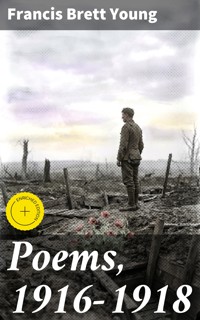
In "Poems, 1916-1918," Francis Brett Young offers a poignant collection of poetry deeply rooted in the context of the First World War. His verses encapsulate the tumultuous emotions of the era, blending vivid imagery with a lyrical style that reflects both personal and collective experiences. The poems traverse themes of loss, longing, and the fragility of life, showcasing Young's ability to capture the essence of human sorrow and resilience against the backdrop of warfare. This collection not only mirrors the literary movements of early 20th-century England but also serves as a testament to the power of poetry to articulate the inexpressible horrors and fleeting beauty of that time. Young, a respected author and poet, was profoundly influenced by his own experiences during the war. His medical background and time on the frontlines provided him with a unique perspective on the psychological and emotional toll of conflict, which resonates throughout his work. The poems reflect a balance between personal reflection and broader societal critiques, marking Young's growth as a literary figure deeply attuned to the struggles of his contemporaries. "Poems, 1916-1918" is a must-read for anyone interested in war literature or the evolution of modern poetry. Young's evocative language and deep reflections will resonate with readers, encouraging them to contemplate the enduring human spirit in times of adversity. Experience the power of these words that stand as a bridge between the past and present, making this collection an essential addition to any literary library. In this enriched edition, we have carefully created added value for your reading experience: - A comprehensive Introduction outlines these selected works' unifying features, themes, or stylistic evolutions. - A Historical Context section situates the works in their broader era—social currents, cultural trends, and key events that underpin their creation. - A concise Synopsis (Selection) offers an accessible overview of the included texts, helping readers navigate plotlines and main ideas without revealing critical twists. - A unified Analysis examines recurring motifs and stylistic hallmarks across the collection, tying the stories together while spotlighting the different work's strengths. - Reflection questions inspire deeper contemplation of the author's overarching message, inviting readers to draw connections among different texts and relate them to modern contexts. - Lastly, our hand‐picked Memorable Quotes distill pivotal lines and turning points, serving as touchstones for the collection's central themes.
Das E-Book können Sie in Legimi-Apps oder einer beliebigen App lesen, die das folgende Format unterstützen:
Veröffentlichungsjahr: 2020
Ähnliche







Poems, 1916-1918
Table of Contents
Introduction
This volume, titled Poems, 1916–1918, brings together verse by Francis Brett Young written across the years named in the collection. It is presented as a focused gathering rather than a general retrospective, concentrating on a short, clearly bounded span of composition that allows readers to follow the poet’s development in close sequence. The purpose of the collection is to provide coherent access to work from these years in one place, so that individual poems can be read both on their own terms and as parts of a sustained creative period.
The collection is made up of poems, and its contents are best approached as lyric and meditative writing rather than narrative fiction or essay. Young is also known as a novelist, but this book concentrates on his poetic practice and the distinctive discipline of line, rhythm, and image that poetry requires. Reading these pieces together foregrounds how he handles compressed statement and tonal modulation, how a poem can register experience without needing the apparatus of plot, and how a sequence of poems can suggest continuity of attention across time.
Within the limits of what a dated selection can responsibly claim, the years 1916 to 1918 situate these poems in an early twentieth-century context marked by intense public and private pressures. The poems in this collection can therefore be read as responses shaped by their moment, while still asking to be judged as crafted literary objects. The chronological framing invites attention to what changes and what persists: shifts in register, widening or narrowing of subject matter, and the ways repeated concerns return in new forms as the period advances.
A unifying feature of Young’s verse is its attentiveness to mood and moral pressure without collapsing into mere statement. The poems frequently work through concentrated observation and controlled feeling, shaping experience into patterns of sound and cadence that carry meaning alongside argument. The collection rewards a reader who listens for the tension between restraint and intensity, for images that do more than decorate, and for the way a poem’s structure—its turns, pauses, and closures—creates an ethics of attention. The result is poetry that seeks clarity without simplification.
Across a compact range of years, the collection also highlights stylistic signatures associated with Young’s poetic voice: a preference for precise, intelligible diction; a measured pace that allows reflection; and a tendency to let implication do much of the work. The poems show how a writer can achieve reach through compression, building resonance from carefully chosen particulars. Even when a poem seems modest in scale, its craft encourages rereading, because its effects often depend on small shifts in emphasis and the accumulation of subtle correspondences across lines.
Reading Poems, 1916–1918 as a single unit emphasizes continuity of sensibility, the persistence of certain concerns, and the gradual refining of technique. The collection’s value lies not only in the individual poems but in the way they collectively record a period of sustained poetic labor. It allows a reader to trace how themes and methods are tested, revised, and sometimes deepened from one piece to the next. That sense of an ongoing workshop—of a poet thinking in verse—gives the book a clear internal cohesion.
The ongoing significance of this collection rests in its demonstration of how early twentieth-century poetry can combine formal control with responsiveness to lived reality. Without requiring specialized context to appreciate its workmanship, the book offers a concentrated encounter with Young as a poet, distinct from his work in other genres. It invites readers to consider how a historically bounded set of poems can still speak through its discipline of language and its seriousness of attention. In gathering these years together, the collection preserves a coherent poetic moment for renewed reading.
Historical Context
Francis Brett Young’s Poems, 1916–1918 emerged during the most intense years of the First World War, when Britain’s mobilization reshaped daily life and literary culture. The period opens after the catastrophic battles of 1915 and coincides with the long strain of industrialized warfare on the Western Front. By 1916, the war had become a national condition rather than a distant campaign, marked by rationing, expanding state authority, and a pervasive language of sacrifice. Young, trained as a physician, wrote amid shifting expectations of duty and endurance, conditions that pressed many writers toward sober realism and moral inquiry.
In 1916 Britain introduced conscription through the Military Service Acts, a turning point that altered the social composition of the army and intensified debates about conscience, class, and obligation. The same year brought the Easter Rising in Dublin (April 1916), followed by executions that deepened tensions within the United Kingdom and complicated wartime narratives of unity. Such events formed the political backdrop for poems attentive to fractured identities and contested loyalties. For a Midlands writer like Young, the war’s reach into villages, factories, and professional life made national policy feel intimate, sharpening contrasts between private continuity and public rupture.
The Battle of the Somme (1 July–18 November 1916) became an emblem of mass loss and attrition, shaping British memory while the war still continued. News reports, casualty lists, and the experiences of returning wounded made grief a collective experience rather than a purely familial one. As a medical officer, Young belonged to the professional cohort exposed to bodily devastation and the moral ambiguities of sustaining fighting strength. The Somme also heightened skepticism about heroic rhetoric, encouraging a more restrained, observational style in much wartime verse. Contemporary readers increasingly expected authenticity grounded in service, which affected reception of soldier-poets and medical writers alike.




