


0,49 €
Niedrigster Preis in 30 Tagen: 1,99 €
Niedrigster Preis in 30 Tagen: 1,99 €
Mehr erfahren.
- Herausgeber: Booksell-Verlag
- Kategorie: Poesie und Drama
- Sprache: Englisch
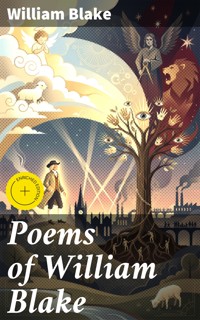
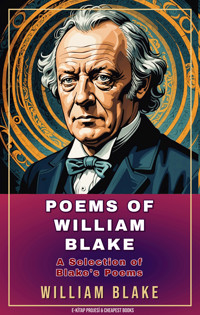
In "Poems of William Blake," the reader encounters a transcendent fusion of lyrical beauty and profound philosophical inquiry. Blake's unique literary style merges vibrant imagery with introspective themes, defying the conventions of the 18th-century Romantic movement. This collection serves as a cornerstone of his artistic vision, filled with mystical exploration, societal critique, and a celebration of the human spirit. Drawing from his intricate beliefs in duality, the poems traverse the realms of innocence and experience, beckoning readers to engage with the dichotomies of life, nature, and spirituality. William Blake (1757-1827) was not only a poet but also a painter and printmaker, making him a pivotal figure in the early Romantic Age. His unconventional perspective on religion, society, and artistic expression owed much to his deep-seated beliefs and experiences in London. Blake'Äôs propensity for social reform, his dreamlike visions, and his radical views on the human condition have shaped both his poetry and visual art, offering rich layers of meaning in every verse. This collection is essential for scholars and general readers alike, as it invites us to reflect on the intricacies of the human experience. Blake's masterpieces encourage contemplation, striking a perfect balance between aesthetic pleasure and intellectual rigor. Engage with these timeless poems and discover the enduring relevance of Blake's insights into innocence, experience, and the complexities of existence. In this enriched edition, we have carefully created added value for your reading experience: - A comprehensive Introduction outlines these selected works' unifying features, themes, or stylistic evolutions. - The Author Biography highlights personal milestones and literary influences that shape the entire body of writing. - A Historical Context section situates the works in their broader era—social currents, cultural trends, and key events that underpin their creation. - A concise Synopsis (Selection) offers an accessible overview of the included texts, helping readers navigate plotlines and main ideas without revealing critical twists. - A unified Analysis examines recurring motifs and stylistic hallmarks across the collection, tying the stories together while spotlighting the different work's strengths. - Reflection questions inspire deeper contemplation of the author's overarching message, inviting readers to draw connections among different texts and relate them to modern contexts. - Lastly, our hand‐picked Memorable Quotes distill pivotal lines and turning points, serving as touchstones for the collection's central themes.
Das E-Book können Sie in Legimi-Apps oder einer beliebigen App lesen, die das folgende Format unterstützen:
Veröffentlichungsjahr: 2019
Ähnliche



Poems of William Blake
Table of Contents
Introduction
This volume, titled Poems of William Blake, gathers poetic work by William Blake into a single, accessible collection. Its purpose is to present Blake’s verse as a coherent body of writing, allowing readers to encounter his distinctive imagination across pieces that were originally circulated in separate publications and contexts. Rather than treating individual poems as isolated achievements, the collection invites sustained attention to the range of Blake’s poetic practice and to the continuity of his concerns. By assembling these works together, the book aims to support both first encounters and return readings, foregrounding the cumulative force of his poetry.
Blake’s reputation rests not only on his poetic invention but on the way his writing participates in a broader artistic project. This collection focuses on poetry as poetry, while recognizing that Blake is also known as an artist and printmaker whose creative work often intertwined word and image. The present gathering therefore emphasizes the literary experience of his verse—its voices, its forms, and its argumentative and lyrical impulses—while offering a framework in which his poems can be read as a sustained exploration of perception, conviction, and moral inquiry. The scope is accordingly comprehensive in spirit, emphasizing breadth of representation within the poetic domain.
The texts represented here are poems: lyrics, songs, and longer visionary pieces as they appear within Blake’s poetic output. Readers will find that Blake’s poems frequently adopt a strongly shaped speaking voice, sometimes direct and songlike, sometimes ceremonious or prophetic in tone. Even when a poem seems brief, it can be constructed with a keen attention to rhythm and repetition, and it often carries a concentrated dramatic energy. The collection’s design places these poetic forms in conversation with one another, so that recurring images, arguments, and tonal contrasts can be traced across the span of his verse rather than encountered only in fragmentary selection.
A defining feature of Blake’s poetry is its insistence that imaginative vision is not ornament but a mode of understanding. Many poems proceed as if perception itself were at stake, pressing the reader to consider how belief, habit, and social custom shape what can be seen and said. This intensity is conveyed through a language that can be at once plain and incantatory, drawing strength from the momentum of statement and the pressure of repeated patterns. Across the collection, Blake’s verse often works by sharpening oppositions—between innocence and experience, freedom and constraint, the vital and the repressed—without reducing them to simple moral formulas.
The poems also demonstrate Blake’s aptitude for compressing large questions into vivid, concrete figures. He often builds a poem around emblematic scenes and sharply etched images, allowing a single speaker, encounter, or symbolic object to carry wide implications. The result can feel simultaneously immediate and expansive: a lyric surface that is easy to follow and a conceptual depth that unfolds over time. This combination has made Blake’s poems enduringly discussable, because their meanings are not exhausted by paraphrase. The collection encourages readers to linger over how the smallest turns of phrase and cadence contribute to the poems’ philosophical and emotional pressure.
Blake’s stylistic hallmarks include a striking directness of diction alongside a bold willingness to declare, to denounce, and to prophesy. Even when a poem proceeds with songlike simplicity, it may pivot toward argument or moral challenge, asking readers to interrogate what passes for natural, acceptable, or inevitable. At other moments, the verse expands into visionary or mythic registers, where abstract forces are personified and conflicts are dramatized in symbolic terms. This range of scale—intimate lyric to sweeping vision—gives the collected poems a dynamic texture, and it demonstrates Blake’s capacity to make poetic form carry both feeling and thought.
Throughout the collection, readers will notice Blake’s engagement with questions of authority, law, and the shaping power of institutions. His poems often examine how rules and sanctioned narratives can constrict human possibility, and how language itself can be used to bind or to liberate. Yet the poetry is not simply oppositional; it also seeks a constructive alternative grounded in imaginative vitality and spiritual seriousness. Blake’s verse repeatedly insists on the dignity of the inner life and on the reality of mental and moral struggle. Bringing these poems together clarifies how persistently he returns to such concerns, varying his approach across different forms and tones.
Another unifying thread is Blake’s attention to childhood, vulnerability, and the formation of consciousness. In poems that adopt seemingly simple perspectives, he explores the tenderness and exposure of early life, and the ways in which experience can harden perception or introduce fear and constraint. These poems are frequently admired for their clarity and memorability, but their power lies equally in their capacity to hold complexity within apparent simplicity. The collection allows readers to see how Blake uses song, address, and narrative vignette to dramatize the transition from protected states of mind to more conflicted awareness, without collapsing the tensions into a single lesson.
Blake’s poetry also stands out for its musicality and structural ingenuity. He employs repetition, refrain-like effects, and strongly patterned lines to build poems that can feel incantatory, as though meaning were being forged through the act of saying. Sound and cadence are not decorative here; they are integral to the persuasive force of the verse. The collection is therefore meant to be read with the ear as well as the eye, attending to how rhythm can steady an argument, sharpen a contrast, or heighten an emotional turn. Encountered across many poems, these techniques reveal an artist attentive to the physical life of language.
At the same time, Blake’s poems are notable for their capacity to unsettle. Familiar terms may be recharged with new intensity, and seemingly straightforward scenes may open onto disquieting implications. The voice of a poem may speak with certainty, but the reader is often invited to test that certainty, to feel the strain between declaration and doubt, or between moral aspiration and lived reality. This quality helps explain the lasting significance of Blake’s work: it does not merely express convictions, but enacts the drama of conviction, making poetry a site where thought is contested and renewed. Collected together, the poems amplify this restless, searching energy.
The purpose of presenting these works in one place is also to offer a practical pathway into Blake for different kinds of readers. Students and general readers can observe how motifs and rhetorical strategies recur and develop, while more experienced readers can reconsider familiar poems in relation to lesser-known pieces and alternate tonal registers. Read as a collection, Blake’s poetry shows a consistent commitment to the imaginative act as a source of insight, and to the idea that art can confront ethical and spiritual questions with urgency. The book thus serves both as an introduction and as a resource for sustained study and rereading.
William Blake’s lasting significance is evident in the continued attention his poems receive as works that combine lyric intensity with intellectual ambition. Their endurance arises from the way they speak to fundamental concerns—freedom and limitation, joy and suffering, innocence and knowledge—through forms that are at once memorable and challenging. This collection aims to honor that legacy by presenting Blake’s poetic work as a unified field of inquiry and feeling, inviting readers to experience its full range and to recognize its coherence. In gathering Poems of William Blake, the volume offers a concentrated encounter with one of English literature’s most distinctive poetic imaginations.
Author Biography
William Blake (1757–1827) was an English poet, painter, and printmaker whose work helped shape the transition from the Enlightenment to early Romanticism. Active largely in London, he developed an idiosyncratic art of word and image, pairing lyric poetry with invented designs and distinctive printing methods. Blake’s books often challenge political and religious orthodoxy while insisting on the primacy of imagination and moral vision. During his lifetime he was better known in small circles than in the wider literary marketplace, but later generations recognized him as a foundational figure in British literature and visual culture.
Blake’s early training was primarily in the visual arts. As a young man he apprenticed to an engraver, a discipline that grounded him in line, composition, and the practical realities of producing images for publication. He also studied drawing and maintained a long engagement with earlier art, including the work of Renaissance masters and the Gothic tradition, which informed his interest in expressive form and spiritual subject matter. These influences appear not as imitation but as a framework Blake reshaped into his own symbolic language, fusing craftsmanship with a radical approach to imagination and prophecy.
From early in his career, Blake sought an integrated practice that could present poetry and art as a single, inseparable experience. His most characteristic works are “illuminated books,” in which he designed, wrote, and printed pages combining text and image. This self-directed mode allowed him to control both meaning and presentation, but it also limited circulation and placed him outside the main commercial channels. The result was a body of work that can be intimate in scale yet ambitious in scope, using myth, allegory, and lyric intensity to address society, faith, and the life of the mind.




