


Erhalten Sie Zugang zu diesem und mehr als 300000 Büchern ab EUR 5,99 monatlich.
- Herausgeber: Demipage
- Kategorie: Poesie und Drama
- Sprache: Spanisch
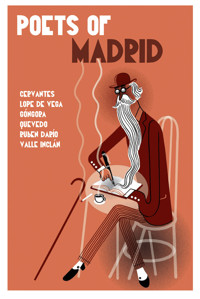
Madrid. Homeric city, the cradle and grave of many of us that pour out the joyful days of youth among its streets and wineries. Throughout its histori it has accepted into its fold non-conforming poets from the four corners of the earth. Because one is born a poet in his land, but one is made and perishes in Madrid. No matter where you are from, Madrid never leaves you indifferent, it always offers the rhapsodist who has moved to the capital in search of fortune, a lively space about which to wrtie their verses. If our lives are the rivers as Manrique said, today the Manzanares river has been reborn and is full of life. Poets of Madrid is a generous title, as is Madrid. This anthology shows that the city drew them in from very distant places: Ruben Darío, for example, was born in Nicaragua; Valle-Inclán in Galicia; Góngora was Andalusian; Cervantes was born in Alcalá de Henares, thirty kilometres from Madrid; only Francisco de Quevedo and Lope de Vega were true Madrid natives. With this, we are trying to say that the presence of Ruben Darío in the anthology represents the percentage of the Hispanic American population who, proud of the city that embraces them, carries the same language in their voices; Góngora and Valle-Inclán, that of the surroundign areas; Cervantes that of the city's close neighbours; and Lope and Quevedo, that of those born in Madrid. Because those us of from other parts of the globe were attracted to this city, which is no loger a "Manchegan dump", for its courtesy and its lack of rejection; as a place known for its cosmopolitanism should be.
Sie lesen das E-Book in den Legimi-Apps auf:
Seitenzahl: 99
Veröffentlichungsjahr: 2026
Das E-Book (TTS) können Sie hören im Abo „Legimi Premium” in Legimi-Apps auf:
Ähnliche



Poets of Madrid
Poets of Madrid
Editorial Demipage
Válgame Dios, 6. Madrid 28004
00 34 91 563 88 67
www.demipage.com
Poets of Madrid, first edition, January 2024
© Demipage, 2019
Cover and interior illustrations:
Daniel Jiménez
Translations:
Catherine Reay
Esta obra ha recibido una ayuda a la edición de la comunidad de Madrid
ISBN
979-13-991615-8-8
No part of this work may be reproduced in any form or by any means, including reprography and computer processing.
Texts have been chosen from writers belonging to two of the most sublime generations of literature: the Spanish Golden Age and Modernism. The selected poems and fragments of prose are those that, as children, some of us learnt by heart at school. They are canonical texts, classics, which have not become fossilized but continue their journey along the paths of our memory; on the contrary, re-reading them today, we find the picaresque, so typical of Madrid, humour, verbal wit and beauty, depth and poetic reflection. But we also find some of the concepts that throughout history forged a certain vision of Spaniards: honour, acerbity, the rowdy nature, but also the doom and inevitable influence of religious faith.
Most of the authors selected here lived together, not always in agreement, in the so-called “Barrio de las Letras” [the Letters District], also known as the district of the literati and of the muses, in the Huertas area, one of the most authentic areas in Madrid. It is not difficult to imagine Quevedo composing satires against Góngora in a bar while Diego de Velázquez, sat on a bench in Antón Martín, observes the porcelain blue Madrid sky and prism light that the genius would later bring to his painting.
Nor Lope, locked in his house on Calle Cervantes, in his bedroom with a beautiful girl or in his studio, finishing a new comedy, while Cervantes himself, leaning out of a window of his home on the corner of León Street, would take a five minute break from his long quixotic journey and notice a scrawny Góngora creating an impossible hyperbaton in his mind after an awful game of cards on his way home to his house on Quevedo Street, from which Quevedo himself would throw him out some time later, causing the most universal real estate anecdote in the history of literature. If this district were in London, Paris or Berlin, it would be one of the most important open air cultural spaces in the world.
This is Madrid.
THIS IS MADRID
By Juan Gracia Armendáriz and Mateo de Paz
The topic of this book, seemingly trivial, is treated lightly by those who only see tourism in a capital city built on the poem of its name. The honour is ours, but the title of this prologue is a tribute to Blas de Otero, a poet born in Bilbao, but who died in Madrid. If we ignore that sublime poem dedicated entirely to the city ("Madrid, divinamente"), we believe it is worth reproducing the stanza in which the coarse and severe verse of the Bilbao-born poet is reflected as with its canto it lights up the dark, post-war metropolis, the Madrid emporium, that initial fort built on the banks of a river that is now a hospitable bed of blooming algae: "Esto es Madrid, me han dicho unas mujeres / arrodilladas en sus delantales, / este es el sitio / donde enterraron un gran ramo verde / y donde está mi sangre reclinada". Homeric city, the cradle and grave of many that have poured out the joyful days of youth among its streets and wineries. Throughout its history it has accepted into its fold non-conforming poets from the four corners of the earth, because one is born a poet in his land, but one is made and perishes in Madrid.
In La Almudena cemetery, for example, it is possible that a bard is buried among its more than five million graves: indeed, there lie Vicente Aleixandre, Dionisio Ridruejo and Dámaso Alonso; while in the San Justo cemetery Larra, Espronceda, Marquina and Gómez de la Serna forever rest. Blas de Otero, the aforementioned poet, lives with his vital silence and his literary noise among the tombs of the Civil Cemetery. Not to insist, but is inevitable to remember that having recently arrived in the city of shelter and defeat, of resistance and fortune, he saw the coarse poetry he had brought in the dull covered Cantabrian folder with gum-coloured elastic bands in a new light. No matter where you are from, Madrid never leaves you indifferent, it always offers the rhapsodist who has moved to the capital in search of fortune, a lively space about which to write his verses: there are, without going far, those dedicated to the town and court by José Bergamín ("Madrid, alma encendida a su espejismo: / ciudad nocturna en urna de su hielo"), Gloria Fuertes ("¡Ojalá sea mentira esa bola / de anhídrido carbónico / que pende bajo el cielo de Madrid!"), Miguel Hernández ("Esta ciudad no se aplaca con fuego"), Dámaso Alonso ("Madrid es una ciudad de más de un millón de cadáveres"), or Góngora himself, with his Culteran style: "La invidia aquí su venenoso diente / cebar suele, a privanzas importuna".
Ethical conduct and literary aesthetics, pillars of the poetic edification of a city of complex lines (if we compare it to the urban grid of Barcelona), which little by little has become fertile and modern, with verses of diverse quality painted and scattered throughout its streets, are bridges for uniting suburbs, souls, stones on a river with very little flow. Indeed, the Manzanares river, tributary of the Jarama and the latter of the Tajo, was the butt of jokes and funny comments in the Baroque era, as it never had enough water to carry and bear the faecal waste generated by such a popular city. Although some scholars maintain its splendid name comes from Celtic ("Magerit""), there are others, however, who trace it back to the somewhat more charming Hispanic Arabic: "arroyo matriz" [mother stream]. Madrid would be womb and centre, therefore, mandorla and mother hated by the surrounding villages, but also "mayrit", in other words, a water channel or conduit that served its first settlers to take the liquid element to the inhabited meseta. What does seem clear at this stage is that Madrid was a city built on water, and the poets that have been bubbling up throughout its history have been channelled by the open arms of a city that has always welcomed extraordinary poetry. If our lives are the rivers as Manrique said, today the Manzanares river has been reborn and is full of life.
Poets of Madrid is a generous title, as is Madrid. It should be said that the Court moved here from Valladolid (where Cervantes and Lope lived for a short time, and perhaps they knew Shakespeare) and with it the power of royal favourites and advisors who could provide economic protection to poets. Of Madrid, which does not have a beach or access to the sea, Machado called it the "breakwater of all Spain". This has some truth to it. Over the last few centuries many writers and artists coming from different parts of the large Spanish-speaking territory have moved to Madrid "in waves" to conquer it with their books of poems, plays, novels and stories, as if the peninsula were hiding a treasure beyond its coral reef. In fact, this anthology shows that the city drew them in from very distant places: Rubén Darío, for example, was born in Nicaragua; Valle-Inclán in Galicia; Góngora was Andalusian; Cervantes was born in Alcalá de Henares, thirty kilometres from Madrid; only Francisco de Quevedo and Lope de Vega were true Madrid natives, a circumstance that correlates with the human geography of the metropolis: at least half of its inhabitants are native to other parts of Spain. This is not unique to Madrid, no. This is a characteristic shared with London and Paris. And at this rate, the "gatos" [cats – a nickname used to refer to people from Madrid] will have to be preserved as a cultural asset. In fact, the nickname has its own history. "Gato" was a very famous surname in the conquest of Madrid in King Alfonso VI’s time. The legend seems simple: during an attack on the city, a brave soldier scaled the wall only aided by his dagger which he inserted into the gaps between the stones. Upon seeing such a feat, the other soldiers said he looked like a cat, a word which was then used to refer to his descendants as well. The family became so important in Madrid that only those belonging to that lineage were deemed traditional nobility. The nickname was so popular that over time all its inhabitants ended up being called "cats". To give an example of what we are saying: the editor of this book is Madrid-born, in other words, a "cat"; while those who have chosen the texts and written the accompanying words are from the Basque country and Navarre, internal emigrants from various parts of the peninsula. Multiculturalism is already a fact in a city that has been home for several decades to a large Hispanic American community from Ecuador, Bolivia, Peru, Colombia, Argentina, etc. Not to mention the Europeans, North Americans, Africans and Asians that live here! It is no exaggeration: in this country, which belongs to everyone, there are one and a half million Hispanic Americans who say they "feel at home" here. With this, we are trying to say that the presence of Rubén Darío in the anthology represents the percentage of the Hispanic American population who, proud of the city that embraces them, carries the same language in their voices; Góngora and Valle-Inclán, that of the surrounding areas; Cervantes, that of the city’s close neighbours; and Lope and Quevedo, that of those born in Madrid. Because those us of from other parts of Spain were attracted to this city, which is no longer a "Manchegan dump", for its courtesy and its lack of rejection; as a place known for its cosmopolitanism should be.
Madrid has grown a lot since the 1950s and 60s thanks to the immigration of people from Andalusia, Extremadura, Galicia and Asturias, among others. The numerous bars, restaurants and flamenco venues, managed by the descendants of these immigrants, are proof of this: cuisines as different as gazpacho, salmorejo, fried anchovies or seafood come together in the same streets, like the poets and writers in this book, with offal and chickpea stew, Creole chorizo sausages and calamari baguette sandwiches, sea bream and beans, garlic soups and scrambled eggs. So we believe that the title, Poets of Madrid, is more than justified as this is a city without a definite identity (something to be grateful for) and whose only rivalry, perhaps, has to do with football, Real Madrid or Atlético de Madrid?, there being no lack of fans of other peninsular clubs or of the three other, somewhat humbler, although valiant, teams from the city and its surroundings: Rayo Vallecano, Getafe and Club Deportivo Leganés.




