


Erhalten Sie Zugang zu diesem und mehr als 300000 Büchern ab EUR 5,99 monatlich.
- Herausgeber: CLXBX
- Kategorie: Gesellschafts- und Liebesromane
- Sprache: Englisch
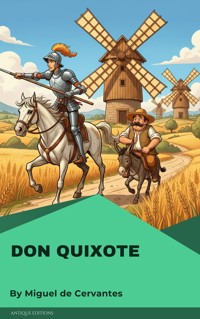
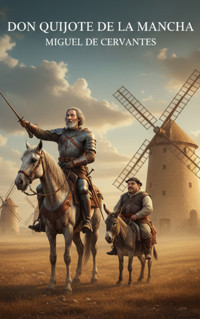
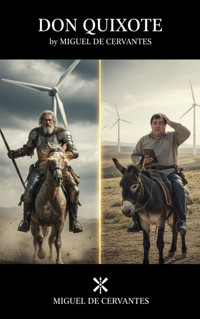
Widely regarded as one of the greatest works of literature ever written, Don Quixote by Miguel de Cervantes is a timeless masterpiece that has captivated readers for over four centuries. A brilliant blend of comedy, adventure, philosophy, and social commentary, this classic novel tells the unforgettable story of a man who dares to dream beyond the limits of reality. Alonso Quixano, an aging gentleman from La Mancha, becomes so enchanted by tales of chivalry that he decides to become a knight-errant, renaming himself Don Quixote. Armed with rusted armor, an old horse named Rocinante, and an unshakable belief in his noble mission, he sets out to revive chivalry and defend the helpless. By his side is his loyal and practical squire, Sancho Panza, whose earthy wisdom and humor provide a perfect contrast to Don Quixote's lofty ideals. As Don Quixote embarks on his quest, ordinary objects transform in his imagination into grand enemies and epic challenges—most famously, windmills that he mistakes for fearsome giants. Through a series of humorous misadventures and poignant encounters, Cervantes masterfully explores themes of illusion versus reality, idealism versus practicality, and the enduring power of imagination. But beneath its comedy lies a profound reflection on human nature. Don Quixote examines the tension between dreams and the world as it is, asking readers whether it is better to live safely within reality or boldly within one's vision of what could be. The novel's richly drawn characters, sharp wit, and emotional depth make it both entertaining and deeply moving. More than just a satire of medieval romances, Don Quixote is a celebration of courage, friendship, and the enduring human spirit. It remains as relevant today as when it was first published in the early 17th century, influencing countless writers and shaping the modern novel as we know it. Whether you are discovering this literary treasure for the first time or returning to it once more, Don Quixote offers an unforgettable journey filled with laughter, wisdom, and timeless insight.
Sie lesen das E-Book in den Legimi-Apps auf:
Seitenzahl: 2063
Veröffentlichungsjahr: 2026
Das E-Book (TTS) können Sie hören im Abo „Legimi Premium” in Legimi-Apps auf:
Ähnliche








DON QUIXOTE
MIGUEL DE CERVANTES
Copyright © 2025 by Miguel de Cervantes
All rights reserved.
No part of this book may be reproduced in any form or by any electronic or mechanical means, including information storage and retrieval systems, without written permission from the author, except for the use of brief quotations in a book review.
CONTENTS
Introduction
Volume 1
Author's Preface
1. Which treats of the character and pursuits of the famous gentleman Don Quixote de la Mancha
2. Which treats of the first sally the ingenious Don Quixote made from home
3. Wherein is related the droll way in which Don Quixote had himself dubbed a knight
4. Of what happened to our knight when he left the inn
5. In which the narrative of our knight's mishap is continued
6. Of the diverting and important scrutiny which the curate and the barber made in the library of our ingenious gentleman
7. Of the second sally of our worthy knight Don Quixote of la Mancha
8. Of the good fortune which the valiant Don Quixote had in the terrible and undreamt-of adventure of the windmills, with other occurrences worthy to be fitly recorded
9. In which is concluded and finished the terrific battle between the gallant Biscayan and the valiant Manchegan
10. Of the pleasant discourse that passed between Don Quixote and his squire Sancho Panza
11. Of what befell Don Quixote with certain goatherds
12. Of what a goatherd related to those with Don Quixote
13. In which is ended the story of the shepherdess Marcela, with other incidents
14. Wherein are inserted the despairing verses of the dead shepherd, together with other incidents not looked for
15. In which is related the unfortunate adventure that Don Quixote fell in with when he fell out with certain heartless Yanguesans
16. Of what happened to the ingenious gentleman in the inn which he took to be a castle
17. In which are contained the innumerable troubles which the brave Don Quixote and his good squire Sancho Panza endured in the inn, which to his misfortune he took to be a castle
18. In which is related the discourse Sancho Panza held with his master, Don Quixote, and other adventures worth relating
19. Of the shrewd discourse which Sancho held with his master, and of the adventure that befell him with a dead body, together with other notable occurrences
20. Of the unexampled and unheard-of adventure which was achieved by the valiant Don Quixote of la Mancha with less peril than any ever achieved by any famous knight in the world
21. Which treats of the exalted adventure and rich prize of Mambrino's helmet, together with other things that happened to our invincible knight
22. Of the freedom Don Quixote conferred on several unfortunates who against their will were being carried where they had no wish to go
23. Of what befell Don Quixote in the Sierra Morena, which was one of the rarest adventures related in this veracious history
24. In which is continued the adventure of the Sierra Morena
25. Which treats of the strange things that happened to the stout knight of la Mancha in the Sierra Morena, and of his imitation of the penance of Beltenebros
26. In which are continued the refinements wherewith Don Quixote played the part of a lover in the Sierra Morena
27. Of how the curate and the barber proceeded with their scheme; together with other matters worthy of record in this great history
28. Which treats of the strange and delightful adventure that befell the curate and the barber in the same sierra
29. Which treats of the droll device and method adopted to extricate our love-stricken knight from the severe penance he had imposed upon himself
30. Which treats of address displayed by the fair Dorothea, with other matters pleasant and amusing
31. Of the delectable discussion between Don Quixote and Sancho Panza, his squire, together with other incidents
32. Which treats of what befell Don Quixote's party at the inn
33. In which is related the novel of "The Ill-Advised Curiosity"
34. In which is continued the novel of "The Ill-Advised Curiosity"
35. Which treats of the heroic and prodigious battle Don Quixote had with certain skins of red wine, and brings the novel of "The Ill-Advised Curiosity" to a close
36. Which treats of more curious incidents that occurred at the inn
37. In which is continued the story of the famous Princess Micomicona, with other droll adventures
38. Which treats of the curious discourse Don Quixote delivered on arms and letters
39. Wherein the captive relates his life and adventures
40. In which the story of the captive is continued
41. In which the captive still continues his adventures
42. Which treats of what further took place in the inn, and of several other things worth knowing
43. Wherein is related the pleasant story of the muleteer, together with other strange things that came to pass in the inn
44. In which are continued the unheard-of adventures of the inn
45. In which the doubtful question of Mambrino's helmet and the pack-saddle is finally settled, with other adventures that occurred in truth and earnest
46. Of the end of the notable adventure of the officers of the Holy Brotherhood; and of the great ferocity of our worthy knight, Don Quixote
47. Of the strange manner in which Don Quixote of la Mancha was carried away enchanted, together with other remarkable incidents
48. In which the canon pursues the subject of the books of chivalry, with other matters worthy of his wit
49. Which treats of the shrewd conversation which Sancho Panza held with his master Don Quixote
50. Of the shrewd controversy which Don Quixote and the canon held, together with other incidents
51. Which deals with what the goatherd told those who were carrying off Don Quixote
52. Of the quarrel that Don Quixote had with the goatherd, together with the rare adventure of the penitents, which with an expenditure of sweat he brought to a happy conclusion
Volume 2
Author's Preface
1. Of the interview the curate and the barber had with Don Quixote about his malady
2. Which treats of the notable altercation which Sancho Panza had with Don Quixote's niece, and housekeeper, together with other droll matters
3. Of the laughable conversation that passed between Don Quixote, Sancho Panza, and the bachelor Samson Carrasco
4. In which Sancho Panza gives a satisfactory reply to the doubts and questions of the bachelor Samson Carrasco, together with other matters worth knowing and telling
5. Of the shrewd and droll conversation that passed between Sancho Panza and his wife Teresa Panza, and other matters worthy of being duly recorded
6. Of what took place between Don Quixote and his niece and housekeeper; one of the most important chapters in the whole history
7. Of what passed between Don Quixote and his squire, together with other very notable incidents
8. Wherein is related what befell Don Quixote on his way to see his lady Dulcinea del Toboso
9. Wherein is related what will be seen there
10. Wherein is related the crafty device Sancho adopted to enchant the lady Dulcinea, and other incidents as ludicrous as they are true
11. Of the strange adventure which the valiant Don Quixote had with the car or cart of "The Cortes of Death"
12. Of the strange adventure which befell the valiant Don Quixote with the bold knight of the mirrors
13. In which is continued the adventure of the knight of the grove, together with the sensible, original, and tranquil colloquy that passed between the two squires
14. Wherein is continued the adventure of the knight of the grove
15. Wherein it is told and known who the knight of the mirrors and his squire were
16. Of what befell Don Quixote with a discreet gentleman of La Mancha
17. Wherein is shown the furthest and highest point which the unexampled courage of Don Quixote reached or could reach; together with the happily achieved adventure of the lions
18. Of what happened Don Quixote in the castle or house of the knight of the green gaban, together with other matters out of the common
19. In which is related the adventure of the enamoured shepherd, together with other truly droll incidents
20. Wherein an account is given of the wedding of Camacho the rich, together with the incident of Basilio the poor
21. In which Camacho's wedding is continued, with other delightful incidents
22. Wherin is related the grand adventure of the cave of Montesinos in the heart of La Mancha, which the valiant Don Quixote brought to a happy termination
23. Of the wonderful things the incomparable Don Quixote said he saw in the profound cave of Montesinos, the impossibility and magnitude of which cause this adventure to be deemed apocryphal
24. Wherein are related a thousand trifling matters, as trivial as they are necessary to the right understanding of this great history
25. Wherein is set down the braying adventure, and the droll one of the puppet-showman, together with the memorable divinations of the divining ape
26. Wherein is continued the droll adventure of the puppet-showman, together with other things in truth right good
27. Wherein it is shown who Master Pedro and his ape were, together with the mishap Don Quixote had in the braying adventure, which he did not conclude as he would have liked or as he had expected
28. Of matters that Benengeli says he who reads them will know, if he reads them with attention
29. Of the famous adventure of the enchanted bark
30. Of Don Quixote's adventure with a fair huntress
31. Which treats of many and great matters
32. Of the reply Don Quixote gave his censurer, with other incidents, grave and droll
33. Of the delectable discourse which the duchess and her damsels held with Sancho Panza, well worth reading and noting
34. Which relates how they learned the way in which they were to disenchant the peerless Dulcinea del Toboso, which is one of the rarest adventures in this book
35. Wherein is continued the instruction given to Don Quixote touching the disenchantment of Dulcinea, together with other marvellous incidents
36. Wherein is related the strange and undreamt-of adventure of the distressed duenna, alias the countess Trifaldi, together with a letter which Sancho Panza wrote to his wife, Teresa Panza
37. Wherein is continued the notable adventure of the distressed duenna
38. Wherein is told the distressed duenna's tale of her misfortunes
39. In which the Trifaldi continues her marvellous and memorable story
40. Of matters relating and belonging to this adventure and to this memorable history
41. Of the arrival of Clavileno and the end of this protracted adventure
42. Of the counsels which Don Quixote gave Sancho Panza before he set out to govern the island, together with other well-considered matters
43. Of the second set of counsels Don Quixote gave Sancho Panza
44. How Sancho Panza was conducted to his government, and of the strange adventure that befell Don Quixote in the castle
45. Of how the great Sancho Panza took possession of his island, and of how he made a beginning in governing
46. Of the terrible bell and cat fright that Don Quixote got in the course of the enamoured Altisidora's wooing
47. Wherein is continued the account of how Sancho Panza conducted himself in his government
48. Of what befell Don Quixote with Dona Rodriguez, the duchess's duenna, together with other occurrences worthy of record and eternal remembrance
49. Of what happened Sancho in making the round of his island
50. Wherein is set forth who the enchanters and executioners were who flogged the duenna and pinched Don Quixote, and also what befell the page who carried the letter to Teresa Panza, Sancho Panza's wife
51. Of the progress of Sancho's government, and other such entertaining matters
52. Wherein is related the adventure of the second distressed or afflicted duenna, otherwise called Dona Rodriguez
53. Of the troublous end and termination Sancho Panza's government came to
54. Which deals with matters relating to this history and no other
55. Of what befell Sancho on the road, and other things that cannot be surpassed
56. Of the prodigious and unparalleled battle that took place between Don Quixote of La Mancha and the lacquey Tosilos in defence of the daughter of Dona Rodriguez
57. Which treats of how Don Quixote took leave of the duke, and of what followed with the witty and impudent Altisidora, one of the duchess's damsels
58. Which tells how adventures came crowding on Don Quixote in such numbers that they gave one another no breathing-time
59. Wherein is related the strange thing, which may be regarded as an adventure, that happened Don Quixote
60. Of what happened Don Quixote on his way to Barcelona
61. Of what happened Don Quixote on entering Barcelona, together with other matters that partake of the true rather than of the ingenious
62. Which deals with the adventure of the enchanted head, together with other trivial matters which cannot be left untold
63. Of the mishap that befell Sancho Panza through the visit to the galleys, and the strange adventure of the fair Morisco
64. Treating of the adventure which gave Don Quixote more unhappiness than all that had hitherto befallen him
65. Wherein is made known who the knight of the white moon was; likewise Don Gregorio's release, and other events
66. Which treats of what he who reads will see, or what he who has it read to him will hear
67. Of the resolution Don Quixote formed to turn shepherd and take to a life in the fields while the year for which he had given his word was running its course; with other events truly delectable and happy
68. Of the bristly adventure that befell Don Quixote
69. Of the strangest and most extraordinary adventure that befell Don Quixote in the whole course of this great history
70. Which follows sixty-nine and deals with matters indispensable for the clear comprehension of this history
71. Of what passed between Don Quixote and his squire Sancho on the way to their village
72. Of how Don Quixote and Sancho reached their village
73. Of the omens Don Quixote had as he entered his own village, and other incidents that embellish and give a colour to this great history
74. Of how Don Quixote fell sick, and of the will he made, and how he died
INTRODUCTION
It was with considerable reluctance that I abandoned in favor of the present undertaking what had long been a favorite project: that of a new edition of Shelton's "Don Quixote," which has now become a somewhat scarce book. There are some—and I confess myself to be one—for whom Shelton's racy old version, with all its defects, has a charm that no modern translation, however skilful or correct, could possess. Shelton had the inestimable advantage of belonging to the same generation as Cervantes; "Don Quixote" had to him a vitality that only a contemporary could feel; it cost him no dramatic effort to see things as Cervantes saw them; there is no anachronism in his language; he put the Spanish of Cervantes into the English of Shakespeare. Shakespeare himself most likely knew the book; he may have carried it home with him in his saddle-bags to Stratford on one of his last journeys, and under the mulberry tree at New Place joined hands with a kindred genius in its pages.
But it was soon made plain to me that to hope for even a moderate popularity for Shelton was vain. His fine old crusted English would, no doubt, be relished by a minority, but it would be only by a minority. His version has strong claims on sentimental grounds, but on sentimental grounds only. His warmest admirers must admit that he is not a satisfactory representative of Cervantes. His translation of the First Part was very hastily made—in forty days he says in his dedication—and, as his marginal notes show, never revised by him. It has all the freshness and vigor, but also a full measure of the faults, of a hasty production. It is often very literal—barbarously literal frequently—but just as often very loose. He had evidently a good colloquial knowledge of Spanish, but apparently not much more. It never seems to occur to him that the same translation of a word will not suit in every case. With him "discreto"—a chameleon of a word in its way of taking various meanings according to circumstances—is always "discreet," "admirar" is always "admire," "sucesos" always "successes" (which it seldom means), "honesto" always "honest" (which it never means), "suspenso" always "suspended;" "desmayarse," to swoon or faint, is always "to dismay" (one lady is a "mutable and dismayed traitress," when "fickle and fainting" is meant, and another "made shew of dismaying" when she "seemed ready to faint"); "trance," a crisis or emergency, is always simply "trance;" "disparates" always "fopperies," which, however, if not a translation, is an illustration of the meaning, for it is indeed nonsense. These are merely a few samples taken at hap-hazard, but they will suffice to show how Shelton translated, and why his "Don Quixote," veritable treasure as it is to the Cervantist and to the lover of old books and old English, cannot be accepted as an adequate translation.
It is often said that we have no satisfactory translation of "Don Quixote." To those who are familiar with the original, it savors of truism or platitude to say so, for in truth there can be no thoroughly satisfactory translation of "Don Quixote" into English or any other language. It is not that the Spanish idioms are so utterly unmanageable, or that the untranslatable words, numerous enough no doubt, are so superabundant, but rather that the sententious terseness to which the humor of the book owes its flavor is peculiar to Spanish, and can at best be only distantly imitated in any other tongue. The dilemma of the translator frequently is this, that terseness is essential to the humor of the phrase or passage, but if he translates he will not be terse, and if he would be terse he must paraphrase.
The history of our English translations of "Don Quixote" is instructive. Shelton's, the first in any language, was made, apparently, about 1608, but not published till 1612. This of course was only the First Part. It has been asserted that the Second, published in 1620, is not the work of Shelton, but there is nothing to support the assertion save the fact that it has less spirit, less of what we generally understand by "go," about it than the first, which would be only natural if the first were the work of a young man writing currente calamo, and the second that of a middle-aged man writing for a bookseller. On the other hand, it is closer and more literal, the style is the same, the very same translations, or mistranslations, of "suceso,", "trance,", "desmayarse," etc., occur in it, and it is extremely unlikely that a new translator would, by suppressing his name, have allowed Shelton to carry off the credit.
In 1687 John Phillips, Milton's nephew, produced a "Don Quixote" "made English," he says, "according to the humour of our modern language." The origin of this attempt is plain enough. In 1656 that indecorous Oxford Don, Edmond Gayton, had produced his "Festivous Notes on Don Quixote," a string of jests, more or less dirty, on the incidents in the story, which seems to have been much relished; and in 1667 Sir Roger l'Estrange had published his version of Quevedo's "Visions" from the French of La Geneste, a book which the lively though decidedly coarse humor, cockney jokes and London slang, wherewith he liberally seasoned it, made a prodigious favorite with the Restoration public. It struck Phillips that, as Shelton was now rather antiquated, a "Don Quixote" treated in the same way might prove equally successful. He imitated L'Estrange as well as he could, but L'Estrange was a clever penman and a humorist after his fashion, while Phillips was only a dull buffoon. His "Quixote" is not so much a translation as a travesty, and a travesty that for coarseness, vulgarity, and buffoonery is almost unexampled even in the literature of that day.
Ned Ward's "Life and Notable Adventures of Don Quixote, merrily translated into Hudibrastic Verse" (1700), can scarcely be reckoned a translation, but it serves to show the light in which "Don Quixote" was regarded at the time.
A further illustration may be found in the version published in 1712 by Peter Motteux, who had then recently combined tea-dealing with literature. It is described as "translated from the original by several hands," but if so all Spanish flavor has entirely evaporated under the manipulation of the several hands. The flavor that it has, on the other hand, is distinctly Franco-cockney. Anyone who compares it carefully with the original will have little doubt that it is a concoction from Shelton and the French of Filleau de Saint Martin, eked out by borrowings from Phillips, whose mode of treatment it adopts. It is, to be sure, more decent and decorous, but it treats "Don Quixote" in the same fashion as a comic book that cannot be made too comic.
To attempt to improve the humor of "Don Quixote" by an infusion of cockney flippancy and facetiousness, as Motteux's operators did, is not merely an impertinence like larding a sirloin of prize beef, but an absolute falsification of the spirit of the book, and it is a proof of the uncritical way in which "Don Quixote" is generally read that this worse than worthless translation—worthless as failing to represent, worse than worthless as misrepresenting—should have been favored as it has been. That it should have been popular in its own day, or that a critic who understood the original so little as Alexander Fraser Tytler should think it "by far the best," is no great wonder. But that so admirable a scholar as Ticknor should have given it even the lukewarm approval he bestows upon it, and that it should have been selected for reproduction in luxurious shapes three or four times within these last three or four years, is somewhat surprising. Ford, whose keen sense of humor, and intimate knowledge of Spain and the Spanish character, make him a more trustworthy critic on this particular question than even the illustrious American, calls it of all English translations "the very worst." This is of course too strong, for it is not and could not be worse than Phillips's, but the vast majority of those who can relish "Don Quixote" in the original will confirm the judgment substantially.
It had the effect, however, of bringing out a translation undertaken and executed in a very different spirit, that of Charles Jervas, the portrait painter, and friend of Pope, Swift, Arbuthnot, and Gay. Jervas has been allowed little credit for his work, indeed it may be said none, for it is known to the world in general as Jarvis's. It was not published until after his death, and the printers gave the name according to the current pronunciation of the day. It has been the most freely used and the most freely abused of all the translations. It has seen far more editions than any other, it is admitted on all hands to be by far the most faithful, and yet nobody seems to have a good word to say for it or for its author. Jervas no doubt prejudiced readers against himself in his preface, where among many true words about Shelton, Stevens, and Motteux, he rashly and unjustly charges Shelton with having translated not from the Spanish, but from the Italian version of Franciosini, which did not appear until ten years after Shelton's first volume. A suspicion of incompetence, too, seems to have attached to him because he was by profession a painter and a mediocre one (though he has given us the best portrait we have of Swift), and this may have been strengthened by Pope's remark that he "translated 'Don Quixote' without understanding Spanish." He has been also charged with borrowing from Shelton, whom he disparaged. It is true that in a few difficult or obscure passages he has followed Shelton, and gone astray with him; but for one case of this sort, there are fifty where he is right and Shelton wrong. As for Pope's dictum, anyone who examines Jervas's version carefully, side by side with the original, will see that he was a sound Spanish scholar, incomparably a better one than Shelton, except perhaps in mere colloquial Spanish. Unlike Shelton, and indeed most translators, who are generally satisfied with the first dictionary meaning or have a stereotype translation for every word under all circumstances, he was alive to delicate distinctions of meaning, always an important matter in Spanish, but especially in the Spanish of Cervantes, and his notes show that he was a diligent student of the great Spanish Academy Dictionary, at least its earlier volumes; for he died in 1739, the year in which the last was printed. His notes show, besides, that he was a man of very considerable reading, particularly in the department of chivalry romance, and they in many instances anticipate Bowle, who generally has the credit of being the first "Quixote" annotator and commentator. He was, in fact, an honest, faithful, and painstaking translator, and he has left a version which, whatever its shortcomings may be, is singularly free from errors and mistranslations.
The charge against it is that it is stiff, dry—"wooden" in a word,—and no one can deny that there is a foundation for it. But it may be pleaded for Jervas that a good deal of this rigidity is due to his abhorrence of the light, flippant, jocose style of his predecessor. He was one of the few, very few, translators that have shown any apprehension of the unsmiling gravity which is the essence of Quixotic humor; it seemed to him a crime to bring Cervantes forward smirking and grinning at his own good things, and to this may be attributed in a great measure the ascetic abstinence from every thing savoring of liveliness which is the characteristic of his translation. Could he have caught but ever so little of Swift's or Arbuthnot's style, he might have hit upon a via media that would have made his version as readable as it is faithful, or at any rate saved him from the reproach of having marred some of the best scenes in "Don Quixote." In most modern editions, it should be observed, his style has been smoothed and smartened, but without any reference to the original Spanish, so that if he has been made to read more agreeably he has also been robbed of his chief merit of fidelity.
Smollett's version, published in 1755, may be almost counted as one of these. At any rate it is plain that in its construction Jervas's translation was very freely drawn upon, and very little or probably no heed given to the original Spanish.
The later translations may be dismissed in a few words. George Kelly's, which appeared in 1769, "printed for the Translator," was an impudent imposture, being nothing more than Motteux's version with a few of the words, here and there, artfully transposed; Charles Wilmot's (1774) was only an abridgment like Florian's, but not so skilfully executed; and the version published by Miss Smirke in 1818, to accompany her brother's plates, was merely a patchwork production made out of former translations. On the latest, Mr. A. J. Duffield's, it would be in every sense of the word impertinent in me to offer an opinion here. I had not even seen it when the present undertaking was proposed to me, and since then I may say vidi tantum, having for obvious reasons resisted the temptation which Mr. Duffield's reputation and comely volumes hold out to every lover of Cervantes.
From the foregoing history of our translations of "Don Quixote," it will be seen that there are a good many people who, provided they get the mere narrative with its full complement of facts, incidents, and adventures served up to them in a form that amuses them, care very little whether that form is the one in which Cervantes originally shaped his ideas. On the other hand, it is clear that there are many who desire to have not merely the story he tells, but the story as he tells it, so far at least as differences of idiom and circumstances permit, and who will give a preference to the conscientious translator, even though he may have acquitted himself somewhat awkwardly. It is not very likely that readers of the first class are less numerous now than they used to be, but it is no extravagant optimism to assume that there are many more of the other way of thinking than there were a century and a half ago.
But after all there is no real antagonism between the two classes; there is no reason why what pleases the one should not please the other, or why a translator who makes it his aim to treat "Don Quixote" with the respect due to a great classic, should not be as acceptable even to the careless reader as the one who treats it as a famous old jest-book. It is not a question of caviare to the general, or, if it is, the fault rests with him who makes it so. The method by which Cervantes won the ear of the Spanish people ought, mutatis mutandis, to be equally effective with the great majority of English readers. At any rate, even if there are readers to whom it is a matter of indifference, fidelity to the method is as much a part of the translator's duty as fidelity to the matter. If he can please all parties, so much the better; but his first duty is to those who look to him for as faithful a representation of his author as it is in his power to give them, faithful to the letter so long as fidelity is practicable, faithful to the spirit so far as he can make it.
With regard to fidelity to the letter, there is of course no hard and fast rule to be observed; a translator is bound to be literal as long as he can, but persistence in absolute literality, when it fails to convey the author's idea in the shape the author intended, is as great an offence against fidelity as the loosest paraphrase. As to fidelity to the spirit, perhaps the only rule is for the translator to sink his own individuality altogether, and content himself with reflecting his author truthfully. It is disregard of this rule that makes French translations, admirable as they generally are in all that belongs to literary workmanship, so often unsatisfactory. French translators, for the most part, seem to consider themselves charged with the duty of introducing their author to polite society, and to feel themselves in a measure responsible for his behavior. There is always in their versions a certain air of "Bear your body more seeming, Audrey." Viardot, for example, has produced a "Don Quixote" that is delightfully smooth, easy reading; but the Castilian character has been smoothed away. He has forced Cervantes into a French mould, instead of moulding his French to the features of Cervantes. It is hardly fair, perhaps, to expect a Frenchman to efface himself and consent to play second fiddle under any circumstances; but to look for a translation true to the spirit from a translator who holds himself free to improve his author is, as a Spaniard would say, "to ask pears from the elm tree."
My purpose here, however, is not to dogmatize on the rules of translation, but to indicate those I have followed, or at least tried to the best of my ability to follow, in the present instance. One which, it seems to me, cannot be too rigidly followed in translating "Don Quixote," is to avoid everything that savors of affectation. The book itself is, indeed, in one sense a protest against it, and no man abhorred it more than Cervantes. "Toda afectacion es mala," is one of his favorite proverbs. For this reason, I think, any temptation to use antiquated or obsolete language should be resisted. It is after all an affectation, and one for which there is no warrant or excuse. Spanish has probably undergone less change since the seventeenth century than any language in Europe, and by far the greater and certainly the best part of "Don Quixote" differs but little in language from the colloquial Spanish of the present day. That wonderful supper-table conversation on books of chivalry in Chap. xxxii. Part I. is just such a one as might be heard now in any venta in Spain. Except in the tales and Don Quixote's speeches, the translator who uses the simplest and plainest every-day language will almost always be the one who approaches nearest to the original.
Seeing that the story of "Don Quixote" and all its characters and incidents have now been for more than two centuries and a half familiar as household words in English mouths, it seems to me that the old familiar names and phrases should not be changed without good reason. I am by no means sure that I have done rightly in dropping Shelton's barbarous title of "Curious Impertinent" by which the novel in the First Part has been so long known. It is not a translation, and it is not English, but it has so long passed current as the title of the story that its original absurdity has been, so to speak, effaced by time and use. "Ingenious" is, no doubt, not an exact translation of "Ingenioso;" but even if an exact one could be found, I doubt if any end would be served by substituting it. No one is likely to attach the idea of ingenuity to Don Quixote. *"Dapple" is not the correct translation of "rucio," as I have pointed out in a note, but it has so long done duty as the distinctive title of Sancho's ass that nobody, probably, connects the idea of color with it. "Curate" is not an accurate translation of "cura," but no one is likely to confound Don Quixote's good fussy neighbor with the curate who figures in modern fiction. For "Knight of the Rueful Countenance," no defence is necessary, for, as I have shown (v. Chap. xix.), it is quite right; Sancho uses "triste figura" as synonymous with "mala cara."
The names of things peculiarly Spanish, like "olla," "bota," "alforjas," etc., are, I think, better left in their original Spanish. Translations like "bottle" and "saddle-bags" give an incorrect idea, and books of travel in Spain have made the words sufficiently familiar to most readers. It is less easy to deal with the class of words that are untranslatable, or at least translatable only by two or more words; such words as "desengaño," "discreto," "donaire," and the like, which in cases where conciseness is of at least equal importance with literality must often be left only partially translated.
Of course a translator who holds that "Don Quixote" should receive the treatment a great classic deserves, will feel himself bound by the injunction laid upon the Morisco in chapter ix. not to omit or add anything. Every one who takes up a sixteenth or seventeenth century author knows very well beforehand that he need not expect to find strict observance of the canons of nineteenth century society. Two or three hundred years ago, words, phrases, and allusions where current in ordinary conversation which would be as inadmissible now as the costume of our first parents, and an author who reflects the life and manners of his time must necessarily reflect its language also.
This is the case of Cervantes. There is no more apology needed on his behalf than on behalf of the age in which he lived. He was not one of those authors for whom dirt has the attraction it has for the blue bottle; he was not even one of those that with a jolly indifference treat it as capital matter to make a joke of. Compared with his contemporaries and most of his successors who dealt with life and manners, he is purity itself; there are words, phrases, and allusions that one could wish away, there are things—though very few after all—that offend one, but there is no impurity to give offence in the writings of Cervantes.
The text I have followed generally is Hartzenbusch's. But Hartzenbusch, though the most scholarly of the editors and commentators of "Don Quixote," is not always an absolutely safe guide. His text is preferable to that of the Academy in being, as far as the First Part is concerned, based upon the first of La Cuesta's three editions, instead of the third, which the Academy took as its basis on the supposition (an erroneous one, as I have shown elsewhere) that it had been corrected by Cervantes himself. His emendations are frequently admirable, and remove difficulties and make rough places smooth in a manner that must commend itself to every intelligent reader; but his love and veneration for Cervantes too often get the better of the judicious conservatism that should be an editor's guiding principle in dealing with the text of an old author. Notwithstanding the abundant evidence before him that Cervantes was—to use no stronger word—a careless writer, he insists upon attributing every blunder, inconsistency, or slipshod or awkward phrase to the printers. Cervantes, he argues, wrote a hasty and somewhat illegible hand, his failing eyesight made revision or correction of his manuscript an irksome task to him, and the printers were consequently often driven to conjecture. He considers himself, therefore, at liberty to reject whatever jars upon his sense of propriety, and substitute what, in his judgment, Cervantes "must have written."
It is needless to point out the destructive results that would follow the adoption of this principle in settling the text of old authors. In Hartzenbusch's "Don Quixote" it has led to a good deal of unnecessary tampering with the text, and, in not a few instances, to something that is the reverse of emendation. He is not, therefore, by any means an editor to be slavishly followed, though all who know his editions will cordially acknowledge his services, among which may be reckoned his judicious arrangement of the text into paragraphs, and the care he has bestowed upon the punctuation, matters too much neglected by his predecessors. Nor is the valuable body of notes he has brought together the least of them. In this respect he comes next to Clemencin; but the industry and erudition of that indefatigable commentator have left comparatively few gleanings for those who come after him.
To both, as well as to Pellicer, I have had frequent recourse, as my own notes will show.
The tales introduced by Cervantes in the First Part have been printed in a smaller type; they are, as he himself freely admits, intrusive matter, and if they cannot be removed, they should at least be distinguished as wholly subordinate.
It is needless to say that the account given in the appendix of the editions and translations of "Don Quixote" does not pretend to be a full bibliography, which, indeed, would require a volume to itself. It is, however, though necessarily an imperfect sketch, fuller and more accurate, I think, than any that has appeared, and it will, at any rate, serve to show, better than could be shown by any other means, how the book made its way in the world, and at the same time indicate the relative importance of the various editions.
The account of the chivalry romances will give the reader some idea of the extent and character of the literature that supplied Cervantes with the motive for "Don Quixote."
Proverbs form a part of the national literature of Spain, and the proverbs of "Don Quixote" have always been regarded as a characteristic feature of the book. They are, moreover, independently of their wit, humor, and sagacity, choice specimens of pure old Castilian. The reader will probably, therefore, be glad to have them in their original form, arranged alphabetically according to what is of course the only rational arrangement for proverbs, that of key-words, and numbered for convenience of reference in the notes.
*"Ingenio" was used in Cervantes' time in very nearly the same way as "wit" with us at about the same period, for the imaginative or inventive faculty. Collections of plays were always described as being by "los mejores ingenios"—"the best wits." By "Ingenioso" he means one in whom the imagination is the dominant faculty, overruling reason. The opposite is the "discreto," he in whom the discerning faculty has the upper hand—he whose reason keep the imagination under due control. The distinction is admirably worked out in chapters xvi., xvii., and xviii. of Part II.
VOLUMEONE
AUTHOR'S PREFACE
Idle reader: thou mayest believe me without any oath that I would this book, as it is the child of my brain, were the fairest, gayest, and cleverest that could be imagined. But I could not counteract Nature's law that everything shall beget its like; and what, then, could this sterile, illtilled wit of mine beget but the story of a dry, shrivelled, whimsical offspring, full of thoughts of all sorts and such as never came into any other imagination--just what might be begotten in a prison, where every misery is lodged and every doleful sound makes its dwelling? Tranquillity, a cheerful retreat, pleasant fields, bright skies, murmuring brooks, peace of mind, these are the things that go far to make even the most barren muses fertile, and bring into the world births that fill it with wonder and delight. Sometimes when a father has an ugly, loutish son, the love he bears him so blindfolds his eyes that he does not see his defects, or, rather, takes them for gifts and charms of mind and body, and talks of them to his friends as wit and grace. I, however--for though I pass for the father, I am but the stepfather to "Don Quixote"--have no desire to go with the current of custom, or to implore thee, dearest reader, almost with tears in my eyes, as others do, to pardon or excuse the defects thou wilt perceive in this child of mine. Thou art neither its kinsman nor its friend, thy soul is thine own and thy will as free as any man's, whate'er he be, thou art in thine own house and master of it as much as the king of his taxes and thou knowest the common saying, "Under my cloak I kill the king;" all which exempts and frees thee from every consideration and obligation, and thou canst say what thou wilt of the story without fear of being abused for any ill or rewarded for any good thou mayest say of it.
My wish would be simply to present it to thee plain and unadorned, without any embellishment of preface or uncountable muster of customary sonnets, epigrams, and eulogies, such as are commonly put at the beginning of books. For I can tell thee, though composing it cost me some labour, I found none greater than the making of this Preface thou art now reading. Many times did I take up my pen to write it, and many did I lay it down again, not knowing what to write. One of these times, as I was pondering with the paper before me, a pen in my ear, my elbow on the desk, and my cheek in my hand, thinking of what I should say, there came in unexpectedly a certain lively, clever friend of mine, who, seeing me so deep in thought, asked the reason; to which I, making no mystery of it, answered that I was thinking of the Preface I had to make for the story of "Don Quixote," which so troubled me that I had a mind not to make any at all, nor even publish the achievements of so noble a knight.
"For, how could you expect me not to feel uneasy about what that ancient lawgiver they call the Public will say when it sees me, after slumbering so many years in the silence of oblivion, coming out now with all my years upon my back, and with a book as dry as a rush, devoid of invention, meagre in style, poor in thoughts, wholly wanting in learning and wisdom, without quotations in the margin or annotations at the end, after the fashion of other books I see, which, though all fables and profanity, are so full of maxims from Aristotle, and Plato, and the whole herd of philosophers, that they fill the readers with amazement and convince them that the authors are men of learning, erudition, and eloquence. And then, when they quote the Holy Scriptures!--anyone would say they are St. Thomases or other doctors of the Church, observing as they do a decorum so ingenious that in one sentence they describe a distracted lover and in the next deliver a devout little sermon that it is a pleasure and a treat to hear and read. Of all this there will be nothing in my book, for I have nothing to quote in the margin or to note at the end, and still less do I know what authors I follow in it, to place them at the beginning, as all do, under the letters A, B, C, beginning with Aristotle and ending with Xenophon, or Zoilus, or Zeuxis, though one was a slanderer and the other a painter. Also my book must do without sonnets at the beginning, at least sonnets whose authors are dukes, marquises, counts, bishops, ladies, or famous poets. Though if I were to ask two or three obliging friends, I know they would give me them, and such as the productions of those that have the highest reputation in our Spain could not equal.
"In short, my friend," I continued, "I am determined that Senor Don Quixote shall remain buried in the archives of his own La Mancha until Heaven provide some one to garnish him with all those things he stands in need of; because I find myself, through my shallowness and want of learning, unequal to supplying them, and because I am by nature shy and careless about hunting for authors to say what I myself can say without them. Hence the cogitation and abstraction you found me in, and reason enough, what you have heard from me."
Hearing this, my friend, giving himself a slap on the forehead and breaking into a hearty laugh, exclaimed, "Before God, Brother, now am I disabused of an error in which I have been living all this long time I have known you, all through which I have taken you to be shrewd and sensible in all you do; but now I see you are as far from that as the heaven is from the earth. It is possible that things of so little moment and so easy to set right can occupy and perplex a ripe wit like yours, fit to break through and crush far greater obstacles? By my faith, this comes, not of any want of ability, but of too much indolence and too little knowledge of life. Do you want to know if I am telling the truth? Well, then, attend to me, and you will see how, in the opening and shutting of an eye, I sweep away all your difficulties, and supply all those deficiencies which you say check and discourage you from bringing before the world the story of your famous Don Quixote, the light and mirror of all knight-errantry."
"Say on," said I, listening to his talk; "how do you propose to make up for my diffidence, and reduce to order this chaos of perplexity I am in?"
To which he made answer, "Your first difficulty about the sonnets, epigrams, or complimentary verses which you want for the beginning, and which ought to be by persons of importance and rank, can be removed if you yourself take a little trouble to make them; you can afterwards baptise them, and put any name you like to them, fathering them on Prester John of the Indies or the Emperor of Trebizond, who, to my knowledge, were said to have been famous poets: and even if they were not, and any pedants or bachelors should attack you and question the fact, never care two maravedis for that, for even if they prove a lie against you they cannot cut off the hand you wrote it with.
"As to references in the margin to the books and authors from whom you take the aphorisms and sayings you put into your story, it is only contriving to fit in nicely any sentences or scraps of Latin you may happen to have by heart, or at any rate that will not give you much trouble to look up; so as, when you speak of freedom and captivity, to insert
Non bene pro toto libertas venditur auro;
and then refer in the margin to Horace, or whoever said it; or, if you allude to the power of death, to come in with--
Pallida mors Aequo pulsat pede pauperum tabernas, Regumque turres.
"If it be friendship and the love God bids us bear to our enemy, go at once to the Holy Scriptures, which you can do with a very small amount of research, and quote no less than the words of God himself: Ego autem dico vobis: diligite inimicos vestros. If you speak of evil thoughts, turn to the Gospel: De corde exeunt cogitationes malae. If of the fickleness of friends, there is Cato, who will give you his distich:
Donec eris felix multos numerabis amicos, Tempora si fuerint nubila, solus eris.
"With these and such like bits of Latin they will take you for a grammarian at all events, and that now-a-days is no small honour and profit.
"With regard to adding annotations at the end of the book, you may safely do it in this way. If you mention any giant in your book contrive that it shall be the giant Goliath, and with this alone, which will cost you almost nothing, you have a grand note, for you can put--The giant Golias or Goliath was a Philistine whom the shepherd David slew by a mighty stone-cast in the Terebinth valley, as is related in the Book of Kings--in the chapter where you find it written.
"Next, to prove yourself a man of erudition in polite literature and cosmography, manage that the river Tagus shall be named in your story, and there you are at once with another famous annotation, setting forth--The river Tagus was so called after a King of Spain: it has its source in such and such a place and falls into the ocean, kissing the walls of the famous city of Lisbon, and it is a common belief that it has golden sands, etc. If you should have anything to do with robbers, I will give you the story of Cacus, for I have it by heart; if with loose women, there is the Bishop of Mondonedo, who will give you the loan of Lamia, Laida, and Flora, any reference to whom will bring you great credit; if with hard-hearted ones, Ovid will furnish you with Medea; if with witches or enchantresses, Homer has Calypso, and Virgil Circe; if with valiant captains, Julius Caesar himself will lend you himself in his own 'Commentaries,' and Plutarch will give you a thousand Alexanders. If you should deal with love, with two ounces you may know of Tuscan you can go to Leon the Hebrew, who will supply you to your heart's content; or if you should not care to go to foreign countries you have at home Fonseca's 'Of the Love of God,' in which is condensed all that you or the most imaginative mind can want on the subject. In short, all you have to do is to manage to quote these names, or refer to these stories I have mentioned, and leave it to me to insert the annotations and quotations, and I swear by all that's good to fill your margins and use up four sheets at the end of the book.
"Now let us come to those references to authors which other books have, and you want for yours. The remedy for this is very simple: You have only to look out for some book that quotes them all, from A to Z as you say yourself, and then insert the very same alphabet in your book, and though the imposition may be plain to see, because you have so little need to borrow from them, that is no matter; there will probably be some simple enough to believe that you have made use of them all in this plain, artless story of yours. At any rate, if it answers no other purpose, this long catalogue of authors will serve to give a surprising look of authority to your book. Besides, no one will trouble himself to verify whether you have followed them or whether you have not, being no way concerned in it; especially as, if I mistake not, this book of yours has no need of any one of those things you say it wants, for it is, from beginning to end, an attack upon the books of chivalry, of which Aristotle never dreamt, nor St. Basil said a word, nor Cicero had any knowledge; nor do the niceties of truth nor the observations of astrology come within the range of its fanciful vagaries; nor have geometrical measurements or refutations of the arguments used in rhetoric anything to do with it; nor does it mean to preach to anybody, mixing up things human and divine, a sort of motley in which no Christian understanding should dress itself. It has only to avail itself of truth to nature in its composition, and the more perfect the imitation the better the work will be. And as this piece of yours aims at nothing more than to destroy the authority and influence which books of chivalry have in the world and with the public, there is no need for you to go a-begging for aphorisms from philosophers, precepts from Holy Scripture, fables from poets, speeches from orators, or miracles from saints; but merely to take care that your style and diction run musically, pleasantly, and plainly, with clear, proper, and well-placed words, setting forth your purpose to the best of your power, and putting your ideas intelligibly, without confusion or obscurity. Strive, too, that in reading your story the melancholy may be moved to laughter, and the merry made merrier still; that the simple shall not be wearied, that the judicious shall admire the invention, that the grave shall not despise it, nor the wise fail to praise it. Finally, keep your aim fixed on the destruction of that ill-founded edifice of the books of chivalry, hated by some and praised by many more; for if you succeed in this you will have achieved no small success."
In profound silence I listened to what my friend said, and his observations made such an impression on me that, without attempting to question them, I admitted their soundness, and out of them I determined to make this Preface; wherein, gentle reader, thou wilt perceive my friend's good sense, my good fortune in finding such an adviser in such a time of need, and what thou hast gained in receiving, without addition or alteration, the story of the famous Don Quixote of La Mancha, who is held by all the inhabitants of the district of the Campo de Montiel to have been the chastest lover and the bravest knight that has for many years been seen in that neighbourhood. I have no desire to magnify the service I render thee in making thee acquainted with so renowned and honoured a knight, but I do desire thy thanks for the acquaintance thou wilt make with the famous Sancho Panza, his squire, in whom, to my thinking, I have given thee condensed all the squirely drolleries that are scattered through the swarm of the vain books of chivalry. And so--may God give thee health, and not forget me. Vale.
TO THE DUKE OF BEJAR, MARQUIS OF GIBRALEON, COUNT OF BENALCAZAR AND BANARES, VICECOUNT OF THE PUEBLA DE ALCOCER, MASTER OF THE TOWNS OF CAPILLA, CURIEL AND BURGUILLOS
In belief of the good reception and honours that Your Excellency bestows on all sort of books, as prince so inclined to favor good arts, chiefly those who by their nobleness do not submit to the service and bribery of the vulgar, I have determined bringing to light The Ingenious Gentleman Don Quixote of la Mancha, in shelter of Your Excellency's glamorous name, to whom, with the obeisance I owe to such grandeur, I pray to receive it agreeably under his protection, so that in this shadow, though deprived of that precious ornament of elegance and erudition that clothe the works composed in the houses of those who know, it dares appear with assurance in the judgment of some who, trespassing the bounds of their own ignorance, use to condemn with more rigour and less justice the writings of others. It is my earnest hope that Your Excellency's good counsel in regard to my honourable purpose, will not disdain the littleness of so humble a service.
Miguel de Cervantes
WHICH TREATS OF THE CHARACTER AND PURSUITS OF THE FAMOUS GENTLEMAN DON QUIXOTE DE LA MANCHA
In a village of La Mancha, the name of which I have no desire to call to mind, there lived not long since one of those gentlemen that keep a lance in the lance-rack, an old buckler, a lean hack, and a greyhound for coursing. An olla of rather more beef than mutton, a salad on most nights, scraps on Saturdays, lentils on Fridays and a pigeon or so extra on Sundays, made away with three-quarters of his income. The rest of it went in a doublet of fine cloth and velvet breeches and shoes to match for holidays, while on week-days he made a brave figure in his best homespun. He had in his house a housekeeper past forty, a niece under twenty, and a lad for the field and market-place, who used to saddle the hack as well as handle the bill-hook. The age of this gentleman of ours was bordering on fifty; he was of a hardy habit, spare, gaunt-featured, a very early riser and a great sportsman. They will have it his surname was Quixada or Quesada (for here there is some difference of opinion among the authors who write on the subject), although from reasonable conjectures it seems plain that he was called Quexana. This, however, is of but little importance to our tale; it will be enough not to stray a hair's breadth from the truth in the telling of it.




