


Erhalten Sie Zugang zu diesem und mehr als 300000 Büchern ab EUR 5,99 monatlich.
- Herausgeber: THP Ireland
- Kategorie: Religion und Spiritualität
- Sprache: Englisch
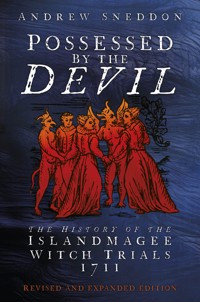
County Antrim, Ireland, 1711: Eight women were put on trial accused of bewitching and demonically possessing young Mary Dunbar, amid an attack by evil spirits on the local community and after the supernatural murder of a clergyman's wife. Mary Dunbar was the star witness in this trial, and the women were, by the standards of the time, believable witches – they dabbled in magic, they smoked, they drank, they had disabilities. A second trial targeted a final male 'witch' and head of the Sellor 'witch family'. With echoes of the Salem witch-hunt, this is a story of murder, of a community in crisis and of how the witchhunts that claimed over 50,000 lives in Europe played out on Irish shores. It plunges the reader into a world where magic was real and the power of the Devil felt, with disastrous consequences.
Sie lesen das E-Book in den Legimi-Apps auf:
Seitenzahl: 317
Veröffentlichungsjahr: 2013
Das E-Book (TTS) können Sie hören im Abo „Legimi Premium” in Legimi-Apps auf:
Ähnliche









To Leanne
For if any wicked person affirms, or any crack’d brain girl imagines, or any lying spirit makes her believe, that she sees any old woman, or other person pursuing her in her visions, the defenders of the vulgar witchcraft tack an imaginary, unprov’d compact to the deposition, and hang the accus’d parties for things that were doing, when they were perhaps, asleep upon their beds, or saying their prayers; or, perhaps, in the accusers own possession, with double irons upon them.
Bishop of Down and Connor (1721–39), Francis Hutchinson, An Historical Essay Concerning Witchcraft (London, 1st ed., 1718), vii.
CONTENTS
Title Page
Dedication
Acknowledgements
Preface
Author’s Notes
Timeline of Events
1 A Well-Respected Woman
2 Arrival in Islandmagee, Co. Antrim
3 To Catch a Witch
4 Witchcraft
5 The Wheels of Justice
6 All the World is a Stage
7 Horror at Knowehead House
8 The Trial, 31 March 1711
9 A Political Witch-Hunt?
10 Denouement?
Notes
Further Reading
Index
Plate Section
Copyright
ACKNOWLEDGEMENTS
Without the help and support (academic and otherwise) of my wife, Dr Leanne McCormick, this book would not have been possible and this is why it is dedicated to her. I must also thank my mum and dad, sister Sharon and her husband Steve, as well as my friend Peter Moore. I thank Dr Neal Garnham, for reading early drafts, sharing his expertise on Irish crime and law, and providing me with references and documents he has collected over the years in relation to Carrickfergus, Co. Antrim. I am also indebted to Brenda Collins for providing archival material and references to the Dunbars of Lisburn, and to Professor David Hayton for reading draft chapters at very short notice just before Christmas 2012. Dr Nerys Young also looked over drafts of early chapters for me, and her Dad, David, tracked down a rare book for me on a well-known auction site! I would also like to thank the staff at the library of the University of Ulster at Coleraine, and those of the Public Record Office of Northern Ireland, who are not only erstwhile colleagues but friends, namely Iain Fleming, Wesley Geddis, Carrie Green, Janet Hancock, Graham Jackson, Ian Montgomery and Stephen Scarth.
I must also thank post-graduate, Mres and Phd students in history at the University of Ulster, Coleraine, who have completed (or are currently completing) theses relating to British and Irish witchcraft under my supervision (John Fulton, Cara Hanley, Robert Rock and Jodie Shevlin), as well as successive under-graduate dissertation students, and those who have taken my Witchcraft and Magic module (HIS304) – I have learned much about Irish witchcraft from teaching you.
PREFACE
In early April 1711, a Dublin newspaper reported that the previous week, ‘8 witches were try’d at the Assizes of Carrickfergus, for bewitching a young gentlewoman, were found guilty, and … imprisoned for a year and a day, and 4 times pilloried.’1 This was of course the infamous trial of the Islandmagee witches, who were convicted of bewitching a teenage girl, Mary Dunbar, at Co. Antrim Assize court in Carrickfergus on 31 March 1711, under the 1586 Irish Witchcraft Act. Although countless witchcraft trials were held in early modern Europe during the ‘witch-craze’, a period that witnessed the execution of around 40,000 people, the Islandmagee case was one of only four known to have been held in Ireland.2 More importantly, it involved the mysterious death of a minister’s wife, demonic haunting and possession, spectral visitations, white magic, and bewitched bonnets. It was also intimately related to infamous witchcraft cases in late seventeenth-century England, Scotland and Salem, New England.
The Islandmagee witches have long intrigued writers, with the nineteenth-century seeing the first flurry of narrative accounts of the trial, provided in books,3 parish surveys,4 newspapers5 and periodicals.6 The early twentieth century saw the publication of more narrative accounts, albeit ones more firmly rooted in local history7 and the history of Irish witchcraft and demonology.8 More recent treatments, however, have eschewed putting the case in its wider historical context,9 with one going as far as fictionalising substantial portions of dialogue and events, as well as names, ages and professions of people involved: even period detail is ‘imagined’ rather than based on historical research. As the book is not easily identifiable as a work of ‘faction’, only one seasoned in surviving documentation can separate the ‘fiction’ from ‘factual’ content.10
The approach taken in this book could not be more different. It aims to be readable and intelligible to the interested reader, by limiting the amount of footnotes and references, and the provision of supplementary explanatory material. However, it rests on solid historical research. The narrative presented, arguments made, and hypotheses posed, are all based on surviving documents from the early modern period, as well as being informed by an understanding of eighteenth-century Ireland and recent developments in the history of witchcraft trials and belief. This study has also been made possible by the fact that the Islandmagee case is one of the best documented witchcraft trials in the British Isles, more so even than some infamous seventeenth-century English witch trials, to which whole books have been dedicated.11 There are surviving pre-trial depositions or witness statements (taken by Mayor of Carrickfergus, Edward Clements in early 1711),12 a lengthy, anonymous, contemporary manuscript account,13 and letters written by eyewitnesses present at the trial.14
I have also tried to bring the people involved in the case to life, which has proven to be one of the most challenging aspects of my research. It is extremely difficult to recover for eighteenth-century Ulster, due to incomplete record keeping and destruction of archives, genealogical data of the type so readily available for other countries. As a result some of the lives (and even names) of a minority of the protagonists remain hidden from view, probably forever. It has also been my aim to bring the story of the Islandmagee witches to a wider audience as interest in, and knowledge of, it has undoubtedly waned in the last few years. So much so, that had I not released a press-statement (via the University of Ulster’s Media and Corporate Relations Office), the 300-year anniversary of the trial would have passed by unnoticed. This is in complete contrast to the commemorations in 2012 of the Lancaster witchcraft trial of 1612, when academic conferences were held, books and novels published, plays performed, and day-trips to sites of historical interest organised. Although the human cost was far greater in the Lancaster case, in terms of adding to our understanding of witchcraft, the Islandmagee trial is surely just as important.
The book demonstrates that people living in Ireland, both among indigenous and settler populations, and in common with every other continent in the world at some time in their history, believed in witches, and that these beliefs had serious and lasting effects on the culture and society in Ireland. It also represents an exploration of Protestant mentalities in the north of Ireland at the beginning of the eighteenth century, revealing a place where belief in the moral, magical universe remained very strong, and where immaterial essences constantly interfered in the lives of humankind: from God and the Devil, to good and evil spirits, and ghosts. It also explains why Mary Dunbar’s accusation was taken seriously by Antrim clergy, wealthy local elites and agents of law enforcement, when other similar cases were not. This in its turn throws light on how religious bodies and the criminal justice system handled witchcraft accusation at that time. Finally, the book demonstrates how a unique blend of local and national politics, religious beliefs, social tensions, and cultural persuasion came together to rob Ireland of any claim to have been a (witchcraft) trial-free Island. Consequently, it follows in a tradition of recent case studies of individual trials (see the work of James Sharpe and Phillip Almond among others) which add a layer of complexity to the ‘one size fits all’ approach to explaining patterns of accusation, prosecution and conviction favoured by some historians in the past.
Andrew Sneddon, Ballmoney, Co. Antrim, December 2012
AUTHOR’S NOTES
NOTES ON REFERENCES
Quotations and end-notes are used primarily to detail material written before 1900. Quotations from these sources which have not been referenced in the end-notes have been taken from the main narrative account of the Islandmagee witches: Anon., The Islandmagee Witches: A Narrative of the Suffering of a Young Girl Called Mary Dunbar, Who was Strangely Molested by Spirits and Witches, at Mr James Hattridge’s house, Islandmagee, near Carrickfergus, in the county of Antrim and Province of Ulster, and in some other Places to which she was Removed during the Time of her Disorder, as also of the Aforesaid Mr Hattridge’s House being Haunted with Spirits in the Latter End of 1710 and the Beginning of 1711, ed. Samuel McSkimmin (Belfast, 1822).
The modern secondary sources that have been used in the writing of this book are detailed in an annotated bibliography contained in the ‘Further Reading’ section, which is arranged by chapter. This reading list also provides an overview of witchcraft literature and a starting point for those new to the themes covered in this book.
NOTES ON SPELLING
When quoting from primary source documents or publications, grammar, punctuation and spelling (as much as the maintenance of sense allows) have been kept as in the original. Capitalisation has been modernised and the abbreviation ‘ye’ has been replaced with ‘the’.
NOTES ON DATES
The dates given in this book are given in the form related in the primary sources and as such are based on the old style calendar. However, the year has been taken to begin on 1 January and not 25 March as was the custom before 1752.
MAIN ‘CHARACTERS’
A variety of spellings are used in contemporary sources for those involved in the Islandmagee witchcraft case. For example, the family name Hattridge is also spelled Hatterick, Hattrick and Haltridge. I have used one surname consistently, Haltridge, in order to avoid confusion and because it is the one used most frequently in surviving sources. I have adopted this approach for the rest of the surnames mentioned in the book.
The Haltridge Family
Revd John Haltridge (died 1697) – Scottish-born, Presbyterian minister of Islandmagee from 1674.
Mrs Ann Haltridge (died 1711) – widow to John, a pious and respected neighbour, she was believed to have been bewitched to death.
James Haltridge – son of John and Ann who was absent from Islandmagee when a large part of the incidents described below took place.
Miss Haltridge (forename unknown) – daughter of John and Ann. She brought Mary Dunbar to Islandmagee for the first time in February 1711.
Young Mrs Haltridge (forename unknown) – wife of James Haltridge, she had two young children and gave evidence for the prosecution at the trial.
Mary Dunbar – a ‘victim’ of demonic possession and witchcraft, she was eighteen years of age in February 1711. Educated and articulate, Dunbar came from a gentry family in Castlereagh, Co. Down, and was first cousin to James Haltridge.
Margaret Spears – a servant to the Haltridge family, who witnessed much of the supernatural phenomena said to have occurred in the Haltridge house, Islandmagee.
The Islandmagee Witches
Catherine McCalmond – from Islandmagee, was considered by her neighbours to be of ‘an ill fame’, and lived close to Revd Robert Sinclair.
Janet Liston – from Islandmagee, was married to William Sellor and by 1711 had a long-standing reputation for witchcraft. She is described by Mary Dunbar in the pamphlet account as ‘the lame woman’.
Elizabeth Sellor – from Islandmagee – daughter of Janet Liston and William Sellor, she was 17 in 1711, and is described as being small and pretty but ‘lame of leg’.
Janet Carson – from Islandmagee, maintained her innocence in the face of Dunbar’s accusations both before and during the trial. Her daughter tried unsuccessfully to defend her against Dunbar’s charges.
Janet Main – from Broadisland, was married to Andrew Ferguson, and considered locally as an irreligious woman with a bad temper. She had an unkempt appearance, suffered from severe arthritis and her face was badly scarred from smallpox. She was considered by Dunbar to be one of the ringleaders of the Islandmagee witches.
Janet Millar – from Scotch Quarter, Carrickfergus, was blind in one eye, and had survived smallpox and falling into a fire, which had left her body badly scarred. She ranted and cursed when interviewed about Dunbar’s bewitchment.
Janet Latimer – from Irish Quarter, Carrickfergus, was tall with black hair, prone to temper tantrums and possessed a reputation for low morals in her local area.
Margaret Mitchell – from Kilroot, Co. Antrim, was known as ‘Mistress Ann’ or ‘Mrs Ann’ to the other suspected witches. According to the pamphlet account, she was one of Dunbar’s ‘greatest tormentors’ and married to a man called ‘Johnny’.15
William Sellor – husband to Janet Liston and father to Elizabeth, he was accused, arrested and convicted of bewitching Mary Dunbar in late 1711, just after his immediate family had been convicted of the same crime.
Prosecutors and Investigators
Edward Clements (died 1733) – Whig Mayor of Carrickfergus, he inherited his brother’s estate, Clements Hill, and took effective control of the investigation into the Islandmagee witches in March 1711.
Revd Robert Sinclair – lived in the townland of Ballymulldraugh, Islandmagee and was Presbyterian minister there from 1704 until his death in 1731. He was involved in the Islandmagee case from the start.
Revd David Robb – Church of Ireland curate of St John’s parish, Islandmagee, he helped both Revd Sinclair and Mayor Clements interview the accused witches and various other witnesses.
Revd William Ogilvie (died September 1712) – Presbyterian minister of Larne and witness for the prosecution in court on 31 March, who initially displayed caution towards Dunbar’s witchcraft accusations.
James Blythe – from Bank-Head in Larne, Blythe gave a pre-trial deposition or statement to Mayor Edward Clements and appeared as a witness for the prosecution. Although there is no record of him holding an official legal position, he played a leading role in the investigation and apprehension of the suspected witches.
Bryce Blan – constable of Larne, a deponent who discovered image magic in Janet Millar’s house.
Randal Leathes – a Ruling Elder (in 1710) for Islandmagee Presbyterian Church, he gave farmland to his congregation so they could build a manse for Revd Sinclair.
John Man – a Ruling Elder in 1714, he stayed overnight in the Haltridge house, praying for the release of Ann from the grips of the demons ‘haunting’ the house.
William Fenton – deponent, prosecution witness, and Ruling Elder of Islandmagee, he was landlord to Janet Liston and helped search McCalmond’s house for spells.
Robert Holmes (died 1724) – was a wealthy Ruling Elder for Islandmagee and helped search McCalmond’s house.
John Logan – constable of Broadisland who arrested Mitchell.
William Hatley – was a deponent, prosecution witness and participated in the search of McCalmond’s house. His wife’s cloak was found mysteriously stuffed with straw and believed bewitched.
Deponents, Witnesses and Commentators
Revd William Tisdall (1669–1735) – rabidly anti-Presbyterian, High-Church, Tory vicar of Belfast, he owned property in Carrickfergus. Convinced of the innocence of the convicted women, he spoke with Dunbar immediately after the trial.
Revd William Skeffington (1659–1741) – Church of Ireland curate of Larne, who was a witness for the prosecution.
Revd James Cobham (1678–1759) – Presbyterian minister of Broadisland (Ballycarry) from 1700, and prosecution witness.
Revd Patrick Adair (died June 1717) – Presbyterian minister of Carrickfergus from 1702 and prosecution witness.
James Stannus – he and his wife visited Dunbar in Islandmagee before allowing her to stay in their home in Larne until the day of the trial.
John Smith – while staying overnight in the Haltridge house, he witnessed the apparitions of two men. He also helped Blythe interview Margaret Mitchell, gave depositions to Mayor Clements on two separate occasions, and was witness for the prosecution.
James Hill – a deponent and prosecution witness.
Shelia McGee – was assaulted in the Haltridge house by an invisible, demonic entity while staying overnight.
Hugh Donaldson – of Islandmagee, deponent and prosecution witness.
Charles Lennan – a member of the Islandmagee gentry, he was a deponent and prosecution witness.
John Wilson – from Islandmagee, deponent and prosecution witness.
Hugh Wilson – from Islandmagee, deponent and prosecution witness.
John Campbell – heard a bedroom door fly open of its own accord and ghostly cat noises while staying overnight at the Haltridge house.
John Getty – a merchant from Larne, he witnessed Margaret Mitchell in her spider ‘form’.
Anthony Upton – Tory Justice of the Common Pleas, and one of the judges who tried the Islandmagee witches. He directed the jury to acquit them.
James MacCartney – Whig Justice of the Queen’s Bench, he also tried the women but directed the jury to convict them.
TIMELINE OF EVENTS
WITCHCRAFT IN IRELAND
1324 – prosecution for witchcraft of Dame Alice Kyteler and associates, Kilkenny, 1324: Petronella de Midia executed.
1578 – ‘two witches’ executed in Kilkenny, 1578.
1586 – first Irish Witchcraft Act passed, which was almost identical to its English counterpart passed thirteen years earlier. It made many magical practices, and more importantly harming or killing using witchcraft, a felony or serious crime.
1655 – Marion Fisher sentenced to death at Carrickfergus Assizes (overturned two years later) for bewitching to death Alexander Gilbert.
1661 – Florence Newton, convicted at Cork Assizes and later executed for causing demonic possession of Mary Longdon and using witchcraft to kill her gaoler, David Jones.
1672 – neighbours suspect that James Shaw, Scottish-born Presbyterian minister of Carnmoney, Co. Antrim, and his wife had been killed by witchcraft.
1698 – in Antrim town, Co. Antrim, an elderly woman is strangled and burned by a local mob for bewitching a nine-year-old girl.
THE ISLANDMAGEE WITCHES
SEPTEMBER 1710 – Ann Haltridge, while living with her son James and his wife at Knowehead House in Islandmagee, Co. Antrim, is ‘haunted’ by a demonic presence.
DECEMBER – Ann and her servant Margaret Spears are visited by a demonic ‘boy’.
11–12 FEBRUARY 1711 – the demonic boy returns, smashes a kitchen window and threatens to kill everyone in the house. Stones and turf are hurled at the house by invisible forces.
15–16 FEBRUARY – bedclothes are stripped from beds and remade in the shape of a corpse. Revd Robert Sinclair contacted to investigate the matter and stays in the house with his church Elders. Ann Haltridge reports stabbing pains in her back.
16–22 FEBRUARY – too frightened to return to her bedroom, Ann retires to another room, where she remains bed-bound and in constant pain.
22 FEBRUARY – Ann dies at twelve o’clock midday and rumours quickly circulated that her death and the demonic haunting was caused by (as yet) unnamed witches.
27 FEBRUARY – Dunbar arrives in Islandmagee from Castlereagh, Co. Down, to keep young Mrs Haltridge company while her husband, James, was in Dublin. Almost immediately supernatural disturbances are felt in the house, as Dunbar unties a knotted apron containing Ann Haltridge’s missing bonnet, which turns out to be the ‘spell’ used to bewitch her.
28 FEBRUARY – Dunbar becomes demonically possessed, is seized by intense pain, and falls into a series of fits and convulsions. She sees the spectres of a number of women who threaten to kill her, among whom are Janet Main and Janet Carson.
1 MARCH – Dunbar’s accuses Janet Carson of her possession, and is then visited spectrally by more witches, Janet Liston and her daughter, Elizabeth Sellor.
2 MARCH – Liston and Sellor are brought to Knowehead House, identity paraded, and tested by Revd David Robb and Revd Sinclair on their Christian faith. A smell of brimstone appears in the house and Dunbar’s body is wracked with pain.
3 MARCH – Dunbar moved to first floor of the house and experiences a catatonic trance. Mayor of Carrickfergus, Edward Clements, takes over investigation of Dunbar’s accusations and begins taking witness statements.
4 MARCH – Dunbar accuses another woman named Catherine McCalmond and picks her from a line-up. McCalmond’s house is then searched for charms.
5 MARCH – Mayor Clements issues a warrant for the arrest of Janet Carson, Catherine McCalmond, Janet Liston and Elizabeth Sellor. They are brought before Dunbar who immediately has a fit. The women are then arrested and remanded in custody at Co. Antrim gaol at Carrickfergus. Dunbar then describes two more of her spectral attackers, Janet Main and Janet Latimer.
6 MARCH – Main and Latimer are arrested, brought before Dunbar and interviewed by Mayor Clements, who remands them in custody. Dunbar’s health improves as a result.
7 MARCH – the demonic boy re-appears to Margaret Spears and a bewitched cloak of one of the Haltridge’s house guests is found stuffed with straw. Dunbar relapses.
8 MARCH – Dunbar experiences more fits and accuses two more witches of attacking her: a woman with one eye and one called Mistress or Mrs Ann.
10 MARCH – Revd Sinclair and various local elites interview Dunbar and she reveals the witches promised to bewitch other members of the Haltridge family.
11 MARCH – Dunbar goes to church and fits during the sermon. A number of women are brought to Knowehead who fit the descriptions of Dunbar’s attackers still at large, the one-eyed woman and Mrs Ann. No positive identification is made and demonic activity continues to cause havoc in the house.
12 MARCH – Mayor Clements takes Dunbar’s statement or deposition, during which she repeats the descriptions of the witches still at large.
13 MARCH – Dunbar travels to Larne by boat and road to the house of James Stannus, fitting continually. Dunbar experiences bodily contortions and a renewed search of the countryside is made. A number of women who match Mistress Ann’s physical description are brought before Dunbar but are released soon afterwards. James Blythe, by chance, sees a woman in a Carrickerfergus street fitting Dunbar’s description of the one-eyed woman, she is called Janet Millar.
14 MARCH – Janet Millar is arrested and transported to Carrickfergus gaol. Bryce Blan, constable for Larne, finds image magic in Millar’s house. Janet Main is chained and bolted in her cell when it is discovered she had been spectrally attacking Dunbar. Local schoolchildren are brought to Knowehead by young Mrs Haltridge but are attacked by the demonic presence in the house.
15 MARCH – Mrs Ann appears to Dunbar in spirit form before leaving in the shape of an insect.
17 MARCH – Mrs Ann visits Dunbar several times in spectral form and threatens to kill her. Dunbar uses (albeit unsuccessfully) a ‘charm’ to fight the effects of the witch’s harmful magic.
19/20 MARCH – Margaret Mitchell from the parish of Kilroot is suspected of being Mrs Ann, and is brought to Larne to confront Dunbar.
21 MARCH – Mitchell arrested by constable of Broadisland, John Logan, before chained, bolted, and gaoled. Dunbar’s overall health improves.
24 MARCH – Dunbar is attacked by Main and Liston in spirit form after they are released from their bolts and chains in Carrickfergus gaol. Dunbar is witnessed levitating above her bed.
25 MARCH – Dunbar loses the power of speech, which is returned to her upon reading the bible.
28 MARCH – Margaret Spears, the servant, feels a demonic presence crawl slowly over her body and pillows are thrown at her by an invisible perpetrator.
29 MARCH – Dunbar travels to Carrickfergus for the trial but is confronted on the road by the spectres of a mysterious man (William Sellor) and two women, who tell her that they will magically remove her ability to speak in court. She loses the power of speech and is forced to stay the night on the road as her fits worsen.
30 MARCH – Dunbar loses the power of speech in late afternoon until early the next morning, when she is told by the witches from the previous day that she will not be able to testify at the trial.
31 MARCH – the eight women are convicted of bewitching Mary Dunbar under the 1586 Irish Witchcraft Act. The trial lasts eight hours, from six o’clock in the morning until two in the afternoon. At five o’clock Dunbar leaves for her mother’s house in Castlereagh.
AFTER LIFE
1 APRIL 1711 – Dunbar experiences several fainting fits and vomits feather and pins.
4 APRIL – Revd William Tisdall writes a letter to an unknown recipient detailing the trial.
2–7 APRIL – Dunbar fits regularly and vomits pins and feathers.
8 APRIL – Dunbar complains that William Sellor visited her in spirit form and threatened to kill her.
12 APRIL – Sellor appears in spectral form to Dunbar and stabs her with a butcher’s knife. Sellor arrested and remanded in custody. Later in the year he is tried and convicted of bewitching the girl.
14 APRIL – The Fly Post; or Post Master, a Dublin newspaper, reports the outcome of the trial of 31 March.
1712 – Jane Wenham convicted of bewitching Ann Thorn but later pardoned.
1822 – Samuel McSkimmin publishes an anonymous, contemporary pamphlet account of the Islandmagee case.
1823 – Samuel McSkimmin’s new edition of his History of Carrickfergus is published and contains the first historical treatment of the Islandmagee witchcraft trial.
1885 – Classon Porter, Presbyterian minister at Larne, publishes Witches, Warlocks and Ghosts in Belfast, which contains a lengthy narrative description of the Islandmagee case.
1896 – pre-trial witness statements housed in Trinity College, Dublin are published in Belfast.
1913 – St John Seymour publishes his seminal book, Irish witchcraft and Demonology, which remains the best general text on Irish witchcraft.
1927 – Dixon Donaldson publishes his History of Islandmagee, which includes a section on the Islandmagee ‘witches’.
1
A WELL-RESPECTED WOMAN
In the early seventeenth-century, Sir Arthur Chichester gained the freehold for Islandmagee. Co. Antrim, and leased the land there to successive generations of absentee landlords from the Hill family. By the end of the century, the peninsula was a small, rural Presbyterian-Scots community containing around 300 people. Its inhabitants were employed in farming, spinning and fishing. Ships regularly landed at Port Davey from Portpatrick in Scotland, a journey that took just over four hours (see fig. 1, ‘Map of Island Maghe’, c.1680, British Library, London). More ominously, and perhaps an omen of events to come, Richard Dobbs, later Mayor of Carrickfergus, reported of the place in 1683, ‘I have heard surveyors say “they could never get their compasses to answer their expectations here, and thought it was bewitched”.’16
In September 1710, Ann Haltridge, an elderly widow, was living with her son, James Haltridge, his wife, their two children and their servants in Islandmagee. According to the pamphlet account, Ann epitomised Irish matriarchy as a pious, respected gentlewoman and neighbour:
during her marriage and widowhood she behaved herself Christianly, prudently, and exemplary, so that she, as much as any in her station, deserved the name of a mother of Israel, by engaging, both by advice and example, those she conversed with to fear and serve God. She was a constant attender upon public ordinances, a frequent and devout communicant, charitable, and tender in her walk and conversation.
As the widow of Revd John Haltridge, late Presbyterian minister of Islandmagee, she would have enjoyed an elevated social position within the community and commanded a high level of respect in an era when Presbyterian clergy played leading roles within their communities and were looked to for leadership and direction.
Revd John Haltridge was ordained by the Presbytery of Antrim on 8 May 1672 in a building rented by the congregation in the village of Ballycarry in the parish of Broadisland (also known as Templecorran), there being no such place in Islandmagee at that point in time.17 Haltridge’s congregation eventually built a meeting-house in 1674 in the townland of Kilcoanmore, Islandmagee.18 Although the meeting-house building underwent considerable alterations in subsequent years, it stood until 1900 (see fig. 2) when it was replaced by the current First Presbyterian Church. The congregation also built for Haltridge a thick-walled, two-storey, thatched manse, which local historian Dixon Donaldson referred to as Knowehead House (see figs 3, 4). Knowehead House was constructed around the same time as the meeting-house, in a similar architectural style, complete with heavy buttresses at the angles of the walls (see fig. 4). The manse stood adjacent to the meeting-house and contemporary accounts suggest the church was ‘within musket shot of the house’, which in eighteenth-century terms meant around 100 yards.19 After John Haltridge’s death in 1697, his family continued to live at Knowehead House.20
Death ultimately ended Haltridge’s ministry in Islandmagee, but in 1689 he had fled to Scotland, along with other Ulster-Scots, including many clergymen, to escape the escalating conflict between supporters of Catholic James II and those of Protestant William of Orange. In common with many refugees, Haltridge returned to Ulster and was back preaching in Islandmagee by November 1690. This decision was possibly arrived at after failing to find a position within the Church of Scotland in Galloway.21
Between 1680 and 1730 over half of Ireland’s Presbyterian ministers were born in Ulster, with around 29 per cent, in common with John Haltridge, being of Scottish birth. The majority of Scottish-born ministers, as well as merchants and gentry, came from the south-west of the country. Presbyterian ministers were highly educated, both through private study and university training, which was usually gained from Glasgow University – Trinity College, Dublin was barred to those dissenting from the Church of Ireland. Haltridge graduated from Glasgow University as MA in 1654 and was later chaplain to Sir William Cunningham, coming to Ireland when he was deprived of his clerical living for non-conformity by the Court of High Commission in Glasgow in 1664. Haltridge had three brothers: Alexander, merchant from Newry, Co. Down, died in 1679; Matthew, graduated from Glasgow University in 1669 and ministered at Ahoghill, Co. Antrim, from 1676 until his death in 1705; and William (died 1691), a successful merchant in Dromore, Co. Down, who owned estates in Scotland and in counties Down and Armagh. Working within the confines of an agricultural economy, early eighteenth-century Presbyterian merchants were largely engaged in the provisions trade, to a variety of locations.22
AN UNWELCOME VISITOR
While sitting by the kitchen fire in Knowehead one September night in 1710, Ann Haltridge was hit by a number of stones on her back and shoulders, presumably coming through the open window behind her. Unhurt but frightened, she retreated to her bedroom on the first floor, where she was barraged with more stones, hurled with so much force they caused the curtains to move. As the curtains flew open, Ann felt a presence crawl slowly over her body, starting at the foot of the bed. She then fruitlessly searched the pitch-black room as the windows and their shutters opened and closed repeatedly, apparently of their own accord. Two nights later, Ann’s pillow was pulled from her head and her bed-covers and blankets mysteriously removed. Seeking a natural explanation, she woke her granddaughter, who lit a candle and searched the room. Once the candle was lit, quiet descended on the room, but when extinguished the disturbances started once more. As night was widely believed to belong to supernatural entities such as ghosts, Ann must have come to the conclusion that what she was dealing with was not of the temporal world.
In early December, after nearly two months free from supernatural incident, Ann was once more sitting at the kitchen fire when a boy appeared before her and one of the servants, Margaret Spears. The expansion of domestic service in Ireland during the eighteenth century meant that even relatively small households would probably have employed a male and a female servant. We know that Spears was a young adult and from what we know about others in service at that time we can speculate that she was also unmarried and from a poorer, rural background. Her job would have entailed a wide range of demanding domestic chores, from cleaning, to serving food and working in the dairy.
Spears described the boy as being ten or twelve years of age, wearing a torn black vest, a black bonnet and a tattered blanket over his shoulders. Given his ragged appearance, Ann assumed the boy was a ‘strolling’ beggar looking for something to eat. Beggars were not an uncommon sight in early eighteenth-century Ulster, especially at times of harvest failure, high unemployment, and economic downturn. More unusual was the fact that the boy covered his face with his hand, despite Ann’s repeated requests for him to remove it and name himself. He then became agitated, danced frantically and menacingly around the kitchen, before leaping out of an open window and running to the end of the garden and into the cow house. Ann’s servants gave chase but soon lost sight of him, only to discover later, when they returned to the house, that he was waiting for them. This charade was repeated around a dozen times before Spears confronted the boy and warned him that, ‘now my master is coming; he will take a course with this troublesome creature.’ The boy then left Knowehead and the house remained free from supernatural disturbance for the next two months.
On the evening of Sunday, 11 February 1711, Ann was reading a hefty book of sermons on the covenant by Scottish Presbyterian minister, Alexander Wedderburn, to compensate for the lack of a sermon that morning in the meeting-house in Islandmagee.23 In Presbyterian religious culture the sermon was regarded as the high point of the service, and ministers often encouraged literate women in their congregation to engage in private reading of the Bible and other devotional texts. After reading for a time, Ann laid the book down but when she went back to collect it, it had disappeared. She searched the room thoroughly but could not find it. At seven o’clock the next morning, 12 February, the ragged boy returned to Knowehead and smashed the kitchen window with his hand while clutching a book. He also spoke for the first time, to Spears, a conversation that the pamphlet account records word for word:
Boy: ‘Do you want a book?’
Spears: ‘No.’
Boy: ‘How came you to lie? For this is the book the old gentlewoman wanted yesterday.’
Spears: ‘How came you by it?’
Boy: ‘I went down quietly to the parlour when you were all in the kitchen, and found it lying upon a shelf with a Bible and a pair of spectacles.’
Spears: ‘How came it that you did not take the Bible too?’
Boy: ‘It was too heavy to carry.’
Spears: ‘Will you give it back? For my Mistress can’t … [wait] any longer.’
Boy: ‘No, she shall never get it again.’
Spears: ‘Can you read it?’
Boy: ‘Yes.’
Spears: ‘Who taught you?’
Boy: ‘The Devil taught me.’
Spears: ‘The Lord bless me from thee? Thou hast got ill lear [learning].’
Boy: ‘Aye, bless yourself twenty times, but that shall not save you.’
Spears: ‘What will you do to us?’
The boy answered Spears’ final question by pulling out a sword and threatening to kill everyone in the house. Spears then bolted the door and took her charge, the eight-year-old son of James Haltridge, to the parlour. Undeterred, the boy followed them, jeering, ‘Now you think you are safe enough but I will get in yet.’ Spears shouted back, ‘What way? For we have the street door shut,’ to which the boy replied, ‘I can come in by the least hole in the house, like a cat or a mouse, for the Devil can make me anything I please.’ ‘God bless me from thee,’ Spears then stated, ‘for thou art no earthly creature if you can do that.’ The boy responded by hurling a large stone at the parlour window and vanishing once more.
ANIMAL SACRIFICE
The boy re-appeared a short time later, clutching one of the family’s turkey cocks. However, the turkey struggled in his arms, causing the stolen book to drop to the ground, which Spears and old Mrs Haltridge quickly picked up. The boy then laid the turkey down and as he raised his sword to kill it, the bird to escaped through the garden hedge. With the valuable book and turkey gone, the boy entered on a new course of action and removed every intact pane of glass (an expensive commodity at the time) from the parlour window. He then went to the bottom of the garden and frantically dug a hole with his sword. When Spears asked what he was doing he replied that he was digging a grave for her master, James Haltridge, whom he claimed had died fourteen days previously in Dublin. When the grave was finished the boy vaulted over the garden wall, as if he ‘had been a bird flying’.
SON OF SATAN
When Spears later related the details of the incident to members of the Haltridge family, they would have suspected that the boy dressed in black and wearing a bonnet was a demon in human form. The Presbyterian Scots Diaspora in Ulster still had strong familial, economic and cultural ties with Scotland, where, in the early modern period, people at all levels of society, from the wealthy to the rural poor, were well aware of the image and the power of the Devil and were constantly reminded of such from the pulpit. Satan, after all, occupied an important position within the theology of Calvinist Presbyterianism in Scotland and Ulster, and it was this Calvinist theology which at least partly explains Satan’s relative ubiquity in Scottish witchcraft accusations and trials.24 The most common form the Devil




