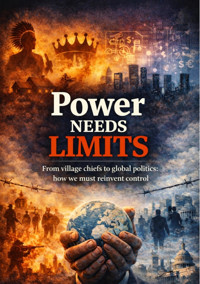
Dominik Mikulaschek (born in Linz in 1983) addresses one of humanity's oldest and most pressing questions: Who controls power?
In his book Macht braucht Grenzen (Power Needs Limits), he soberly and systematically analyses why power never disappears – but grows if it is not effectively limited. From village chiefs to empires and nation states to global corporations, algorithms and financial flows, he shows how power structures have developed historically and why our current political systems can no longer keep pace with the global reality of the 21st century. Instead of moral appeals or ideological camp-building, Mikulaschek develops a structural concept: democratic control must be effective where power actually works – including globally. The book combines political philosophy, historical analysis and institutional systems thinking to arrive at a clear thesis: freedom does not arise from good intentions, but from cleverly constructed limitations. A passionate plea for an update of our political architecture – before loss of control becomes the new normal.
Dominik Mikulaschek
Power needs limits
From village chiefs to global politics: how we must reinvent control
tredition GmbH
© 2026 Dominik Mikulaschek
Printing and distribution on behalf of the author:
tredition GmbH, Heinz–Beusen–Stieg 5, 22926 Ahrensburg, Germany
This work, including its parts, is protected by copyright. The author is responsible for the content. Any use without his consent is prohibited. Publication and distribution are carried out on behalf of the author, who can be reached at: Dominik Mikulaschek, Holzwurmweg 5, 4040 Linz, Austria.
Contact address in accordance with the EU Product Safety Regulation:
Contents
Foreword
Why this book now
The one question that decides everything: Who controls power?
A promise: not ideology, but a functioning system
PART I – POWER: OUR OLDEST PROBLEM
Chapter 1. Around the village fire: How power arises (and why it remains)
Chapter 2. The three sources of power: violence, money, information.
Chapter 3. From chieftain to king: the first "state" power machine
Chapter 4. Empires, religions, bureaucracies: power becomes invisible
Chapter 5. The great deception: "Good people" are not enough
Chapter 6. Why power always grows if it is not curbed
Chapter 7. The psychology of domination: fear, loyalty, reward
PART II – WHEN POWER IS UNLEASHED
Chapter 8. Wars, oppression, exploitation: what happens without limits
Chapter 9. The modern variant: corporations, platforms, oligarchs
Chapter 10. Lobbying, influence, media: power without office
Chapter 11. The Algorithm as Ruler: Attention Becomes Currency
Chapter 12. Global problems, national politics: The world's tax gap
Chapter 13. Why "national democracy" alone is no longer enough
Chapter 14. The most dangerous illusion: "It'll be fine somehow"
PART III – THE DISCOVERY OF EMPOWERMENT
Chapter 15. The breakthrough in history: Rights that should not be reversed
Chapter 16. Women's suffrage: How the powerful were disempowered – by a law
Chapter 17. Constitutions as safety belts: How democracies tame power
Chapter 18. Separation of powers: Why good intentions fail, but systems work
Chapter 19. Courts, media, civil society: the watchdogs of freedom
Chapter 20. The price of freedom: Why control sometimes has to be 'slow'
Chapter 21. When democracies collapse: How power breaks down boundaries again.
Chapter 22. The lesson to be learned: Rights must become globally unassailable
PART IV – THE WORLD IS TOO COMPLEX FOR OLD RULES
Chapter 23. Climate crisis, migration, pandemics: problems without borders
Chapter 24. Financial flows, data flows, supply chains: Power moves globally
Chapter 25. Why billionaires and states have similar leverage today
Chapter 26. The blind spot: human rights without global enforcement
Chapter 27. The new reality: those who operate globally must be controlled globally
Chapter 28. What we really need: an update of civilisation
PART V – THE SOLUTION: A DEMOCRATIC WORLD PARLIAMENT + CONTROL BODIES
Chapter 29. What a world parliament is not (and why that is important)
Chapter 30. The core principle: global power only where problems are global
Chapter 31. Fair representation: people, regions, minorities
Chapter 32. Two chambers for balance: population + states/regions
Chapter 33. Transparency as a duty: the end of shadow politics
Chapter 34. Global supervisory bodies: Court of Auditors, Ethics Council, Anti-Corruption
Chapter 35. Global courts: human rights without loopholes
Chapter 36. An independent electoral and integrity authority for the world
Chapter 37. Protection against abuse of power: term limits, disclosure, blackout periods
Chapter 38. Emergency powers only with an emergency brake: crisis mechanisms with an expiry date
PART VI – THE GLOBAL CONSTITUTION: HUMAN RIGHTS THAT RENDER THE POWERFUL POWERLESS
Chapter 39. Why human rights are too often just "paper" today
Chapter 40. The principle of inviolability: Which rights are never negotiable
Chapter 41. Equality before the law – worldwide and enforceable in practice
Chapter 42. Protection from violence, torture, exploitation: No more "exceptions"
Chapter 43. Freedom of expression and freedom of information: Without truth, there can be no control
Chapter 44. Property, work, dignity: minimum standards against dependency
Chapter 45. Fundamental digital rights: data, algorithms, surveillance
Chapter 46. Rights of the future: climate, resources, intergenerational justice
Chapter 47. How to secure rights: Hurdles, vetoes, international rights of action
Chapter 48. The decisive mechanism: When citizens can take the world to court
PART VII – CRITICAL OBJECTIONS (AND GENUINE ANSWERS)
Chapter 50. "That's naive" – Why the alternative is more expensive and dangerous
Chapter 51. "Cultural differences!" – How diversity is protected instead of being steamrolled
Chapter 52. "Sovereignty!" – What states retain and what they must share
Chapter 53. "Who pays for it?" – The costs of chaos vs. the costs of order
Chapter 54. "Corruption!" – Why control systems must be stronger than people
Chapter 55. "It'll never work" – How large systems nevertheless came into being historically
PART VIII – THE WAY THERE: A REALISTIC ROADMAP
Chapter 56. Stage 1: Global transparency requirements (lobbying registers, cash flows, assets)
Chapter 57. Stage 2: Strengthening international control bodies (with real sanctioning powers)
Chapter 58. Stage 3: Making civil rights globally enforceable
Chapter 59. Stage 4: A world parliament, first advisory, then legislative (clearly limited)
Chapter 60. Stage 5: Ratifying the global constitution – with "untouchable" hurdles
Chapter 61. Stage 6: Enforcement: courts, audit bodies, democratic recall
Chapter 62. How to win majorities: the narrative that unites people
Chapter 63. The role of business, the media, science and civil society
Chapter 64. What each individual can do: influence without abuse of power
PART IX – TWO FUTURES
Chapter 65. Future A: The world without borders (crises, authoritarianism, tech oligarchy)
Chapter 66. Future B: The world with borders (stability, freedom, fair opportunities)
Chapter 67. Our generation's decision: control or loss of control
Afterword. The simple truth: power will never disappear – but it can be limited
Foreword
Why this book now
Power is a primal force in human coexistence, as constant and inevitable as gravity, and yet we often treat it as a temporary phenomenon or a moral failing of individuals. When we talk about abuse of power, excessive bureaucracy or the dominance of global corporations, public debate is usually characterised by outrage, the search for culprits or calls for better characters at the top. This book takes a different approach, because history teaches us an uncomfortable truth: power never disappears, it merely changes its form, its aggregate and its efficiency, and it always strives structurally for expansion unless it encounters an equally structural boundary. We are now living in a time of profound loss of control, in which the architectural designs of our political order, most of which date back to the 18th and 19th centuries, are colliding with the technological and economic reality of the 21st century. The reason why this book is necessary now is because of the growing gap between the reach of decisions and the reach of their control. While in early history a village chief exercised power only over those people he could physically reach, today's concentrations of power – be they social network algorithms, global financial flows or ecological tipping points – affect billions of people across national borders without those people having an effective authority to hold them accountable. This structural powerlessness generates the corrosive cynicism that weakens our democracies from within. We instinctively sense that the old brakes are no longer working and often react with alarmism or withdrawal into the private sphere. But the problem is not a moral one, but a systemic one. In this sense, control is not an expression of mistrust, but the highest form of civilisational achievement; it is the seatbelt of freedom. Without functioning boundaries, power becomes a destructive force, no matter how good the intentions of those who wield it may be. The most dangerous illusion of our time is the belief that good intentions alone are enough to keep complex systems stable. We have relied too long on the right people doing the right thing at the right time, instead of building institutions that automatically correct missteps and abuses. The complexity of the modern world overwhelms the old national structures because power today is global, but control remains largely fragmented at the national level. Those who exercise global influence must be subject to global accountability, otherwise a legal vacuum will arise in which the law of the strongest prevails. This book is a plea not to demonise power, but to analyse it soberly and understand its taming as a permanent engineering task of civilisation. We must reinvent the mechanisms of power restraint, from the foundations of human psychology to the heights of world politics. It is not a question of playing ideologies off against each other, but of designing a functioning system that guarantees the protection of the individual from the arbitrariness of the powerful. Prevention is always cheaper than repair after a collapse, and yet we usually only act when disaster has already struck. We are at a turning point where technological developments have created opportunities for surveillance and manipulation that would have made any previous dictatorship green with envy. At the same time, we are confronted with crises that can only be overcome through coordinated exercise of power. This tension between the need for action and the need for restraint is the central theme of the following chapters. We will examine how power arose around the village fire, how it became invisible through money and information, and why we now need a new level of separation of powers that extends beyond the nation state. It is time to update our political operating systems before the loss of control becomes irreversible. This book does not offer a utopian blueprint for a perfect world, but rather a realistic analysis of how we can organise power so that it serves people rather than dominates them. Because in the end, only one question determines the quality of a society: Who controls power? If we do not answer this question anew for the global age, we leave the future to those who do not want to accept any limits. This foreword is an invitation to understand power not as fate, but as a malleable structure whose limitation is the prerequisite for any form of lasting freedom.
The one question that decides everything: Who controls power?
If we view the history of human civilisation as a long struggle for order, then in every century, every political experiment and every failed empire we encounter the same unresolved core conflict, which is more urgent today than ever before. It is the question that the Roman satirist Juvenal cast into timeless form almost two thousand years ago: Quis custodiet ipsos custodes? Who guards the guardians themselves? This question is not merely an intellectual game for constitutional lawyers, but the architectural foundation on which the stability of every society rests, for power without control becomes structurally dangerous, regardless of the ideology in whose name it is exercised. We must understand that power has a social physics that is almost as predictable as the laws of thermodynamics. Power strives for where it encounters the least resistance, and it tends to concentrate, solidify and elude observation. Those who have resources, information or means of violence at their disposal will almost inevitably use this preponderance to secure and expand their position ; this is not a moral failing on the part of the individuals involved, but an inherent characteristic of power itself. History is littered with the ruins of systems that trusted that the character of the ruler, the wisdom of the chieftain or the moral integrity of an elite would be sufficient to prevent excesses. But psychology and history teach us unequivocally: systems are stronger than character. Even the most virtuous person will be corrupted in a structure that offers them unlimited and uncontrolled opportunities – not necessarily through malice, but through the creeping conviction that their goals are so important that the ends justify the means. Therefore, the question of controlling power is the real dividing line between civilisation and barbarism. In a functioning civilisation, no one is above the law, which means that any exercise of power must be bound to a countervailing power that can question, correct or, in extreme cases, terminate it. For a long time, we believed we had solved this question within the boundaries of the nation state. We wrote constitutions, elected parliaments and established independent courts to create a safety net of freedom that would keep power in check. But we are currently experiencing a historic turning point in which this safety net is tearing apart. The problem of our era is that in recent decades, power has broken out of its national cages, while the guardians have remained within the old boundaries. When global financial flows can destabilise entire economies within seconds, when digital platforms curate the information base of billions of people without democratic legitimacy, or when transnational corporations shift their profits to places where no tax authority can reach them, we are dealing with concentrations of power for which there is currently no satisfactory answer to the question "Who controls power?" These gaps in control are not coincidental, but the result of a world in which complexity has overwhelmed the reach of our existing supervisory bodies. Complexity creates gaps in control, and power exploits these gaps with almost instinctive precision. A national audit office can audit a government's spending, but who audits the algorithms that determine the political will of an entire continent? A national court can convict a corrupt politician, but who ensures that global human rights standards are not ignored by actors who have simply become too big for the jurisdiction of a single state? We find ourselves in a dangerous interregnum in which the old order of national control is eroding, but a new global order of accountability has not yet emerged. In this vacuum, arbitrariness is growing. It is a fallacy to believe that transparency alone would be enough to solve this problem. Transparency is a necessary check on power, but it remains ineffective if it is not linked to genuine accountability and the power to impose sanctions. We must not only defend the separation of powers, but also completely rethink it for an age of global interdependence. The separation of powers is not an expression of mistrust towards those in power, but the most effective protection for those being governed. Those who operate globally must be controlled globally – this is the axiom that we must translate into reality if we want to prevent our freedom from being crushed between the mills of state supremacy and private oligarchies. In doing so, we must not succumb to the temptation to call for a "strong man" who will supposedly clean up the mess, because history shows that any power that sets out to restore order without control ultimately becomes the greatest source of disorder and oppression itself. The true strength of a society is not measured by the assertiveness of its leadership, but by the robustness of its control mechanisms. We must admit to ourselves that the controllability of the world is currently an illusion as long as we do not have mechanisms that bind power where it is actually exercised: beyond national sovereignty, in the spheres of global trade, technology and ecological dependence. The question "Who controls power?" inevitably leads us to the need to understand control as an infrastructure of freedom that is as essential as roads or electricity grids. We do not need moral sermons, but an update of civilisation, a technical system of power limitation that functions independently of day-to-day politics and the whims of those in power. Only by structurally curbing power can we ensure that it remains a tool for progress and does not become an instrument of exploitation. Control is not an obstacle to efficiency, but a prerequisite for trust, and without trust, any complex system collapses under the weight of its own contradictions. If we do not scale power control globally, we risk a relapse into archaic patterns of power where only size and ruthlessness count. This chapter forms the foundation for everything that follows, for it marks the end of the era in which we could afford the luxury of uncontrolled spaces. Anyone reading this book must abandon the idea that there is such a thing as "good power" that does not need to be controlled. There is only power that is limited and power that is abused. Our task is to build the architecture of limitation in such a way that it can withstand the complexity of our world. This leads us directly to the question of how such a system must actually be constructed beyond ideologies in order not to become an instrument of new power interests itself, and thus to a promise: not ideology, but a functioning system.
A promise: not ideology, but a functioning system
This book is not a manifesto for a particular political worldview, but an analysis of the mechanics of human domination and its necessary containment. At a time when political debates are increasingly characterised by emotional polemics and deep ideological divides, refraining from taking an ideological position may seem unusual, but it is a prerequisite for an honest assessment of our situation. When we talk about power and its limitations, we leave the realm of moral wishful thinking and enter the realm of political statics. Just as an architect designing a skyscraper does not hope that gravity will make an exception, or an engineer does not make the safety of a bridge dependent on the integrity of motorists, a stable political order must not be based on the hope that those in power will act moderately of their own accord. The promise of this book is therefore that it is not about "good" versus "evil" or "left" versus "right," but exclusively about "functional" versus "dysfunctional." We will consider power as a neutral but highly reactive energy that, without structural resistance, inevitably leads to the erosion of freedom. The central insight of the history of civilisation is that good people alone are never enough to prevent the abuse of power; only systems with built-in, automatic control mechanisms are capable of doing so. Anyone who studies the history of democracies will recognise that their most successful phases were not those in which particularly wise leaders were at the helm, but those in which the institutions were strong enough to keep even mediocre or even dangerous actors in check. In this sense, the separation of powers is not a philosophical ornament, but a functional component, a safety belt that cushions the impact of human hubris. In the chapters that follow in , we will consistently take this systemic perspective and examine why our existing control architectures are failing in the face of a globalised, highly complex world. We will not sketch utopian designs that presuppose a new, better human being, but will seek solutions that work with human beings as they are: selfish, power-conscious and fallible. Control is not a vote of no confidence in democracy, but its vital prerequisite. A system that has no effective brakes is not an expression of freedom, but an invitation to tyranny. We must abandon the dangerous illusion that complexity can be solved through centralism or blind trust. Instead, we will analyse how transparency, accountability and subsidiary separation of powers can act as functional brakes on power, making the misuse of resources and information structurally more difficult. This path leads us away from a society of outrage and towards a logic of design that sees prevention as the smarter and cheaper alternative to crisis management. Those who operate globally must be controlled globally – this principle will run like a thread through the argument, not out of a globalist ideology, but out of the simple necessity of binding power where it is actually exercised today. This book is a toolbox for updating civilisation. It aims to show how we can regain control over the unleashed forces of the 21st century by thinking through the principles of power limitation to their logical conclusion. We begin this journey not in the present, but where our oldest problem originated: at the village fire.
PART I – POWER: OUR OLDEST PROBLEM
Chapter 1. By the village fire: How power arises (and why it remains)
To understand the origin of the force that today moves entire continents and determines the fate of the biosphere, we must return to where human social structures began: the village fire. In this archaic setting, which shaped our everyday lives for tens of thousands of years, power is not yet an abstract bureaucratic construct, but an immediate functional necessity. Let us imagine a small group of hunters and gatherers faced with the challenge of ensuring their survival in a hostile environment. In such a community, power does not arise primarily from malice or a desire to oppress, but as a solution to a coordination problem. When a decision has to be made – whether to follow the game or cross the river – the absence of leadership paralysis means collective doom. In this primitive state, power is a service: someone takes responsibility for coordination, gains trust in return, and in turn gains the authority to direct actions. But even here, in the intimacy of the small group, we see the first seeds of the structural dynamic that continues to puzzle us to this day: power has a tendency towards self-preservation. Once in a position to make decisions, one gains access to information, prestige and privileges that go beyond purely functional benefits. Status becomes a currency, and the human biological makeup responds to this with the release of neurotransmitters that reward the pursuit of leadership. Thus, the temporary task of coordination gradually becomes a permanent position. The reason power remains is because of its systemic efficiency; a group with a clear hierarchy is often more capable of acting than a completely amorphous collective ( ). But this efficiency comes at a price. In the early village structure, the brake on this increase in power was still organic in nature: social transparency. In a group of fifty people, it is impossible to hide abuse of power permanently. Daily interaction, gossip and the leader's direct dependence on the cooperation of others formed a natural control mechanism. However, power without control becomes structurally dangerous at this stage when the leader begins to see his role not as a service to the community but as a personal privilege. We recognise a fundamental pattern here: Power does not need an artificial growth programme; it grows unchecked all by itself, because every advantage that a powerful person gains provides them with the means to secure the next advantage. The village teaches us that systems are stronger than character. A 'good' chief may use his power wisely, but without the social control of the community, there is no guarantee that his successor will act in the same way. Civilisation begins where we stop hoping for the character of individuals and start defining rules for office. In the village, control was not yet mistrust, but a survival strategy. But as communities grew, the architecture of rule changed fundamentally. When the group exceeds the size of a manageable community, informal control breaks down. Complexity creates gaps in control, as not everyone can see everyone else. This is where the abstraction of power begins: it detaches itself from the individual and attaches itself to symbols, weapons or supplies. Power remains because without it we cannot solve the coordination problem of the large group, but it becomes dangerous because it now has the means to turn against those who originally legitimised it. The chieftain sitting by the fire is the ancestor of the modern head of state and corporate leader. The mechanisms he used to secure his position back then – the distribution of spoils, the threat of exclusion or access to supposedly secret knowledge – can be found today in the complex structures of world politics . The fact that power never disappears is an anthropological constant; it is the connective tissue of every society. The central question is therefore not how we abolish power, but how we bind it in such a way that its coordinating force is preserved without it becoming an absolute rule in its own right. We must understand that control is not an obstacle, but a prerequisite for civilisational stability. When we look at the global centres of power today, we often see only the shiny facades, but underneath them, the same archaic impulses are still at work as they were thousands of years ago around the fire. The development from personal prestige to institutional power machinery is a process of increasing alienation. The further power moves away from the direct observation of those affected, the more urgently we need artificial, systemic brakes. For while in the village, social shame and conversation around the fire were enough to set boundaries, a world of eight billion people requires a far more robust architecture of scrutiny. We are only at the beginning of investigating how this primal force of human order can be tamed, but looking back shows us that power arises from necessity, remains through utility, and is corrupted by a lack of resistance. To understand how this force has been able to extend its reach so enormously, we must look at the resources that feed it. This leads us directly to an analysis of the cornerstones on which all rule has rested since the dawn of time: force, money, and information.
Chapter 2. The three sources of power: violence, money, information.