


69,99 €
Mehr erfahren.
- Herausgeber: John Wiley & Sons
- Kategorie: Fachliteratur
- Sprache: Englisch
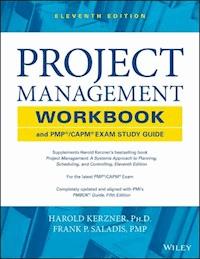
This is the Eleventh Edition of the student workbook that accompanies the best selling "bible" of project management. The workbook contains additional problems and exercises to reinforce the concepts presented in the main text. It also serves as a self-study guide for the Project Management Professional (PMP®) certification exam to be based on PMI®'s PMBOK® Guide, 5E. Both as accompanying supplement to Kerzner's text and as standalone self-study guide, this workbook gives students key insights from the acknowledged world leader in project management. (PMI, PMBOK, CAPM, PMP, and Project Management Professional are registered marks of the Project Management Institute, Inc.)
Sie lesen das E-Book in den Legimi-Apps auf:
Seitenzahl: 658
Veröffentlichungsjahr: 2013
Ähnliche









Contents
Preface
Chapter One: Project Management Overview
Glossary of terms
Activities, Questions, and Exercises
Kerzner “Quick tips” for the Project Management Institute PMP® and CAPM® EXAM
Answers to Questions and Exercises
Your Personal Learning Library
Chapter Two: Project Management Growth: Concepts and Definitions
Glossary of terms
Activities, Questions, and Exercises
Kerzner “Quick tips” for the Project Management Institute PMP® and CAPM® EXAM
Answers to Questions and Exercises
Your Personal Learning Library
Chapter Three: Organizational Structures
Glossary of terms
Activities, Questions, and Exercises
The Project Management Center of Excellence—A Review
Kerzner “Quick tips” for the Project Management Institute PMP® EXAM
Answers to Questions and Exercises
Your Personal Learning Library
Chapter Four: Organizing and Staffing the Project Office and Team
Glossary of terms
Activities, Questions, and Exercises
Kerzner “Quick tips” for the Project Management Institute PMP® and CAPM® EXAM
Answers to Questions and Exercises
Your Personal Learning Library
Chapter Five: Management Functions
Glossary of terms
Activities, Questions, and Exercises
Kerzner “Quick tips” for the Project Management Institute PMP® and CAPM® EXAM
Answers to Questions and Exercises
Your Personal Learning Library
Chapter Six: Management of Your Time and Stress
Glossary of terms
Activities, Questions, and Exercises
Kerzner “Quick tips” for the Project Management Institute PMP® and CAPM® EXAM
Answers to Questions and Exercises
Your Personal Learning Library
Chapter Seven: Conflicts
Glossary of terms
Activities, Questions, and Exercises
Kerzner “Quick tips” for the Project Management Institute PMP® and CAPM® EXAM
Answers to Questions and Exercises
Your Personal Learning Library
Chapter Eight: Special Topics
Glossary of terms
Activities, Questions, and Exercises
Kerzner “Quick tips” for the Project Management Institute PMP® and CAPM® EXAM
Answers to Questions and Exercises
Your Personal Learning Library
Chapter Nine: The Variables for Success
Glossary of terms
Activities, Questions, and Exercises
Kerzner “Quick tips” for the Project Management Institute PMP® and CAPM® EXAM
Answers to Questions and Exercises
Your Personal Learning Library
Chapter Ten: Working with Executives
Glossary of terms
Activities, Questions, and Exercises
Kerzner “Quick tips” for the Project Management Institute PMP® and CAPM® EXAM
Answers to Questions and Exercises
Your Personal Learning Library
Chapter Eleven: Planning
Glossary of terms
Activities, Questions, and Exercises
Kerzner “Quick tips” for the Project Management Institute PMP® and CAPM® EXAM
Answers to Questions and Exercises
Your Personal Learning Library
Chapter Twelve: Network Scheduling Techniques
Glossary of terms
Time Management Processes—A Brief Review
Activities, Questions, and Exercises
Kerzner “Quick tips” for the Project Management Institute PMP® and CAPM® EXAM
Answers to Questions and Exercises
Your Personal Learning Library
Chapter Thirteen: Project Graphics
Glossary of terms
Activities, Questions, and Exercises
Kerzner “Quick tips” for the Project Management Institute PMP® and CAPM® EXAM
Answers to Questions and Exercises
Your Personal Learning Library
Chapter Fourteen: Pricing and Estimating
Glossary of terms
Activities, Questions, and Exercises
Kerzner “Quick tips” for the Project Management Institute PMP® and CAPM® EXAM
Answers to Questions and Exercises
Your Personal Learning Library
Chapter Fifteen: Cost Control
Glossary of terms
Activities, Questions, and Exercises
Kerzner “Quick tips” for the Project Management Institute PMP® and CAPM® EXAM
Answers to Questions and Exercises
Your Personal Learning Library
Chapter Sixteen: Trade-off Analysis
Glossary of terms
Activities, Questions, and Exercises
Kerzner “Quick tips” for the Project Management Institute PMP® and CAPM® EXAM
Answers to Questions and Exercises
Your Personal Learning Library
Chapter Seventeen: Risk Management
Glossary of terms
Activities, Questions, and Exercises
Risk Management Processes—A brief review
Plan Risk Management
Identify Risks
Perform Qualitative Risk Analysis
Perform Quantitative Risk Analysis
Plan Risk Response
Monitor and Control Risks
Kerzner “Quick tips” for the Project Management Institute PMP® and CAPM® EXAM
Answers to Questions and Exercises
Your Personal Learning Library
Chapter Eighteen: Learning Curves
Glossary of terms
Activities, Questions, and Exercises
Kerzner “Quick tips” for the Project Management Institute PMP® and CAPM® EXAM
Answers to Questions and Exercises
Your Personal Learning Library
Chapter Nineteen: Contract Management
Glossary of terms
PMBOK® Guide—Fifth Edition
Activities, Questions, and Exercises
Kerzner “Quick tips” for the Project Management Institute PMP® and CAPM® EXAM
Answers to Questions and Exercises
Your Personal Learning Library
Chapter Twenty: Quality Management
Glossary of terms
Activities, Questions, and Exercises
Kerzner “Quick-tips” for the Project Management Institute PMP® and CAPM® EXAM
Answers to Questions and Exercises
Your Personal Learning Library
Chapter Twenty-One: Modern Developments in Project Management
Activities, Questions, and Exercises
Answers to Questions and Exercises
Your Personal Learning Library
Chapter Twenty-Two: Situational Exercises
Your Personal Learning Library
Chapter Twenty-Three: Project Management Crossword Puzzles
Your Personal Learning Library
Chapter Twenty-Four: PMP® and CAPM® Exam Review
Your Personal Learning Library
Practice Questions for the Project Management Professional—PMP® Exam
Answers
Chapter Twenty-Five: Challenging and Engaging Questions and Exercises
How to Solve Logic Problems
Answers
Challenging Questions and Scenarios
Answers to Challenging Questions
Matching (Memory Jogger) Exercises
Matching Memory jogger Answer key
Crashing the Schedule Exercises
Crashing the Schedule (Part 2)
Analyzing the Schedule
Analyzing Yet Another Schedule
Crashing the Schedule Answers
Analyzing the Schedule
Analyzing Yet Another Schedule
Earned Value Problems
Earned Value Questions
Earned Value Answers
Estimating The Budget at Completion Questions
Estimating the Budget at Completion Answers
Decision Trees
Cover image: ©iStockphoto/xiaoke ma
Cover design: John Wiley & Sons, Inc.
Copyright © 2013 by John Wiley & Sons, Inc. All rights reserved
Published by John Wiley & Sons, Inc., Hoboken, New Jersey
Published simultaneously in Canada
No part of this publication may be reproduced, stored in a retrieval system, or transmitted in any form or by any means, electronic, mechanical, photocopying, recording, scanning, or otherwise, except as permitted under Section 107 or 108 of the 1976 United States Copyright Act, without either the prior written permission of the Publisher, or authorization through payment of the appropriate per-copy fee to the Copyright Clearance Center, 222 Rosewood Drive, Danvers, MA 01923, (978) 750-8400, fax (978) 646-8600, or on the web at www.copyright.com. Requests to the Publisher for permission should be addressed to the Permissions Department, John Wiley & Sons, Inc., 111 River Street, Hoboken, NJ 07030, (201) 748-6011, fax (201) 748-6008, or online at www.wiley.com/go/permissions.
Limit of Liability/Disclaimer of Warranty: While the publisher and author have used their best efforts in preparing this book, they make no representations or warranties with the respect to the accuracy or completeness of the contents of this book and specifically disclaim any implied warranties of merchantability or fitness for a particular purpose. No warranty may be created or extended by sales representatives or written sales materials. The advice and strategies contained herein may not be suitable for your situation. You should consult with a professional where appropriate. Neither the publisher nor the author shall be liable for damages arising here from.
For general information about our other products and services, please contact our Customer Care Department within the United States at (800) 762-2974, outside the United States at (317) 572-3993 or fax (317) 572-4002.
Wiley publishes in a variety of print and electronic formats and by print-on-demand. Some material included with standard print versions of this book may not be included in e-books or in print-on-demand. If this book refers to media such as a CD or DVD that is not included in the version you purchased, you may download this material at http://booksupport.wiley.com. For more information about Wiley products, visit www.wiley.com.
Library of Congress Cataloging-in-Publication Data:
Kerzner, Harold.
Project management workbook and PMP/CAPM exam study guide / Harold Kerzner, Ph.D., Frank P. Saladis, PMP.—Eleventh edition.
pages cm
Includes index.
ISBN 978-1-118-55253-7 (pbk.); ISBN 978-1-118-74086-6 (ebk); ISBN 978-1-118-74098-9 (ebk)
1. Project management—Examinations—Study guides. 2. Project management—Problems, exercises, etc. I. Saladis, Frank P. II. Title.
HD69.P75K493 2013
658.4′04076—dc23
2013013966
Preface
The purpose of this workbook is to provide students of project management with meaningful exercises and homework problems that will enhance the knowledge of the subjects included in the textbook Project Management: A Systems Approach to Planning, Scheduling, and Controlling, Eleventh Edition by Harold Kerzner.
The material in this workbook is directly related to the subject and knowledge areas associated with the Project Management Institute® Project Management Professional PMP® Exam and the Certified Associate Project Manager CAPM Exam and will provide a sound framework for exam preparation.
The workbook is designed to engage the student in activities that will provide practical application of the concepts of project management as described in the textbook and in the PMI® Guide to Project Management Body of Knowledge (PMBOK® Guide)—Fifth Edition.
Included in this workbook are topic specific glossaries, common project terms and acronyms, knowledge area summaries, examples of typical project management mathematical formulas and equations, key project terms and enjoyable crossword puzzles. The workbook also includes PMP® Exam study tips, situational exercises, and sample questions designed to simulate the type of questions that may be encountered on the actual PMP® exam.
We hope you will find this book enjoyable and educational.
CHAPTER ONE
PROJECT MANAGEMENT OVERVIEW
Glossary of terms
Key project management terms and definitions to review and remember. The disciple of project management includes a lexicon that is widely used in most industries and it is beneficial to learn the “language” of the professional project manager.
Deliverable A tangible, verifiable work output. Project work will generally produce multiple deliverables that will comprise the final project deliverable.
Functional Manager Generally, the manager who “owns” or supervises the resources that will be assigned to project activities. Functional managers are considered to be the technical experts and usually provide information about resource requirements, task duration, schedule development and cost estimates. Project managers engage the assistance of functional managers (also known as line managers) to develop the project plan and subsidiary project plans.
Non-Project Driven Generally, these organizations do not have a project methodology in place, are not organized around the delivery of projects, and are arranged in a functional, organizational structure. Work is generally associated with manufacturing and production lines. Projects are established as needed to improve or support functional lines and activities or organizational changes.
Program A group of related projects managed in a coordinated way to obtain benefits and control not available from managing them separately. Generally, projects in a program are interrelated.
Project A temporary endeavor undertaken to create a unique product, service, or result. A project has a specific objective, defined start and end dates, and funding limitations. Projects consume resources including human (labor), equipment and materials. A project is generally multifunctional or cross-organizational in nature.
Project Driven Organization Also known as “project based.” In these organizations all work is characterized through projects. Projects are arranged as separate cost centers and the sum of all project work is associated with organizational goals and strategic objectives.
Project Management Application of knowledge skills, tools, and techniques to project activities to meet project requirements. Project management involves the utilization of the 5 major process groups: initiation, project planning, executing, monitoring and controlling, and closing. These processes are applied to each project phase and enable the project manager to effectively integrate the 10 project management knowledge areas described in the Guide to the Project Management Body of Knowledge® developed by the Project Management Institute or PMI®.
Project Sponsor Generally, described as the person or organization that authorizes the project and provides the financial resources required to plan, execute, and deliver the project objectives.
Triple Constraint A framework for evaluating the effects of changes to the competing project demands of Time (schedule), Cost (budget), and Scope (specifications) usually depicted as a triangle. Specifically, the Triple constraint emphasizes that a change to any one side or element will have an effect on the other elements. The Triple Constraint was considered to display the key factors that define project success. Today, project success is defined using several success factors including quality, value added, and fitness for use. These factors may be referred to as competing constraints or competing demands.
Activities, Questions, and Exercises
This exercise is intended to provide you with a basis and understanding of the major goals of an enterprisewide project management methodology and process for improvement. The 16 Points to Project Management Maturity are designed to assist an organization in achieving continuously higher levels of project performance by providing a baseline for assessing the current level of project management maturity and then developing steps to enhance existing processes and/or create new processes that will improve overall project performance.
Exercise: Review Dr. Kerzner’s 16 points to project management maturity and identify the specific benefits associated with each point. Identify actions that may be taken to introduce, implement, or further enhance the value of each of the listed points in an organization.
Example:
Action: Provide management with supporting information about how project management can assist in achieving organizational objectives. Obtain best practices documentation from companies that are actively using project management processes and methodologies and provide a summary to executive management.
Kerzner “Quick tips” for the Project Management Institute PMP® and CAPM® EXAM
An important item to remember is the Project Management Framework, as described in the PMBOK® Guide — Fifth Edition, which defines a total of 47 project processes that describe the activities generally found throughout a project’s life cycle. These processes are organized into ten knowledge areas and comprise the five process groups: Initiating, Planning, Executing, Monitoring, and Closing.
The 10 knowledge areas of Project Management are: Integration Management, Scope Management, Time Management, Cost Management, Risk Management, Human Resources Management, Quality Management, Procurement Management, Communication Management, and Stakeholder Management. These knowledge areas and the subprocesses associated with them are connected through the “system” of project management and are all Integrated, Interrelated, and Interdependent. There are no independent components of a project and changes to the elements of one knowledge area, such as Scope Management, as described in the PMBOK® Guide, may, in some way, impact any of the other knowledge areas. Each knowledge area and its detailed subprocesses are part of the total system of project management.
Important terms to remember
Change Control Board A team or group designated or empowered to review and determine the value of a change and to approve or deny change requests.
Close Project Utilizing the project management methodology, Project Management Information System (PMIS), and the expert judgment of the functional managers to complete the project and perform all final administrative procedures. The processes required to obtain formal acceptance and completion of project files for reference as historical information.
Configuration Management Process that will ensure that configuration changes (changes to features, functions, dimensions, physical characteristics) are managed and approved to prevent or reduce the risks of additional cost and scope changes, or other impacts to the project.
Constraints and Assumptions Constraints are the limitations the project manager and team must operate within. Examples: predetermined schedule and budget, limited resources. Assumptions in the project management context are items that, for planning purposes can be believed to be true, real, or certain. Assumptions are not grounded in fact and should be verified.
Enterprise Environmental Factors Internal and external factors may influence the project outcome and must be considered by the project manager and team during project planning and implementation such as the organizational culture, industry standards, resource availability and capability, risk tolerance, and political environment.
Historical Records Data and information gathered during project planning and execution and recorded for legal purposes, references, and lessons learned.
Integrated Change Control The 10 knowledge areas are managed in an integrated manner with an understanding that a change in one area can impact any or all of the other knowledge areas. Example: A change in the scope of a project may impact the schedule and budget. A change in quality requirements may impact the budget and the human resource requirements. It is recommended that the project team considers the impact of the change before implementing the change by using a predefined change control process. A change control process generally has three major objectives: Obtain approval for the change, determine if change has occurred through comparison of the baseline with actual results and, determine when and how to introduce the change to minimize the impact on ongoing operations.
Monitor and Control Project Work Agreed upon processes for managing work performance, managing change requests, utilization of earned value techniques, identifying corrective and preventive actions.
Organizational Process Assets Standard policies and procedures established by an organization and expected to be followed such as safety procedures, quality assurance reviews, project health checks. Process assets may also include available planning templates, financial controls, change control procedures, and risk management processes.
Organizational Strategies How an organization will achieve its goals and objectives. A formal project management process may be an organizational strategy. Consider how your project impacts or supports your organization’s objectives. Make sure you can link your project to the organizational goals.
Preliminary Project Scope Statement This document describes the project and the desired objectives at a very high level. The preliminary scope statement includes the definition of the project, the products and services to be delivered, major milestones, and acceptance criteria. A final project scope statement is developed during the PMBOK Guide® “define scope” process.
Progressive Elaboration The process of moving forward incrementally and adding more detail to the project plan.
Project Charter The initial project document that authorizes the project and the use of resources. Assignment of the project manager and level of decision making authority of the project manager is also included in a project charter.
Project Management Information System Any system or group of systems working together to gather, store, and distribute information about your project. Examples: Time-reporting system, Accounting System, Project Software.
Project Management Plan All of the actions necessary to integrate and coordinate the entire project effort including any subsidiary plans that have been established by the project team. The project plan guides the team during project execution and is expected to change as the project is progressively elaborated
Project Plan The approved document that provides the baseline for executing and managing the project.
SMART Objectives Well defined objectives are considered to be Specific, Measurable, Attainable, Realistic, Time bound
Stakeholders People and or organizations directly involved in or impacted by the project. Consider who the key stakeholders are and also other stakeholders who may view your project as a threat or an obstacle to their projects or personal objectives. Determine who the negative stakeholders are and what risks they may introduce to the successful completion of your project. Develop strategies for dealing with your project stakeholders
Subsidiary Plans Plans created to support the higher-level project management plan. An example of a subsidiary plan is the Change Control Plan—the control processes in place to manage other knowledge areas such as Scope Change Control, Schedule Change Control, Cost Change Control, etc. The total or Integrated Project Management plan may include several subsidiary plans depending on the complexity of the project. Other examples of subsidiary plans: Human Resources Plan, Quality Plan, Safety Plan.
Integrated planning includes many processes, so be prepared to answer questions that may include several different processes related to a project situation. Become familiar with all process groups, and make sure you are familiar with the inputs, tools, techniques, and outputs of each process described in the PMBOK® Guide.
PMI® emphasizes the importance of planning. Proper planning requires effective communication among the team and sound leadership from the project manager. The result of effective and comprehensive planning is a project team that is more completely informed and has a strong understanding of the larger, integrated purpose and objectives of the project.
Answers to Questions and Exercises
Your Personal Learning Library
Insights, key learning points, personal recommendations for additional study, areas for review, application to your work environment, items for further discussion with associates.
Personal Action Items:
Action Item
Target Date for Completion
CHAPTER TWO
PROJECT MANAGEMENT GROWTH: CONCEPTS AND DEFINITIONS
Glossary of terms
Key terms and definitions to review and remember
General Systems Management When applied to organizational structure, it is a management technique designed to cross many organizational disciplines. For example: finance, manufacturing, engineering, and marketing. Systems management refers to the need to understand how each component of a system affects the operation of the entire system.
Lesen Sie weiter in der vollständigen Ausgabe!
Lesen Sie weiter in der vollständigen Ausgabe!
Lesen Sie weiter in der vollständigen Ausgabe!
Lesen Sie weiter in der vollständigen Ausgabe!
Lesen Sie weiter in der vollständigen Ausgabe!
Lesen Sie weiter in der vollständigen Ausgabe!
Lesen Sie weiter in der vollständigen Ausgabe!
Lesen Sie weiter in der vollständigen Ausgabe!
Lesen Sie weiter in der vollständigen Ausgabe!
Lesen Sie weiter in der vollständigen Ausgabe!
Lesen Sie weiter in der vollständigen Ausgabe!
Lesen Sie weiter in der vollständigen Ausgabe!
Lesen Sie weiter in der vollständigen Ausgabe!
Lesen Sie weiter in der vollständigen Ausgabe!
Lesen Sie weiter in der vollständigen Ausgabe!
Lesen Sie weiter in der vollständigen Ausgabe!
Lesen Sie weiter in der vollständigen Ausgabe!
Lesen Sie weiter in der vollständigen Ausgabe!
Lesen Sie weiter in der vollständigen Ausgabe!
Lesen Sie weiter in der vollständigen Ausgabe!
Lesen Sie weiter in der vollständigen Ausgabe!
Lesen Sie weiter in der vollständigen Ausgabe!
Lesen Sie weiter in der vollständigen Ausgabe!




