


2,99 €
Mehr erfahren.
- Herausgeber: epubli
- Kategorie: Lebensstil
- Sprache: Englisch
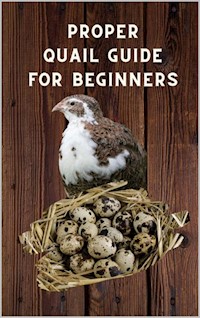
★ Proper Quail Guide for Beginners ★ 1x1 Guide to Quail Keeping and Breeding Japanese Laying Quail. Perfect Quail Raising. A wonderful Poultry Breeds Why it's worth keeping quail: In recent years, quail has become one of the most popular birds in hobby keeping and professional breeding. The reasons for this are obvious: Quails - in contrast to chickens, for example - have relatively manageable requirements in terms of space, feed and their general housing conditions. In addition, they have an extremely friendly, rather reserved nature, which makes dealing with them particularly uncomplicated and pleasant. Due to their fine character and the quite fulfilling demands on owner and keeper, the little ones are excellently suited for beginners and newcomers in the field of breeding and keeping. This guide provides all the information you need to get started with quail keeping or breeding. Here you will learn everything you need to know to make sure that keeping, caring and living together works out in the long run. The following topics are covered: the different quail breeds and their typical characteristics, the nature and character of quails, size, age and laying performance, the correct and species-appropriate housing: different forms of enclosures and their advantages and disadvantages, what equipment you need for the enclosure, how and when to clean and muck out, which food is the best and which foods are not suitable, how to get your quails through the winter, what diseases there are, and what to do if your quails get sick, the right way to deal with vacations and longer absences, quail breeding: how natural brood and artificial brood work, how chicks are fed and raised, legal framework for keeping and slaughtering, and much more!
Das E-Book können Sie in Legimi-Apps oder einer beliebigen App lesen, die das folgende Format unterstützen:
Seitenzahl: 33
Veröffentlichungsjahr: 2022
Ähnliche











Proper Quail Guide for Beginners. 1x1 Guide to Keeping and Breeding Japanese Quail.
By Thorsten Hawk
contents
1. Overview of quail breeds
2. Origin
3. Natural Habitat
4. Behavior
5. Why Quail? Livestock or ornamental bird?
6. Group size and composition
7. Obligation to report a quail husbandry?
8. Accommodation and Size
quail house
gate
aviary
9. Basic equipment:
feeding place
substrate
Hideouts and quail houses
sand bath
10. Accommodation maintenance, routine expenses
11. Fresh feed
12. Dry food
13. What foods not to feed?
14. Keeping quail in winter
temperature
humidity
draft
15. Care on vacation
16. Quail eggs all year round?
17. Breeding of quail, natural breeding, artificial breeding
18. Chick care and feeding
19. Diseases and first aid, lice, mites, worms, colds, prolapsed intestines, bacteria
20. Battles
1. Overview of quail breeds
Before you can start with the right keeping and care, some general things about the quail should first be clarified. The scientific name of the quail is Coturnix coturnix, it belongs to the pheasant family and the Galliformes order. In general, it can be said about size and weight that adult animals weigh about 100 grams and are about 20 centimeters tall.
However, this is only a guideline: Since there are over 100 different species of quail, quail keepers should be prepared for the sometimes serious differences between the individual species. For example, it can happen that a quail weighs a proud 300 or even 500 grams instead of the stated 100 grams.
A sensible first classification of the quail species can be made into the groups ornamental quail, laying quail, dwarf quail and wild quail. The ornamental quails are originally wild quails that were domesticated over long periods of time and eventually kept as ornamental birds. Ornamental quail form the largest group among the four mentioned above.
The most popular and common ornamental quail is the California Crested Quail, which belongs to the Crested Quail species and the toothed quail family. She is the state animal of California. In addition to the California quail, there are four other subspecies of the quail, which are distinguished by the color of their upper body. The crested quail was named after its distinctive feature of the crest ('Schopf'), which is made up of six black feathers. The Californian quail can grow up to 27 cm and weigh up to 200 g. On average, the females are slightly smaller and lighter than the males and their coloring is less intense. The hen's crest will also be slightly shorter than that of the rooster.
Another very popular ornamental quail is the blue-scaled quail, which is one of four subspecies of the scaled quail. It can reach a size of 29 centimeters and a weight of 220 grams. It also belongs to the toothquail family. In this species, the female is also slightly smaller and lighter than the male, but the differences here are not as clear as in the Crested Quail. True to its name, the blue-scaled quail has a bluish-grey coloration and scale pattern. Her bonnet is white.
The Virginia quail is also an ornamental quail from the toothed quail family. The males of this species grow up to 28 cm tall, the females are usually a little smaller. Virginia quail weigh up to 250 g, although it is also the case here that the female animals tend to be slightly lighter than the males, but the differences are not serious. The species of Virginia quail has a total of 21 subspecies, the plumage basically has different brownish-reddish nuances. The intensity and pattern of the hen is somewhat weaker than that of the rooster.




