


Erhalten Sie Zugang zu diesem und mehr als 300000 Büchern ab EUR 5,99 monatlich.
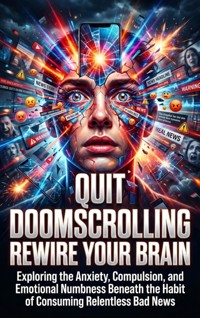
Doomscrolling rarely feels like a choice. It feels like falling—a pull toward one more headline, one more update, one more confirmation that the world is exactly as unsettling as you suspected. And somewhere in the middle of it, the scrolling stops being about staying informed and becomes something harder to name: a compulsive search for certainty in a feed that only ever delivers more uncertainty. This book explores what actually drives the habit of consuming relentless negative content. It examines the emotional patterns beneath doomscrolling—the anxiety that masquerades as vigilance, the hypervigilance that mistakes bad news consumption for control, and the quiet emotional numbness that settles in when the nervous system has absorbed more distress than it can meaningfully process. Quit Doomscrolling Rewire Your Brain offers a compassionate look at the neurological and psychological dynamics behind compulsive news consumption. It explores how the brain's threat-detection systems interact with algorithmically curated fear, how that interaction gradually reshapes what feels normal, and how understanding these patterns with honesty and self-compassion can begin to loosen their hold more effectively than willpower alone ever could. This is not a news avoidance manual or a digital wellness prescription. It is a thoughtful exploration of the inner life behind the habit—for anyone who has closed a news app feeling worse than before they opened it, and opened it again anyway.
Sie lesen das E-Book in den Legimi-Apps auf:
Seitenzahl: 225
Veröffentlichungsjahr: 2026
Das E-Book (TTS) können Sie hören im Abo „Legimi Premium” in Legimi-Apps auf:
Ähnliche



















Table of Contents
Chapter 1: Understanding Doomscrolling
What is Doomscrolling?
Emotional Triggers Behind Doomscrolling
The Neuroscience of Fear and Media Consumption
The Psychological Impact of Doomscrolling
Chapter 2: The Science Behind Anxiety and News Consumption
Understanding the Amygdala
The Cycle of Fear and News Consumption
Neuroplasticity and Changing Habits
Recognizing Emotional Numbness
Chapter 3: The Compulsion to Stay Informed
Understanding the Urge
The Role of Technology
Emotional Patterns and Reactions
The Comfort of Familiarity
Breaking the Cycle
Chapter 4: Hypervigilance and Its Impact
Understanding Hypervigilance
The Emotional Toll of Constant Alertness
Social Isolation and Hypervigilance
Finding Balance: Awareness vs. Hypervigilance
Chapter 5: Emotional Numbness: The Aftermath of Overconsumption
Understanding Emotional Numbness
The Cycle of Overconsumption
The Impact on Mental Health
Recognizing Your Triggers
Strategies for Reconnection
Moving Towards a Healthier Relationship with News
Chapter 6: The Role of Social Media Algorithms
Understanding Algorithms
The Sensationalism Factor
Reward Systems and the Brain
The Echo Chamber Effect
The Impact on Mental Health
Breaking Free from the Algorithms
Chapter 7: The Illusion of Control
The Search for Stability
Hypervigilance and the Illusion of Control
The Vicious Cycle of Doomscrolling
Finding Real Control
Chapter 8: Finding Balance: News Consumption vs. Wellness
Understanding Your News Consumption Habits
Creating a Healthy News Routine
Engaging with Perspective
The Role of Community in News Consumption
Chapter 9: Cultivating Mindfulness in a Digital Age
Understanding Mindfulness
Recognizing Your Triggers
Mindful Consumption Techniques
Emotional Awareness
Creating a Mindful Environment
Reflecting on Your News Consumption
Chapter 10: Rewiring Your Brain: Practical Exercises
Understanding Your Triggers
Setting Healthy Boundaries
Cultivating Mindfulness
Establishing Healthy Alternatives
Seeking Professional Support
Chapter 11: Seeking Positivity Amid Chaos
The Power of Positive News
Creating a Balance in Consumption
The Impact of Positive Narratives on Mental Health
Practicing Gratitude as a Pathway to Positivity
Chapter 12: Building a Supportive Community
The Importance of Connection
Finding Your Tribe
Setting Boundaries Together
Engaging in Active Support
Celebrating Progress Together
Resources for Building Community
Chapter 13: The Path Forward: Creating Your Own Media Diet
Understanding Your Needs
Curating Your Sources
Setting Boundaries
Mindful Consumption Techniques
Replacing Negativity with Positivity
Regular Assessment and Adjustment
Chapter 14: When to Seek Professional Help
Recognizing the Signs
Understanding Emotional Burnout
Options for Professional Support
Creating a Personalized Plan
The Role of Mindfulness
Chapter 15: Reflection and Growth
Looking Back at Your Journey
The Role of Awareness in Growth
Building New Habits
Embracing Emotional Insight
Looking Forward
Chapter 16: Embracing a New Narrative
Recognizing the Power of Narrative
Shifting from Scarcity to Abundance
Mindfulness and the Present Moment
Cultivating Hope and Agency
Closing Thoughts: Reclaiming Your Peace
Chapter 1: Understanding Doomscrolling
In this chapter, we will break down the concept of doomscrolling. What makes us drawn to negative news? It's essential to examine the triggers and feelings associated with consuming relentless bad news, as we explore the connection between our emotional state and our habits around media consumption.
What is Doomscrolling?
Doomscrolling is more than just a habit—it's a phenomenon deeply intertwined with our emotional responses to the world around us. Understanding what doomscrolling is will help us recognize why we feel compelled to participate in it, even when we know it doesn't contribute to our well-being.
Doomscrolling defined
Doomscrolling, at its core, is the act of persistently scrolling through a barrage of negative news stories, often at the expense of our mental well-being. It can induce feelings of anxiety, panic, or distress, leaving us overwhelmed. Many individuals find themselves trapped in this cycle, compelled to seek out the latest updates in a world that feels increasingly chaotic.
This phenomenon is characterized by the tendency to immerse ourselves in a continuous feed of tragic, alarming, or upsetting headlines. What begins as a quest for awareness can quickly morph into a tenacious ritual that, ironically, generates more fear than grounding. The urgency to stay informed about disasters, violence, and societal breakdowns keeps us engaged despite the detrimental toll it takes on our emotional health.
The pull of negativity
The allure of negative news is powerful and, as research suggests, quite rooted in our biology. Our brains are inherently wired to detect threats—this evolutionary trait helps us survive in a world filled with potential dangers. Consequently, whether it’s a natural disaster or a political debacle, our minds are primed to attend to negative stories more acutely than positive tales of achievement or hope.
This focus on negativity isn’t merely psychological; it is amplified by the media landscape, where bad news generates higher engagement. The result? An addictive loop in which we find negativity not only compelling but irresistible—grabbing our attention and holding us captive. Ironically, while positive news might uplift our spirits, the dopamine spikes from consuming distressing content can further entrench us in this unhealthy behavior.
Comparison with traditional news consumption
Unlike traditional news consumption, which often involves intentional engagement with selected stories, doomscrolling usually occurs in a more mindless manner. This habitual scrolling often lacks the consideration often given to news articles in print or broadcast media. Instead of consuming news with purpose, individuals find themselves navigating endless feeds devoid of context, focus, or reflection.
This mindless consumption leads to a cycle where anxiety begets further scrolling, creating a spiral of discomfort and compulsion. The tendency to consume news in this way diminishes our ability to process information critically and can distort our perception of reality. Over time, the consequences become evident—not just in feelings of uncertainty and dread but in broader mental health impacts that reverberate through our everyday lives.
Media's role in shaping our experience
Media outlets play a significant role in cultivating an environment conducive to doomscrolling. The prevalence of sensational headlines and the prioritization of breaking bad news over uplifting stories create a feedback loop where negativity thrives. In the quest for views and clicks, media platforms often capitalize on our fears, amplifying the urgency and gravity of troubling events.
This imbalance contributes to a distorted view of reality, fostering a misleading sense of constant crisis. Over time, individuals may internalize this negative narrative, believing that the world is far more dangerous than it truly is. Acknowledging the media's influence on our emotional responses empowers us to engage more mindfully with the information we consume, paving the way for healthier media habits and a more balanced emotional landscape.
Emotional Triggers Behind Doomscrolling
Understanding the emotional triggers that lead us to doomscroll can help us break free from this habitual cycle. Let's investigate the underlying feelings that keep us glued to our screens.
Seeking reassurance
Many individuals find themselves doomscrolling as a way to seek reassurance about their fears and worries regarding the world’s state. In moments of uncertainty, it becomes a familiar cycle: the more we consume troubling news, the more we feel compelled to go back for more evidence of our concerns. This behavior is often rooted in an emotional need for validation—confirmation that our feelings of anxiety and unease are justified.
While we may hope that fresh headlines could bring clarity or comfort, the reality is that current events often amplify our fears instead. This search for reassurance can quickly turn into a paradox, where instead of calming our nerves, the continuous influx of negative news exacerbates our anxiety. Understanding this emotional trigger is crucial. Recognizing our need for reassurance can empower us to seek healthier ways to find comfort without falling into the doomscrolling trap.
Anxiety and hypervigilance
For many, the anxiety stemming from uncertainty leads to compulsive doomscrolling. This behavior is often a misguided attempt to find control in a chaotic world. Hypervigilance—a state of heightened alertness—can trick us into believing that consuming bad news is essential for staying prepared and safe. We may feel that by monitoring every potential threat, we are somehow protecting ourselves from harm.
However, this constant scanning of news feeds typically offers no real control, but rather perpetuates a cycle of anxiety and distress. The brain becomes wired to react to alarming news with urgency, reinforcing the habit of seeking out negative information. Awareness of this cycle can help us break free from the need to incessantly check for updates, allowing us to recognize when our drive to be 'informed' is actually an expression of anxiety.
Feeling overwhelmed
The overwhelming barrage of negative news can easily become paralyzing. When faced with an avalanche of distressing headlines, it is all too common to feel helpless and hopeless, which can lead to a compulsive need to revisit news feeds repeatedly. This behavior reflects an emotional struggle that often goes unrecognized.
As we scroll through article after article, the sheer weight of global suffering and crisis can leave us feeling incapacitated. This sense of overwhelm often prompts people to dig deeper into their feeds, seeking some semblance of clarity amidst the chaos. Ultimately, recognizing this emotional response is vital; it encourages us to establish boundaries around our media consumption to safeguard our mental well-being.
Immediate gratification
Doomscrolling often delivers a form of immediate gratification, as the brain craves information and stimulation. Even though the content may be distressing, there’s an addictive quality to the rush of acquiring fresh updates. Each notification or new headline can trigger a dopamine response, providing a fleeting sense of reward that keeps us coming back for more.
This short-term gratification can lead to an unconscious cycle where we chase after that next bit of sensational news, mistaking it for a need to stay informed. Unfortunately, this can divert our focus away from healthier coping mechanisms and deeper engagement with the world. Recognizing this pattern can help us become more mindful about our media habits, empowering us to seek information that nourishes rather than depletes us.
The Neuroscience of Fear and Media Consumption
The brain plays a crucial role in our relationship with news consumption. Let's look at how our neurology influences our tendency to engage with negative content.
The amygdala's response
The amygdala, often referred to as the brain's fear center, plays a pivotal role in how we process distressing information. When we encounter alarming news, the amygdala activates, triggering a cascade of emotional responses. This reaction is primarily intended to prepare us for potential threats, aligning with our evolutionary survival instincts.
However, in the context of today’s news consumption, this reaction can become problematic. Each notification or headline that elicits fear or anxiety floods our system with adrenaline and heightened alertness. Over time, this can lead to a constant state of hypervigilance, creating an almost addictive loop where frightening news is not just consumed but sought after. It’s a paradox where our quest for safety through information leads to greater unease.
Neurotransmitters and emotional regulation
During the consumption of distressing news, various neurotransmitters, particularly cortisol, flood our brains. Cortisol, often termed the “stress hormone,” is released during moments of perceived threat. While intended to help us manage short-term stress, chronic elevation of cortisol levels due to continuous exposure to negative media can severely impact our emotional well-being.
This process can disrupt our emotional regulation, leading to feelings of irritability, anxiety, and even depression. The challenge lies in finding balance. Instead of enhancing our resilience against threats, prolonged exposure to stressful news diminishes our capacity to cope and can skew our perception of reality, making it feel overwhelmingly dire. Understanding this biochemical response helps in recognizing the need to reclaim our emotional balance.
Neurological pathways formed by habits
When we repeatedly engage with negative content, our brains form specific neural pathways that reinforce this behavior and make it more habitual. This is known as neuroplasticity, where the brain reshapes itself based on our experiences and actions. Each time we dive into distressing news, we strengthen these pathways, making doomscrolling feel more automatic and less of a conscious choice.
The challenge arises when these pathways become so entrenched that they influence our daily routines and emotional states without us even realizing it. Over time, the brain begins to associate news consumption with certain emotional responses, perpetuating a cycle of anxiety and compulsion. Recognizing these patterns is the first step towards actively rewriting our interactions with media, allowing us to break free from the grip of habitual doomscrolling.
The impact of algorithms
In today's digital landscape, algorithms play a crucial role in shaping our news consumption experience. News platforms often rely on algorithms designed to capture our attention, primarily by showing content that elicits strong emotional responses—often fear. This design taps into our brain's natural predisposition to pay attention to threats, ensuring that distressing news takes precedence in our feeds.
Unfortunately, this can create an echo chamber of negativity, reinforcing the habit of doomscrolling. The more we engage with traumatic or alarming content, the more these platforms prioritize similar stories, resulting in an overwhelming and relentless influx of bad news. Understanding the mechanics of these algorithms encourages us to critically assess our media consumption habits, empowering us to take control and seek out more balanced, constructive content instead.
The Psychological Impact of Doomscrolling
Doomscrolling doesn't just impact our immediate mood. Understand the long-term psychological effects of consuming constant negative news.
Increased anxiety levels
Doomscrolling, by its very nature, exposes individuals to a relentless stream of distressing and negative news. This continual exposure can slowly build up a significant level of anxiety. Initially, people might feel a need to stay informed, but soon the act of scrolling becomes more about seeking reassurance in a world that often feels chaotic and unpredictable.
Research suggests that this perpetual engagement with bad news can create a heightened sense of threat, activating the brain’s stress response system. This invalid feedback loop can make it increasingly difficult to break free from the cycle of anxiety, as the perceived necessity to remain vigilant feeds into the habit of scrolling. Over time, what began as a seemingly benign activity transforms into a compulsive practice that amplifies feelings of unease and overwhelm. Recognizing this cycle is the first step toward addressing and mitigating its effects on mental health.
Desensitization
One of the more concerning effects of doomscrolling is desensitization. After repeated exposure to distressing content, individuals can begin to feel numb to the very situations that once elicited a strong emotional response. News that might have sparked fear or anger at first gradually becomes just another headline, rendering them emotionally indifferent to tragedies unfolding around the globe.
This emotional numbing can create a false sense of safety; however, it often leads to a lack of empathy and a disconnected existence. When people become desensitized, they may also find it increasingly challenging to connect with others in a meaningful way. This disconnection creates a cycle where the individual seeks even more distressing news, paradoxically attempting to feel something amid their emotional numbness while further withdrawing from genuine human interactions.
Impact on relationships
As individuals become ensnared in the doomscrolling habit, the consequences often extend beyond the individual, affecting their relationships as well. Friends and family may notice that a person who once actively engaged in social activities becomes increasingly withdrawn, choosing to scroll through news feeds instead of participating in conversations or outings.
This withdrawal can stem from overwhelming feelings, as constant exposure to negative news can heighten stress and anxiety, making social interactions feel daunting. Consequently, loved ones may feel alienated or frustrated, not understanding the pull of the news cycle that keeps their afflicted family member tethered to their screens. The emotional distance created by doomscrolling can strain even the strongest of relationships, highlighting the need for open conversations about media consumption and its psychological toll.
Difficulty in processing emotions
The relentless barrage of bad news can adversely affect an individual's ability to process and articulate their own feelings. When inundated with negative information, it becomes increasingly difficult to distinguish between personal emotions and the collective anxiety reflected in the news cycle. This conflation can lead to confusion and emotional overload.
Moreover, individuals might find themselves trapped in a state of hyper-vigilance, continually scanning for the next distressing headline, leaving little room for reflection on their personal experiences and emotions. As a result, they may struggle with feelings such as sadness, anger, or fear, which remain unaddressed. This emotional chaos inhibits personal growth and healing, making it vital to confront and analyze our media habits to regain emotional clarity and well-being.
Chapter 2: The Science Behind Anxiety and News Consumption
This chapter focuses on the neurological underpinnings of anxiety. How does our brain react to constant exposure to distressing information? We will explore the role of the amygdala, the brain's alarm system, and how it influences our reactions to news that feeds into our fears.
Understanding the Amygdala
The amygdala plays a crucial role in processing emotions and controlling our fear responses. In this section, we will look at how this small almond-shaped cluster of nuclei influences our reactions to news that triggers anxiety.
The amygdala as the brain's alarm system
The amygdala, often referred to as the brain's alarm system, is integral to our survival. It's a small, almond-shaped cluster of nuclei located deep within the temporal lobes, acting as a sentinel that constantly scans for threats. When faced with stressful situations or perceived dangers, the amygdala triggers a cascade of responses throughout the body. This response can be immediate, culminating in the instinctual fight-or-flight reaction.
In the context of news consumption, particularly negative or distressing stories, the amygdala becomes overactive. Each alarming headline can set off this alarm, compelling the individual to react as if they are in immediate danger. This reactivity is not merely a byproduct of the news; it signifies how our brains have evolved to prioritize survival over comfort, leading us to seek out information that confirms our fears. Understanding this can help us recognize why doomscrolling feels so compelling despite its detrimental effects on our mental wellbeing.
How the amygdala responds to perceived threats
The amygdala responds to perceived threats by quickly processing sensory information and determining whether it warrants a protective reaction. Even if a threat is not physically present, the amygdala can become activated simply through the intake of distressing news. When confronted with alarming updates, the amygdala signals the release of stress hormones like cortisol and adrenaline, energizing the body to either flee or confront the danger.
This reaction is often automatic, designed to protect us. In the realm of news consumption, each new headline can trigger this response, leading to a cycle of anxiety and compulsion as we continually search for more information to assess the situation. The more we engage with negative news, the more our brains perceive the world as threatening, intensifying our anxiety. Recognizing this cycle is vital for breaking free from the grip of compulsive news consumption.
Connection between amygdala activation and anxiety
Research has shown a direct connection between amygdala activation and anxiety levels. When the amygdala is repeatedly activated due to constant exposure to distressing content, it can lead to heightened feelings of fear and unease. This increased sensitivity can create a feedback loop where an anxious individual turns to the news for reassurance, but instead finds more reasons to feel anxious.
This phenomenon is particularly concerning as chronic activation of the amygdala can lead to long-term changes in brain circuitry, making an individual more prone to anxiety disorders. Thus, understanding this connection emphasizes the importance of moderating news consumption to protect our mental health. By recognizing how deeply news can affect our emotional state, we can take proactive steps to manage our exposure responsibly.
Impact of chronic stress on amygdala function
Chronic stress can severely impact amygdala function, leading to altered emotional processing and heightened anxiety. Continuous exposure to stressors can cause the amygdala to become hyperactive, making it less capable of distinguishing between real threats and benign stimuli. This hyperactivity can exacerbate feelings of anxiety, leading individuals to perceive the world as more dangerous.
As this dysfunction progresses, people may find themselves stuck in a cycle of fear and anxiety, continually seeking out stressful news that feeds into their heightened alertness. To combat this, it is necessary to adopt strategies that reduce both stress and news consumption. Mindfulness practices, cognitive behavioral approaches, and establishing boundaries around media intake can help restore balance to the amygdala's function, allowing for healthier emotional processing and a more accurate appraisal of safety.
The Cycle of Fear and News Consumption
Our brains are wired to seek out information that confirms our fears. This section explores how the cycle of anxiety and doomscrolling perpetuates itself, creating a feedback loop that can be hard to escape.
How anxiety drives the need for information
Anxiety can create an almost insatiable need for information, manifesting as a compulsion to stay updated on distressing events. This relentless pursuit is rooted in our brain's survival instincts, where being informed feels like a way to anticipate and evade potential threats. The amygdala, which acts as our internal alarm system, goes into overdrive when it detects perceived danger. This heightened state prompts a quest for news, as it seems essential for maintaining a sense of control over our environment.
When we engage in doomscrolling, each new piece of information momentarily satisfies this quest, only to trigger more anxiety afterward. This cycle feeds itself: the more we consume, the more anxious we become, driving us to seek even more information. This behavior becomes entrenched, leading us further down the rabbit hole of negativity, often leaving us feeling drained and overwhelmed.
The role of confirmation bias in news consumption
Confirmation bias plays a significant role in how we consume news, as it leads individuals to seek out information that aligns with their pre-existing beliefs and fears. When we find headlines that resonate with our anxieties, it reinforces our worldview and can feel validating, despite being potentially harmful. This bias can push us deeper into a cycle of consuming bad news, as we are drawn to stories that confirm what we already think or worry about.
In the context of doomscrolling, this means we are not just passively consuming content; we actively participate in a narrative that amplifies our fears. Algorithms on social media platforms enhance this effect by curating feeds that cater to our interests, often amplifying negative content. Over time, this creates bubbles of distress, wherein our information landscape is suffused with negativity, further entrenching our anxious responses.
Why bad news sticks more than good news
Psychologically, negative information has a more potent effect on us than positive news. This phenomenon can be traced back to evolution: being aware of threats was crucial for survival. Consequently, we are wired to pay closer attention to adverse events. As a result, bad news tends to linger in our minds far longer than good news, distorting our overall perception of reality.
When we read tragic stories or unsettling headlines, they activate our fear responses, leading to ruminative thoughts that can dominate our mental space. By contrast, good news often gets glossed over because it does not evoke the same immediate sense of urgency or threat. This leads to a skewed understanding of the world, where we perceive it as more dangerous than it may genuinely be, feeding our anxiety and driving us back to doomscrolling for reassurance.
Psychological comfort in the familiar discomfort
As paradoxical as it may seem, there can be a psychological comfort found in familiar discomfort. For many, the routine of checking news feeds filled with distressing information provides a sense of predictability, even as it causes anxiety. Developments in our lives may be chaotic and uncertain, but the cycle of consuming bad news feels like something we can control, leading to attachment and habitual behavior.
This notion of comfort stems from the brain's tendency to gravitate toward what it knows, even if that involves distress. Over time, this creates a habitual response where the discomfort becomes normalized, making it challenging to break free from the cycle. Recognizing this can be a powerful first step in reshaping our consumption habits, allowing some distance from the familiar habit, and fostering new coping strategies that prioritize mental well-being.
Neuroplasticity and Changing Habits
Our brains are capable of changing. In this section, we will discuss neuroplasticity and how understanding this concept can empower us to shift away from compulsive news habits.
The concept of neuroplasticity explained
Neuroplasticity, or brain plasticity, refers to the brain's remarkable ability to reorganize itself by forming new neural connections throughout life. This concept is crucial when understanding how our thoughts and habits can shape our brain structure and function. By engaging with different experiences and learning new information, the brain adapts, ensuring we can respond to our environment effectively.
This adaptability also means that negative habits like doomscrolling can create entrenched pathways in our brains. Each time we engage in this compulsive behavior, the neural connections reinforcing those habits grow stronger. Conversely, by actively choosing to replace these habits with healthier patterns, we can begin to alter our brain's wiring for the better, leading to improved emotional resilience and mental well-being.
How new habits can reshape brain pathways
New habits can profoundly influence the brain's neural pathways, effectively rewiring our responses and behaviors. When we consciously practice different activities—like engaging in positive news consumption or limiting our time on distressing news feeds—we initiate the process of reshaping our brain's landscape. Each small step taken toward healthier habits contributes to building new pathways.
Moreover, consistency is key in this transformation. As we repeat these new habits, they become more automatic, making it easier over time to default to healthier behaviors. This gradual change not only reduces the grip of anxiety but also nurtures a more balanced perspective on the world, fostering a sense of control over our consumption of information.
The importance of intentionality in habit change
Intentionality plays a pivotal role in transforming habits related to news consumption. It involves being mindful of our choices and the motivations behind them. By consciously deciding when and how we engage with news, we can reclaim agency over our emotional well-being. This could mean setting specific times to check news updates or choosing to engage with content that uplifts rather than overwhelms.
This intentional approach helps in recognizing triggers that lead to compulsive scrolling, allowing us to replace these impulses with healthier alternatives. By fostering an environment that supports our commitment to change, we empower ourselves to break free from destructive patterns and promote a more balanced mental state.
Practicing mindfulness as a tool for rewiring
Mindfulness serves as a powerful tool for rewiring our brains away from the compulsive behavior of doomscrolling. By practicing mindfulness, we cultivate an awareness of our thoughts and feelings without judgment. This practice encourages us to pause and reflect on why we might reach for our devices when faced with uncertainty or anxiety.
Engaging in mindfulness allows us to differentiate between our habitual responses and intentional actions. Through techniques like meditation and deep-breathing exercises, we can create moments of calm, which serve as a counterbalance to the chaotic influx of negative news. Over time, this awareness empowers us to make more thoughtful decisions, fostering healthier habits that facilitate emotional healing instead of exacerbation.




