


91,19 €
Mehr erfahren.
- Herausgeber: Packt Publishing
- Kategorie: Wissenschaft und neue Technologien
- Sprache: Englisch
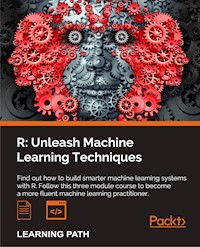
Find out how to build smarter machine learning systems with R. Follow this three module course to become a more fluent machine learning practitioner.
About This Book
- Build your confidence with R and find out how to solve a huge range of data-related problems
- Get to grips with some of the most important machine learning techniques being used by data scientists and analysts across industries today
- Don't just learn – apply your knowledge by following featured practical projects covering everything from financial modeling to social media analysis
Who This Book Is For
Aimed for intermediate-to-advanced people (especially data scientist) who are already into the field of data science
What You Will Learn
- Get to grips with R techniques to clean and prepare your data for analysis, and visualize your results
- Implement R machine learning algorithms from scratch and be amazed to see the algorithms in action
- Solve interesting real-world problems using machine learning and R as the journey unfolds
- Write reusable code and build complete machine learning systems from the ground up
- Learn specialized machine learning techniques for text mining, social network data, big data, and more
- Discover the different types of machine learning models and learn which is best to meet your data needs and solve your analysis problems
- Evaluate and improve the performance of machine learning models
- Learn specialized machine learning techniques for text mining, social network data, big data, and more
In Detail
R is the established language of data analysts and statisticians around the world. And you shouldn't be afraid to use it...
This Learning Path will take you through the fundamentals of R and demonstrate how to use the language to solve a diverse range of challenges through machine learning. Accessible yet comprehensive, it provides you with everything you need to become more a more fluent data professional, and more confident with R.
In the first module you'll get to grips with the fundamentals of R. This means you'll be taking a look at some of the details of how the language works, before seeing how to put your knowledge into practice to build some simple machine learning projects that could prove useful for a range of real world problems.
For the following two modules we'll begin to investigate machine learning algorithms in more detail. To build upon the basics, you'll get to work on three different projects that will test your skills. Covering some of the most important algorithms and featuring some of the most popular R packages, they're all focused on solving real problems in different areas, ranging from finance to social media.
This Learning Path has been curated from three Packt products:
- R Machine Learning By Example By Raghav Bali, Dipanjan Sarkar
- Machine Learning with R Learning - Second Edition By Brett Lantz
- Mastering Machine Learning with R By Cory Lesmeister
Style and approach
This is an enticing learning path that starts from the very basics to gradually pick up pace as the story unfolds. Each concept is first defined in the larger context of things succinctly, followed by a detailed explanation of their application. Each topic is explained with the help of a project that solves a real-world problem involving hands-on work thus giving you a deep insight into the world of machine learning.
Sie lesen das E-Book in den Legimi-Apps auf:
Seitenzahl: 1440
Veröffentlichungsjahr: 2016
Ähnliche
















Table of Contents
R: Unleash Machine Learning Techniques
R: Unleash Machine Learning Techniques
Find out how to build smarter machine learning systems with R. Follow this three module course to become a more fluent machine learning practitioner
A course in three modules
BIRMINGHAM - MUMBAI
R: Unleash Machine Learning Techniques
Copyright © 2016 Packt Publishing
All rights reserved. No part of this course may be reproduced, stored in a retrieval system, or transmitted in any form or by any means, without the prior written permission of the publisher, except in the case of brief quotations embedded in critical articles or reviews.
Every effort has been made in the preparation of this course to ensure the accuracy of the information presented. However, the information contained in this course is sold without warranty, either express or implied. Neither the authors, nor Packt Publishing, and its dealers and distributors will be held liable for any damages caused or alleged to be caused directly or indirectly by this course.
Packt Publishing has endeavored to provide trademark information about all of the companies and products mentioned in this course by the appropriate use of capitals. However, Packt Publishing cannot guarantee the accuracy of this information.
Published on: September 2016
Published by Packt Publishing Ltd.
Livery Place
35 Livery Street
Birmingham B3 2PB, UK.
ISBN 978-1-78712-734-0
www.packtpub.com
Credits
Authors
Raghav Bali
Dipanjan Sarkar
Brett Lantz
Cory Lesmeister
Reviewers
Alexey Grigorev
Vijayakumar Nattamai Jawaharlal
Kent S. Johnson
Mzabalazo Z. Ngwenya
Anuj Saxena
Vikram Dhillon
Miro Kopecky
Pavan Narayanan
Doug Ortiz
Shivani Rao, PhD
Content Development Editor
Parshva Sheth
Graphics
Abhinash Sahu
Production Coordinator
Melwyn Dsa
Preface
"He who defends everything, defends nothing."
--Frederick the GreatMachine learning is a very broad topic. The following quote sums it up nicely: The first problem facing you is the bewildering variety of learning algorithms available. Which one to use? There are literally thousands available, and hundreds more are published each year. (Domingo, P., 2012.) It would therefore be irresponsible to try and cover everything in the chapters that follow because, to paraphrase Frederick the Great, we would achieve nothing. With this constraint in mind, we hope to provide a solid foundation of algorithms and business considerations that will allow the reader to walk away and, first of all, take on any machine learning tasks with complete confidence, and secondly, be able to help themselves in figuring out other algorithms and topics. Essentially, if this course significantly helps you to help yourself, then I would consider this a victory. Don't think of this course as a destination but rather, as a path to self-discovery.
What this learning path covers
Module 1, R Machine Learning By Example, Data science and machine learning are some of the top buzzwords in the technical world today. From retail stores to Fortune 500 companies, everyone is working hard to make machine learning give them data-driven insights to grow their businesses. With powerful data manipulation features, machine learning packages, and an active developer community, R empowers users to build sophisticated machine learning systems to solve real-world data problems. This module takes you on a data-driven journey that starts with the very basics of R and machine learning and gradually builds upon the concepts to work on projects that tackle real-world problems.
Module 2, Machine Learning with R, Machine learning, at its core, is concerned with the algorithms that transform information into actionable intelligence. This fact makes machine learning well-suited to the present-day era of big data. Without machine learning, it would be nearly impossible to keep up with the massive stream of information. Given the growing prominence of R—a cross-platform, zero-cost statistical programming environment—there has never been a better time to start using machine learning. R offers a powerful but easy-to-learn set of tools that canassist you with finding data insights. By combining hands-on case studies with the essential theory that you need to understand how things work under the hood, this book provides all the knowledge that you will need to start applying machine learning to your own projects.
Module 3 Mastering Machine Learning with R, The world of R can be as bewildering as the world of machine learning! There is seemingly an endless number of R packages with a plethora of blogs, websites, discussions, and papers of various quality and complexity from the community that supports R. This is a great reservoir of information and probably R's greatest strength, but I've always believed that an entity's greatest strength can also be its greatest weakness. R's vast community of knowledge can quickly overwhelm and/or sidetrack you and your efforts. Show me a problem and give me ten different R programmers and I'll show you ten different ways the code is written to solve the problem. As I've written each chapter, I've endeavored to capture the critical elements that can assist you in using R to understand, prepare, and model the data. I am no R programming expert by any stretch of the imagination, but again, I like to think that I can provide a solid foundation herein. Another thing that lit a fire under me to write this book was an incident that happened in the hallways of a former employer a couple of years ago. My team had an IT contractor to support the management of our databases. As we were walking and chatting about big data and the like, he mentioned that he had bought a book about machine learning with R and another about machine learning with Python. He stated that he could do all the programming, but all of the statistics made absolutely no sense to him. I have always kept this conversation at the back of my mind throughout the writing process. It has been a very challenging task to balance the technical and theoretical with the practical. One could, and probably someone has, turned the theory of each chapter to its own book. I used a heuristic of sorts to aid me in deciding whether a formula or technical aspect was in the scope, which was would this help me or the readers in the discussions with team members and business leaders? If I felt it might help, I would strive to provide the necessary details. I also made a conscious effort to keep the datasets used in the practical exercises large enough to be interesting but small enough to allow you to gain insight without becoming overwhelmed.
This book is not about big data, but make no mistake about it, the methods and concepts that we will discuss can be scaled to big data. In short, this module will appeal to a broad group of individuals, from IT experts seeking to understand and interpret machine learning algorithms to statistical gurus desiring to incorporate the power of R into their analysis. However, even those that are well-versed in both IT and statistics—experts if you will—should be able to pick up quite a few tips and tricks to assist them in their efforts.
What you need for this learning path
This software applies to all the chapters of the book:
For hardware, there are no specific requirements, since R can run on any PC that has Mac, Linux, or Windows, but a physical memory of minimum 4 GB is preferred to run some of the iterative algorithms smoothly.
Who this learning path is for
Aimed for intermediate-to-advanced people (especially data scientist) who are already into the field of data science
Reader feedback
Feedback from our readers is always welcome. Let us know what you think about this book—what you liked or disliked. Reader feedback is important for us as it helps us develop titles that you will really get the most out of.
To send us general feedback, simply e-mail <[email protected]>, and mention the book's title in the subject of your message.
If there is a topic that you have expertise in and you are interested in either writing or contributing to a book, see our author guide at www.packtpub.com/authors.
Customer support
Now that you are the proud owner of a Packt book, we have a number of things to help you to get the most from your purchase.
Downloading the example code
You can download the example code files for this book from your account at http://www.packtpub.com. If you purchased this book elsewhere, you can visit http://www.packtpub.com/support and register to have the files e-mailed directly to you.
You can download the code files by following these steps:
You can also download the code files by clicking on the Code Files button on the book's webpage at the Packt Publishing website. This page can be accessed by entering the book's name in the Search box. Please note that you need to be logged in to your Packt account.
Once the file is downloaded, please make sure that you unzip or extract the folder using the latest version of:
The code bundle for the book is also hosted on GitHub at
https://github.com/PacktPublishing/R-Maching-Learning-Techniques
Errata
Although we have taken every care to ensure the accuracy of our content, mistakes do happen. If you find a mistake in one of our books—maybe a mistake in the text or the code—we would be grateful if you could report this to us. By doing so, you can save other readers from frustration and help us improve subsequent versions of this book. If you find any errata, please report them by visiting http://www.packtpub.com/submit-errata, selecting your book, clicking on the Errata Submission Form link, and entering the details of your errata. Once your errata are verified, your submission will be accepted and the errata will be uploaded to our website or added to any list of existing errata under the Errata section of that title.
To view the previously submitted errata, go to https://www.packtpub.com/books/content/support and enter the name of the book in the search field. The required information will appear under the Errata section.
Piracy
Piracy of copyrighted material on the Internet is an ongoing problem across all media. At Packt, we take the protection of our copyright and licenses very seriously. If you come across any illegal copies of our works in any form on the Internet, please provide us with the location address or website name immediately so that we can pursue a remedy.
Please contact us at <[email protected]> with a link to the suspected pirated material.
We appreciate your help in protecting our authors and our ability to bring you valuable content.
Questions
If you have a problem with any aspect of this book, you can contact us at <[email protected]>, and we will do our best to address the problem.
Part I. Module 1
R Machine Learning By Example
Understand the fundamentals of machine learning with R and build your own dynamic algorithms to tackle complicated real-world problems successfully
Chapter 1. Getting Started with R and Machine Learning
This introductory chapter will get you started with the basics of R which include various constructs, useful data structures, loops and vectorization. If you are already an R wizard, you can skim through these sections and dive right into the next part which talks about what machine learning actually represents as a domain and the main areas it encompasses. We will also talk about different machine learning techniques and algorithms used in each area. Finally, we will conclude by looking at some of the most popular machine learning packages in R, some of which we will be using in the subsequent chapters.
If you are a data or machine learning enthusiast, surely you would have heard by now that being a data scientist is referred to as the sexiest job of the 21st century by Harvard Business Review.
Note
Reference: https://hbr.org/2012/10/data-scientist-the-sexiest-job-of-the-21st-century/
There is a huge demand in the current market for data scientists, primarily because their main job is to gather crucial insights and information from both unstructured and structured data to help their business and organization grow strategically.
Some of you might be wondering how machine learning or R relate to all this! Well, to be a successful data scientist, one of the major tools you need in your toolbox is a powerful language capable of performing complex statistical calculations and working with various types of data and building models which help you get previously unknown insights and R is the perfect language for that! Machine learning forms the foundation of the skills you need to build to become a data analyst or data scientist, this includes using various techniques to build models to get insights from data.
This book will provide you with some of the essential tools you need to be well versed with both R and machine learning by not only looking at concepts but also applying those concepts in real-world examples. Enough talk; now let's get started on our journey into the world of machine learning with R!
In this chapter, we will cover the following aspects:
Delving into the basics of R
It is assumed here that you are at least familiar with the basics of R or have worked with R before. Hence, we won't be talking much about downloading and installations. There are plenty of resources on the web which provide a lot of information on this. I recommend that you use RStudio which is an Integrated Development Environment (IDE), which is much better than the base R Graphical User Interface (GUI). You can visit https://www.rstudio.com/ to get more information about it.
Note
For details about the R project, you can visit https://www.r-project.org/ to get an overview of the language. Besides this, R has a vast arsenal of wonderful packages at its disposal and you can view everything related to R and its packages at https://cran.r-project.org/ which contains all the archives.
You must already be familiar with the R interactive interpreter, often called a Read-Evaluate-Print Loop (REPL). This interpreter acts like any command line interface which asks for input and starts with a > character, which indicates that R is waiting for your input. If your input spans multiple lines, like when you are writing a function, you will see a + prompt in each subsequent line, which means that you didn't finish typing the complete expression and R is asking you to provide the rest of the expression.
It is also possible for R to read and execute complete files containing commands and functions which are saved in files with an .R extension. Usually, any big application consists of several .R files. Each file has its own role in the application and is often called as a module. We will be exploring some of the main features and capabilities of R in the following sections.
Using R as a scientific calculator
The most basic constructs in R include variables and arithmetic operators which can be used to perform simple mathematical operations like a calculator or even complex statistical calculations.
Remember that everything in R is a vector. Even the output results indicated in the previous code snippet. They have a leading [1] symbol indicating it is a vector of size 1.
You can also assign values to variables and operate on them just like any other programming language.
Operating on vectors
The most basic data structure in R is a vector. Basically, anything in R is a vector, even if it is a single number just like we saw in the earlier example! A vector is basically a sequence or a set of values. We can create vectors using the : operator or the c function which concatenates the values to create a vector.
You can clearly in the previous code snippet, that we just added two vectors together without using any loop, using just the + operator. This is known as vectorization and we will be discussing more about this later on. Some more operations on vectors are shown next:
Output:
You might be confused with the second operation where we tried to multiply a smaller vector with a bigger vector but we still got a result! If you look closely, R threw a warning also. What happened in this case is, since the two vectors were not equal in size, the smaller vector in this case c(2, 4) got recycled or repeated to become c(2, 4, 2, 4, 2) and then it got multiplied with the first vector c(1, 3, 5, 7 ,9) to give the final result vector, c(2, 12, 10, 28, 18). The other functions mentioned here are standard functions available in base R along with several other functions.
Tip
Downloading the example code
You can download the example code files for this book from your account at http://www.packtpub.com. If you purchased this book elsewhere, you can visit http://www.packtpub.com/support and register to have the files e-mailed directly to you.
You can download the code files by following these steps:
Once the file is downloaded, please make sure that you unzip or extract the folder using the latest version of:
Special values
Since you will be dealing with a lot of messy and dirty data in data analysis and machine learning, it is important to remember some of the special values in R so that you don't get too surprised later on if one of them pops up.
The main values which should concern you here are Inf which stands for Infinity, NaN which is Not a Number, and NA which indicates a value that is missing or Not Available. The following code snippet shows some logical tests on these special values and their results. Do remember that TRUE and FALSE are logical data type values, similar to other programming languages.
The functions are pretty self-explanatory from their names. They clearly indicate which values are finite, which are finite and checks for NaN and NA values respectively. Some of these functions are very useful when cleaning dirty data.




