


0,49 €
Niedrigster Preis in 30 Tagen: 1,99 €
Niedrigster Preis in 30 Tagen: 1,99 €
Mehr erfahren.
- Herausgeber: Booksell-Verlag
- Kategorie: Krimi
- Sprache: Englisch
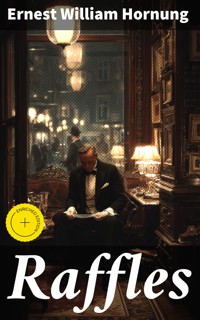
Raffles, a collection of short stories by Ernest William Hornung, introduces readers to the unforgettable character of A.J. Raffles, a charming English gentleman and master burglar. Hornung's literary style is marked by a blend of suspense, wit, and elegant prose, effectively capturing the duality of Raffles' persona as both a rogue and a gentleman of society. Set against the backdrop of Victorian London, these tales explore themes of morality, class, and the allure of crime, often inviting readers to sympathize with a protagonist who, despite his transgressions, adheres to a personal code of ethics. Ernest William Hornung, born in 1866, was not only a writer but also the brother-in-law of the renowned Arthur Conan Doyle. Hornung's experiences and background in literature, coupled with his fascination with the criminal mind, led him to create Raffles as a counterpoint to Sherlock Holmes. His works reflect a deep understanding of societal norms and the darker undercurrents of human behavior, allowing readers to experience the thrill of the chase while pondering the complexities of right and wrong. For readers who revel in intricate plots and richly drawn characters, Raffles is an essential addition to the canon of crime literature. Hornung's eloquent storytelling will captivate those who appreciate both the intellectual depth of classic literature and the excitement of cat-and-mouse intrigue, making this collection a timeless exploration of the boundaries of legality and morality. In this enriched edition, we have carefully created added value for your reading experience: - A succinct Introduction situates the work's timeless appeal and themes. - The Synopsis outlines the central plot, highlighting key developments without spoiling critical twists. - A detailed Historical Context immerses you in the era's events and influences that shaped the writing. - A thorough Analysis dissects symbols, motifs, and character arcs to unearth underlying meanings. - Reflection questions prompt you to engage personally with the work's messages, connecting them to modern life. - Hand‐picked Memorable Quotes shine a spotlight on moments of literary brilliance. - Interactive footnotes clarify unusual references, historical allusions, and archaic phrases for an effortless, more informed read.
Das E-Book können Sie in Legimi-Apps oder einer beliebigen App lesen, die das folgende Format unterstützen:
Veröffentlichungsjahr: 2020
Ähnliche
















Raffles
Table of Contents
Introduction
A cultivated veneer confronts concealed appetite as a celebrated gentleman, lauded in daylight for grace and fair play, nightly tests the limits of conscience by converting charm, intellect, and social privilege into instruments of crime, inviting readers to weigh the seductions of elegance against the stubborn demands of ethics while observing how performance, reputation, and loyalty can be both masks and motives in a world that prizes appearances as staunchly as it punishes transgression.
Raffles by Ernest William Hornung stands at the crossroads of crime fiction and late Victorian adventure, set chiefly in London’s polished clubs, quiet squares, and gaslit streets. First introduced in stories later gathered in the collection The Amateur Cracksman (1899), with additional volumes appearing in the early 1900s, the sequence reflects the sensibilities of the fin de siècle and the transition into the Edwardian era. Its premise belongs to the gentleman-thief tradition: a figure who moves with ease through high society even as he plans illicit enterprises, offering readers suspense tempered by urbane wit and an eye for social nuance.
At the center is A. J. Raffles, renowned on the cricket field and equally adept at navigating the drawing rooms where trust is a currency. His companion and chronicler, Bunny Manders, relates their exploits in an intimate, first-person voice that balances admiration with unease. Together they pursue high-stakes thefts that depend less on brute force than on timing, poise, and the misdirection afforded by impeccable manners. The result is a sequence of capers that privilege anticipation over spectacle and conversation over confession, allowing the reader to experience the thrill of preparation and the peril of improvisation without forfeiting restraint.
Hornung crafts a distinctive mood, simultaneously light-footed and morally charged. The prose favors economy and irony, often gliding from clubroom banter to nocturnal tension in a handful of sentences. Sporting language shades the action, as if each enterprise were an innings played against fate, and the city itself becomes an arena where nerves, not merely locks, must be picked. This is a world in which a well-cut suit, a steady hand, and a plausible explanation can open doors as effectively as a skeleton key, and where the difference between audacity and disaster is measured in seconds and tone.
Beneath the surface elegance lies a pointed inquiry into class and complicity. Raffles’s ease among the privileged raises questions about who is permitted to transgress and who must obey, while Bunny’s conflicted narration examines how admiration can blur judgment. The stories dramatize codes of honor and loyalty that persist even in criminal contexts, exploring what it means to keep faith with a friend when the law is the adversary. Hornung’s London is a mosaic of thresholds—club entrances, apartment corridors, bedroom windows—where social ritual collides with private impulse and the line between legitimacy and larceny is artfully, sometimes perilously, thin.
For contemporary readers, the appeal lies in the sophisticated antihero and the shrewd portrayal of double lives. The figure of the gentleman thief illuminates enduring tensions between reputation and reality, public image and private intent. The narratives invite reflection on how institutions reward polish and overlook excess, and how charm can be a strategy as potent as force. They also exemplify the pleasures of the short form—swift setup, mounting pressure, and decisive release—without surrendering psychological texture. In an era preoccupied with image-making, the stories remain relevant for their insight into performance, complicity, and the fragile bargains we strike with our ideals.
Approached as an entertainment, Raffles offers clever plots, crisp dialogue, and the glamour of risk; approached as a cultural artifact, it maps anxieties about class, sport, and respectability at the turn of the twentieth century. Hornung’s creation endures because it fuses gallantry with transgression, bathing moral uncertainty in the glow of style. To read these stories is to enter a refined yet precarious realm where wit is a tool, nerve is a method, and friendship is both solace and snare. The experience is at once urbane and unsettling, a poised invitation to consider how allure and ethics share the same stage.
Synopsis (Selection)
Raffles by Ernest William Hornung introduces A. J. Raffles, a celebrated cricketer who leads a secret life as a gentleman thief, and his friend and chronicler, Harry "Bunny" Manders. Set in late Victorian and Edwardian London, the book unfolds as a sequence of linked adventures that blend social comedy with crime. Raffles’s dual identity frames the narrative, while Bunny’s first-person account provides continuity and perspective. The stories balance clubland elegance with nocturnal risk, presenting carefully planned burglaries alongside polite society’s rituals. Without overt moralizing, the book observes class, sport, and reputation, charting how daring schemes intersect with appearances and the pressures of public life.
The opening phase follows Bunny at a low ebb, burdened by debt and uncertain prospects. Reconnecting with Raffles, he discovers the cricketer’s hidden profession and is invited into a partnership governed by discretion, nerve, and loyalty. This initiation establishes the pair’s methods: patient scouting, considered tools, and an emphasis on guile over force. It also sets terms for Bunny’s role as both accomplice and recorder, framing his position between admirer and uneasy participant. The early episodes build their working rhythm and mark out the terrain they exploit: private houses, hotel corridors, and exclusive clubs where access, manners, and timing are as crucial as lockpicks.
Subsequent escapades consolidate their style. Raffles uses cricket fixtures, social invitations, and seasonal travel as cover for operations that prize audacity and finesse. The duo adopt disguises, manipulate lighting and routine, and exploit the privileges of class to pass unchallenged. A persistent foil emerges in the form of a tenacious Scotland Yard detective whose attention heightens risk and sharpens their evasive drills. The stories probe limits without dwelling on graphic detail, emphasizing outwitting over confrontation. The pair’s private code surfaces repeatedly: avoid violence, keep faith with each other, and treat theft as a contest of wits in which preparation and coolness decide outcomes.
In the next arc, often published as The Black Mask, the tone grows more taut as notoriety begins to shadow success. Raffles leans further into disguise and deception, testing elaborate identities in tighter spaces. Targets become more complex, and the consequences of failure more visible. Rival criminals and vigilant householders complicate operations, while press attention threatens to turn rumor into recognition. Bunny’s narration records increased strain alongside continued admiration, noting how improvisation under pressure becomes the hallmark of their craft. The detective’s net narrows, and the margin for error shrinks, directing the narrative toward episodes where escape depends on timing measured in seconds.
A decisive sequence closes this phase, bringing public scrutiny and private reflection into sharp alignment. The partners confront a heist whose stakes blend personal risk with the prospect of exposure, pressing Raffles to consider the cost of continued notoriety. This culminates in a choice shaped by reputation, pride, and a changing national mood as a distant war gathers relevance at home. The narrative hints at a turning point without lingering on particulars, signaling that the duo’s bold play may require a different kind of courage. The result reframes their partnership’s trajectory and leaves space for earlier, unrecorded exploits to be explored with retrospective clarity.
A Thief in the Night revisits missing chapters in their career, with Bunny recounting untold episodes that fill gaps and deepen character. These stories emphasize craft over spectacle: stakeouts, coded notes, and the reading of rooms and routines. Moments of personal history surface, sketching formative influences on Raffles’s methods and manners. The detective’s presence remains a steady pressure, though the focus shifts to quieter tensions—promises kept, temptations resisted, and what it means to live by a private rulebook. The retrospective structure lets Hornung alternate brisk plotting with glimpses of doubt, loyalty, and the small decisions that shape later, larger choices.
Mr. Justice Raffles, a later novel, narrows its lens to a single extended scheme that joins crime to a sense of retribution. Here, Raffles applies his skills not only for gain but to correct a social wrong, targeting an individual whose respectability masks misconduct. Cricket’s ethic of fair play supplies both theme and disguise, while Bunny records the strain that comes from playing accuser, judge, and thief at once. The plan requires infiltration, patience, and moral calculation, revealing how their code adapts when theft intersects with a notion of justice. The outcome underscores limits, consequences, and the public and private costs of such improvisation.
Throughout, Hornung’s structure relies on Bunny’s intimate narration: confessional, clipped, and attentive to habit and detail. London’s clubs, hotels, and terraces provide recurring stages, contrasted with country houses and sporting grounds where Raffles’s fame smooths access. The plots turn on misdirection, timing, and social engineering rather than brute force. Themes recur unobtrusively: the advantages of class, the fragility of respectability, and the pull of camaraderie under pressure. The detective’s pursuit offers continuity and a test of method, while newspapers, gossip, and windows of opportunity function as silent characters. Each episode stands alone yet contributes to an arc of rising risk and recalibration.
Taken together, Raffles presents the archetype of the gentleman cracksman: polished, resourceful, and bound by a personal code that complicates simple judgment. The central message is less a defense of crime than an exploration of appearances, loyalty, and the thin line between sport and transgression. By tracing glamorous entrances and discreet exits, the book shows how calculation, charm, and discipline can both disguise and define identity. Without resolving every question, it follows the pair from initiation through heightened peril and reflective aftermath. The result is a compact cycle that marries suspense with social observation, shaping a template for later stories of elegant, elusive thieves.
Historical Context
Ernest William Hornung’s Raffles stories are set primarily in late Victorian and early Edwardian London, with scenes centered on Piccadilly’s Albany chambers—bachelor apartments built in 1802—and the elite world of West End clubs and Lord’s Cricket Ground. The time frame mirrors the 1890s through the first decade of the twentieth century: magazine stories began in 1898, The Amateur Cracksman appeared in 1899, The Black Mask in 1901, A Thief in the Night in 1905, and Mr. Justice Raffles in 1909. The setting draws on a metropolis of gaslit streets transitioning to electricity, omnibus and rail networks, and an imperial capital whose wealth and anxieties radiated from Mayfair to the East End and beyond to South Africa.
A central historical frame is the British class system expressed through amateur sport. In nineteenth‑century cricket, amateurs (often gentlemen of means) and professionals (paid players) were institutionally divided; the celebrated Gentlemen v Players fixtures were staged from 1806 (regularly after 1835) at Lord’s and The Oval. W. G. Grace (1848–1915) epitomized the era’s cricketing prestige. The Marylebone Cricket Club (MCC), founded in 1787, codified the sport’s ethos, while the County Championship became official in 1890. Hornung’s A. J. Raffles—celebrated as a “Gentleman of England” batsman—exploits deference attached to status and sport: the same credentials that open club doors also mask his crimes, dramatizing how class privilege could disarm scrutiny.
The public‑school “games ethic” and Muscular Christianity shaped Victorian ideals of character and empire. Thomas Arnold’s reforms at Rugby School (1828–1842) popularized organized games as moral training; by the 1870s–1890s, sport underwrote claims of manly discipline for governing an empire. The Ashes rivalry with Australia dates to 1882, and Lord’s functioned as the symbolic home of national prowess. Raffles’s cricketing celebrity evokes these ideals while subverting them: he uses the respect attached to fair play, team spirit, and gentlemanliness as cover for burglary. Hornung thus mirrors a society that proclaimed moral rectitude through sport even as social realities—class hierarchy and opportunism—eroded those lofty claims.
Urban policing and the sensational press provide another key context. London’s Metropolitan Police were founded in 1829, with the Criminal Investigation Department (CID) established in 1878 to professionalize detection. Forensic modernity accelerated with the adoption of fingerprint classification in 1901 and the first British fingerprint conviction in 1902. Meanwhile, mass papers such as the Daily Mail (1896) and crusading “New Journalism” (exemplified by W. T. Stead’s Pall Mall Gazette exposés in 1885) amplified interest in crime. Inspector Mackenzie in the stories evokes Scotland Yard’s expanding reach. Raffles thrives in this world: anonymity in crowds, disguises, and media fascination create a cat‑and‑mouse arena between celebrity criminality and modern law enforcement.
The “social question” of poverty and urban inequality loomed large in the 1880s–1900s. Charles Booth’s Life and Labour of the People in London (1886–1903) mapped destitution across East End streets; the 1888 Whitechapel murders dramatized policing limits and public fear; the Poor Law and workhouses remained harsh backstops for the indigent. Settlement houses such as Toynbee Hall (founded 1884) pioneered social intervention. Hornung’s milieu reflects this divide between Mayfair affluence and slum deprivation. By Mr. Justice Raffles (1909), the hero’s targets increasingly include unscrupulous profiteers, echoing real debates over slum landlordism, gambling, and exploitation. The stories’ jewel thefts and clubland capers thus orbit a city economically and morally bifurcated.
The Second Boer War (1899–1902) profoundly informs the series’ trajectory. Britain fought the South African Republic (Transvaal) and the Orange Free State amid tensions over the Witwatersrand goldfields (discovered 1886) and the failed Jameson Raid (1895–1896). Early British setbacks—Magersfontein (December 1899) and Spion Kop (January 1900)—preceded the reliefs of Ladysmith and Mafeking (May 1900), events that sparked mass “mafficking” celebrations in London. Under Kitchener, guerrilla warfare prompted scorched‑earth tactics and civilian concentration camps, where tens of thousands of Boer women and children died. Hornung sends Raffles to enlist under an alias and die in action (published 1901), channeling both patriotic volunteerism and the era’s sobering cost of imperial conflict.
Financial shocks and imperial speculation flavored the high society Raffles haunts. The Baring Crisis (1890), a near‑collapse of Barings Bank over Argentine debt, revealed London’s vulnerability to global finance. In southern Africa, Cecil Rhodes consolidated diamond interests through De Beers (chartered 1888), and the 1895 Jameson Raid exposed the entanglement of capital, adventurism, and policy. Clubland—St. James’s and Piccadilly—mixed aristocrats, industrial plutocrats, and gamblers; bankruptcies and sudden fortunes were common in the 1890s. Hornung mirrors this volatile elite economy: Raffles’s victims include jewel‑laden socialites and speculative magnates, and his timing exploits fashionable gatherings, racing calendars, and seasons at Lord’s, indicting wealth built on risk, privilege, and imperial extraction.
As social and political critique, the book exposes contradictions at the heart of late Victorian Britain. It reveals how deference to class and sport insulated wrongdoing, how policing modernized yet could be outwitted by those versed in elite codes, and how urban inequality set glittering salons against precarious streets. By making a national sportsman a burglar, Hornung questions whether “gentlemanliness” reflects virtue or merely access and impunity. The Boer War episode complicates imperial bravado with loss and moral ambiguity. Across its episodes, Raffles interrogates the justice of property, the selectivity of law, and the ethical emptiness of reputation divorced from responsibility.
Raffles
No Sinecure
No Sinecure
I
I AM still uncertain which surprised me more, the telegram calling my attention to the advertisement, or the advertisement itself. The telegram is before me as I write. It would appear to have been handed in at Vere Street at eight o'clock in the morning of May 11, 1897, and received before half-past at Holloway B.O. And in that drab region it duly found me, unwashen but at work before the day grew hot and my attic insupportable.
"See Mr. Maturin's advertisement Daily Mail might suit you earnestly beg try will speak if necessary————"
I transcribe the thing as I see it before me, all in one breath that took away mine; but I leave out the initials at the end, which completed the surprise. They stood very obviously for the knighted specialist whose consulting-room is within a cab-whistle of Vere Street, and who once called me kinsman for his sins. More recently he had called me other names. I was a disgrace, qualified by an adjective which seemed to me another. I had made my bed, and I could go and lie and die in it. If I ever again had the insolence to show my nose in that house, I should go out quicker than I came in. All this, and more, my least distant relative could tell a poor devil to his face; could ring for his man, and give him his brutal instructions on the spot; and then relent to the tune of this telegram! I have no phrase for my amazement. I literally could not believe my eyes. Yet their evidence was more and more conclusive: a very epistle could not have been more characteristic of its sender. Meanly elliptical, ludicrously precise, saving half-pence at the expense of sense, yet paying like a man for "Mr." Maturin, that was my distinguished relative from his bald patch to his corns. Nor was all the rest unlike him, upon second thoughts. He had a reputation for charity; he was going to live up to it after all. Either that, or it was the sudden impulse of which the most calculating are capable at times; the morning papers with the early cup of tea, this advertisement seen by chance, and the rest upon the spur of a guilty conscience.
Well, I must see It for myself, and the sooner the better, though work pressed. I was writing a series of articles upon prison life, and had my nib into the whole System; a literary and philanthropical daily was parading my "charges," the graver ones with more gusto; and the terms, if unhandsome for creative work, were temporary wealth to me. It so happened that my first check had just arrived by the eight o'clock post; and my position should be appreciated when I say that I had to cash it to obtain a Daily Mail.
Of the advertisement itself, what is to be said? It should speak for itself if I could find it, but I cannot, and only remember that it was a "male nurse and constant attendant" that was "wanted for an elderly gentleman in feeble health." A male nurse! An absurd tag was appended, offering "liberal salary to University or public-school man"; and of a sudden I saw that I should get this thing if I applied for it. What other "University or public-school man" would dream of doing so? Was any other in such straits as I? And then my relenting relative; he not only promised to speak for me, but was the very man to do so. Could any recommendation compete with his in the matter of a male nurse? And need the duties of such be necessarily loathsome and repellent? Certainly the surroundings would be better than those of my common lodging-house and own particular garret; and the food; and every other condition of life that I could think of on my way back to that unsavory asylum. So I dived into a pawnbroker's shop, where I was a stranger only upon my present errand, and within the hour was airing a decent if antiquated suit, but little corrupted by the pawnbroker's moth, and a new straw hat, on the top of a tram.
The address given in the advertisement was that of a flat at Earl's Court, which cost me a cross-country journey, finishing with the District Railway and a seven minutes' walk. It was now past mid-day, and the tarry wood-pavement was good to smell as I strode up the Earl's Court Road. It was great to walk the civilized world again. Here were men with coats on their backs, and ladies in gloves. My only fear was lest I might run up against one or other whom I had known of old. But it was my lucky day. I felt it in my bones. I was going to get this berth; and sometimes I should be able to smell the wood-pavement on the old boy's errands; perhaps he would insist on skimming over it in his bath-chair, with me behind.
I felt quite nervous when I reached the flats. They were a small pile in a side street, and I pitied the doctor whose plate I saw upon the palings before the ground-floor windows; he must be in a very small way, I thought. I rather pitied myself as well. I had indulged in visions of better flats than these. There were no balconies. The porter was out of livery. There was no lift, and my invalid on the third floor! I trudged up, wishing I had never lived in Mount Street, and brushed against a dejected individual coming down. A full-blooded young fellow in a frock-coat flung the right door open at my summons.
"Does Mr. Maturin live here?" I inquired.
"That's right," said the full-blooded young man, grinning all over a convivial countenance.
"I—I've come about his advertisement in the Daily Mail."
"You're the thirty-ninth," cried the blood; "that was the thirty-eighth you met upon the stairs, and the day's still young. Excuse my staring at you. Yes, you pass your prelim., and can come inside; you're one of the few. We had most just after breakfast, but now the porter's heading off the worst cases, and that last chap was the first for twenty minutes. Come in here."
And I was ushered into an empty room with a good bay-window, which enabled my full-blooded friend to inspect me yet more critically in a good light; this he did without the least false delicacy; then his questions began.
"'Varsity man?"
"No."
"Public school?"
"Yes."
"Which one?"
I told him, and he sighed relief.
"At last! You're the very first I've not had to argue with as to what is and what is not a public school. Expelled?"
"No," I said, after a moment's hesitation; "no, I was not expelled. And I hope you won't expel me if I ask a question in my turn?"
"Certainlv not."
"Are you Mr. Maturin's son?"
"No, my name's Theobald. You may have seen it down below."
"The doctor?" I said.
"His doctor," said Theobald, with a satisfied eye. "Mr. Maturin's doctor. He is having a male nurse and attendant by my advice, and he wants a gentleman if he can get one. I rather think he'll see you, though he's only seen two or three all day. There are certain questions which he prefers to ask himself, and it's no good going on the same ground twice. So perhaps I had better tell him about you before we get any further."
And he withdrew to a room still nearer the entrance, as I could hear, for it was a very small flat indeed. But now two doors were shut between us, and I had to rest content with murmurs through the wall until the doctor returned to summon me.
"I have persuaded my patient to see you," he whispered, "but I confess I am not sanguine of the result. He is very difficult to please. You must prepare yourself for a querulous invalid, and for no sinecure if you get the billet."
"May I ask what's the matter with him?"
"By all means—when you've got the billet."
Dr. Theobald then led the way, his professional dignity so thoroughly intact that I could not but smile as I followed his swinging coat-tails to the sick-room. I carried no smile across the threshold of a darkened chamber which reeked of drugs and twinkled with medicine bottles, and in the middle of which a gaunt figure lay abed in the half-light.
"Take him to the window, take him to the window," a thin voice snapped, "and let's have a look at him. Open the blind a bit. Not as much as that, damn you, not as much as that!"
The doctor took the oath as though it had been a fee. I no longer pitied him. It was now very clear to me that he had one patient who was a little practice in himself. I determined there and then that he should prove a little profession to me, if we could but keep him alive between us. Mr. Maturin, however, had the whitest face that I have ever seen, and his teeth gleamed out through the dusk as though the withered lips no longer met about them; nor did they except in speech; and anything ghastlier than the perpetual grin of his repose I defy you to imagine. It was with this grin that he lay regarding me while the doctor held the blind.
"So you think you could look after me, do you?"
"I'm certain I could, sir."
"Single-handed, mind! I don't keep another soul. You would have to cook your own grub and my slops. Do you think you could do all that?"
"Yes, sir, I think so."
"Why do you? Have you any experience of the kind?"
"No, sir, none."
"Then why do you pretend you have?[2q]"
"I only meant that I would do my best."
"Only meant, only meant! Have you done your best at everything else, then?"
I hung my head. This was a facer. And there was something in my invalid which thrust the unspoken lie down my throat.
"No, sir, I have not," I told him plainly.
"He, he, he!" the old wretch tittered; "and you do well to own it; you do well, sir, very well indeed. If you hadn't owned up, out you would have gone, out neck-and-crop! You've saved your bacon. You may do more. So you are a public-school boy, and a very good school yours is, but you weren't at either University. Is that correct?"
"Absolutely."
"What did you do when you left school?"
"I came in for money."
"And then?"
"I spent my money."
"And since then?"
I stood like a mule.
"And since then, I say!"
"A relative of mine will tell you if you ask him.[1q] He is an eminent man, and he has promised to speak for me. I would rather say no more myself."




