


13,19 €
Mehr erfahren.
- Herausgeber: Saqi Books
- Kategorie: Poesie und Drama
- Sprache: Englisch
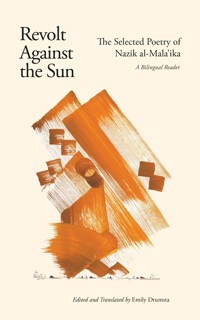
The Iraqi poet Nazik al-Mala'ika was one of the most important Arab poets of the twentieth century. A pioneer of free verse poetry, over four decades, she transformed the landscape of modern Arabic literature and culture. Revolt Against the Sun presents a selection of Nazik alMala'ika's poetry in English for the first time. Bringing together poems from each of her published collections, it traces al-Mala'ika's transformation from a lyrical Romantic poet in the 1940s to a fervently committed Arab nationalist in the 1970s and 1980s. This bilingual reader reveals how one woman transformed the landscape of modern Arabic literature and culture in the twentieth century. Introduction includes a bio-bibliography of al-Mala'ika, historical and biographical context for her evolution as a poet, an overview of the 'free verse' debates, and discusses how she reconfigured gender stereotypes.
Das E-Book können Sie in Legimi-Apps oder einer beliebigen App lesen, die das folgende Format unterstützen:
Seitenzahl: 169
Veröffentlichungsjahr: 2020
Ähnliche












REVOLT AGAINST THE SUN
REVOLT AGAINST THE SUN
THE SELECTED POETRY OFNĀZIK AL-MALĀʾIKAH
A Bilingual Reader
Edited and translated byEMILY DRUMSTA
Saqi Books
26 Westbourne Grove
London W2 5RH
www.saqibooks.com
Published 2020 by Saqi Books
Copyright © Emily Drumsta 2020
Emily Drumsta has asserted her right under the Copyright, Designs and Patents Act, 1988, to be identified as the author of this work.
This book is sold subject to the condition that it shall not, by way of trade or otherwise, be lent, resold, hired out, or otherwise circulated without the publisher’s prior consent in any form of binding or cover other than that in which it is published and without a similar condition including this condition being imposed on the subsequent purchaser.
ISBN 978 0 86356 317 1
eISBN 978 0 86356 352 2
A full CIP record for this book is available from the British Library.
Typesetting and design by Stuart Brown
Printed and bound by Clays S.A.r, Elcograf
CONTENTS
INTRODUCTION
POEMS FROMNIGHT LOVER (1947)
Revolt Against the Sun
Elegy for a Drowned Man
Night Lover
To the Poet Keats
POEMS FROMSHRAPNEL AND ASH (1949)
The Train Passed By
Elegy for an Unimportant Day
At the End of the Stairs
Song of the Abyss
To My Late Aunt
Cholera
A Funeral for Happiness
Accusations
POEMS FROMAT THE BOTTOM OF THE WAVE (1957)
To a Girl Sleeping in the Street
Elegy for a Woman of No Importance
Three Elegies for my Mother
I A Song for Sadness
II The Arrival of Sadness
III The Black Flower
Killing a Dancer
When I Killed My Love
Words
An Invitation to Life
POEMS FROMTHE MOON TREE (1968)
The Moon Tree
Greetings to the Iraqi Republic
A Song for the Arab Ruins
A Song for the Moon
Three Communist Songs
POEMS FROMFOR PRAYER AND REVOLUTION (1978)
Sleeping Beauty
A Letter from Him
A Letter to Him
Headlines and Advertisements in an Arab Newspaper
POEM FROMTHE SEA CHANGES ITS COLORS (1977)
And We Still Have the Sea
ACKNOWLEDGMENTS
INTRODUCTIONEmily Drumsta
Nāzik al-Malāʾikah (1923–2007) was one of the most significant Arab writers of the twentieth century. Over the course of her career, she published seven poetry collections, four full-length works of literary criticism, and dozens of articles in the most widely read Arabic literary periodicals of the time. Yet for decades, to read Malāʾikah in English translation was to go hunting through anthologies of Arab women’s poetry, seeking out a few poems here and there. By contrast, nearly every collection Maḥmūd Darwīsh ever wrote has been published as its own volume in English, and readers can peruse several books of Adūnīs’ poetry in English too. Though equally as significant to the development of Arab modernism, women poets like Malāʾikah and her contemporaries Fadwā Ṭūqān, Lamīʿah ʿAbbās ʿAmārah, Mayy Ṣāyigh, and many others have for years been relegated to the realm of anthologies.
The significance of Nāzik al-Malāʾikah’s poetry lies in the way each poem tells two stories at the same time. The first story relies on reference and association; it’s what the poem is ostensibly about. The second story emerges in the sound of the poem as it sonically unfolds. And where the poem’s narrative content leads us on a journey of the mind, its sound leads us on a journey of the senses, carrying us with its music.
For al-Malāʾikah, poetry and music are inseparable, and musical metaphors can be found throughout her writing, both in her poetry and critical essays. Although she is best known as a pioneer of ‘free verse’ poetry in Arabic, Malāʾikah remained fervently committed to the unique features of Arabic metrics throughout her career. ‘The poetic feet have their roots in music,’ she wrote in the landmark critical study Issues in Contemporary Poetry in 1962, ‘and they are as stable and fixed in any language as numbers are in math.’1 Indeed, nearly every time the word ‘meter’ (al-wazn) appears in Issues, musical terminology is not far behind. ‘Meter is the soul that electrifies literary material and transforms it into poetry,’ she writes. ‘Indeed, images and feelings do not become poetic, in the true sense, until the fingers of music touch them and the pulse of meter beats in their veins.’2 Poems with musical titles abound in nearly all of her collections, including ‘songs’ (ughniyyāt), ‘hymns’ (anāshīd), ‘melodies’ (alḥān), and ‘tunes’ (naghamāt), extending all the way through the poems ‘Journey along the Strings of an Oud,’ from For Prayer and Revolution, and ‘The Symphony of Carpets,’ from The Red Rose. And when Malāʾikah was asked to publish her 1977–79 Kuwait University lectures on Arabic metrics, including an essay titled ‘The Secret of Poetic Music,’ she titled the collection The Music of Poetry.3
Reading the many published biographies of Malāʾikah, it is not difficult to understand why music was so important to her theory and practice of poetry. Born in 1923, Malāʾikah was the eldest of seven children in the family of Ṣādiq and Salīmah al-Malāʾikah (also known as Salmā and, later, as Umm Nizār), both of whom were poets in their own right. According to one account, Nāzik began playing the oud at a very young age and composed her earliest poems as the lyrics to songs performed during social gatherings at the Malāʾikah family home, in the well-to-do Karrādah neighborhood of Baghdad.4 Malāʾikah herself also describes having learned and internalized the rhythms of Arabic poetry not only through formal schooling, but also in time with the rhythms of her mother’s household chores. ‘In my childhood,’ Malāʾikah writes, ‘I would often hear my mother accompanying her housework with the poetry of Jamīl Buthaynah, Kuthayyir ʿAzzah, Qays ibn al-Mulawwaḥ, al-Sharīf al-Raḍī, Abū Firās al-Ḥamadānī, Ibn al-Fāriḍ, al-Bahāʾ Zuhayr, and others.’5 This may sound like a rose-tinted memory, but Malāʾikah was not the only writer to reflect on how classical Arabic poetry gave rhythm and form to the traditionally feminine tasks of housework: her contemporary, the Palestinian poet Fadwā Ṭūqān, also remembers ‘performing household tasks with a poem in my pocket’ and ‘memorizing poetry while I ironed my brothers’ shirts and trousers, while I made the beds, and while I washed the naphtha glass tops and filled the lamps with fuel.’6 Though Malāʾikah likely exaggerated these and other stories about her childhood for effect, the portrait she paints of a family home where love ghazals, Sufi odes, and poetry from the Abbasid Golden Age mingled with housework, parties, and crowded Ashura gatherings aptly conveys how she understood her own literary formation. Poetry, music, and the culturally specific rhythms of Arabic verse, she implies to her biographers, have been in her blood almost since birth, inherited from her literary parents and imbibed with the rhythms of daily life. Every account she gives of her life underscores the importance of these meters to her very being.
Given Malāʾikah’s longstanding interest in the ties between musical and poetic composition, it is no surprise that she dedicated one of her major works of literary criticism, The Monk’s Cell and the Red Balcony (1965), to the Egyptian Romantic Poet ʿAlī Maḥmūd Ṭāhā, who is best known for his ‘highly developed sense of music.’7 In a fashion typical of her practical criticism, Malāʾikah eschews what she calls the ‘vague language of “ringing” (ranīn) and “incandescence”’ (tawahhuj) that saturates other scholars’ criticism on Ṭāhā, developing instead specific, descriptive terms to show how Ṭāhā plays with alliteration and Arabic morphology to achieve his particular form of poetic music. Even in her criticism, then, Malāʾikah was as interested in identifying ‘the secret of a poem’s music’ as she was in parsing its thematic content.8
Despite this longstanding interest in meter and music, Malāʾikah’s legacy in the world of Arabic letters is built on her reputation as the pioneer of a specific poetic form, known in Arabic as al-shiʿr al-ḥurr and in English, somewhat misleadingly, as ‘free verse’. Far from ‘free’ of metrical regularity, al-shiʿr al-ḥurr isolated the Arabic metrical ‘foot’, or tafʿīlah, as the most basic unit of sound in Arabic poetry. The traditional Arabic poetic line generally consists of two hemistichs separated by a caesura. Some meters combine two different feet in alternating patterns, while others repeat the same foot three or four times per hemistich. When written down, these poems generally look like two columns laid on the page, leading many modernists to describe them (often pejoratively) as ‘columnar’, or ʿamūdī. In the ‘free verse’ poetry for which Malāʾikah would become famous, by contrast, the poet chooses a single poetic foot to repeat as many or as few times as desired in each line, in accordance with the dictates of the poem’s thematic content. The base foot of the meter, however, had to remain the same – on this point Malāʾikah insisted.
In the introduction to her 1949 collection Shrapnel and Ash, Malāʾikah presented al-shiʿr al-ḥurr as a revolutionary, radical departure from the Arabic meters systematized and described by the lexicographer al-Khalīl ibn Aḥmad al-Farāhīdī in the eighth century CE. ‘We are still prisoners,’ she wrote, ‘held captive by the rules our forebears established in the pre-Islamic and early Islamic periods ... gasping for air in our poems, shackling our emotions in the chains of old meters and creaking, dead expressions.’9 However, with the publication of Issues in Contemporary Poetry thirteen years later, Malāʾikah seemed to have softened in her attitudes toward the traditional meters. ‘The free verse movement’, she wrote, emerged ‘not from a desire to do away with traditional prosody (al-ʿarūḍ), but rather from an extreme care for prosody, which caused modern poets to notice the incredible uniqueness embedded in six of the Arabic meters and make these meters the bearers of a new metrical style, one which is built upon the old but adds something new and contemporary to it.’10 Starting in the early nineteen-sixties, then, Malāʾikah’s critical attitude toward ‘free verse’ had pivoted: the new style, epitomized in her own poem ‘Cholera’, was not a radical departure from a stifling tradition (as she had presented it in Shrapnel and Ash), but merely a reconfiguration of time-honored, authentically ‘Arab’ rhythms.
Malāʾikah carefully crafted, honed, and repeated the origin story of ‘Cholera’ over the course of her career, insisting on its status as a ‘first’ in order to seal her reputation as a modern metrical innovator, even though the poem is monostrophic rather than ‘free’.11 While she anticipated that the main resistance to al-shiʿr al-ḥurr would come from Arab readers devoted to the monorhyme and regular rhythms of classical Arabic poetry, in the end Arab publics proved largely hospitable to the new form, having already encountered it in earlier poems by Ṭāhā, Jibrān Khalīl Jibrān, Niqūlā Fayyāḍ, Lūwīs ʿAwaḍ, ʿAlī Bākāthīr, and others who had ‘broken the back of poetry’ (to borrow ʿAwaḍ’s famous phrase) in the first half of the twentieth century.12 The greatest resistance to al-shiʿr al-ḥurr, it turned out, would come not from those who wanted to maintain the classical forms, but from those who felt the new poetry did not go far enough to break with tradition. Ironically then, despite her emphasis on ‘freedom’ throughout Issues – and on all the ties between this Arabic word (ḥurriyyah) and political ‘liberation’ (taḥrīr) from colonial rule – Malāʾikah began to ‘style herself as a present-day al-Khalīl’,13 a self-fashioning which landed her on the receiving end of virulent criticism from advocates of the ‘prose poem’ (qaṣīdat al-nathr) in Arabic. Standing by ‘Cholera’ as the standard against which all other formal experimentations were to be measured, Malāʾikah became known as a fierce defender of grammatical and metrical ‘correctness’ against the tides of what she considered to be dangerous poetic experimentation. Yūsuf al-Khāl’s disparaging remark that Malāʾikah had ‘donned the veil of conservatism and closed-mindedness’ aptly sums up the reputation she came to have as a critic.14
Perhaps the most virulent attack on Malāʾikah’s formal conservatism, however, came from the Palestinian-Iraqi author and critic Jabrā Ibrāhīm Jabrā, who published his polemical response to Issues, ‘Poetry and Ignorant Criticism’, in 1963.15 Unlike Malāʾikah, for whom ‘free verse’ was a modification of essentially Arab meters, music, and forms, Jabrā insisted ‘the only examples and parallels capable of shedding light on modernist Arabic poetry must be found in the literatures and arts of the West, not of the Arab world.’16 To explain the new currents of modernist innovation, Jabrā turns neither to al-Khalīl nor even to Jibrān or Ṭāhā, but rather to ‘the history of poetry, painting and music in the West, from the Romantic revolution through whatever literary or artistic movement is currently in vogue in the cafés of Saint Germain-des-Près or the alleyways of London and Los Angeles.’17 Though Jabrā does not dismiss the importance of the past in modernist innovation, still he argues that ‘what Nāzik al-Malāʾikah wants from the past is restraint, as evidenced by her recourse to the meters of al-Khalīl and what she vaguely calls “the Arab instinct” (al-fiṭrah al-ʿarabiyyah) or “the Arab ear” (al-udhun al-ʿarabiyyah).’18
Unlike the ‘free verse’ poetry composed by Malāʾikah, her contemporary Badr Shākir al-Sayyāb, and others, the ‘prose poem’ had no allegiance to the Arabic poetic foot. Poets like Yūsuf al-Khāl, ʿUnsī al-Ḥājj, Adūnīs, and others in the Beirut circle of Shiʿr magazine advocated – in theory and in practice – a form similar to English-language free verse: poetry whose rhythms, line-breaks, and layout on the page would be determined entirely by the poet’s will, not by the dictates of classical poetic feet. Here music resided not in the undulations of long and short vowels pressed into the regular patterns of the tafʿīlah, but in the rhythms of the poet’s ‘personal, private world.’19 Malāʾikah was vehemently opposed to the prose poem, however, and she lashed out against its advocates at great length in Issues. ‘Over the last ten years, a strange heresy (bidʿah) has spread through the literary climate in Lebanon,’ she wrote.20 She claimed to be distressed mainly by the Shiʿr poets’ application of the term ‘poetry’ (shiʿr) to what was essentially ‘prose’ (nathr) with line-breaks, and she worried that this ‘prose poetry,’ which resembled al-shiʿr al-ḥurr on the page, might ‘confuse ordinary, everyday readers, who are not poets themselves and who may have very little background in Arabic poetry’ into thinking there is no difference between the two.21 This concern for the average Arab reader, however, hides a deeper disdain for European infiltrations into the Arabic poetic tradition. Malāʾikah referred to Shiʿr as a magazine published ‘in the Arabic language and the European spirit’ and to her contemporaries as ‘a generation that imitates Europe in everything, casting aside the rich and storied heritage of the Arabs.’22 When citing the prose poetry of the Syrian Muḥammad al-Maghūṭ, meanwhile, she pointedly refused to reproduce its line-breaks. ‘We will write this prose as prose should be written, with apologies to its author (whose excellent literary taste and originality have been damaged by the artificial European spirit he has forcibly injected into his thoughts and expressions).’23
Given these and other examples of essentialism and dismissiveness in Issues, it is difficult not to agree with many of Jabrā’s criticisms in ‘Free Verse and Ignorant Criticism,’ despite the condescension that saturates his essay. For one thing, as Jabrā points out, the language Malāʾikah used to write off poets who didn’t strictly adhere to the formal standards of al-shiʿr al-ḥurr was often unnecessarily cruel. At one point in Issues, she zeroes in on a poem by the Syrian-Lebanese poet Fuʾād Rifqah, which is technically composed in the hazaj meter but frequently breaks the line in the middle, rather than at the end, of a foot. Malāʾikah called the poem ‘useless and without purpose’ and urged that ‘no critic should stay silent about such things,’ since ‘chaos and ugliness have limits.’24 The syntax of the original Arabic – inna li-l-fawḍā wa-l-qubḥ ḥudūd – echoes the lyrics of ‘Patience has Limits’ (Li-l-Ṣabr Ḥudūd), a famous song by the Egyptian singer and pan-Arabist emblem Umm Kulthūm, of whom Malāʾikah was a great admirer. Even more significantly, as Jabrā also points out, the arguments advanced in Issues tend to rely too heavily on essentialisms such as ‘the Arab instinct’ or ‘the Arab ear,’ which land uncomfortably on contemporary ears.
To understand Malāʾikah’s reliance on such essentialisms, we must revisit a key literary debate about modernity and tradition that rocked the Arab world in the nineteen-fifties and sixties. On one side of this debate, there were the poets and critics associated with Shiʿr magazine in Beirut, who sought to launch Arabic poetry onto the stage of global modernism in part through the translation and implementation of European and American critical, theoretical, and poetic paradigms.25 On the other side of this debate were figures like Malāʾikah, Suhayl Idrīs, and others associated with al-Ādāb magazine (also published in Beirut), who viewed European cultural incursions into Arabic poetry as extensions of the colonial and imperial systems of power whose hold over Arabic-speaking countries had, it was believed at the time, recently come to an end. Malāʾikah’s Issues, though it has predominantly been read as a manifesto for al-shiʿr al-ḥurr, can also be read as a manifesto of Arab nationalism in line with the views and principles held by this latter group.26 Like many of her contemporaries invigorated by the rise to power of Gamal Abdel Nasser in Egypt, Malāʾikah countered colonial essentialisms with anti-colonial ones, revalorizing an Arab identity that had been studied, classified, and deemed lacking by generations of European colonial administrators and Orientalists. In the very last paragraph of Issues, Malāʾikah writes:
Many of [our Arab critics] resolutely believe that we are less gifted than Western poets, and that we must be spoon-fed their theories if we want to develop Arabic poetry and criticism. I, on the other hand, would say that the material of our Arabic poetry and our Arab life is even richer and more fertile than the material of contemporary European poetry ... I would even predict that a sweeping wave of renewal will soon emerge from this Arab world of ours – one which will turn the West into pupils studying at the feet of our most gifted writers and critics. But this will only happen if we believe in ourselves ... Let us cease bending to the West. We are sick of French and English words in Arabic criticism. We are thirsty for local criticism whose keywords are derived from Arabic poetry itself, and in which Arab-ness (al-ʿurūbah) is the source of renewal. I call upon the new generation of critics to look inside themselves when they write, such that the fertile Arab mind might yield its fruit. Soon the nation will discover the true sources of its thought – those Arab sources in which the Arab critic will find all the richness and goodness he needs, without recourse to others.27
Read with critical, contemporary eyes, Malāʾikah’s emphasis on the ‘fertile Arab mind’ (al-dhihn al-ʿarabī al-khaṣīb), its ‘fruits’ (athmār), and its ‘true sources’ (al-manābi‘al-ḥaqq) feel unsavory at best. Read historically, however, they reveal that there was more at stake in the free verse debates than line-breaks, rhyme schemes, and metrical feet. Malāʾikah and others, despite their reverence for John Keats, Lord Byron, and Thomas Gray, saw the incursion of European attitudes, terms and forms into Arabic literary criticism as little more than a continuation of colonial hegemony. Their Arabism was an anti-colonial political creation translated into aesthetic, formal terms.
If reverence for tradition and Arab nationalism were the bywords of Malāʾikah’s reputation as a critic, as a poet, by contrast, she was known, particularly in her early collections, as the mistress of death, pain, and loss, a ‘woman in love with night and all its lush ravines’.28 Many studies of her poetry focus on its sadness and pessimism, its treatment of death, its explorations of pain and suffering, and its fascination with night and darkness.29 Malāʾikah’s views on ‘Poetry and Death’ were clearly shaped by her studies of British Romantic poets in particular, both in Iraq and abroad.30




