


Erhalten Sie Zugang zu diesem und mehr als 300000 Büchern ab EUR 5,99 monatlich.
- Herausgeber: IVP
- Kategorie: Religion und Spiritualität
- Sprache: Englisch
- 2019 Foreword INDIES Book of the Year Award - Political and Social Sciences The religious Right taught America to misread the Bible. Christians have misused Scripture to consolidate power, stoke fears, and defend against enemies. But people who have been hurt by the attacks of Christian nationalism can help us rediscover God's vision for faith in public life. Jonathan Wilson-Hartgrove explores how religious culture wars have misrepresented Christianity at the expense of the poor, and how listening to marginalized communities can help us hear God's call to love and justice in the world. He highlights people on the frontlines of issues ranging from immigration policy and voting rights to women's rights and environmental stewardship. Through these narratives, we encounter a recovery of values that upholds the dignity of all people. Rediscover hope for faithful public witness that serves the common good. Join the revolution.
Sie lesen das E-Book in den Legimi-Apps auf:
Seitenzahl: 278
Veröffentlichungsjahr: 2019
Das E-Book (TTS) können Sie hören im Abo „Legimi Premium” in Legimi-Apps auf:
Ähnliche
















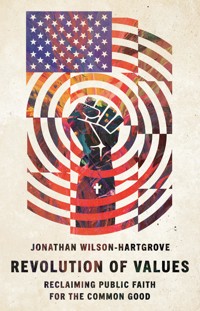
Revolution of Values
Reclaiming Public Faithfor the Common Good
FOR ALL THE SAINTS WHO’VE GONE BEFORE
“There is a river . . .”
Contents
Introduction
MORAL CLARITY ANDTHE FOG OF WAR
War is the realm of uncertainty; three quarters of the factors on which action in war is based are wrapped in a fog of greater or lesser uncertainty. A sensitive and discriminating judgment is called for; a skilled intelligence to scent out the truth.
When the Son of Man comes in his glory, and all the angels with him, he will sit on his glorious throne. All the nations will be gathered before him, and he will separate the people one from another as a shepherd separates the sheep from the goats. . . .
Then the righteous will answer him, “Lord, when did we see you hungry and feed you, or thirsty and give you something to drink? When did we see you a stranger and invite you in, or needing clothes and clothe you? When did we see you sick or in prison and go to visit you?”
The King will reply, “Truly I tell you, whatever you did for one of the least of these brothers and sisters of mine, you did for me.”
Since the late 1970s in America, political operatives have invested money and energy in framing the cultural concerns of conservative white Christians as the moral issues in our public life. This framing was the explicit agenda of many of the organizations that built the religious right, but it has become commonplace across political and religious divides in America’s public square. Whether you agree with them or not, conservative white evangelicals serve as the spokespersons for morality on the evening news.
This was not always the case. Just half a century ago, the most famous religious leader in America was the Reverend Dr. Martin Luther King Jr. In the context of the civil and human rights movements of the 1960s, voting rights, equal protection under the law, economic justice, peace, and the environment were widely recognized as moral issues. Americans from different racial and religious groups certainly did not agree on how to address these issues, but they were consistently addressed as moral issues.
I grew up in the Southern Baptist church in the 1980s and 1990s, during the heyday of the Moral Majority movement and the emergence of the Christian Coalition, both of which mobilized conservative white evangelicals to join the Republican Party and hold onto “traditional values.” In that context, I learned to understand myself as a Christian at war with the dominant culture. Anxious that our way of life was passing away as the world around us became more diverse, my white evangelical culture taught me to turn to the Bible for solace and direction. As in any battle, our leaders argued about strategy. Should we seek political power to influence legislation or try to influence popular culture? Should we engage more in public life or retreat to spaces where we could avoid the culture’s corrupting influence? Should we attempt to use culture, try to change culture, or build a counterculture?
These questions animated a lively debate within white evangelicalism for decades. But amid the back and forth about strategy and tactics, most people came to agree that Americans were, in fact, at war. James Davison Hunter, a sociologist attuned to the ways elites and institutions were shaping public conversations in the late twentieth century, named the phenomenon in his 1991 book Culture Wars: “America is in the midst of a culture war that has had and will continue to have reverberations not only within public life but within the lives of ordinary Americans everywhere.”
Describing the institutions that had lined up across from one another in American public life, Hunter noted that historic divisions in the nation had shifted. Religious people no longer divided themselves along the denominational lines that had shaped public engagement for most of American history. Increasingly, Hunter observed, Americans saw themselves on one side or the other of a war between traditional morality and progressive values. This wasn’t just about Left versus Right in politics, though the culture wars inevitably shaped where people stood with regard to partisan issues. The divide between orthodoxy and progressivism was more fundamental, Hunter argued. People on each side increasingly understood their way of seeing the world as fundamentally incompatible with their enemies across the battle line.
In the realignment that Hunter described, Americans who look to the Bible for moral authority were asked to line up against progressive values and policy proposals that sought to expand rights and alleviate poverty. In the name of defending traditional morality and a biblical worldview, I was taught to fight against policy proposals advocated by marginalized and vulnerable sisters and brothers crying out for justice in public life. On the front lines of the culture war, many who had committed to follow Jesus as Lord realized we had been deployed to fight against the people through whom Jesus promised to be present in Matthew 25.
How did white Christian nationalists wrest America’s public moral narrative away from the civil rights movement and persuade many people of faith to defend white cultural values in the name of Jesus? This question has haunted me since, as a young man on my way out of the religious right, I met black Christians who taught me another way of following Jesus in public. Twenty years later, after the election of Donald Trump, I wrote Reconstructing the Gospel: Finding Freedom from Slaveholder Religion to say what I had learned from the black-led freedom movement about how white identity politics distorted American Christianity’s understanding of everything from personal salvation to shared public witness. But as I taught that long history in churches and seminaries across the country, I quickly realized that slaveholder religion’s more recent impact on American public life was the pressing concern, not only for Christians struggling to understand public witness but also for the wider American public that simply could not comprehend how white Christians who claimed to be concerned about morality could stand by a president who was so obviously and egregiously immoral.
I wrote this book both for those who share my experience in white Christian institutions and for the many who do not because the false moral narrative of the tradition I was raised in has impacted everyone caught up in the American story. Revolution of Values is a search for clarity on behalf of a people who lost our way in the midst of the culture wars. Such confusion is not uncommon in the fog of war, veterans remind us. “A sensitive and discerning judgment is called for,” Carl von Clausewitz writes in his famous treatise On War, “a skilled intelligence to scent out the truth.” My methodology has been to scent out the truth of what happened to faith in public life by examining the political and economic interests that invested in winning the political allegiance of white evangelicals in the late twentieth century. The prophets and apostles who warn us against false teachers in Scripture call for such discernment. But it is not easy to question the authority of teachers who tell you that the fate of your very soul is at stake.
I know this because I was trained as a foot soldier in the culture wars. I was taught to vilify liberals, environmentalists, and civil and women’s rights advocates, not as a strategy to gain political power but as a religious duty. The true aim of social justice warriors, I was warned, is a squishy tolerance that, in the end, can stand anything but a true Christian. My memory verses in Sunday school taught me to love my enemies, but the culture war taught me to be on guard. Love someone too much and it might cost you your moral grounding.
I did not defect from the moral crusade I was trained to fight because I lost my faith. I went AWOL when I realized Jesus was present to me in the people I had been taught to fear. Poor and marginalized people’s desire for justice had been written off as “progressive” and “atheistic.” But they showed me how to read the Bible as both a vision for God’s justice and a story about how justice comes through people who’ve been rejected.
So this is not only a book about how the religious right taught America to misread the Bible. It’s also an introduction to the people who can teach us to hear God’s Word anew. Each chapter tells the story of someone who has been directly harmed by the policy agenda of politicians who promised to stand for “biblical” and traditional values. Each, in real and painful ways, is a victim of the culture war. But these individuals are more than that. They have been my teachers, and my account of their stories here is the result of interviews I have conducted with them for this book, conversations we have shared over years, and background research into their context and the broader forces that shape their individual biographies. In the light of God’s plan to bring justice and mercy through marginalized people, these women and men are prophets who show us a better way. They are heralds of an America that has never yet been.
And they are not alone. While this book focuses on the revolution of values we need because of the disproportionate influence of white Christian nationalists in American public life, it draws from the wisdom of people both within and outside the Christian tradition. While America’s distorted moral narrative has overrepresented white cultural values, wisdom from black, native, Latinx, Asian, and progressive white communities has also shaped traditions of rich moral reflection in America. Faith in these traditions, combined with the growing subset of unaffiliated Americans who want nothing to do with religion, represents far more people than the roughly 17 percent of Americans who self-identify as evangelical Protestant.
In the fog of war, people often become confused about where battle lines lie and who the real enemy is. Those who’ve known physical combat are honest about this. Clarity is hard to come by in the heat of battle. But at the Last Judgment, Jesus says, nations will be measured by how we treat the least among us (Matthew 25:31-46). Such an apocalypse isn’t meant to inspire fear; rather, it intends to offer clarity about which side to take in confusing times. When we stand with people who are hungry and thirsty, naked and far from home, sick and incarcerated, we stand with Jesus.
The culture warriors who challenged me to practice my faith in public life were not wrong to suggest that the gospel of Jesus is political. Their error was in believing that the enemy of morality was progressive values and not the genocidal white supremacy and patriarchy that have compromised Christian witness throughout US history. This was not an innocent miscalculation. As this book shows, people of considerable means invested an incredible amount of resources in encouraging this particular lie.
No lie can live forever, but this lie has brought us, four centuries after the first enslaved Africans were brought to this land, to a moral crisis unlike anything America has experienced since its families, churches, and government were rent by civil war. Now, as then, it is uncertain whether a democratic political arrangement can endure without addressing the fundamental division in our common life—not an irreconcilable difference of worldviews but a growing breach between the extremes of inequality. If a multiethnic democracy is possible in twenty-first-century America, it will depend on a moral movement that resists the false gods of Christian nationalism and rediscovers a biblical vision for justice and mercy in our common life.
I am convinced that such a vision for faith in public life has always been present in the American story, however marginalized and overlooked it has been. I have had the opportunity to learn from and with communities that received this vision and passed it on. This book is an invitation to draw deeply from the freedom-movement streams that have nurtured me and to join the present struggle for the heart and soul of our democracy. It is, I pray, an invitation you will accept and share with others. In the fierce urgency of our present moral crisis, the well-being of millions and the viability of our common home are at stake.
Chapter One
WADE IN THE WATER
In the West Texas borderlands of the Rio Grande Valley, El Paso, is one side of a city that straddles two nations, a river running through it. Annexed by the United States as a part of the Republic of Texas in 1845, El Paso was officially separated from Juárez, Mexico, in 1848, though the border remained fluid well into the mid-twentieth century. It is a river after all. During the Kennedy administration, in an effort to establish a dividing line more precise than the water’s ebb and flow, the US government constructed large concrete embankments on each side of the Rio Grande between El Paso and Ciudad Juárez, creating a manmade canyon that is spanned by three footbridges that connect the people of El Paso/Juárez to this day.
María lives and works on the El Paso side. A grandmother whose dark black hair is streaked with natural silver highlights, she has spent her adult life watching the distance grow between her and her family in Juárez, across the concrete canyon. Since 2002, she has not been able to visit with her children and grandchildren who live just across the border. During a regular check-in with US Immigration and Customs Enforcement (ICE) in 2016, María’s husband was deported without notice, released on the Juárez side of the now heavily militarized border. Though able to reunite with family he had not seen in years, he is now separated from María. Their family, like the living waters of the Rio Grande, does not fit within the boundaries imposed upon them.
I met María on a Sunday morning in the fall of 2017, when the Border Network for Human Rights (BNHR), an advocacy group organized by dozens of women like María, invited a delegation of preachers to join them for a family reunion they called “Hugs Not Walls.” After Donald Trump’s 2016 presidential campaign popularized the idea of a wall between the United States and Mexico as a symbol of his proposed America First policy, Pope Francis exhorted the faithful around the world to “build bridges, not walls.” But anything as permanent as a bridge would require permits that María and her colleagues with the BNHR cannot get. Still, they are not powerless. Where a bridge is impossible, a hug might still happen.
But hugs cannot happen without the help of Border Patrol. Before we can get to the concrete canyon from the El Paso side of the border, we have to travel through a no-man’s land behind chainlink fences, under constant video-camera surveillance. Our escorts on this journey are community relations officers from the US Border Patrol. Some years ago, after the El Paso Times published an exposé on illegal home invasions and human rights abuses that had been chronicled by the BNHR, local Border Patrol officials asked BNHR for a meeting. “We learned that we have to turn our needs into rights,” one of María’s colleagues told me. By honestly confronting the Border Patrol on its violations of the Fourth Amendment’s prohibition against “illegal searches and seizures,” BNHR began a sustained conversation about how Border Patrol can do its job while also respecting the dignity of the people they encounter.
Thus, some years later, while living apart from her family under an administration committed to extreme immigration enforcement, María is willing to get in a van with Border Patrol agents and lead our small delegation to the northern rim of El Paso’s concrete canyon. Descending by foot on ramps built into the cement embankment, we reach the water’s edge, where a makeshift set of iron stairs offers an entry point into the Rio Grande. Twenty yards across, on the river’s Mexican shore, María can see her husband, two sons, and son-in-law climbing backwards down another set of stairs. As she waves to them and smiles, I notice a quiver in her cheek. It is the first time they’ve all been this close to one another in sixteen years.
Families that are separated long to be together. The people of Border Patrol understand this as well as María does. They insist that their job is only to enforce the law, not to keep families apart. In the ongoing conversation between Border Patrol and the BNHR, someone asked an important question: In all the apparatus that has been built around the river over the past half a century, where precisely is the border? The official answer: in the middle of the Rio Grande.
Looking out across the river, I notice a small island— a sandbar, really—halfway between our set of stairs and the small gathering of people on the other side. This is our destination—a place in the middle where we can straddle two nations. As we step down into the brown water, we hold hands and join our voices to sing,
Wade in the water,
Wade in the water, children.
Wade in the water,
God’s gonna trouble the water.
The river isn’t very deep here, but the surface beneath is unpredictable, swallowing our legs in mud as we search for a foothold with each step. With an absence of any clear path forward, we find our way together, pausing for anyone who loses their balance or needs a moment to catch up. By the time we climb onto the sandbar, María’s husband is already there to pull her into his arms. As they embrace, their sons quickly form a circle around them. I watch tears stream down their cheeks and fall to the water that swirls around our ankles. They only have five minutes—ten, if we can stretch it—for this family reunion; then we’ll each have to return to the side of the river we came from. We haven’t built a bridge, just a tenuous way toward this temporary embrace.
“Hugs Not Walls,” the BNHR calls it. For me, it is a second baptism.
Moral Crisis in Our Public Life
Capitalizing on decades of Republican outreach to conservative Christian communities, Donald Trump won an unprecedented majority of white evangelicals’ votes in the 2016 presidential election while at the same time alienating the vast majority of black and brown people—and consistently receiving the disapproval of a majority of Americans. Embracing Steve Bannon, an avowed nationalist, as his chief counselor, President Trump appealed to the fear and anxiety of aggrieved white Americans, promising to “Make America Great Again.” When his administration acted in its first year to implement his America First policy by imposing a travel ban on several majority Muslim countries, enacting extreme immigration enforcement, rolling back civil rights protections for the LGBTQ community, publicly attacking NFL players who protested police brutality, and disregarding US allies in foreign affairs, both fans and detractors saw Trump’s rejection of norms as confirmation of their views. To crowds who had chanted “build that wall” at campaign rallies, Trump was keeping his promises. To the resistance that emerged in airport terminals and on the streets, Trump’s administration was a cruel Frankenstein, called to life by his extreme campaign rhetoric wreaking havoc in public life.
Among many white Christians, I noted a quiet anxiety. All my adult life, I’ve shared the message of Jesus with one foot in the white evangelical world that raised me and the other in the black Baptist church I now call home. I know the tensions within these different yet often overlapping church cultures. But something was different now. I was straddling a border that had become more rigid, feeling in my gut something of what María must feel, watching her family torn in two by powers beyond her control.
Black sisters and brothers in the church were aghast. How could white people who call themselves Christian endorse outright bigotry? President Trump defended Nazis after Heather Heyer was run over by a white nationalist in Charlottesville, saying there were “very fine people on both sides.” At a rally in Alabama, he called black NFL players who knelt during the national anthem to protest the killing of unarmed black people “sons of bitches.”
Many white Christians I talked to cringed. They told me they felt torn and confused. Despite a faithful track record in the United Methodist Church, Hillary Clinton had been consistently demonized by conservative religious media outlets for three decades. Though people who considered “family values” a central issue in public life had been uncomfortable with a thrice-married reality TV star who publicly flaunted his promiscuity, many said they just couldn’t have voted for Clinton. In their moral imagination, she symbolized a liberal establishment that could never be trusted. “I had to hold my nose, but I voted for him,” one Presbyterian elder told me. “We’ll see. Maybe God can do something new through an unconventional president.”
However compromised their reasoning, white Christians I talked to were anxious, even cautious. They asked for prayers that America would “make it through this difficult time” and lamented growing partisanship. I spent much of the first year of Trump’s presidency both asking white Christians to rethink what they thought they knew, and praying with black folks who had no doubt that God opposed the nonsense we were all watching play out before us. In my preaching and teaching, I asked white Christians to lean into their uncertainties and listen to people whose experiences taught them to question when, precisely, America had ever been great for them.
Meanwhile, the coalition of religious nationalists who’d rallied to support Trump’s campaign offered a contrasting clarity of purpose. “When I think of you, President-elect Trump,” the Southern Baptist pastor Robert Jeffress preached on the morning of Trump’s inauguration, “I am reminded of another great leader God chose thousands of years ago in Israel.” Jeffress recalled how God called Nehemiah to rebuild Jerusalem’s broken city walls after the exiles returned from Babylonian captivity, before declaring with triumphal delight: “You see, God is NOT against building walls!”
On the Christian Broadcasting Network (CBN) and Fox News, Jeffress regularly joined Christian media mogul Pat Robertson, Pentecostal prosperity preacher Paula White, Jerry Falwell Jr. of Liberty University, and Franklin Graham, the son of evangelist Billy Graham, to defend Trump against his critics. After leading “nonpartisan” prayer rallies at all fifty state capitols during the 2016 campaign, Graham declared President Trump an answer to prayer and offered general amnesty for any past moral failings, regularly quoting verses on forgiveness. When Falwell invited President Trump to address the graduating class of 2017 at Liberty University, he called Trump evangelicals’ “dream president.”
Historian John Fea has dubbed this circle of Christian preachers who stood ready to defend Trump against all critics “court evangelicals,” evoking the image of a king who ruled absolutely by divine right. At any rate, the loudest Christian voices in American public life were not exhorting the faithful to dwell on their concerns about this president. They were using the Bible to defend him.
Observing the contrast between the spiritual struggle people were facing in their real lives as they grappled with the rupture of the Trump presidency and the manufactured certainty of these “court evangelicals,” I began to ask whether teachers in the church like myself had done enough to equip people for faithful citizenship. “God is not a Republican or a Democrat,” I’d often said in pulpits, challenging people to see through the either/or of a partisan imagination to a beloved community where God prepares a table before us, even in the presence of our political enemies. But María knew that political difference wasn’t just a difference of opinion. She and her family couldn’t sit down and enjoy God’s heavenly banquet with enemies who think the same God wants a wall to permanently separate them. To worship God, María had to reject the false teaching of enemies who were using the Bible against her.
I remembered a letter I’d come across while researching slaveholder religion in which the Reverend Robert Dabney, a Presbyterian minister in mid-nineteenth-century Virginia, explained to one of his colleagues why using the Bible to defend slavery was so important. “Here is our policy then: to push the Bible argument continually, drive abolitionism to the wall, and compel it to assume an anti-Christian position. By doing so we compel the whole Christianity of the North to array itself to our side.” I realized, whether they know it or not, this is what the court evangelicals are doing. Recognizing the moral force of the resistance to Trump, the court evangelicals were pushing the Bible argument continually. They knew they would never change the minds of people in the streets who were protesting family separation and the subversion of democratic norms. But if they could frame that resistance as anti-Christian—if they could undermine the moral force of its argument—then they could, at the very least, persuade the hesitant and concerned Christians to stay out of their way. This was not new. It was the pattern of slaveholder religion playing out all over again.
The Danger of False Teaching
The moral crisis of the Trump administration has revealed the danger of false teachers who misuse the Bible and twist its words to whitewash injustice. Since the mid-2000s, when George W. Bush was reelected by an overwhelming majority of white evangelicals, political strategists like Kevin Phillips have warned of an “American theocracy,” and good journalists like Michelle Goldberg, Chris Hedges, and Sarah Posner have chronicled the networks of corporately funded religious right programs and media networks that have used the Bible to simultaneously promote a “Christian worldview” and pro-corporate ideologies. Many have endeavored to expose the false teachers of extremism, but most teachers in the church have ignored them.
At the same time, polling and reporting for at least a decade have suggested that millennial evangelicals reject many of the political assumptions of the religious right. While small government and family values were considered sacred by our parents’ generation, many evangelicals under forty have experienced care for creation, justice for the poor, and radical welcome of marginalized neighbors as central to their experience of Jesus. When I visited the studios of Trinity Broadcasting Network (TBN) outside of Nashville during the Obama years, it felt like a relic from the past. The gold spray paint was chipping off the angelic statues, exposing the cheap concrete underneath. I thought anyone could see that the emperor had no clothes.
But on the set of The Apprentice, Donald Trump had learned what the folks at TBN always knew—that people don’t believe the emperor’s lies because they are convincing or well-framed. We believe them—or go along with them, at least—because no one does what only the child in the fable was able to do: stand in the middle of the street and point out the obvious. Outside the mainstream in most of our faith traditions, religious nationalists seemed like fringe fanatics. To take them on, we reasoned, would only legitimize them. Meanwhile, powerful political and corporate interests were more than happy to take them seriously. They laid the foundation for the resurgence of Christian nationalism we all witnessed in the Trump administration.
For María, the lie of Christian nationalism is obvious. When I took her hand and followed her into the middle of the Rio Grande, I saw how America First and family values cannot coexist. But the experience was more than a political education. It was a challenge to reclaim the Bible from the religious right.
“Before the coming of this faith,” Paul says, “we were held in custody under the law, locked up” (Galatians 3:23). That bondage was visceral as I stood in the middle of the river with a family divided by my nation’s laws. My country’s broken history and immigration system had separated this family, and Robert Jeffress’s claim that God blesses walls was keeping them apart. Yet here was a mother who had learned to put faith into action—to link up with others and build a temporary bridge of bodies, where no permits were available, by turning needs into rights. Here was an embodiment of another way of reading the Bible.
“For all of you who were baptized into Christ have clothed yourselves with Christ,” Paul explained to the Galatians in his meditation on baptism, “for you are all one in Christ Jesus” (Galatians 3:27, 28). To go down into the waters with Christ is to die to our old ways of seeing the world. To come out of the waters of baptism is to see the whole world anew. “Therefore, if anyone is in Christ,” Paul writes elsewhere, “the new creation has come: The old has gone, the new is here!” (2 Corinthians 5:17).
Paul, the religious terrorist turned apostle for Christ, knew better than most how Scripture can be used to prop up laws that condemn, separate people, and reinforce harmful ways of seeing the world. But after Jesus knocked him off his horse, stood in the middle of the road, and pointed out the obvious—“Why do you persecute me?”—Paul apprenticed himself to Ananias and the apostles and learned to read the Bible anew (Acts 9).
It’s not enough to say that the court evangelicals and their religious media apparatus have hijacked the Bible. We must understand how these false teachers twist Scripture, what corporate interests have supported their work, and how many in American public life have been willing to go along with their demonization of others as long as it didn’t impact them. While this critical assessment of false teaching is part of the work a book aims to do, critical work alone is not enough. For anyone who wants to follow the way of Jesus, our essential task is to learn a better way of reading the Bible in public life. We who are uncomfortable with Christian nationalism cannot retreat to a private faith; if policy violence is being implemented in the name of Jesus, we have a particular obligation to show up, resist, and demonstrate a better way.
The good news is that people like María know how to read the Bible as a story of freedom for those who have been oppressed and as a vision for justice in public life. In the story of the God who raised Israel out of Egypt before raising Jesus from the dead, poor and marginalized people in America know the good news that both offers hope to people suffering injustice and equips us to stand up and fight in the power of the Spirit. It’s not enough to read the scholars and journalists who can explain how the Bible was taken captive by corporate and political powers. We must also apprentice ourselves to sisters like María in order to learn how the Bible comes to life when we are baptized in the waters of resistance.
After María and I climbed out of the Rio Grande on that Sunday morning in the fall of 2017, I sat down on the concrete embankment, wiped the mud off my legs, and put the shoes back on that I’d removed before going down into the water. Then I climbed the embankment on the El Paso side, thinking about what it meant to carry María’s story with me. I looked across the river to the Juárez side. There on the mountain, in large white stones, someone had written, “La Biblia es la verdad. Léela.” (The Bible is the truth. Read it.)
People of faith must take up the Bible and read it again if we are to name the forces that hold its message captive and discover its power to give hope and vision despite that manipulation. Most of Scripture was written by and about imprisoned, exiled, and occupied people who knew their God was powerful, even if evil forces controlled the seats of power. An incredible amount of money has been invested to tame that subversive message. Even still, it speaks to us, offering a way out of no way for those who will receive it.
Half a century ago, the Reverend Dr. Martin Luther King Jr. said we needed a “revolution of values” if we were to become the nation we have never yet been. King was able to name our moral crisis because he had learned the Bible’s revolutionary vision of a whole new world among the poor and disposed. If we are willing, we can join him and María and millions with them in the freedom church of the poor. But first we must rediscover the revolutionary movement that has outlasted every worldly regime.




