


9,49 €
Mehr erfahren.
- Herausgeber: Ingwe Publishing
- Kategorie: Religion und Spiritualität
- Sprache: Englisch
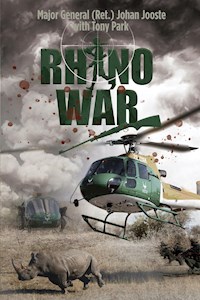
In 2012 retired South African general Johan Jooste was parachuted into the seemingly unwinnable war against rhino poaching in the Kruger National Park.
With poaching spiralling out of control, Jooste was given the mandate to ‘go military’, to convert Kruger’s ranger corps into a para-military force capable of taking the fight to the poachers.
Aged 60, white, and a veteran of 35 years' military service, Jooste’s controversial appointment was immediately met with resentment and outright hostility by elements of South African National Parks, the police, and even the military he had served with.
With the media, government, conservationists, human rights activists and the people of South Africa looking over his shoulder, Jooste had to battle opponents within and without to see through his strategy for turning the tide of rhino poaching.
Rhino War tells how Jooste, facing an unprecedented assault on a single national park and a species, took a demoralised force of men and women and turned them into arguably the best anti-poaching unit on the African continent.
Told through his eyes and stories of the courage and grit of rangers who daily risked their lives to protect wildlife in the face of a wily and determined foe, this is a story of heroism, sacrifice and determination.
Humbly, honestly and decisively, Jooste tells of the successes and failures of his bold strategy, and shares his vision for the future.
Das E-Book können Sie in Legimi-Apps oder einer beliebigen App lesen, die das folgende Format unterstützen:
Veröffentlichungsjahr: 2022
Ähnliche
















ABOUT THE AUTHORS
Major General (Ret.) Johan Jooste retired from the South African National Defence Force in 2006 after 35 years of active service. In 2012, after a stint in the corporate world, he was appointed Commanding Officer, Special Projects at SANParks, where he was responsible for anti-poaching strategy, planning and execution. He went on to establish a Wildlife Crime and Corruption Combatting Coordination Centre, with funding from the Peace Parks Foundation. He continues to serve in the fight against poaching as a Programme Manager for Law Enforcement and Security with the Peace Parks Foundation.
Tony Park is the bestselling author of 20 thriller novels set in Africa and several non-fiction biographies. A former journalist and press secretary, he also served 34 years in the Australian Army Reserve, including six months in Afghanistan. He and his wife, Nicola, divide their time between Australia and southern Africa. www.tonypark.net Social media: @tonyparkauthor
ALSO BY TONY PARK
Far Horizon
Zambezi
African Sky
Safari
Silent Predator
Ivory
The Delta
African Dawn
Dark Heart
The Prey
The Hunter
An Empty Coast
Red Earth
The Cull
Captive
Scent of Fear
Ghosts of the Past
Last Survivor
Blood Trail
The Pride
Part of the Pride, with Kevin Richardson
The Grey Man, with John Curtis
Bush Vet, with Dr Clay Wilson
War Dogs, with Shane Bryant
Courage Under Fire, with Daniel Keighran VC
No One Left Behind, with Keith Payne VC
Bwana, There’s a Body in the Bath! with Peter Whitehead
RHINO WAR
MAJOR GENERAL (RET.) JOHAN JOOSTE
TONY PARK
INGWE PUBLISHING
First published 2022 by Pan Macmillan South Africa.
This edition published 2022 by Ingwe Publishing
Copyright © 2022 by Major General (Ret.) Johan Jooste and Tony Park
All rights reserved.
www.ingwepublishing.com
The moral right of the authors has been asserted.
All rights reserved. No part of this book may be reproduced or transmitted by any person or entity (including Google, Amazon or similar organisations), in any form or by any means, electronic or mechanical, including photocopying, recording, scanning or by any information storage and retrieval system, without prior permission in writing from the publisher.
Rhino War.
EPUB: 978-1-922825-02-5
POD: 978-1-922825-03-2
Cover design by Leandra Wicks
Picture captions back cover (print edition):
Clockwise from top centre:
White rhinoceros
SANParks Chief Pilot Grant Knight with sedated orphan rhino
Major General (Ret.) Johan Jooste with SANParks, SAPS and SADF personnel and captured poacher
Jooste conducts a briefing in the Mission Area Joint Operations Centre
Major General (Ret.) Johan Jooste in SANParks uniform.
For Arina, Queen of my heart
GLOSSARY
Big Five – lion, leopard, buffalo, rhino and elephant
‘N Boer maak ‘n plan – a farmer (boer) makes a plan – a common expression reflecting the can-do attitude of South Africans
Border War – South Africa’s campaigns against the liberation movement in South West Africa (Namibia), and in support of anti-communist forces in Angola, lasting from 1966 to 1990.
Bakkie – light utility vehicle (‘ute’ in Australia); pick-up truck
Bliksem – Afrikaans expression of surprise or displeasure
Fiscus – the South African Treasury or ‘public purse’
Groenkloof – location of SANParks headquarters, in Pretoria
HiP - Hluhluwe-iMfolozi Park, formerly the Hluhluwe and Umfolozi game reserves, large public game park in KwaZulu-Natal
Indaba – a meeting
JOC – Joint Operations Centre
Jong – young, a term of endearment for younger friend
Klapped – hit
KNP – Kruger National Park
Kudu – A large antelope with spiral horns
Kudu kop – Kudu head, the antelope’s head insignia of SANParks
KZN – the South African province of KwaZulu-Natal
Lekker – good
Madala – African term of respect for an older person
Moer – to beat, or bash; ‘get the moer in’ – to feel rage, or fury
Muthi (umuthi) – traditional African medicine
NG Kerk – Dutch Reformed Church
NPA – National Prosecuting Authority
Oke – short for ‘outjie’, Afrikaans slang for a man
Oom – Afrikaans for uncle, also used as a term of respect for an older male.
Potjiekos – pot food, a slow cooked meal, usually oxtail
R1 - 7.62 millimetre assault rifle
Rondavel – a round dwelling, self-catering tourist accommodation unit in the Kruger Park
Recce – abbreviation of Reconnaissance Commando, South African special forces.
Sangoma – a traditional healer (plural: izangoma)
SADF – South African Defence Force (prior to 1994)
SANDF – South African National Defence Force (post 1994)
SANParks – South African National Parks
SAPS – South African Police Service
Sitrep - situation report
Skoonpa – father in law
Skukuza – the largest rest camp in the Kruger Park and home to the park’s headquarters and nearby airport
Tekkie – running shoe
Tannie – Afrikaans for aunty, also used as a term of respect for an older woman.
Tjommie – friend or ‘chum’
Vellies – short for veldskoen – suede bush shoes
Veldt – (also Bushveld), open grasslands or, generally, the South African bush
Vlei – an open plain or floodplain
Wors - short for boerewors, traditional South African ‘farmers’ sausage’
CONTENTS
Prologue
Chapter 1
Chapter 2
Chapter 3
Chapter 4
Chapter 5
Chapter 6
Chapter 7
Chapter 8
Chapter 9
Chapter 10
Chapter 11
Chapter 12
Chapter 13
Chapter 14
Chapter 15
Chapter 16
Chapter 17
Chapter 18
Acknowledgments
PROLOGUE
It was a time for good cheer, prayer and war. My wife, Arina, sat smiling beside me in the South African National Parks Air Wing helicopter. Below us, the seemingly endless wilderness of the Kruger Park stretched away to the horizon. We had just left the Houtboschrand Ranger Post, in the centre of the reserve, smiling children waving as we lifted off. We had delivered Christmas gifts and much-needed amenities to the field rangers and their families.
At Mopani, the nearest of Kruger’s rest camps below, local and foreign tourists would be relaxing, perhaps settling down to a lunch-time braai and a cold beer or a chilled glass of wine, or taking a siesta in their thatch-roofed rondavel after an early-morning game drive. Our daughters, Ilze and Liezl, were far away, in Johannesburg and Cape Town, but, now, in December 2015, after nearly three long years of living in the bush, Arina and I at last felt truly welcome in this new family we had joined.
The veld had shed its winter khakis and browns, and had turned a rich emerald with the advent of the summer. The seasonal rains brought new life, perfectly in sync with the timeless rhythm of this African landscape. From the open grasslands around Mopani, the pilot tracked south-east, towards the Lebombo Mountains, the 800-kilometre-long range of rocky hills that mark the border between South Africa and Mozambique.
Our next stop was the N’wanetsi Ranger Post in the centraleastern part of the park. At nearby Olifants Rest Camp and the N’wanetsi Picnic Site to the south, visitors could sit atop the mountains and watch game through binoculars. Elephants splashed through the Olifants River below; giraffe, easy to spot because of their tall, graceful silhouettes, browsed from trees bristling from the rocky landscape. An eagle-eyed, lucky onlooker might even see a rhino.
The stress of my job as Chief Ranger of the Kruger Park was seen and felt by Arina. We had been married for nearly 40 years and she had been with me when I had gone to war as a younger man, also helping to care for other men in uniform under my command, as well as their families. She had borne witness to the horrors of armed conflict, accompanying me during one terrible week when I made a sombre pilgrimage around South Africa to visit the grieving families of men who had been killed in action during the Border War.
She took my hand and squeezed it. Her smile lifted me. It was rare for us to be out together, taking in the natural beauty of the place where I lived and she was a regular visitor. ‘You are so lucky to live in the Kruger,’ so many had said to us. It was true; the park was a natural paradise, but those people never saw the dark side of the Kruger.
I was wearing a headset so that I could communicate with the chopper pilot. Through the earphones I heard a ranger come onto the radio net. ‘We’ve just made contact; we have three poachers wounded, copy?’
I didn’t need to give any orders; we were all too well versed by now. In the operations room, based at Skukuza Airport about 150 kilometres south of where we were, the police would be notified and officers would be sent from the town of Phalaborwa. A fixed-wing aircraft from our Air Wing, with Kruger’s physician, Dr Gary Peiser, on board, had already been sent to Satara, the nearest airstrip to the contact. The aircraft would be used to evacuate the wounded poachers to the nearest hospital if necessary.
Our helicopter re-routed to Satara, where we picked up Dr Peiser and then flew to the location of the contact.
We came in low and the pilot flared the nose as we touched down on an open grassy vlei. Robbie Bryden, the section ranger for N’wanetsi, was already on the scene. I went to him, ducking under the still-churning blades of the chopper, and shook his hand.
‘The guys picked up the spoor of the poachers, General,’ Robbie said. I was no longer a major general in the South African National Defence Force (SANDF) – I had retired several years previously – but the form of address had stuck. ‘They made visual contact and our guys were then shot at. A firefight ensued.’
Lean, deeply tanned, with a stubbled jaw, Robbie’s face was grim. He was in full combat gear, his face streaked with sweat and dirt. He was hands on, as always, and the bush was in Robbie’s blood. He had been born into a ranger family – his father, Bruce, had been chief ranger here in the Kruger Park and had penned the bestselling book A Game Ranger Remembers, before his untimely death. Robbie’s wife, Judy, was also a qualified section ranger who had been heading up our tracking training before taking time off to take care of their children.
As we spoke, Arina was already organising for the cooler box to be offloaded from the helicopter. She handed out cold drinks to those on the ground. As she did so, Dr Peiser was assessing the wounded poachers. One, he said, could be transported by road in an ambulance, but the other needed to be flown to Satara and evacuated to hospital in the waiting aircraft.
It was like a scene from a war zone.
Fortunately, this time the rangers were not responding to the discovery of a rhino carcass; they had found the tracks of the poachers and had been able to stop them before they could slaughter yet another rhino. It was a small win, a tiny step in the right direction. A South African Police Service bakkie arrived on the scene while Robbie and I were talking. Robbie nodded to a nearby bush, where the third poacher from the gang lay motionless on the ground.
Despite receiving first-aid treatment from our rangers, he had died awaiting medical evacuation.
The helicopter lifted off on its mercy flight with Dr Peiser and the wounded man on board, raising a cloud of dirt, grass and dust in its wake. A police officer began questioning Robbie about what had happened, and how it was that three men had been shot, one of whom had died of his wounds. The policeman’s tone became overly assertive, asking the how, when, where and why – just as our rangers were trained to interrogate poaching suspects.
Arina looked towards Robbie and the police officer. ‘Why is he treating Robbie like he’s the one who’s done something wrong, like he’s a criminal?’
Any ranger who had shot a poacher and caused his death would automatically become the subject of a murder investigation, so our on-call legal counsel would be notified as a matter of course. The investigation would now hang over Robbie’s head until the Attorney General dismissed it – no ranger had so far been taken to court on a murder charge – but the uncertainty was just one more example of the stress rangers have to deal with.
The area where the contact had taken place was bare; apart from a few sparse bushes, there was not a single tree, no shade within sight. For now, there was nothing more Arina or I could do, but wait for the chopper to return for us. The state pathologist had been called to collect the deceased poacher.
‘You must never forget that this man has a family as well, Love,’ Arina said.
I nodded. Arina was always quick to remind me of the human cost of the war we were fighting. Our rangers ran the risk, daily, of being killed or wounded by a poacher; they spent protracted periods in the field, often shunned by their own communities, who saw the poachers as ‘Robin Hood’ figures.
Poachers risked their lives in pursuit of a commodity: rhino horn, worth more than gold, diamonds or cocaine. The one lying just metres from us had paid the ultimate price. Across the border, in Mozambique, a family would soon be in mourning.
After three years of war, Arina and I were both exhausted. ‘Life is to be lived,’ we had told each other when we took on this fight, in what should have been our retirement years. But this was harsh living.
1
In another helicopter, in another life, in 1990, I was on my way to a very important event, a christening of sorts.
‘Colonel, you must come,’ Piet Bronkhorst, Park Warden of the Augrabies Falls National Park, had said excitedly on the phone, ‘Blompot has had a baby.’
By then I was a colonel in the old South African Defence Force (SADF). As commander of 8 SAI, the 8th South African Infantry Battalion, I was also in charge of the 76 000-hectare Riemvasmaak training area on the banks of the Orange River. Here, in this wide-open expanse of rocky desert terrain, we could conduct exercises with a fully mechanised battalion, aerial bombing trials, and test firing of the South African-designed G6 Rhino self-propelled 155-millimetre howitzer.
Today, however, I was on my way to see a real-life rhino – my first. In 1988, during my time in command, the Defence Force signed an agreement with the then Department of Environmental Affairs to link our military training area with the adjoining national park. While we had competing aims, the very fact that the military had appropriated this huge area meant that it had become a sanctuary for wildlife, as well as a wide-open space in which to conduct manoeuvres. It made sense that our two departments should communicate and see what benefits could be shared.
We had landed and picked up Piet, and the pilot of the camouflaged Oryx helicopter now flew low over the reserve, following Piet’s directions for us to rendezvous with his scouts on the ground who had found Blompot, a female rhino. This harsh, arid country was good habitat for black rhino, I had learned. Blompot – she was named ‘flower pot’ because of the particular shape of her spoor – was, like all her kind, mostly solitary, only coming into company with another rhino when she was ready to mate. When we spotted Blompot she was with another rhino, a tiny thing not much bigger than a pig. Its ears looked too big for its body – it would grow into them – and it scampered about, full of energy, almost hopping on its skinny little legs.
‘The black rhino doesn’t calve easily,’ Piet explained to me over the chopper’s internal radio as we circled. The single young stay with the mother for two to three years and Blompot would not come into oestrus again for that entire period, until her calf left her protection. Piet grinned and his eyes lit up. ‘Look what has happened here in our park, Colonel!’
Not only had I just seen my first rhino, and her calf – now christened Blommetjie, or ‘Little Flower’ – I had also witnessed what could happen when two different authorities worked together for a common purpose, and borders were dropped for the sake of nature.
I was born in Postmasburg, in the dry Northern Cape region of South Africa. The harshness of the semi-desert terrain was contrasted by the kindness of the solid, hard-working people who lived there.
I started my schooling in a small building in the mining outpost of Smith’s Mine, along with a group of about 20 pupils, from grades one to seven. We only had two teachers and it was thanks to their sterling work that I could not only complete secondary school, but also ready myself for university.
When I was nine, my teacher, Mrs Dippenaar, said to my father: ‘Johan is talented and gifted; I will do my best to give him extra stimulation.’ This remark was not meant for my ears, but my father passed it on and it gave me an early lesson for life about the importance of appreciating and encouraging others and seeing what can be done with few resources but a positive attitude. With no library or organised sports at her disposal at the school, Mrs Dippenaar spent her own time and the art of tuition to provide that extra stimulation.
My father was a diamond miner and my mother cared for the home and my two sisters and me. We grew up in a working-class household where structure, ethics, values and religion were important. I achieved solid results in high school and was planning to enrol for a Bachelor of Commerce degree, with some law subjects, at the University of the Free State. However, I had enjoyed being in the army cadets at school and, with national service looming on the horizon, sought out information on the military academy.
When I decided to join the army, the postmaster and the school headmaster in the one-horse town of Barkly West, where we now lived, came to visit my parents.
‘Please reconsider sending him to the military,’ the postmaster said to my father. ‘If you have money problems, we can help you. How can you do this?’
My father and mother, however, supported my decision and in 1971, at the age of 18, I left home to begin the coveted course at the military academy at Saldanha Bay on the West Coast, and become an army officer.
Around the same time, the Defence Force opened its first positions for women since the Second World War in a newly established Civil Defence College (CDC). The following year, in 1972, women were allowed to join the army; in 1973 a group of these female candidate officers was selected to do a leadership course at the military academy.
My classmates at the academy and I had seen photos of these women in the army newspaper. ‘I want that one,’ I had said to one of my fellow cadets and I pointed to an attractive girl in one of the pictures.
The young woman’s name, I soon learned, was Arina. Having won the leadership trophy at the completion of her CDC training, she was one of those selected for the academy. It is there that we met. She finished her course, but flew back later that year to watch my passing-out parade, at which I received the trophy for best army student. We were birds of a feather, meant to nest together. Two years after we met, she and I were married.
Commissioned as an infantry officer in 1975, I served in 1 SAI as a lieutenant and then as a captain at the school of infantry in the late 1970s. Between 1981 and 1982 I had my first experiences of working in the Lowveld when, as a major with 7 SAI, based at Phalaborwa, the army negotiated with the owners of the Letaba Ranch to use their game conservancy as a training area.
On weekends, Arina and I would sometimes visit the Kruger Park, but the bush, for me, was also my workplace. I preferred to take my leave on the coast. It wasn’t until my next posting, as a lieutenant colonel based at Jozini, in northern Natal, that I had my first real up-close encounters with wildlife. While there, operating in the uMkhuze, Kosi Bay and Sodwana reserves, I was co-opted as an honorary game ranger with the old Natal Parks Board.
Arina and I pulled night-time duties in 1983, assisting with measuring, recording and tagging endangered leatherback turtles as they made their pilgrimage ashore to lay their eggs on the beach in the Seven Lakes area. As we stood there under the moonlight, just the two of us, we watched this moving, ancient ritual, as a giant, prehistoric-looking female turtle hauled herself across the sand. She used her flippers to dig a deep hole, laid her eggs, then turned and silently returned to the sea.
I looked to Arina and we held hands; tears were rolling down her cheeks. I felt moved, humbled that we could be here, making a difference simply by watching over these amazing creatures. In the back of my mind I was already worrying about what would happen to the tiny hatchlings when they broke to the surface, and what dangers awaited them. For how long, I wondered, would this little piece of pristine beach remain the way it was then, unchanged for millennia?
Dog tired after our vigil, but still excited, Arina and I made a fire on the beach and talked about the miracle we had just witnessed. Finally, we went to sleep in a simple reed hut. It was heavenly.
After completing the command and staff course, I was posted to the border and given command of a battalion group at Eenhana operational base, six kilometres from Angola, in eastern Ovamboland in the old South West Africa, now Namibia.
Arina and the girls stayed in Oshakati, 150 kilometres away via a white gravel road. I would sometimes visit them on the weekends. One Saturday evening, Arina shook me awake – the People’s Liberation Army of Namibia (PLAN), the military wing of SWAPO, the South West Africa People’s Organisation, were attacking Oshakati with rockets and mortars. Shrapnel had ricocheted against one of our windows, but by that time I was so used to the sound of mortar fire I had slept through most of the attack.
I was then offered command of the San Battalion, made up of 800 soldiers plus about 2 700 of their dependants. The San people, commonly known as Bushmen back then, were from across the nearby border in Angola. These men, who spoke a mixture of Portuguese and their own San languages, had been enlisted into the SADF to fight PLAN. Our base, Omega, was in the Western Caprivi area, subtropical bushland situated between Katima Mulilo to the east and Rundu to the west. From Omega, my soldiers deployed into various operational areas, including Angola, just 15 kilometres away, using their phenomenal tracking skills in pursuit of our foes.
At any one time I would have under my command six young South African national servicemen who had been trained in nature conservation. Their job was to monitor game in the area and to keep an eye on soil erosion and alien plant eradication. It was part of a hearts-and-minds campaign, to show we were protecting wildlife while a war was raging. While allegations have been made of SADF personnel being involved in poaching rhinos and elephants during the Border War, I can honestly say that I never came across evidence of those activities. Perhaps I was too naive, or too remote, but what might well be true was that our ally across the border in Angola, Jonas Savimbi, paid for his war with the proceeds from the trade in wildlife products.
It was terrible, what the war did to the people and wildlife of Angola and northern Namibia. Sometimes, when I went jogging, I noticed lion spoor in the bush, but I never saw an actual cat; the wildlife and the environment were under pressure. I had been told not to allow the San soldiers to cut down wood for cooking fires, or to hunt or set snares to catch antelope; it was a pity that they were not permitted to follow their traditional ways, but I was responsible for nature conservation in the area. They were excellent warriors and trackers and I learned much about them and about working with different cultures during my time in the Caprivi.
Because of the war, the San were exiles from their country and their traditional hunting grounds and had brought their families with them. Arina became involved in supporting the soldiers’ wives and children, setting up a programme to teach the women needlework and on-base cooking skills.
These people were the nomads of Africa and had been pushed around and forced out of their lands by various other ethnic groups for centuries. I learned of their complex family structures and their concerns. When a San man told me his heart was sore, then I knew he was depressed or anxious.
Family was key to their emotional stability, so we developed a policy where one of the soldiers would always stay behind with the wives and children when the rest crossed the border on a mission. Each night the stay-behind warrior would radio through to the patrol, passing on news from the families and relaying messages back to the wives and children.
Following my term in South West Africa I received an accelerated promotion and was given command of 8 SAI, based in Upington in the Northern Cape. As an infantry officer, with much of my time spent on operations, I had lived in the African bush for months on end, so it was little wonder that Arina and I liked our creature comforts when it came time for leave.
Change was in the air in South Africa. When Nelson Mandela and the African National Congress (ANC) were elected to parliament in 1994, I was commanding the newly established Army Gymnasium, a junior leader training establishment at Heidelberg in what was then still the Transvaal. I was fortunate to be the parade commander and share the podium with President Mandela when he was awarded the Freedom of the City of Heidelberg.
The following year, I played a part in the transformation of the old SADF into the new SANDF. My staff and I ran the first induction training for a number of newly promoted colonels and brigadiers who had been commanders in what was termed the ‘previous non-statutory forces’. The men and women who attended that course had been senior fighters in uMkhonto we Sizwe (MK) – the ‘Spear of the Nation’, the military wing of the ANC – and the Azanian People’s Liberation Army. These were people I had fought against.
On the Sunday before the course started, I visited the officers’ mess for a meet-and-greet in the living quarters as the students settled in. As I walked from room to room, the atmosphere was icy. I stretched out my hand in greeting to one member and he refused to take it. Others would not make eye contact when I introduced myself.
We broke this ice the next evening when, as was customary, students and staff met for welcoming drinks in the mess. After much consideration, I decided to stick to the habit of everyone introducing themselves around the lounge.
When it was my turn, I shot straight from the hip, hiding nothing about my service and involvement in past operations. I urged them to do the same and right there we reached common ground. A few sentences shared as soldiers made the difference and brought about a degree of trust and respect, forming a basis we could build on.
During the course, the barriers started to come down, and I learned a great deal about my fellow South Africans. We had debates and made compromises. For instance, I had to explain to the new officers that in the mess the minimum dress standard for men was a sports jacket and tie.
‘But for us, an African shirt,’ the type often worn by the new president, ‘is formal wear,’ one of the officers said. And so we agreed on that, but sandals had always been banned in the mess and the new officers agreed to wear closed shoes.
While we could make allowances for some minor issues, I had to make perfectly clear our strategy for the transformation to the new national defence force. ‘We don’t negotiate,’ I told the inductees, ‘we do “joint planning”. We are apolitical and we maintain high standards.’
Despite our cultural differences, I insisted that when it came to the matter of discipline in the new defence force, there was only one way to go about it: to set the example you want others to follow on a daily basis. I prided myself on being punctual; I polished my boots every day; I was respectful, and I expected nothing less than those basic standards from the future leaders of our defence force, that they be on time and keep their uniforms immaculate.
The new government had made the decision to stay with a conventional defence force, rather than a guerrilla army, and that was what we trained for. I was lucky that English had been chosen as the language for the army – it had previously been Afrikaans – because if the powers that be had opted for isiXhosa or isiZulu I would have been at a serious disadvantage. To my shame, I had never taken the time to learn one of the other official languages of our country. I was mindful that I should neither lecture nor talk down to these new officers; I tried to see the experience through their eyes, and then accompany them on their journey.
I had always believed that, as an officer, my leadership was ratified by what was in the hearts of the people I led. I was as an outsider, white-skinned, so I had to work hard, right from the outset, to build trust with the men and women who participated in that first course. Many went on to become senior generals, including Rudzani Maphwanya, who became Chief of the National Defence Force. I am proud to say that, some 17 years on, I count many of them as friends. Most importantly, I learned valuable lessons about respect for diversity and working with people from different backgrounds – even former enemies – for the greater good.
In the later stages of my military career, between 1998 and 2001, I served as the Director: Projects for the army. As an infantryman, I had not been required to embrace or understand cutting-edge technology, but in this new role I had to learn about the full spectrum of modern weapons and systems, including electronic warning systems, computerisation and radar.
I had a good deal of contact with the Council for Scientific and Industrial Research (CSIR), a very can-do organisation driven by that good old-fashioned attitude of ’n Boer maak ’n plan. My job involved travelling internationally to meet other military personnel and arms manufacturers. If all my wanderings convinced me of anything, it was that if you give South African engineers a million dollars and six months, they will come up with a plan; some other countries, which I will not name, would need several million dollars and many years to come up with the same result.
By 2006, I was a major general, with 35 years of service in the army. I was the Chief Director of Corporate Services. I had helped oversee the transformation of the military, but I realised it was time for me to leave. Also, at the age of 53, I was young enough to embark on a second career. I had been sounded out by various companies when I was still in uniform and now it was time for me to start considering some of those offers.
I took a job with a smaller defence contractor and, after a few years, moved to BAE Systems, employed in South Africa by the American branch of this UK-based firm, at the time the second largest armaments company in the world. My position was Director of International Business Development, mostly promoting South African-made armoured vehicles. Arina had endured me being away from home on manoeuvres and operations for weeks and even months on end, and now she was being left behind by a husband who needed to travel the world for business. I maintained two maxi-sized passports, travelling with one while the other was being submitted for a new visa to a new country. I was away as often as three times a month, travelling to every continent. I visited countries such as Brazil, the United States, Canada, Sweden, Ireland, Spain, Poland, the UAE, Singapore, Malaysia, India and Japan. These trips, however, furthered my understanding and appreciation of different cultures, and I learned that people in other parts of the world, even in other African countries, viewed our world from different vantage points.
After five years of jet-setting and concluding deals for BAE, I was becoming jaded in the corporate world. I had seen how the phenomenon of ‘groupthink’ – in which employees were rewarded for blind loyalty, rather than expressing different views or challenging the accepted way of doing things – robbed senior management of the ability to self-correct when things went wrong.
I was turning 60 and Arina and I started to consider the next phase of our life. We talked about possibly finding work at a small game lodge. Arina would do the books and I would look after the guests; we would ease our way into retirement and still keep busy. It was a good plan.
In late 2012, as I did whenever I was home, I went to the monthly gathering of the Infantry Association, a lunch – some formalities and drinks all round – at the Bronberg Restaurant in Pretoria.
Old soldiers know how to scout out a bargain and the owner, Flip Marks, offered us a very good deal. Flip was a former Special Forces operator who had moved to the private sector and made a success selling military vehicles before taking over the Bronberg. There were about 30 of us present and, as usual, the food was good and the wine and beer affordable. At the lunch was Marius Roos, who, in his early forties, was still serving as a colonel in the Army Reserve. Tall, fit and engaging, Marius was a master networker and highly respected by both the part-time and permanent-force members of the military.
‘Marius,’ I said to him as we walked out into the afternoon sunshine after lunch, ‘apart from you, the young blood, I’m one of the youngest in that room. Do you realise how old we are?’
We lingered on the restaurant stoep and he asked how my work was going.
‘Jong, I’m considering my options,’ I said to him. ‘Turning 60, I’ll have to retire from BAE.’
‘I take it you still want to work, General?’ he said. ‘Yes.’
‘I might have something for you,’ Marius said.
I thanked him and, giving little more thought to our conversation, went home and took advantage of a quiet night. The next morning the phone rang. It was Marius.
‘I’ve spoken to Dr David Mabunda,’ he said. Interesting, I thought. Dr Mabunda was the CEO of SANParks, South African National Parks. ‘He’s looking for someone to consolidate and para-militarise the ranger corps in the Kruger Park.’
Like virtually every other South African, I had heard that rhino poaching was escalating in the Kruger and other reserves. Marius, I had learned, had been doing some security consulting work for SANParks through his company, Pathfinder. Marius explained that the CEO was coming under intense political pressure to do something decisive to slow or even stop the mounting toll of dead rhinos. The fact that Marius had the ear of the CEO was further proof of his trustworthiness and people skills.
I asked Marius for some time to think about what he had offered, before I signalled my interest. When I ended the call, I told Arina. We discussed the possibility of an offer and I weighed the option up against another job I had also been tentatively offered at the Voortrekker Monument in Pretoria as general manager of operations and tourism at the Afrikaner Heritage Foundation.
‘What do you think of Marius’s offer?’ Arina asked.
‘My girl, this is a parastatal,’ I said of SANParks, a government-funded organisation. ‘What are the chances that they would want a “platinum status” like me?’ I was referring to my hair colour by this time.
And so, although I did not fancy my chances, I called Marius back later that afternoon. ‘I am definitely interested.’
The next day, Marius called me back and asked me to send him my CV. A few days later, he then asked if I would come and brief the CEO and the SANParks Exco, the executive council. I agreed, although I was surprised by the request. I had been expecting at least an interview – if I was lucky – not to brief senior management about an issue I knew next to nothing about.
I set to work concocting a presentation, based mostly on what I had seen and read in the South African news media about the issue of rhino poaching. On the appointed day, I arrived at the SANParks headquarters, a collection of two-storey, pinkish-coloured office buildings in Groenkloof, Pretoria. Marius met me and showed me to a boardroom. Six individuals sat around a table, including David Mabunda, who I recognised from the picture I had found on the internet, and had cut and pasted into the PowerPoint presentation on my laptop.
Dr Mabunda was taller than I had expected, good looking, articulate and quite formal in his manner. I greeted them all and started my digital briefing. From what I had learned, there were several agencies involved in combatting rhino poaching – the SANParks Ranger Corps, the police and military, as well as private security companies operating in private game reserves.
‘I would start by establishing clear lines of command and control in a JOC,’ I said.
‘What is a JOC?’ one of the Exco members asked.
I paused. ‘A Joint Operations Centre,’ I said. ‘Joint’, commonly used in the military, is a term used to describe an operation in which there are several different forces on the same side. How, I wondered, could they even begin to target a problem of armed incursions into a national park without a JOC?
I ran through some basic ideas I had about how I might tackle the issue, but stressed that I would need to do a proper appreciation, as a military commander would, of the ‘enemy’ – the poachers; the friendly forces – the various agencies involved in fighting poaching; and the terrain – the Kruger Park.
I had mixed emotions as I walked out onto the tree-lined street after that meeting. On the one hand, I was excited; I could already sense that this was a huge opportunity to achieve something worthwhile. On the other, I thought: Is this what you really want to do at the age of 60? I had already made the transition from army officer to businessman, but this would require me reinventing myself all over again.
SANParks – or, at least, its CEO – wanted to turn his rangers into a paramilitary unit, but my instinct told me that I could not go into this task being ‘too military’. There would be those who would object, I was sure, not just to my platinum status, but to having an army general put in charge of what was basically crime fighting in a national park.
The more I thought about it, the more the doubts began to creep into my thinking. I was clueless, I realised, about rhino poaching except from what I had read online and seen in the media. I wondered whether an entire corps of rangers could actually be turned into a force capable of thwarting armed criminals. The other job, at the Heritage Foundation, I realised, would be a lot easier and I said as much to Arina when I got home.
‘That’s not you, anyhow you’d be bored,’ Arina said of the other position, with her customary honesty.
I had some news for Arina, which I had gleaned from my meeting with Exco. I took a deep breath – this would not be easy. ‘If I get the job, we will have to move to Skukuza … They will give us a house in the staff village.’
I could see mixed emotions on her face. This would be our thirteenth move to a new home, although it had been some time since our army days when we had to change houses every couple of years. Also, Arina would have to leave her job as head of a non-profit organisation supporting schools for children with disabilities. On the plus side, we would be living in the bush, in the iconic Kruger Park, surrounded by wildlife.
‘OK,’ Arina said, sensing there was more to come.
I braced myself. ‘And we can’t take Jonty.’
Her eyes widened in shock. With our daughters gone, Jonty, our little Jack Russell, was like a third child to Arina. ‘But I thought there would be fences around the houses, to keep the wild animals out?’
I shook my head. ‘No pets allowed, not even for staff.’ Arina burst into tears.
I tried not to think about the offers before me, or about Jonty, but a day later I received another call. This time it was from someone from the human resources department of SANParks.
‘We have decided to take you on board, sir,’ he said. ‘It’s a five year contract.’
That, at least, told me they were serious. If, as I had half-feared, I had been offered a 12-month contract then I knew the idea of bringing in someone to transform the ranger corps would have been nothing more than a public relations stunt. I would have been set up to fail, because there was no way this mission could be successfully completed in a year.
At the personal invitation of Dr Mabunda, Arina and I attended the Kudu Awards, the annual recognition of achievements by individual national parks, departments, rest camps and people in SANParks. I put on my camouflage – a dinner suit and bow tie – and Arina dressed up. We went to the awards undercover.
We sat at a table at the back of the auditorium at the Gallagher Estate, the large convention centre in Midrand, Johannesburg. Only David Mabunda and the members of the Exco knew about my appointment. We sat with the secretary of the SANParks Board of Directors. I ate and listened as about a hundred awards were made. I did not blow my cover; I was there to gather intelligence.




