


0,49 €
Niedrigster Preis in 30 Tagen: 1,99 €
Niedrigster Preis in 30 Tagen: 1,99 €
Mehr erfahren.
- Herausgeber: DigiCat
- Kategorie: Poesie und Drama
- Sprache: Englisch
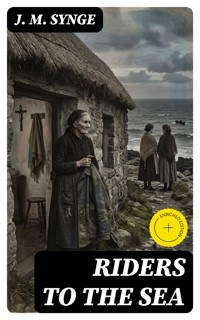
In "Riders to the Sea," J. M. Synge crafts a poignant one-act play that delves into the harsh realities of life on the Aran Islands. Through lyrical dialogue and stark imagery, Synge depicts the struggles of a family beset by the relentless forces of nature and fate. The play explores themes of grief, loss, and the inevitable pull of the sea, which serves both as a life source and a grim adversary. Synge's use of the Irish dialect enriches the narrative, capturing the authenticity of rural Irish life and immersing the audience in the cultural context of the early 20th century. As a prominent figure in the Irish literary revival, Synge was deeply influenced by his travels to the Aran Islands and his engagement with the local inhabitants and their traditions. His appreciation for the vernacular language and the complexities of rural existence is vividly reflected in this work. Personal experiences of witnessing the impact of the sea on people's lives arguably informed the heartfelt narrative of "Riders to the Sea," making it a quintessential expression of human resilience amidst despair. Scholars and theatre enthusiasts alike will find "Riders to the Sea" an essential addition to their collections, as it embodies the spirit of Irish drama while confronting universal themes of mortality and belonging. Engaging, evocative, and tragically beautiful, this play captures the essence of Synge's mastery, inviting readers to reflect on the fragility of life and the pull of the natural world. In this enriched edition, we have carefully created added value for your reading experience: - A succinct Introduction situates the work's timeless appeal and themes. - The Synopsis outlines the central plot, highlighting key developments without spoiling critical twists. - A detailed Historical Context immerses you in the era's events and influences that shaped the writing. - A thorough Analysis dissects symbols, motifs, and character arcs to unearth underlying meanings. - Reflection questions prompt you to engage personally with the work's messages, connecting them to modern life. - Hand‐picked Memorable Quotes shine a spotlight on moments of literary brilliance. - Interactive footnotes clarify unusual references, historical allusions, and archaic phrases for an effortless, more informed read.
Das E-Book können Sie in Legimi-Apps oder einer beliebigen App lesen, die das folgende Format unterstützen:
Veröffentlichungsjahr: 2022
Ähnliche












Riders to the Sea
Table of Contents
Introduction
At the meeting point of hunger, hope, and an ocean that yields as much as it destroys, Riders to the Sea distills the struggle to live with nature’s power into a stark meditation on what families owe to work, to memory, and to one another, as the rhythms of island life beat against the implacable pulse of the waves, turning the ordinary tasks of a single day into an ordeal of choice, endurance, and acceptance that asks whether courage means resisting the tide or learning how to speak in the same breath as its relentless, salt-thick air.
J. M. Synge’s one-act tragedy unfolds in a cottage on the Aran Islands off Ireland’s west coast, where sea and weather dictate both livelihood and loss. Emerging from the early twentieth-century Irish Literary Revival, the play was first staged in Dublin in 1904 and is shaped by Synge’s close listening to island speech and custom. Its scale is austere, its action compressed, yet its imaginative horizon feels oceanic. The work belongs to a modern dramatic moment that sought a national voice by returning to local realities, and its classical poise sits alongside an ethnographic attentiveness that never lapses into spectacle.
The premise is simple and immediate: in a poor household led by the widow Maurya, her daughters Cathleen and Nora weigh a mysterious bundle from the mainland that may confirm what the sea has already suggested, while the remaining son, Bartley, readies himself to cross the water on necessary business despite rising swells and the mother’s fear. Synge arranges these ordinary acts—sorting clothes, baking, arguing over preparations—so that each gesture carries the weight of a life lived on the brink. Without elaborate plot mechanics, the play invites readers to inhabit waiting, rumor, and the fragile hush before news arrives.
The reading experience is spare and musical: sentences move with the cadences of Hiberno-English, repetition accrues like surf, and silences open spaces where fear and love speak more loudly than argument. The voice is compassionate but unsentimental, refusing ornament that would soften the cost of survival. Synge’s stage directions and images are precise without fuss; the palette is gray stone, rough cloth, turf smoke, sea-light. In performance or on the page, the one-act form creates a held breath, a steady narrowing of options that never feels contrived, because the logic seems to arise from the land, the weather, and work.
At its core are themes of fate and agency, the economics of subsistence, and the rituals by which communities face danger they cannot master. The sea is neither villain nor backdrop but a system that both sustains and exacts; the family’s decisions are ethical as well as practical, entwining love with survival. Religious belief and folk knowledge coexist, shaping how people interpret omens and handle their dead, yet the play resists judging them. The women’s labor becomes a lens on endurance and authority, while the men’s departures dramatize a cultural script of risk that cannot be entirely rewritten.
For contemporary readers, the work speaks sharply to precarious labor and environmental vulnerability, as coastal communities worldwide negotiate storms, diminishing resources, and the hard arithmetic of necessity. Its minimalism offers a model of sustainability in art, showing how modest means can carry immense feeling without spectacle. The play also deepens conversations about grief, mourning practices, and the social fabric that holds after public loss, inviting empathy across distance and time. In classrooms and book clubs, it prompts discussion of language preservation, migration, and care, illuminating how local speech and custom can bear universal questions about risk, responsibility, and and belonging.
Approach Riders to the Sea as you would a piece of music or a ritual act: slowly, attentively, aloud if possible, letting the patterned phrases, the pauses, and the ordinary objects onstage accrue meaning. Its brevity is not a shortcut but a discipline that invites re-reading and, in performance, careful listening to breath and silence. Without announcing symbols, the drama allows images of water, doors, animals, and bread to resonate, guiding us toward recognition rather than surprise. What endures is its lucid compassion, a clarity that acknowledges limits while honoring the courage required to stand, speak, and keep working beside the sea.
Synopsis
Riders to the Sea is a one‑act play by J. M. Synge, first staged in 1904, set in a cottage on the Aran Islands off Ireland’s west coast. It portrays a fishing family living at the edge of endurance, where the sea provides livelihood and takes lives. Maurya, an aging mother, has already lost several sons to storms, and the household is marked by vigilance, ritual, and fear. The play opens in a mood of hushed anxiety, with the rhythms of island life—baking, mending, watching the weather—framing a story about necessity, fate, and the costs of survival in an unforgiving landscape.
Inside the kitchen, Maurya’s daughters, Cathleen and Nora, try to shield their mother from new uncertainty. A bundle has come from the mainland—clothes recovered from a drowned man—and the sisters fear the garments may belong to their missing brother, Michael. They whisper over the parcel and debate whether to open it, mindful of customs around death and the hope that ambiguity can still protect Maurya’s heart. The sea remains an unseen presence, audible in the imagination and in the talk of neighbors, while ordinary tasks continue, as if routine might steady the household against the weight of rumor and threat.
Maurya’s surviving son, Bartley, prepares to sail for the mainland to sell a horse at the fair, an errand that promises much‑needed cash but demands a perilous crossing. The weather is unsettled, and Maurya, haunted by past losses, pleads for caution and delay. Bartley gathers rope and tack and speaks with the unbending practicality of someone who must work despite risk. The daughters weigh whether to tell their mother what the bundle might mean, hoping to secure her blessing for Bartley before he goes. Domestic gestures—bread wrapped for a traveler, a door watched against wind—carry an anxious, ceremonial gravity.
Left briefly without their mother, Cathleen and Nora untie the parcel and compare a shirt and stocking with Michael’s known stitches and patterns, practical details that stand in for a body the sea may not return. Their scrutiny brings a painful clarity, yet they hesitate to speak it aloud, knowing that naming a loss can make it irrevocable. The scene underscores the islanders’ resourcefulness and the delicate ethics of withholding news for mercy’s sake. When Maurya reenters, the sisters manage the conversation carefully, balancing respect for her authority with their wish to soften the blow and preserve hope a moment longer.
Bartley resolves to depart despite warnings, and the urgency of employment overrules the caution of grief. Maurya, torn between forbidding him and letting him fulfill his duty, finally hurries after him to offer bread and a blessing she had withheld. On her return, she describes a disturbing sight on the road and reads it as a sign, drawing on the islanders’ blend of Christian prayer and older intuitions about fate. Her words deepen the air of inevitability around the sea’s power, while the daughters, now more certain of Michael’s fate, try to steady the household for whatever news may come.
The play’s brief, concentrated action converges as voices from outside interrupt the domestic space with tidings from the shore. Neighbors gather, the rhythms of lament and prayer take shape, and the sea that hovered unseen becomes a fact that must be faced. The focus remains on Maurya, whose authority, sorrow, and faith meet in measured speech rather than outcry. Synge avoids melodrama, letting simple gestures and communal rites show how a family receives another turn of fate. The ending offers a stark acknowledgment and a hard‑won calm, expressing a kind of release without undoing the realities that brought it.
Compact and elemental, Riders to the Sea stands as a touchstone of the Irish Literary Revival, drawing on Synge’s close observation of Aran life to craft a tragedy without ornament. Its spare structure, everyday diction, and ritual sense of community allow the play to probe the tension between human agency and an environment that cannot be mastered. The work’s restraint gives it enduring force: it honors labor, faith, and kinship while confronting the limits of protection and foresight. Frequently studied and produced, it continues to resonate as a concise meditation on loss and resilience in a world governed by indifferent powers.




