


1,99 €
Mehr erfahren.
- Herausgeber: Quickie Classics
- Kategorie: Gesellschafts- und Liebesromane
- Sprache: Englisch
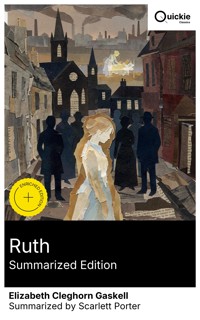
Ruth (1853) follows Ruth Hilton, an orphaned seamstress seduced and abandoned by a gentleman, whose illegitimate pregnancy is concealed under the fiction of "Mrs. Denbigh." Given refuge by the dissenters Mr. Benson and his sister Faith, she navigates the unforgiving scrutiny of a Nonconformist town and the pieties of her employer, Mr. Bradshaw. Gaskell fuses domestic realism with moral argument, scrutinizing the sexual double standard and communal hypocrisy; the plot arcs toward Ruth's selfless nursing during a fever epidemic. An omniscient, observant narrator sustains a measured, compassionate tone that reconfigures the "fallen woman" narrative as redemption through sympathy. Elizabeth Gaskell, a Unitarian minister's wife in industrial Manchester, drew on years of charitable work among the poor and her knowledge of dissenting culture. After Mary Barton sharpened her social conscience, she composed Ruth amid debates on sexual morality, braving circulating-library censure to argue for justice tempered by mercy. Readers of Victorian fiction, gender history, and religious culture will find Ruth both intellectually bracing and deeply humane. It rewards close study for its supple prose, ethical nuance, and fearless critique of respectability, and deserves a place beside Dickens, Brontë, and Eliot. Quickie Classics summarizes timeless works with precision, preserving the author's voice and keeping the prose clear, fast, and readable—distilled, never diluted. Enriched Edition extras: Introduction · Synopsis · Historical Context · Author Biography · Brief Analysis · 4 Reflection Q&As · Editorial Footnotes.
Das E-Book können Sie in Legimi-Apps oder einer beliebigen App lesen, die das folgende Format unterstützen:
Veröffentlichungsjahr: 2026
Ähnliche


















Ruth (Summarized Edition)
Table of Contents
Introduction
At its heart, Ruth turns the Victorian obsession with respectability into a searching drama about whether kindness can resist the cold arithmetic of judgment, asking readers to weigh institutional morality against the claims of individual conscience, the crush of gossip against the stubbornness of love, and the rules that police women’s bodies against the deeper ethics that bind communities together, so that every glance, whisper, and choice becomes a test of character and a plea for mercy in a world that often confuses punishment with virtue, and every act of understanding feels like a quietly defiant form of justice.
Elizabeth Gaskell’s Ruth, first published in 1853, is a Victorian social novel set in nineteenth-century England, moving between countryside retreats and a provincial town whose churches, workshops, and parlors shape the fate of its characters. Working in a realist mode closely associated with the mid-century “social-problem” tradition, Gaskell builds a world attentive to labor, class, and the moral climate of the day. The book belongs to the same era that produced her most engaged examinations of industrial and domestic life, and it situates private scandal within public debate, using the conventions of the novel to test the limits of charity, respectability, and reform.
Ruth follows a young seamstress whose beauty and innocence attract the attention of a cultivated gentleman, drawing her into a relationship that exposes the precarity of a working girl with few protectors and fewer choices. When circumstances swiftly darken and the couple is separated, she confronts abandonment and disgrace in a society ready to condemn before it listens. At a moment of deepest vulnerability, she encounters unexpected guardians who recognize need before fault and offer a path toward stability. From this point, the narrative traces her attempt to rebuild a life, quietly asking what true responsibility and forgiveness might require.
The narration is steady, humane, and observant, guided by an omniscient voice that moves with ease from drawing room to workshop, from public sermon to private conscience. Gaskell’s style blends careful social observation with an ethical tenderness that never lapses into sentimentality; conflicts unfold through gesture and silence as much as through plot. Dialogue carries the cadences of class and conviction, while descriptive passages anchor feeling in place and weather. The pacing is measured yet increasingly absorbing, inviting readers to inhabit the textures of daily existence, to feel the weight of rumor and reputation, and to witness the tentative growth of courage.
Central to the book is a critique of the double standard that punishes women more harshly than men for the same transgression, and an exploration of how communities decide who is worthy of help. Gaskell probes the intersections of gender, class, and labor, showing how economic dependence narrows moral options and how language—names, titles, euphemisms—can both protect and endanger. Motherhood, education, and vocation become sites where dignity may be reclaimed. The novel contrasts rule-bound respectability with active mercy, suggesting that character is revealed not in spotless reputations but in sustained acts of care, truthful self-knowledge, and the courage to stand with the vulnerable.
As a contribution to the Victorian conversation about the so-called “fallen woman,” Ruth refuses the spectacle of ruin and instead composes a sustained argument for restorative compassion. Without preaching, Gaskell invites readers to scrutinize the institutions—religious, familial, civic—that adjudicate guilt and extend pardon, revealing their power to wound or to heal. The book’s moral imagination is expansive rather than permissive: it treats choices seriously while insisting that shame never tells the whole story. In doing so, it illuminates how reputations are constructed, how rumor functions as a form of governance, and how ordinary kindness can unsettle entrenched hierarchies.
For contemporary readers, Ruth remains urgent because its questions are not historical relics: who deserves a second chance, how societies police women’s sexuality, what support single parents receive, and whether public virtue can coexist with private empathy. Its portrait of stigma anticipates modern dynamics of exposure and judgment, reminding us that headlines and whispers often outrun facts. Gaskell’s novel offers neither easy consolation nor punitive closure; it proposes that personal responsibility and social responsibility are inseparable. To read it now is to practice attention—to lives constrained by circumstance, to the quiet heroism of care—and to imagine communities ordered by justice and grace.
Synopsis
Elizabeth Cleghorn Gaskell’s Ruth, published in 1853, opens in a provincial English town where Ruth Hilton, a teenage orphan apprenticed to a dressmaker, works under exacting conditions. The workroom’s long hours and strict surveillance frame a world in which character is measured by reputation as much as by conduct. Ruth is inexperienced and impressionable, yet conscientious, and the narrative establishes the social pressures that will shape her choices: the vulnerability of working girls, the power of employers, and the close scrutiny of a community eager to detect fault. This setting introduces the moral questions that guide the story’s exploration of judgment, mercy, and social responsibility.
Amid the bustle of a public ball, which flaunts wealth and hierarchy, Ruth catches the attention of a young gentleman, Henry Bellingham. Their paths cross when she is present in a capacity linked to her work, and his charm exposes the gulf between privileged leisure and precarious labor. Shortly afterward, a humiliating reprimand leaves Ruth isolated and adrift. In this moment of weakness, Bellingham’s attentions become decisive. He persuades her to leave the town’s harsh confines, promising escape from drudgery. The departure marks a turning point, placing Ruth at the mercy of class assumptions, private desire, and the era’s unforgiving standards of female respectability.
Away from her former routines, Ruth experiences an interval of seclusion and emotional dependence. The idyll is fragile. Differences of class and expectation begin to surface, and the arrangement’s instability becomes clear when illness intrudes and older family influences exert pressure. Decisions are made without Ruth’s consent, and she suddenly finds herself abandoned in a strange place. Gaskell presents the consequences without sensationalism, focusing on the quiet devastation of a young woman left to confront poverty and social disgrace alone. This section underscores the novel’s central concern: how society addresses, or refuses to address, the needs of those who fall outside its narrow codes.
Rescue arrives through a dissenting minister, Mr. Benson, and his sister, who discover Ruth at her lowest ebb and deliberate over the ethics of aid. Their conversation centers on the obligations of Christian charity versus the claims of conventional morality. Choosing compassion, they offer her shelter and a path to recover dignity. To protect her from ruinous stigma, they agree on a discreet fiction that will allow her to live peaceably and care for her expected child. The decision binds the household to a delicate secrecy and places them at odds with a culture that confuses public reputation with moral truth.
Settled in a new town, Ruth adopts a quiet identity and becomes a governess in the household of Mr. Bradshaw, a prosperous manufacturer and prominent figure in the local chapel. She brings steadiness and gentleness to her duties while devoting herself to her son, whose upbringing becomes her guiding purpose. The Bradshaw home showcases the energy and self-confidence of the industrial middle class, along with a strict code that judges lapse and virtue by visible order. Within this environment, Ruth’s modest conduct, industry, and restraint begin to win respect, even as the possibility of exposure shadows her reformed life.
The narrative broadens to include civic affairs and religious life, contrasting Mr. Bradshaw’s certainty and social ambition with the Bensons’ humility and moral searching. Ruth expands her circle through quiet acts of service, nursing the poor and visiting the sick, demonstrating growth that is inward as well as outward. As the town debates principle and propriety, Gaskell traces fault lines between genuine conscience and performative righteousness. Rumor remains a constant peril, and the gap between private compassion and public verdicts threatens to unravel hard-won stability. The novel’s ethical inquiry sharpens: what counts as repentance, and who has the authority to recognize it?
Past and present collide when a figure from Ruth’s earlier life reappears in altered circumstances, now aligned with public prominence and political interests. The encounter tests the integrity of everyone involved: Ruth’s commitment to a truthful, disciplined existence; the Bensons’ resolve to protect without deceiving; and the town’s pride in its moral leadership. Offers and pressures arise that would restore appearances at the cost of principle, while reform and ambition intersect with personal history. Gaskell uses these convergences to probe complicity and responsibility, suggesting that social position can disguise frailty as virtue and treat compassion as weakness.
Inevitably, knowledge of Ruth’s history widens, provoking a crisis that reveals the period’s sexual double standard. Consequences fall unevenly: employment becomes uncertain, friendships strain, and her child faces judgment for matters not his own. Yet the scandal also elicits unexpected loyalties and reflection within the community, including in households that once viewed ethics chiefly through respectability. Domestic trials among leading townspeople complicate easy judgments and force a reconsideration of what true moral leadership entails. Through it all, Ruth persists in quiet duty, and the narrative emphasizes endurance, integrity, and the possibility that grace can survive public disgrace.
As the town later confronts widespread illness, Ruth’s response draws together the novel’s themes. Her choices during this emergency highlight a standard of goodness rooted in service rather than status, and faith expressed in action rather than assertion. Without relying on melodrama, Gaskell presents a study of forgiveness, restitution, and the human capacity to begin again, even under the weight of unforgiving social codes. Ruth endures as a significant work of Victorian social fiction, challenging readers to consider how communities might balance truth with mercy and extend protection to the vulnerable without erasing accountability. Its questions remain unsettled, and therefore enduring.
Historical Context
Elizabeth Gaskell’s Ruth, published in 1853, is set in early Victorian England, amid provincial towns shaped by the textile economy and the needle trades. Its world includes dressmakers’ workshops, boarding apprenticeships, and the genteel spaces of hotels and seaside or spa resorts frequented by middle-class travelers. The social landscape is structured by the Church of England, numerous dissenting chapels, and expanding charitable associations, alongside the commercial reach of circulating libraries that mediated middle-class reading. This setting frames a narrative attentive to class, gender, and respectability at a time when industrial growth, urban migration, and evangelical morality were reshaping everyday life and institutional authority.
The novel’s focus on a young seamstress aligns with documented conditions in the mid-nineteenth-century needle trades. Dressmaking, millinery, and plain sewing employed large numbers of girls and young women in towns linked to the cotton and woollen districts. Hours were long, wages low, and peak “season” work could extend late into the night under a “sweating” system outside factory regulation. Thomas Hood’s widely read poem The Song of the Shirt (1843) dramatized such hardships. Factory Acts in 1833 and 1844 limited hours for protected groups in mills, but small workshops and home-based piecework—where many seamstresses labored—remained largely unregulated and precarious.
Victorian sexual ideology emphasized female purity and domesticity, while tolerating a double standard that severely stigmatized unmarried mothers. Illegitimacy carried civil and social penalties affecting employment, housing, and parish support. Under the Poor Law Amendment Act of 1834, parishes were discouraged from pursuing putative fathers for child maintenance, placing much of the burden on women; only in 1844 did Parliament ease access to affiliation orders. The workhouse system, designed as a deterrent, was often the default for destitute mothers and infants. Such legal and moral frameworks inform the novel’s treatment of reputation, concealment, and the practical limits of charity.
Religious debate pervaded early Victorian civic life. Evangelical currents within Anglicanism promoted strict personal morality and philanthropy, while Nonconformist denominations—Methodists, Baptists, and Unitarians—built influential networks of chapels, schools, and relief societies. Elizabeth Gaskell, married to a Unitarian minister in Manchester, was active in charitable visiting and education, experiences that shaped her fiction’s ethical focus. Dissenting communities emphasized conscience, social duty, and organized benevolence, often cooperating with, yet also critiquing, Anglican authority. In such circles, Sunday schools, adult lectures, and mutual-aid initiatives sought to mitigate urban poverty. Ruth reflects these debates, portraying religion as both a source of judgment and compassionate intervention.
Public health crises formed a stark backdrop to mid-century life. Britain endured major cholera epidemics in 1831–32, 1848–49, and 1853–54, alongside recurrent typhus and “fever” outbreaks in crowded districts. The Public Health Act of 1848 established a General Board of Health and enabled local boards to improve sanitation, water, and drainage, though implementation varied widely. Hospitals depended on voluntary subscriptions, and professional nursing remained limited before reforms associated with the Crimean War. Middle-class women frequently engaged in district visiting and improvised nursing during epidemics. The novel’s engagement with disease environments echoes these realities, linking bodily vulnerability to questions of civic duty and care.
The political culture after the Reform Act of 1832 elevated the influence of industrial and commercial elites in Parliament and local government, intensifying a public ethos of respectability. Reputation became a political asset, policed by newspapers, pulpit opinion, and club society, while women’s conduct was scrutinized as a sign of family standing. Expanding railway travel and resort seasons created new spaces for genteel sociability—and for transgressions harshly judged afterward. The novel situates private choices within this climate, where a gentleman’s prospects and a working woman’s survival could hinge on appearances, and where charitable discourse coexisted uneasily with demands for social conformity.
Ruth appeared after Gaskell’s Mary Barton (1848) had established her as a socially engaged novelist and during her contributions to Charles Dickens’s periodical Household Words. Mid-Victorian print culture fostered debate on poverty, women’s work, and moral reform, yet many readers and reviewers found sympathetic portrayals of a “fallen woman” controversial. Contemporary notices of Ruth were mixed: some praised its moral seriousness and realism, while others condemned its challenge to punitive norms. Circulating libraries, powerful gatekeepers of middle-class fiction, often steered clients toward “safe” titles, shaping reception. The novel thus entered a marketplace alert to propriety and wary of unsettling compassion.
Against this backdrop of industrial change, legal inequities, religious contention, and intermittent public health emergencies, Ruth both mirrors and critiques its era. It records the economic fragility of working women in unregulated trades, the social penalties attached to sexual transgression, and the power of dissenting philanthropy to temper exclusion. At the same time, it questions whether respectability and legal reform without empathy can deliver justice. By situating private distress within recognizable institutions—workrooms, resorts, chapels, hospitals, and charitable committees—Gaskell aligns narrative sympathy with contemporary reformist energies, urging readers to reconsider judgment, responsibility, and the possibilities of communal care in mid-nineteenth-century Britain.
Author Biography
Elizabeth Cleghorn Gaskell (1810–1865) was an English novelist, biographer, and writer of short fiction whose work bridges social realism and domestic comedy in the high Victorian era. Publishing frequently as “Mrs. Gaskell,” she became known for compassionate portrayals of working-class life and nuanced examinations of class, conscience, and community. Her best-known books include Mary Barton, Cranford, North and South, and the posthumously unfinished Wives and Daughters, alongside influential shorter fiction and The Life of Charlotte Brontë. A regular contributor to mid-century magazines—especially those edited by Charles Dickens—Gaskell combined narrative warmth with pointed social observation, helping define the nineteenth-century industrial novel.
Born in London in the early 1810s, Gaskell spent much of her childhood in Knutsford, Cheshire, a small town that later informed the gentle satire of Cranford. After receiving the kind of boarding-school and home education typical for middle-class girls of her era, she developed a wide reading habit in history, travel, and moral philosophy. After marriage, she settled in industrial Manchester, where she was closely connected with Unitarian circles and charitable visiting among the poor. That environment, together with a reform-minded religious ethos and close observation of factory districts, provided the moral and material landscape for her earliest fiction.
Her first ventures into print were short pieces in magazines, but her major debut came with Mary Barton (1848), an anonymous novel set among Manchester’s workers and small masters during economic depression. Its vivid depiction of strikes, hunger, and moral choice drew both praise and controversy, immediately establishing Gaskell as a leading voice on “condition of England” questions. Charles Dickens admired the book and soon invited her to contribute to Household Words, where she would publish serialized work and tales. The success of Mary Barton gave Gaskell a national readership and positioned her as a mediator between middle-class audiences and industrial realities.
During the 1850s she consolidated her reputation across contrasting modes. Cranford (1851–53), issued in sketches and later as a novel, affectionately rendered small-town rituals and female friendship, quickly becoming one of her most beloved works. Ruth (1853), a bold treatment of social stigma surrounding a “fallen woman,” provoked heated debate. North and South (1854–55), serialized in Household Words, returned to the industrial novel with a broader canvas, exploring conflict and negotiation between workers and manufacturers in a fictional northern city. Reviewers were divided on her politics, but many praised her humane characterization, humor, and careful attention to regional speech.
Gaskell’s range extended far beyond the industrial novel. She wrote memorable ghost and Gothic tales—among them The Old Nurse’s Story, Lois the Witch, and A Dark Night’s Work—and pastoral or provincial novellas such as My Lady Ludlow and Cousin Phillis. Her The Life of Charlotte Brontë (1857), based on letters and personal knowledge, was one of the era’s most widely read literary biographies. Its frankness stirred public controversy and prompted revisions, yet it shaped Brontë’s posthumous reputation and demonstrated Gaskell’s narrative gifts in nonfiction. Across forms, she examined conscience, duty, religious tolerance, and the constraints on women’s choices in Victorian society.
In the 1860s Gaskell turned to expansive historical and provincial studies. Sylvia’s Lovers (1863) is a sombre tale set in a northern whaling community, notable for its psychological complexity. She followed with Wives and Daughters (1864–66), serialized in the Cornhill Magazine and left unfinished at her death, a layered portrait of family life and social mobility in a midland county town. Throughout these years she maintained active ties with prominent editors and fellow authors, travelled in Britain and on the Continent, and continued to publish shorter fiction. Critics increasingly recognized the subtlety of her narrative structure and the breadth of her social observation.
Gaskell died suddenly in 1865, leaving the last pages of Wives and Daughters unwritten. By then she had secured a distinctive place in Victorian literature as a novelist who integrated moral inquiry with sympathetic realism, balancing large public questions with finely observed domestic life. Her work has remained in print, inspiring successive waves of critical reappraisal and numerous stage and television adaptations. Today she is valued for her lucid style, ethical imagination, and sustained engagement with class, gender, and regional culture. Read both for social history and for artistry, Gaskell continues to speak to contemporary debates about work, community, and empathy.




