


Erhalten Sie Zugang zu diesem und mehr als 300000 Büchern ab EUR 5,99 monatlich.
- Herausgeber: Pitkin
- Kategorie: Religion und Spiritualität
- Sprache: Englisch
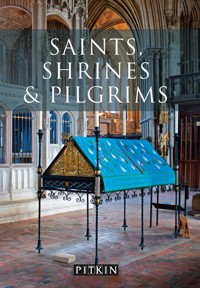
To be a medieval pilgrim evokes an image of a dauntless soul, braving weather, weariness and woe to fulfil a spiritual quest, treading ancient highways and following some inner force to Jerusalem, Rome, Santiago or Canterbury. Pilgrims today are more fortunate since, through the wonders of modern travel and communications, pilgrim sites are now accessible in a way our medieval forbears could never have imagined. Be that as it may, true pilgrimage never changes: it is to set out on a journey of outward and inner discovery; and to return changed and inspired by all that has been seen and experienced along the way. This Pitkin guide explores the history of pilgrimage; covering pagan, celtic and Christian sites. It also describes the main shrines throughout the UK – Winchester, Canterbury, Westminer, Lincoln, Durham and more – and the saints connected to them.
Sie lesen das E-Book in den Legimi-Apps auf:
Seitenzahl: 44
Veröffentlichungsjahr: 2019
Das E-Book (TTS) können Sie hören im Abo „Legimi Premium” in Legimi-Apps auf:
Ähnliche




















WHEN IN APRIL THE SWEET SHOWERS FALL
AND PIERCE THE DROUGHT OF MARCH TO THE ROOT ...
THEN PEOPLE LONG TO GO ON PILGRIMAGES ...
TO SEEK THE HOLY BLISSFUL MARTYR, QUICK
TO GIVE HIS HELP TO THEM WHEN THEY WERE SICK.
TRANSLATED FROM THE PROLOGUE OF THE CANTERBURY TALES,GEOFFREY CHAUCER
SAINTS,SHRINES& PILGRIMS
Keith Sugden
CONTENTS
Pagans & Pilgrims
Motives & Means
The Celtic Saints Columba † Cuthbert
The Celtic Saints David (Dewi Sant) † Winefrede
The Pilgrim Routes Canterbury † Rome † Jerusalem † Santiago
The Pilgrim’s Journey
Walking the Pilgrim Ways
Saints & Shrines Beverley † Canterbury † Chester
Saints & Shrines Chichester † Durham † Ely
Saints & Shrines Hereford † Lichfield † Lincoln
Saints & Shrines Ripon † St Alban’s † St Edmundsbury † Salisbury
Saints & Shrines Westminster † Winchester † Worcester † York
Survival & Revival
Map of Sites
Acknowledgements
PAGANS & PILGRIMS
Pilgrimage is by no means the sole domain of Christians. Think of the Hadj to Mecca, one of the five pillars of Islam; or consider those pagan supplicants at the Delphic Oracle or the great shrine to Aphrodite in Asia Minor. Naturally, ancient philosophy influenced the early Christians. Evangelists generally found it prudent to adapt the pagan beliefs to the new religion rather than simply destroy them, taking on board the old myths and sacred sites. A famous letter from Pope Gregory the Great to St Augustine instructs the 6th-century missionary to build his churches on ancient places of worship. Of course many Britons had been Christians under the Roman Empire, and at a few places in Britain, tradition or modern research claims that Christianity never died out during the pagan invasions of the Dark Ages – Glastonbury in Somerset and Deerhurst in Gloucestershire are among them.
St Augustine and his followers began their mission in England by converting the Saxon royal families; from that point the faith of the individual kings led to the replacement of the pagan beliefs. Some rulers became so devout that their own souls took precedence over the kingdom. Such was King Ina of Wessex, who abdicated, gave his throne to a kinsman and made the ‘permanent pilgrimage’ to Rome – where he spent the rest of his days. Many wealthy Englishmen of the day followed suit, trusting that by dying at Rome, close to the bearer of the keys of heaven, St Peter, they would stand the best possible chance on the Day of Judgement.
PAGAN SITES
Two of Britain’s most evocative and popular shrines are pagan in origin. The Isle of Avalon in Celtic mythology is the mystical land of the dead. For centuries, this paradise has been identified as a magical hill rising out of the Somerset Levels – Glastonbury Tor.
For the Romans and their British subjects, the hot springs of Aquae Sulis (modern Bath), unique in Britain, held an even greater attraction. A genuine little shrine-town developed there by the 3rd century AD, now beautifully excavated and explained in the Roman Baths Museum.
The Gorgon’s head from the pediment of the temple in Bath, found in 1790 when the Pump Room was being built, also represents Sul, god of the sacred spring.
The temple of Stonehenge, a shrine of the moon and later of the sun, was a focus for prehistoric religion in Wessex for 1,700 years. Bronze Age chieftains sought to be buried within sight of it.
MOTIVES & MEANS
In early Christian times only the wealthy could afford the pilgrimage to Rome and common Englishmen had to rest content with visiting a local shrine. Even then the choice of shrines must have been wide, with the memory of the foundation of their churches still fresh in the minds of the people, and the relics of hundreds of founders (‘saints’) close at hand, especially in Wales and Cornwall. By the time pilgrimage reached its heyday in the 14th century the phenomenon was enormous. During this period, the recorded numbers of pilgrims to Canterbury exceeded 200,000 a year, out of a total population in England estimated at just under four million on the outbreak of the Black Death in 1348.
The number of famous shrines grew and grew as monks and prelates vied to attract more pilgrims. Every single church was supposed to have a relic of some kind. Many judged the fame of towns, not on the size of the population or the quality of their products, but on the number and reputation of their relics. Some shrines had connections with numerous saints: 13 at Glastonbury. Other monasteries and churches possessed more relics than they knew what to do with – over 400 were said to exist at Canterbury, where 250 miracles were described in the six years after St Thomas’s death.




