


0,99 €
Mehr erfahren.
- Herausgeber: The Ebook Emporium
- Kategorie: Gesellschafts- und Liebesromane
- Sprache: Englisch
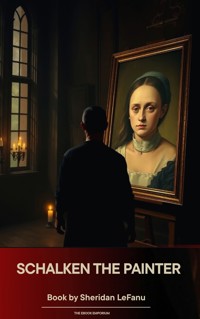
"He was not a man of this world, and the gold he paid with had a cold, ancient gleam." In the workshops of 17th-century Leyden, the young and talented artist Godfried Schalken falls in love with Rose, the beautiful niece of his master, Gerard Douw. But their romance is shattered by the arrival of a mysterious suitor: Minheer Vanderhausen. Blue-skinned, breathless, and draped in magnificent but outdated finery, Vanderhausen offers a chest of gold so immense that Douw cannot refuse. Rose is bartered away to this living corpse, disappearing into a nightmare from which there is no return. Years later, Schalken is granted one final, terrifying glimpse of his lost love—and the horrific entity she now serves in the shadows. The Horror of the Visual: Le Fanu, himself an admirer of art, uses the techniques of the Dutch masters to tell his story. He describes scenes as if they were paintings, utilizing chiaroscuro—the intense contrast between deep shadows and bright light—to hide the grotesque features of the supernatural antagonist. The result is a story that feels as textured and atmospheric as an oil painting come to life. A Tale of Moral Decay: At its heart, the story is a critique of avarice. Gerard Douw's willingness to sell his niece for a chest of gold is the "true" horror that invites the supernatural in. Le Fanu explores the idea that human greed can be more monstrous than any phantom, leading to a tragedy that haunts the protagonist until his dying day. The Legacy of the "Demon Lover": Schalken the Painter is a foundational text in the "demon lover" tradition of Gothic fiction. It avoids the typical "clanking chains" of 18th-century ghosts, opting instead for a quiet, physical, and deeply uncanny presence. The final image of the story—the "living" painting—remains one of the most famous and frightening endings in horror literature. Don't look too closely at the shadows. Purchase this masterpiece of the macabre today.
Das E-Book können Sie in Legimi-Apps oder einer beliebigen App lesen, die das folgende Format unterstützen:
Veröffentlichungsjahr: 2026
Ähnliche














Schalken the Painter
Joseph Sheridan Le Fanu
"For he is not a man as I am that we should come together; neither is there any that might lay his hand upon us both. Let him, therefore, take his rod away from me, and let not his fear terrify me."
There exists, at this moment, in good preservation a remarkable work of Schalken's. The curious management of its lights constitutes, as usual in his pieces, the chief apparent merit of the picture. I say apparent, for in its subject, and not in its handling, however exquisite, consists its real value. The picture represents the interior of what might be a chamber in some antique religious building; and its foreground is occupied by a female figure, in a species of white robe, part of which is arranged so as to form a veil. The dress, however, is not that of any religious order. In her hand the figure bears a lamp, by which alone her figure and face are illuminated; and her features wear such an arch smile, as well becomes a pretty woman when practising some prankish roguery; in the background, and, excepting where the dim red light of an expiring fire serves to define the form, in total shadow, stands the figure of a man dressed in the old Flemish fashion, in an attitude of alarm, his hand being placed upon the hilt of his sword, which he appears to be in the act of drawing.
There are some pictures, which impress one, I know not how, with a conviction that they represent not the mere ideal shapes and combinations which have floated through the imagination of the artist, but scenes, faces, and situations which have actually existed. There is in that strange picture, something that stamps it as the representation of a reality.
And such in truth it is, for it faithfully records a remarkable and mysterious occurrence, and perpetuates, in the face of the female figure, which occupies the most prominent place in the design, an accurate portrait of Rose Velderkaust, the niece of Gerard Douw, the first, and, I believe, the only love of Godfrey Schalken. My great grandfather knew the painter well; and from Schalken himself he learned the fearful story of the painting, and from him too he ultimately received the picture itself as a bequest. The story and the picture have become heir-looms in my family, and having described the latter, I shall, if you please, attempt to relate the tradition which has descended with the canvas.
There are few forms on which the mantle of romance hangs more ungracefully than upon that of the uncouth Schalken—the boorish but most cunning worker in oils, whose pieces delight the critics of our day almost as much as his manners disgusted the refined of his own; and yet this man, so rude, so dogged, so slovenly, in the midst of his celebrity, had in his obscure, but happier days, played the hero in a wild romance of mystery and passion.
When Schalken studied under the immortal Gerard Douw, he was a very young man; and in spite of his phlegmatic temperament, he at once fell over head and ears in love with the beautiful niece of his wealthy master. Rose Velderkaust was still younger than he, having not yet attained her seventeenth year, and, if tradition speaks truth, possessed all the soft and dimpling charms of the fair, light-haired Flemish maidens. The young painter loved honestly and fervently. His frank adoration was rewarded. He declared his love, and extracted a faltering confession in return. He was the happiest and proudest painter in all Christendom. But there was somewhat to dash his elation; he was poor and undistinguished. He dared not ask old Gerard for the hand of his sweet ward. He must first win a reputation and a competence.
There were, therefore, many dread uncertainties and cold days before him; he had to fight his way against sore odds. But he had won the heart of dear Rose Velderkaust, and that was half the battle. It is needless to say his exertions were redoubled, and his lasting celebrity proves that his industry was not unrewarded by success.
These ardent labours, and worse still, the hopes that elevated and beguiled them, were however, destined to experience a sudden interruption—of a character so strange and mysterious as to baffle all inquiry and to throw over the events themselves a shadow of preternatural horror.
Schalken had one evening outstayed all his fellow-pupils, and still pursued his work in the deserted room. As the daylight was fast falling, he laid aside his colours, and applied himself to the completion of a sketch on which he had expressed extraordinary pains. It was a religious composition, and represented the temptations of a pot-bellied Saint Anthony. The young artist, however destitute of elevation, had, nevertheless, discernment enough to be dissatisfied with his own work, and many were the patient erasures and improvements which saint and devil underwent, yet all in vain. The large, old-fashioned room was silent, and, with the exception of himself, quite emptied of its usual inmates. An hour had thus passed away, nearly two, without any improved result. Daylight had already declined, and twilight was deepening into the darkness of night. The patience of the young painter was exhausted, and he stood before his unfinished production, angry and mortified, one hand buried in the folds of his long hair, and the other holding the piece of charcoal which had so ill-performed its office, and which he now rubbed, without much regard to the sable streaks it produced, with irritable pressure upon his ample Flemish inexpressibles. "Curse the subject!" said the young man aloud; "curse the picture, the devils, the saint—"




