


0,00 €
Mehr erfahren.
- Herausgeber: Echoes & Pages Press
- Kategorie: Gesellschafts- und Liebesromane
- Sprache: Englisch
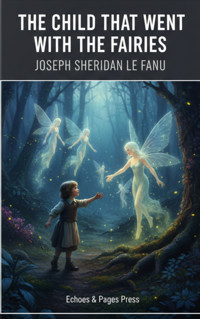
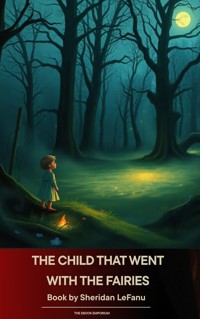
Rooted in Irish folklore, The Child That Went With the Fairies is a haunting and sorrowful tale of innocence lost to the supernatural. Joseph Sheridan Le Fanu weaves myth, superstition, and emotional tragedy into a powerful story of fairy lore and unseen worlds. A timeless classic of Celtic fantasy and Gothic fiction.
Das E-Book können Sie in Legimi-Apps oder einer beliebigen App lesen, die das folgende Format unterstützen:
Veröffentlichungsjahr: 2026
Ähnliche


The Child That Went With The Fairies
Joseph Sheridan Le Fanu
Eastward of the old city of Limerick, about ten Irish miles under the range of mountains known as the Slieveelim hills, famous as having afforded Sarsfield a shelter among their rocks and hollows, when he crossed them in his gallant descent upon the cannon and ammunition of King William, on its way to the beleaguering army, there runs a very old and narrow road. It connects the Limerick road to Tipperary with the old road from Limerick to Dublin, and runs by bog and pasture, hill and hollow, straw-thatched village, and roofless castle, not far from twenty miles.
Skirting the healthy mountains of which I have spoken, at one part it becomes singularly lonely. For more than three Irish miles it traverses a deserted country. A wide, black bog, level as a lake, skirted with copse, spreads at the left, as you journey northward, and the long and irregular line of mountain rises at the right, clothed in heath, broken with lines of grey rock that resemble the bold and irregular outlines of fortifications, and riven with many a gully, expanding here and there into rocky and wooded glens, which open as they approach the road.
A scanty pasturage, on which browsed a few scattered sheep or kine, skirts this solitary road for some miles, and under shelter of a hillock, and of two or three great ash-trees, stood, not many years ago, the little thatched cabin of a widow named Mary Ryan.
Poor was this widow in a land of poverty. The thatch had acquired the grey tint and sunken outlines, that show how the alternations of rain and sun have told upon that perishable shelter.
But whatever other dangers threatened, there was one well provided against by the care of other times. Round the cabin stood half a dozen mountain ashes, as the rowans, inimical to witches, are there called. On the worn planks of the door were nailed two horse-shoes, and over the lintel and spreading along the thatch, grew, luxuriant, patches of that ancient cure for many maladies, and prophylactic against the machinations of the evil one, the house-leek. Descending into the doorway, in the chiaroscuro of the interior, when your eye grew sufficiently accustomed to that dim light, you might discover, hanging at the head of the widow's wooden-roofed bed, her beads and a phial of holy water.
Here certainly were defences and bulwarks against the intrusion of that unearthly and evil power, of whose vicinity this solitary family were constantly reminded by the outline of Lisnavoura, that lonely hillhaunt of the "Good people," as the fairies are called euphemistically, whose strangely dome-like summit rose not half a mile away, looking like an outwork of the long line of mountain that sweeps by it.




