


Erhalten Sie Zugang zu diesem und mehr als 300000 Büchern ab EUR 5,99 monatlich.
- Herausgeber: Carcanet Classics
- Kategorie: Poesie und Drama
- Sprache: Englisch
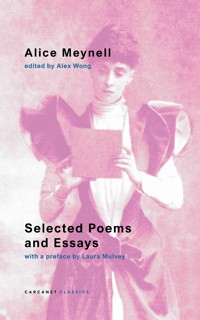
Alice Meynell was a major British author of the late nineteenth and early twentieth centuries. This is the first anthology of her verse and prose to be published for over seventy-five years. Meynell was highly regarded both as a poet and as a writer of essays and was seriously proposed for the laureateship on two occasions. G.K. Chesterton said of her that she 'never wrote a line, or even a word, that does not stand like the rib of a strong intellectual structure; a thing with the bones of thought in it'. The present selection includes the early romantic poems of yearning, full of poignant surprises, and the terser, less personal poems of her maturity. Also included is a broad sample of Meynell's literary essays, in each case a careful work of art. They include reflections on literature, culture and the natural world, nuanced observations on childhood, and moving defences (both specific and general) of women against trespasses on their dignity. This selection is introduced by Alex Wong, who offers a poet's view of Meynell's distinctive artistic achievements and locates her within her literary contexts. It also includes an appreciative preface by the renowned feminist critic and theorist Laura Mulvey, who is the author's great-granddaughter.
Sie lesen das E-Book in den Legimi-Apps auf:
Seitenzahl: 255
Veröffentlichungsjahr: 2025
Das E-Book (TTS) können Sie hören im Abo „Legimi Premium” in Legimi-Apps auf:
Ähnliche




1
2
3
Contents
Prefaceby Laura Mulvey
I am very grateful to Alex Wong for inviting me to write a Preface to his anthology of poems and essays by my great-grandmother, Alice Meynell. His selection, particularly of her essays, has definitely strengthened my earlier, rather guarded, sense of the relevance of the term ‘feminism’ for her work. He points out that ‘she uses the new-coined word herself, with wary quotation marks, though not disowning its meaning’. Alice Meynell wrote about male writers and cultural figures and her perspective is not consistently ‘woman-orientated’. However, concentrating on her prose writing for this Preface, I’ve found the originality and radicality of her ideas striking. On the one hand, her feminism is overt. She denounced male misogyny (as forcefully illustrated by several of the essays in this selection) and she wrote over and over again about women’s achievements, whether recognised or insufficiently recognised by conventional history and culture. On the other hand, her feminism more subtly, but inextricably, inflects her choice of topics, her modes of thought and how she translates those thoughts into words.
Although A.M. was only occasionally a poet, she was a professional journalist.1 She and her husband, Wilfrid Meynell, produced two short-lived literary journals during the 1880s, and from 1881 to 1900 they also collaborated in the constant struggle to produce the Weekly Register (a Catholic periodical), Wilfrid’s bread and butter. A.M. embarked on her 10intense essay-writing career in 1889, after six of her children were born (one had died in infancy and two were still to come). Her essays were all commissioned by various journals that flourished in the late nineteenth century. Her weekly contribution to the Pall Mall Gazette column ‘The Wares of Autolycus’ drew immediate critical and reader acclaim and attention, leading to subsequent essay collections published by John Lane and others. She worked hard, sometimes owing 16,000 words a week. Family legend has it that she wrote all morning in the sacrosanct space of her room, only emerging for lunch and to join the hectic, deadline-driven chaos at the library table in 47 Palace Court, Bayswater.
Alex astutely characterises the structure of Alice Meynell’s essays as ‘connective’: a progression that moves surprisingly but naturally from one idea or observation to another. But, I thought, might a mixture of looseness and surprising turnings be relevant both to the essay form and to women’s writing? I remembered a remark of Elizabeth Hardwick’s: ‘We would not want to think of the essay as the country of old men, but it is doubtful that the slithery form, wearisomely vague and as chancy as trying to catch a fish in the open hand, can be taught’. Perhaps, it seemed to me, this unregulated, undefined ‘country’ might offer women writers a literary ‘room of their own’.2 I also remembered Theodor Adorno’s polemical defence of the essay as a form that challenged and evaded the rigidities of logic and reason—spheres of intellectual activity, incidentally, that had traditionally been closed to women. He says:
Concepts do not form a continuum of operations. Thought does not progress in a single direction; instead the moments are interwoven as in a carpet. 11The fruitfulness of the thought depends on the density of the texture […]. The essay proceeds methodically un-methodically.3
Although A.M. exploits the form’s freedoms, she often ends with a specific, quite intense, thought, sometimes illuminating, sometimes perplexing, that leaves the reader pondering.
‘The Rhythm of Life’, the first essay in this selection, offers a case in point. The topic is time, which, A.M. suggests in the first sentence, is ‘metrical’. In this visualisation of temporality as non-linear, I recognised an early form of today’s feminists’ aversion to linear time, to its associations with a patriarchally conceived history and chronologically compiled achievements. Here she argues in prose for a concept of time that often recurs in her poetry: leaping backwards and forwards, bringing past and future into dialogue. Oliver Hawkins has pointed out, for instance, that in A.M.’s early poem, ‘A Letter from a Girl to her Own Old Age’, time is criss-crossed—‘before cinema had taught us to understand flash-backs and fast-forwards’.4 Meanwhile the idea of ‘recurrence’ in ‘The Rhythm of Life’ evokes for me, as someone influenced by psychoanalytic theory, the unconscious mind, outside logical order and sequence, the source of non-sequitur thoughts and actions. In both instances, time is fluid.
But the essay’s argument moves on, apparently at a tangent, to the particular ‘rhythm of life’ that’s derived from the moon. The moon is given a feminine article: ‘her metrical phases’ are the source of her natural and cultural power, and she is subject to ‘the order of recurrence’. Although a more explicit 12association between femininity and cyclical time is not made, it’s sufficiently implied for any reader, as I did, to recognise and reflect on further. These ‘cumulative’ thoughts, to my mind at least, hint, as nearly as might be possible at the end of the nineteenth century, at the ‘periodicity’ of menstruation. The essay then returns to the general problem of the need in life to ‘do away with the hope and fear of continuance’. Its final sentence ends with a surprising, unresolved, juxtaposition, leaving the reader puzzling, trying to decipher what the writer might mean by ‘the law that rules all things—a sun’s revolutions and the rhythmic pangs of maternity’.
While ‘A Woman in Grey’ is written with Alice Meynell’s characteristic loose connectivity, it also has a more unusual, symmetrical pattern, opening and closing with two quotations from Shakespeare, both evoking the strong influence of a mother on a son. This tighter structure gives special weight to the essay’s central section, but it’s prefaced, slightly blurring the symmetry, with some acute and extremely important points about gender binaries: the social tradition that imposes stasis on women while their male equivalents enjoy unfettered freedom of movement. If, as the essay points out, the battle of Waterloo was won ‘on the playing fields of Eton’, there was some other place ‘where the future wives of the football players were sitting still’. Here the essay speaks the unspoken side of the movement/stillness opposition, naming the unmentioned feminine that heroic masculinity depends on but obscures.
A specific moment, observed in real life, turns the traditional opposition upside down. A.M., travelling on a bus along Oxford Street, notices a woman in grey riding a bicycle calmly through the chaos of the traffic churning all around her: through ‘omnibuses and carriages, cabs and carts’. ‘Beside all the unequal movement, there were the stoppings. It was a delicate tangle to keep from knotting’. The woman moves with a ‘watchful confidence’ and ‘unstable equilibrium’, passing 13between security and danger: ‘she leapt into a life of moments. No pause was possible to her as she went except the vibrating pause of a perpetual change and an unflagging flight’. A.M.’s prose style vividly conjures up the scene’s double temporality: its instantaneity, as she had observed it, and then, as she interprets it, its break with past precedent. Here the essay deviates from conventional linguistic transparency. Although, on a literal level, the simultaneity of ‘pause’ and ‘perpetual change’ might relate to the way a bicycle works, on a more figurative level there’s a suggestion of paradox, even a confusion of logical sequence. The added adjectives, ‘vibrating’ and ‘perpetual’, then further disturb their nouns: the quiet of ‘pause’ is physically shaken and the prospect of ‘change’ has no end in sight. A.M. not only captures this hitherto unimaginable insertion of a female presence in, and movement through, the mass of ‘male-dominated’ traffic, but she also dissolves traditional binaries in the seeming contradiction of ‘unstable equilibrium’.
The essay moves: from the actual bicyclist to her subversive significance as a woman in motion, and then to her wider allegorical associations. ‘She evidently had not in her mind a single phrase, familiar to women, made to express no confidence except in accidents […]. No woman could ride a bicycle along Oxford Street with that kind of baggage about her’. Here the bicyclist acquires implications beyond herself: she stands for the way the female psyche had been, and must continue to be, reconfigured in order for mobility to displace stasis. Furthermore, in the same spirit, in her progression along Oxford Street, the bicyclist represents the Movement, the ongoing struggle for Women’s Rights, the politics of progress with which Alice Meynell so deeply identified.
Alex’s selection of A.M.’s essays concludes with four that, although not ‘women-related’, have a special significance for her idiosyncratic writing style as well as her way of seeing and relating to the world. These essays all revolve around her 14intense pleasure in natural phenomena; most particularly, perceptions and sensations produced by their movement and transience. This ‘Alice Meynell’ counters the image that so often haunts her: of austerity, reserve, reticence, withdrawal, etc. On the contrary, she writes as passionately about a passing cloud as she does about the rights of women. For the reader, these essays can transform old, habitual ways of seeing into unforgettable lessons in looking.
Due, perhaps, to my interest in the photographic image (still or moving), I’ve been struck by A.M.’s ability to capture immediacy in her prose. In certain passages, an original moment seems to leave its trace in her writing, printed, as it were, into the print on the page—just as light leaves an imprint on photosensitive paper. For André Bazin, a photograph is a natural phenomenon, untouched by the hand of man. In an interestingly analogous sleight of the imagination, the natural phenomena celebrated in these essays are all indifferent to, only rarely affected by, human presence. A.M. loved certain landscape painters (see, for instance, her thoughts on Corot’s early morning light in the essay on the ‘Hours of Sleep’, included here). But on a different aesthetic register, simplicity defined nature’s fascinating affects, precisely due to a lack of mediation, and the absence of ingenuity. For instance, in her essay ‘Ceres’ Runaway’ (collected into a 1909 volume of the same title) she celebrates wildflowers growing high in Rome’s ancient ruins. And this aesthetic of simplicity extends further. For instance, in an essay on the Brontës:
The student passes delighted through the several courtyards of poetry, from the outer to the inner, from riches to more imaginative riches, and from decoration to more complex decoration; and prepares himself for the greater opulence of the innermost chamber. But when he crosses the last threshold 15he finds this midmost sanctuary to be a hypaethral temple, and in its custody and care a simple earth and a space of sky.5
The essays on ‘Cloud’, ‘Shadows’, ‘Horizon’ and ‘Reflections’ observe the beauty of simplicity and of chance. Only in ‘Horizon’ is human experience necessary to create movement, the sensation of being raised up through and into a series of constantly shifting views, from a small dell to a distant seascape. She attributes a kind of autonomy to the natural forces that spread their beauty onto the world: the transient and insubstantial immediacy of light, for example, in clouds or on water, when set in motion by the wind. Clouds control light, ‘distributing the sun’ and decorating the earth, while their statuesque shapes decorate the sky. The shadow ‘rushes to meet its bird when the bird swoops on to a branch and clings’. A.M.’s prose captures the complexity of these natural phenomena: ‘shade and shine have been entangled as though by some wild wind through their million molecules’. And ‘Reflections’ pictures the visuality and physicality, then the instability, of a reflection on water: ‘it is shattered to bits, it is flung wide, it is intricate with fine shadows’. Throughout the essays, A.M. bemoans London, lost under the fog, until at the very end of ‘Reflections’, suddenly ‘a thousand replies to the sunset shine in the windows of the streets’.
It’s quite usual to consider Alice Meynell’s childhood, and most especially the influence of her father, Thomas Thompson, in any assessment of her character and her literary work. However, her original way of observing the world around 16her, as well as her extraordinary responsiveness to natural beauty, come from her mother, Christiana. Alice and her older sister, Elizabeth (who grew up to be an eminent painter), were educated by their father, whose outstanding erudition, intellectual precision and devotion to literature were undoubtedly absorbed and emulated by his literary daughter. Vita Sackville-West, in her otherwise perceptive Introduction to the centenary publication of A.M.’s Prose and Poetry (1947), sets up a dichotomy between the parents. She says: ‘It is easy to trace the influence of [her father’s] austerity upon the spirit that later informed every gesture of Alice Meynell’. On the other hand, her mother is described as ‘a somewhat feckless, ecstatic, sentimental, “artistic”, example of Victorian womanhood’.6
Charles Dickens, Christiana’s former admirer and Thompson’s one-time best friend, gives an illuminating account of an 1853 visit to the Thompsons’ ‘beautiful situation in a ruinous palace’ near Genoa. Dickens says: ‘We had disturbed [Christiana] at her painting in oils, and I have rather received the impression that, what with that, and what with music, the household affairs went a little to the wall’. He found Thompson teaching ‘the little girls multiplication tables in a disorderly old billiard room’.7 To my mind, Elizabeth and Alice were saved from any correct womanly preparation for domestic life and its duties by the combined influence of both parents: the education, rigorous, if eccentric, they received from their father and their mother’s complete indifference to housekeeping in favour of her art. (It would be quite often noted in later years that women’s traditional skills were not Mrs. Meynell’s forte.) 17
Christiana Weller had been a successful concert pianist when she married Tom Thompson in 1845, bringing her promising professional career to an end. From 1851, they spent half of every year in Italy, where Christiana began to paint. Her diaries record her responses to the varying lights and colours of land, sky and sea, their changeability and their transience and her constant striving to capture these effects in their elusive moments of perfection. Her grand-daughter, Viola Meynell, in her Memoir of her mother (Alice), describes the diary entries as ‘flying impressions’: ‘They telegraph themselves onto the page as if they were recorded in the actual hurry of their happening, instead of the quiet pause afterwards’.8
Christiana’s diary entries do, indeed, tend towards the ‘ecstatic’, as she records her vivid visual impressions and emotions swaying, as Viola puts it, from rapture to distress. For instance, after the distress of a cold, difficult journey, rapture: ‘Sun shone sweetly and three large trees on the opposite side of the Place made waving shadows on the walls’. Or, when in Italy: ‘Magical morn. No white paint. Despair’.9 To reiterate: Alice Meynell learnt lessons in looking from her mother, not only her passion for natural beauty but also her unusual responsiveness to everyday life; Christiana’s ability, that is, to transform the otherwise ordinary into the extraordinary, into event and anecdote. In ‘the quiet pause afterwards’, the daughter’s own observations of the everyday telegraphed the ‘hurry of things happening’ onto her pages.
The characterisation of Alice Meynell as ‘austere’ overlooks the way that emotion, or feeling, acts as a driving force within many of her essays. This is perhaps most obvious in her observations of childhood and her close identification 18with children (see, in this selection, ‘The Child of Tumult’, ‘The Child of Subsiding Tumult’ and ‘Near the Ground’), but it’s evident too in her fascination with the natural world. It’s also there in her response to ‘A Woman in Grey’. But emotion is subjected, first, to a rigorous process of thought and then refracted into A.M.’s highly controlled literary style. There are moments when her writing gives the reader pause for thought. Sometimes these moments seem to me to prefigure a modernist rejection of writing for easy habits of reading (a ‘making strange’). Or, I wonder, do they prefigure Hélène Cixous’s concept (in her 1975 essay ‘The Laugh of Medusa’) of ‘écriture feminine’, women’s errant, anti-patriarchal mode of writing?
In the Introduction to this selection, Alex has given a fascinating analysis of Alice Meynell’s sense of a ‘wildness’ within herself, which she acknowledged while always also searching for its regulation.
In the tension between wildness and law, according to the conceit of that late poem [‘The Laws of Verse’], instead of a drifting feather she can be a bird in flight, with the bird’s weight, its will, its orderly wingbeat, and the freedom and propulsion these allow. The bird she chooses in that poem is the skylark, famously free in song as well as in motion.
The transition from feather to bird presents a particular challenge to women writers: how to acquire ‘weight’ and ‘wingbeat’ without succumbing to a law which is not only not theirs, but also enforces their silence? This dilemma has preoccupied those contemporary feminists who have argued that the Freudian/Lacanian theory of the Oedipus complex gives a compelling account of the origins and perpetual renewal of women’s oppression. To sum up the patriarchal 19pattern: when a child learns the rules of language, it exchanges bodily dependence on its mother for the society, culture, etc., that is ruled by the law of the Father, his ‘Symbolic Order’. Women’s potential for thought and creativity, silenced in this divided world, might turn to this ‘wildness’ in opposition to Law. But, in the process of the feather’s transition to bird, as an acultural wildness finds its own voice, perhaps a different, alternative, Symbolic begins to be born.
Imposing contemporary feminist thought on a writer working over a century ago might well risk anachronism. But, to my mind, Alice Meynell’s writing, her version of an ‘écriturefeminine’, consciously breaks boundaries to depict, vividly, new ways of experiencing the world. For instance, ‘The Rhythm of Life’ turns upside down a traditional idea of time: ‘recurrence’ undermines the age-old image of an aspirational and one-dimensional future. And then: ‘A Woman in Grey’ witnesses nothing less than a reconfiguration of the female psyche, leaping forward into freedom, and casting the oppression of traditional stillness aside. This is not to suggest that (in either form or content) she stands for an essentially feminine aesthetic or worldview. Rather, A.M. contributes to a woman-inflected perspective. Her voice and her insights work to rebalance a culture that had been deprived, for so long, of fifty per cent of its creative potential.
A last, personal note. My generation of great-grandchildren grew up without knowing A.M. (she died in 1922) but with an acute awareness of her. Our immediate family tree is traced back to W. and A.M. and the family still meets at Greatham, the country home they acquired in 1911. A.M. has always been greatly admired for achieving acclaim in a male-dominated literary world and for her fervent support for women’s rights. But writing this Preface, I’ve found, if late in life, a new sense of affinity with my great-grandmother. My writing, going back to the 1970s, has been rooted in feminist-influenced ways of 20thought, but it has, also, always been essayistic. It’s probably due to A.M.’s aura, as a pioneering woman intellectual, that her female descendants have been unusually intellectually encouraged and valued. I benefited fully from this legacy as I grew up. And as, by some fortunate chance, I inherited my great-grandmother’s writing table, I can imagine that I have, at least to some extent, written in her footsteps.
Laura Mulvey
2025
1 I have been unsure how to name my great-grandmother in this Preface. She was always known to her grandchildren and beyond as ‘Gammer’ (Wilfrid was ‘Gaffer’), and then, more formally, as ‘A.M’. I have great difficulty with the academically acceptable ‘Meynell’, which feels too alien and forced, due to our relationship. I have alternated between ‘Alice Meynell’ and ‘A.M’., my preference.
2 Hardwick, ‘Its Only Defense: Intelligence and Sparkle’, in the NewYork Times (14 Sept 1986).
3 Adorno, ‘The Essay as Form’, in Notes to Literature, ed. Rolf Tiedemann, vol. 1 (1991), p. 13.
4 Oliver Hawkins, a great-grandson of Alice Meynell, from an unpublished paper, ‘Against the Flight of Time’.
5 ‘Charlotte and Emily Brontë’, in Essays of To-day and Yesterday, ed. Wilfrid Meynell (1925), pp. 44-57; pp. 53-54. Thanks to Mark Dallyn, A.M.’s great-grandson, for giving me a copy of this very special collection of her essays on women writers, and for pointing out this passage to me.
6 Sackville-West, ‘Introduction’, in Alice Meynell, Prose and Poetry:Centenary Volume (1947), p. 11, p. 10.
7 Viola Meynell, Alice Meynell: A Memoir (1929), p. 17.
8Ibid., p. 14.
9Ibid., p. 21.
Introductionby Alex Wong
Alice Meynell (1847–1922) was a major English author of the last quarter of the nineteenth century and the opening decades of the twentieth. The evidence of this is not to be found only in the manifest value of her writing itself, though this ought to be the more important thing. She was admired, celebrated and almost venerated by some of the most serious-minded of her peers, and meanwhile popular enough to attract large and enthusiastic audiences on extended lecture tours in the United States. If Coventry Patmore’s personal devotion to her casts doubt on his impartiality in calling her prose ‘the finest that was ever written’,1 strong praise of both her prose and her verse is easy to find in plenty from other quarters. Her journalistic work, editorial as well as authorial, was energetic, prolific, various and far-reaching, and her essays and criticism maintained the highest literary standards amid the rush, ephemerality and financial imperatives of periodical publishing. She was President of the Society of Women Journalists and Vice-President of the Women Writers’ Suffrage League. As a poet, she was a serious contender (not that she herself contended) for the laureateship on two occasions. Passages of even her earliest poetry, which she herself came to deprecate, were called by Ruskin ‘the finest things I’ve seen or felt in modern verse’.2
Meynell is a writer full of surprises, ones that justify themselves by their serious imaginative thoughtfulness: not flights of fancy, though she could respond to these, but imagination dedicated to realities as she saw them. ‘The surprise coming on us’, George Meredith said of her essays, 22‘from their combined grace of manner and sanity of thought is like one’s dream of what the recognition of a new truth would be’.3 Within chosen bounds of form and style—bounds she was always ready to acknowledge and emphasise, and which, in her verse especially, belonged to standards already somewhat classical—she found an authentic distinctiveness and an enabling space from which, with acuity, moral courage and wit, she could challenge routine expectations.
In a late poem, ‘The Laws of Verse’, which closes the selection of poems in this anthology, she writes about these bounds that contain, and yet somehow enable, a wildness inside. In poetry, as in other areas of life, that inner wildness could flourish and be turned to good account within the safety of the outer laws, and she submitted to literary laws as well as to the moral doctrine of her religion (she was a Catholic convert) with a conviction that these, in curtailing some freedoms, were conditions of a freedom more worthwhile. The poem invokes the ‘laws’ of verse, of versification, which are to meet around her like embracing arms: she is not only ‘ruled’ by them but also ‘warmed’. Held by these laws, she becomes newly ‘aware’—of her own breath and rhythm, the fundamentals of voice—and can ‘feel her wild heart beat’. I think she believed that an unheld wildness, the wild heart left only to its wildness, could be random, indulgent, destructive, and would lack a creative tension, but that with discipline it could find its creativeness and self-insight. At any rate the wild heart was a human truth to be honoured it its place, and the ‘wild’ was one of the things she sought in poetry. ‘The nearest she could get to defining the poetry she loved best’, Viola Meynell wrote of her mother, ‘was to say that it had the quality of wildness’.423
In the tension between wildness and law, according to the conceit of that late poem, instead of a drifting feather she can be a bird in flight—with the bird’s weight, its will, its orderly wingbeat, and the freedom and propulsion these allow. The bird she chooses in that poem is the skylark, famously free in song as well as in motion.
Out of this constant tension she administered her surprises. Conscience seems to have occupied the place of a muse to her, and often the surprises, paradoxes and second thoughts are those of an active self-examination, while at other times, more generally, the striking phrase or image is licensed and guaranteed by the artistic, moral and intellectual conscientiousness of an unsentimental and painstaking mind. ‘Mrs. Meynell is always to be trusted’, said Vita Sackville-West, who introduced the last anthology of Meynell’s verse and prose—as long ago as 1947.5
(i) Style and Thought
‘November Blue’ begins as a poem lamenting the lack of blue sky in modern London, where metropolitan pollution does away with that ‘heavenly colour’ even in the narrow gaps between buildings where, for the hemmed-in Londoner, the sky is parcelled up into modest slivers. Another poet of the period might have continued in the same vein, ending the poem in dismay, or drawing out a sobering moral or spiritual lesson in the manner of Ruskin. Still another would have made a deliberately ‘decadent’ virtue of the smog, with lurid imagery and an attitude of knowingly morbid or perverse delight in the effects of urban contamination. What Alice Meynell does in the second half of her poem is to tread her own path, 24offering the reader a sharply focused observation, vividly and imaginatively expressed, and combining the spiritual implication of the one approach (though free from righteous judgement) with the other’s openness to strange modern beauty (though untouched by morbidity). It makes one wish one could see the effect it describes: the blue glow of a damp November evening by gaslight in fin-de-siècle London. This is not the natural blue of the sky but an accident of artificial life. And yet it is blue all the same—the heavenly colour, which ‘comes to earth’ and ‘walks the streets’. For those who will take it, there is a religious suggestion there in addition to the brilliant poetry of description and appreciation, and I think it would be wrong to see one element as merely a vehicle or opportunity for the other. The connection for the poet is not an arbitrary one, a trick of rhetoric, but somehow a real one.
Her habit was a hard one—of resisting habit. ‘November Blue’ offers a good illustration of Meynell’s preference for refreshed thinking and her reluctance to fall in too readily with comfortable grooves of thought.
Similarly characteristic, and likewise declining to come to rest in its first, more predictable thought, is her poem ‘The Threshing-Machine’. Rather late to be quite topical, it is about the replacement of age-old manual threshing—a communal ritual of the harvest, often accompanied by songs in time with its human rhythms—by efficient but unpoetical machines. Behind the theme is all the controversy, unease and political debate of the preceding century over industrialisation and mechanisation, with a recognition of the continuing importance for nature and society of the larger tide of change. ‘No “fan is in his hand” for these / Young villagers beneath the trees, / Watching the wheels’, she begins. The opening reference is to Matthew 3:11-12: 25
… he that cometh after me is mightier than I, whose shoes I am not worthy to bear: he shall baptize you with the Holy Ghost, and with fire: Whose fan is in his hand, and he will throughly purge his floor, and gather his wheat into the garner; but he will burn up the chaff with unquenchable fire.




