


Erhalten Sie Zugang zu diesem und mehr als 300000 Büchern ab EUR 5,99 monatlich.
- Herausgeber: Paraclete Press
- Kategorie: Religion und Spiritualität
- Sprache: Englisch
If you have not read Heather King before, her honesty may shock you. In this remarkable memoir, you will see how a convert with a checkered past spends a year reflecting upon St. Thérèse of Lisieux—and discovers the radical faith, true love, and abundant life of a cloistered 19th-century French nun.
Sie lesen das E-Book in den Legimi-Apps auf:
Seitenzahl: 196
Veröffentlichungsjahr: 2011
Das E-Book (TTS) können Sie hören im Abo „Legimi Premium” in Legimi-Apps auf:
Ähnliche


















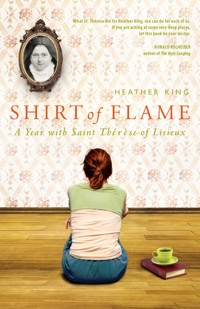
A Year with Saint Thérèse of Lisieux
SHIRT of FLAME
A Year with Saint Thérèse of Lisieux
SHIRT of FLAME
HEATHER KING
Shirt of Flame: A Year with St. Thérèse of Lisieux
2011 First Printing
Copyright © 2011 by Heather King
ISBN 978-1-55725-808-3
Scripture quotations are taken from the Revised Standard Version of the Bible, copyright © 1952 by the Division of Christian Education of the National Council of the Churches of Christ in the United States of America. Used by permission. All rights reserved.
Library of Congress Cataloging-in-Publication Data
King, Heather, 1952–
Shirt of flame : a year with St. Thérèse of Lisieux / Heather King.
p. cm.
Includes bibliographical references (p. ).
ISBN 978-1-55725-808-3 (paper back)
1. Thérèse, de Lisieux, Saint, 1873-1897. I. Title.
BX4700.T5K56 2011
282.092—dc23
2011022594
10 9 8 7 6 5 4 3 2 1
All rights reserved. No portion of this book may be reproduced, stored in an electronic retrieval system, or transmitted in any form or by any means—electronic, mechanical, photocopy, recording, or any other—except for brief quotations in printed reviews, without the prior permission of the publisher.
Published by Paraclete Press
Brewster, Massachusetts
www.paracletepress.com
Printed in the United States of America.
For Alfred Leroy Davis III
The dove descending breaks the air
With flame of incandescent terror
Of which the tongues declare
The one discharge from sin and error.
The only hope, or else despair
Lies in the choice of pyre or pyre—
To be redeemed from fire by fire.
Who then devised the torment? Love.
Love is the unfamiliar Name
Behind the hands that wove
The intolerable shirt of flame
Which human power cannot remove.
We only live, only suspire
Consumed by either fire or fire.
—T.S. ELIOT, from “Four Quartets”
CONTENTS
INTRODUCTION
JANUARY
EARLY LOSS(On Facing Ancient Grievances)
FEBRUARY
THE CONFLUENCE OF WILL AND GRACE(On Illness and Healing)
MARCH
THÉRÈSE’S SECOND CONVERSION(On Learning to Serve)
APRIL
THE PAPAL VISIT(On Daring to Ask)
MAY
POVERTY, CHASTITY, OBEDIENCE(On Radical Social Conscience)
JUNE
THE CONVENT(On Shedding Our Illusions)
JULY
THE LITTLE WAY(On the Martyrdom of Everyday Life)
AUGUST
ARIDITY(On Praying Without Ceasing)
SEPTEMBER
THE LONG, SLOW DECLINE OF THÉRÈSE’S FATHER(On Being Stripped Down)
OCTOBER
THE STORY OF A SOUL(On Offering Up Our Work)
NOVEMBER
MY VOCATION IS LOVE!(On Letting Our Flame Burn Hot)
DECEMBER
THE DIVINE ELEVATOR(On Facing Death with Joy)
APPENDIX A: THE MARTIN FAMILY, IN BRIEF
APPENDIX B: CHRONOLOGY OF THÉRÈSE’S LIFE
NOTES AND PERMISSIONS
SELECTED BIBLIOGRAPHY
INTRODUCTION
ST. THÉRÈSE OF LISIEUX lived only twenty-four years, from 1873 to 1897. She was the youngest of five daughters, all of whom eventually became nuns. When Thérèse was four, her mother died. From the age of nine she had a vocation. When the Carmelite convent where she longed to make her home said they couldn’t take her until the standard age of twenty-one, she badgered her father to take her to Rome so that she could appeal, in person, to the Pope. In 1888, at the age of fifteen, she entered the cloister. Her life in the convent was unremarkable. She did not distinguish herself spiritually or in any other way with her fellow nuns. But inside her soul, a conflagration raged. Inside she was on fire with love.
Inside, she consented to wear the “intolerable shirt of flame” (see the passage from T.S. Eliot’s poem on page vii) that can either purify or destroy, redeem or eternally torment. Inside, she allowed her heart to be consumed—invisibly, in obscurity—by the cleansing blaze of Christ’s love. So vivid was the phrase from Eliot’s poem, so beautifully did the image evince Thérèse’s inner life, struggles, and spiritual evolution, that I chose Shirt of Flame as the title of this book.
In fact, Thérèse must have exhibited some small outward spark. For in the winter of 1894, under orders from her second-oldest sister Pauline (Mother Agnes of Jesus, at that time prioress of the convent), who in turn had been urged by Sister Marie of the Sacred Heart (Thérèse’s eldest sister Marie), Thérèse began writing a memoir of her childhood, the development of her life in Christ, and her six years of religious life. The result, “Manuscript A,” comprises chapters 1 through 8 of most editions of her autobiography, L’histoire d’une Âme (The Story of a Soul).
She completed the rest of the book in stages. A letter written to Sister Marie of the Sacred Heart while on retreat in September 1896 became “Manuscript B,” comprising chapter 9 and containing the well-known treatise “My Vocation is Love.” Meanwhile, Thérèse had begun coughing up blood, a harbinger of what would become a two-year, increasingly excruciating onslaught of tuberculosis. In June 1897, only three months before Thérèse’s death, Mother Marie de Gonzague, the superior of Carmel at that time, directed her to write what would become “Manuscript C,” comprising chapters 10 and 11 of The Story of a Soul and including, among other things, the “Divine Elevator” passage and an explication of Thérèse’s “little way.” Full of charity and good cheer to the end, she died in agony, with no pain medication, on September 30, 1897, crying: “I love You!”
The Story of a Soul, published posthumously and heavily edited by Pauline, became an immediate bestseller. The entire world seemed to respond to the simple, childlike nun who was nicknamed “The Little Flower.” In an unusual move, Pope Benedict XV waived the usual fifty-year beatification requirement. Though others had waited centuries to become saints, Thérèse was canonized a mere twenty-eight years after her death.
At first glance, her observations can seem commonplace: “At each new opportunity to do battle, when my enemies come and provoke me, I conduct myself bravely” [SS, p. 238]. “God wouldn’t know how to inspire desires that can’t be realized” [SS, p. 230]. “Now I no longer have any desire, unless it’s to love Jesus passionately” [SS, p. 201].
This deceptively simple book, and the inner journey it describes, however, continue to instruct, confound, and inspire. As writers from Father Ronald Rolheiser to Dorothy Day have noted, Thérèse was a mass of contradictions: pampered child, yet with a will of iron; possessed of a lifelong, innate, and in the end conscripted loneliness, yet able to embrace the whole world; essentially unschooled, yet one of only three women (along with St. Teresa of Avila and St. Catherine of Siena) made by papal decree a Doctor of the Church; a spiritual giant whose philosophy has come to be known as “the little way.”
I think we all heave a sigh of relief when we hear “the little way.” When we try to practice it, though, we tend to find that the way is not so little, or rather not so easy. We see that “the little way” is grounded in great paradox, great complexity, and great labor. Thérèse tells in The Story of a Soul, for example, of the nun who sat behind her in choir who made a supremely annoying noise, like “two shells rubbing together.” Thérèse trained herself, literally breaking into a sweat from the effort, to refrain from turning around and giving the woman a nasty glare. Try that next time someone jumps the line at the bank, or cuts you off as you try to merge onto the freeway, or insinuates that you’re not working hard enough! Begin to ponder the years of discipline, prayer, and the turning of the will toward God required for such a “tiny” taming of the instincts.
Maybe Thérèse’s point is not that little sacrifices are easy, but that little sacrifices—opportunities that present themselves hundreds of times daily—are pleasing to God. Big things, too—though what is a big thing, really? You broker peace in a war, but you can only broker peace if you’re at peace with yourself. You free the enslaved, but to free the enslaved you have to have done the long, hard, lonely work of being freed from your own inner bondage. All things, big and small, are a version of this: you allow your ego to be crucified.
To allow your ego to be crucified, you have to get very close to Christ. You have to believe with all your heart that Christ is a friend. Thérèse’s gift was to have penetrated the Gospels in such a way that she discovered a way of being with Christ that we’d never quite seen before. She wanted to marry him, to be consumed by the fire of his love, to die for him. Like most of us, however, she knew herself to be too small, too little, too unworthy, too unremarkable, too bereft of talent and glitter for so great a task. So she opened a whole new door by daring to believe that Christ would meet us where we are and lift us up to him.
She offered to be his plaything—his rubber ball that he kicked into a corner when he got tired, that he pierced, if he chose. She prayed for him, breathed for him, slept for him, ate for him: “I imagine myself at Nazareth, in the house of the Holy Family. If, for instance, I am served with salad, cold fish, wine, or milk with rum [in the infirmary], I offer it to St. Joseph, and think: Oh, how good that will be for him! To our Blessed Lady I offer hot foods and ripe fruit, and to the Infant Jesus our feast-day fare, especially broth, rice, and preserves. Lastly, when I do not like the food at all, I say cheerfully: ‘Today, my Little One, it is all for you.’”
Much as we long for such closeness, most of us are also afraid: that we’re not good enough, not clever enough, not deserving enough. But maybe the real reason is that we’ve been frightened by the wounds of childhood into closing our hearts. We’re afraid of getting hurt again. As a child, when presented with a sewing basket of ribbons and trimmings by her sister Léonie and invited to choose, Thérèse famously replied, “I choose all!”
I don’t know about you, but I’m more the type whose response would have been: “I choose none.” If you ask for “all,” people might think you’re selfish. If you ask for all, you might not get anything. If you keep your wants to a minimum, you don’t have to risk rejection or disappointment. If you choose nothing, you never have to suffer the pain of deterioration and loss. As the oldest of six children in a family affected by alcoholism, the delusion that if only I were good enough, accomplished enough, pretty enough, perfect enough I could save them (“them” being my family, the poor, the sick and suffering, the world) had been seemingly hard-wired into my psyche since practically my first sentient day. I’d come a long way, but from a very young age, my “strategy” for getting through the world had been to hoard and to slave. We have to want it all. We have to have the courage to open our hearts and want all that God has to give us, knowing that we may be disappointed.
Thérèse wanted “all,” but to her that meant she wanted all the suffering. The scandal of Christ is that to have a relationship with him means to share in his suffering. The truth is that we are going to share in his suffering, whether or not we want to, whether or not we know it as such. Christ invites us to share in his suffering consciously. He invites us to share in his suffering, not by taking on extra suffering but by joyfully participating in the mostly small but myriad instances of suffering that come to us unbidden each day. He invites us to share in his suffering and to thereby break through to new life, new wholeness, a new level of awareness.
Thérèse devoted her short but almost unimaginably intense life to coming awake in this way—a task she accomplished not by doing great things, but by doing the smallest things with utter attention and utter love, and by recognizing the glory in the smallness of others. “To pick up a pin for love can convert a soul.” “Everyone you meet is fighting a hard battle.” “Nothing is sweeter than to think well of others.” Nothing is sweeter and just about nothing is harder. We want to think well of ourselves, not of others. We want to judge so we’ll look better in comparison. (Here’s a simple test, offered by a priest friend, for gauging your spiritual condition: see how you react when another person is praised in your presence.)
I, too, wanted to come more awake in Christ. I, too, wanted to abandon myself: body, mind, spirit, soul. I didn’t want to be emotionally or materially stingy. I didn’t want to live in crabbed fear. I wanted to be like St. Thérèse of Lisieux saying, “I choose all!” “I’m of a nature such that fear causes me to draw back,” Thérèse noted; but “with love, not only do I go forward, but I fly…. ” Me, too: but how to get to the love?
I wasn’t sure, but I did know that St. Thérèse was just as alive today as she had been in the late 1800s, and every bit as relevant. She didn’t speak directly to “romance and finance”—those two areas of perennial human struggle—but almost everything she did say bore on the subjects. From her spare, cold cell, she studied the human heart. From behind the grille, she looked out at the whole of the human condition. Within the walls of her cloistered convent, she made the perilous journey toward becoming a fully realized human being.
Why “walk” with a saint at all? What does it matter if a person is a saint? In one way, it doesn’t; in fact, one of my abiding obsessions is the “unsung saint”: the person who, unlike Thérèse, is never noticed. But here’s why saints are interesting: Saints are exceptional. Saints are extreme. As William James observed in The Varieties of Religious Experience: “There can be no doubt that as a matter of fact a religious life, exclusively pursued, does tend to make the person exceptional and eccentric … It would profit us little to study [a conventional, ordinary] second-hand religious life. We must make search rather for … individuals for whom religion exists not as a dull habit, but as an acute fever rather.”
I, too, wanted to experience religion as an acute fever: to some extent, in fact, I already did. My heart had always burned with holy longing. I had always ached for someone or something upon whom to lavish my love. That I had come to God, then to Christ, through alcoholism was no accident, for in spiritual terms my craving for drink had been a thirst for the infinite, gone badly awry. That the obsession to drink had been removed one long-ago month at a Minnesota rehab was the central fact of my existence. That after being lost for so long I’d found my way as well to writing and the Church was the miracle around which constellated, on my better days, boundless gratitude, astonishment, and joy. I’d been sober for twenty-two years, a writer (after giving up my hateful job as a lawyer) for fifteen, a Catholic for thirteen. I saw my writing as vocation, my conversion as a kind of marriage, and sobriety as the deepest available way to do unto “the least of these” (and myself).
My outer life was active but not crowded. I cooked dinner for friends, took road trips, drove to jails, psych wards, and rehabs to share my experience with other drunks, reveled in a love-hate relationship with my adopted city of Los Angeles. But my real life was an inner journey, lived at fever pitch. I prayed, I wrote, I went to Mass and Confession, I took long, solitary walks, I made retreats at convents and monasteries. I thought about God incessantly, I loved Christ, I saw the Church as my Mother, I had labored to carve out a religious path in the midst of a resolutely secular culture.
Like every human being, I had also known intense, prolonged suffering. Over the course of the fifteen years I’d been writing, I had published dozens of essays and two memoirs: one about addiction as spiritual thirst; the other the story of my (ongoing) conversion. I had been anthologized, given more interviews than I could count, written and recorded over thirty stories for National Public Radio’s “All Things Considered,” a show to which twelve million people listened—and yet my career seemed to have not quite caught fire. My literary agent kept saying, “Your breakthrough will come,” and though I was abjectly grateful ever to have been published at all, the breakthrough, or the breakthrough I’d envisioned, had not come.
In the last decade, I had also undergone a series of deeply painful losses. A sixteen-year marriage had ended in divorce and annulment. I’d had a brief (brief because I’d gone against medical advice and refused radiation and chemo) bout with cancer. I’d watched my beloved father die a slow, painful death. My siblings and I had moved my mother, who suffers from Alzheimer’s, into an assisted-living facility. And then, just as I’d turned fifty, I’d fallen in love—incandescently, excruciatingly, in love—with someone who didn’t, couldn’t, wouldn’t love me back.
I was not in despair, but I did not understand where my love was “supposed” to go; upon whom or what this explosive, burning desire of my heart was supposed to focus. No matter which way I turned, I found a blank wall. I felt baffled, frustrated, even ashamed, I felt as if, over and over again, I’d given birth to a stillborn. Did passion, discipline, and hard work count for nothing? Making my way alone was hard enough; did I also, after years of pain, still have to feel conflicted and semi-obsessed about the unrequited love?
Not to put too fine a point on it, but to be a woman—aging, single, and without significant means—is a fairly deep kind of poverty. I didn’t mind not having a lot of money. I didn’t mind—and this is not in any way to diminish my many generous, kind, loyal friends—having no particular support, validation, encouragement, or companionship. I didn’t mind that for over twenty years I’d been writing moral inventories, examining my conscience, working with a spiritual director. What I did mind was the sense that my life was to bear no fruit at all.
No matter which direction I looked, I saw more suffering, and the only reason I knew I was marginally on the right path was that for the most part I did not inflict my suffering on others. I went out to the world with a basic sense of gratitude, wonder, joy; and the joy was not faked. I had not lost my sense of compassion; if anything, my compassion had deepened. I had not lost my sense of humor. But I was also in a kind of dark night of the soul that I couldn’t see my way out of. The only thing I knew to do was keep doing what I’d been doing all along: praying, availing myself of the Sacraments, participating in the fellowship of sober alcoholic brothers and sisters that, day after day, saved my life. The only thing I knew to do was keep walking, hand-in-hand with Christ, through the dark wood.
Who better to walk with than the little saint who had offered herself as a “holocaust victim” to love? Who better to guide me through this thicket than the Little Flower who from childhood had given up all earthly love in favor of a greater love? I could bring Thérèse with me to Mass. I could walk with Thérèse on my daily rounds through my L.A. neighborhood of Koreatown: to the Assi grocery store, the Benitez produce truck, 24-Hour Fitness, the Pio-Pico branch library. I could bring her with me while working at my desk, while driving the freeways, in my interactions with family, strangers, adversaries, and friends. Thérèse could show me how to continue to steer my own course. She could demonstrate how to get to the love, because love was her vocation.
Thérèse was attractive for one further reason: she was a memoirist who wrote of the spiritual path. She could shed light on the vitally important work of bringing beauty and richness, complexity, depth, and truth to the arts. She could especially guide those of us who were trying to tell the story of our ongoing journey to Christ.
The world tells us to strive for fame: Thérèse strove to be forgotten. The world rewards passing things: Thérèse strove for eternity. I, too, wanted to glorify God. I, too, wanted to leave writing that endured. I was willing to spend a year to read about, reflect upon, pray, eat, sleep, and live with a saint. I looked to St. Thérèse of Lisieux for help.
A Year with Saint Thérèse of Lisieux
SHIRT of FLAME
JANUARY
EARLY LOSS
(On Facing Ancient Grievances)
I don’t remember crying a lot; I didn’t talk to anyone about the deep feelings I was experiencing… I watched and listened in silence…Nobody had the time to be concerned with me, so I saw lots of things that they might have wanted to keep hidden from me. Once, I found myself standing in front of the coffin lid… I stopped and considered it for a long time. I had never seen anything like it, but nevertheless I understood….
—The Story of a Soul [p. 25]
THÉRÈSE’S FAMILY WAS DEEPLY RELIGIOUS—so religious, in fact, that her father Louis Martin, thirty-five at the time of his wedding, had initially proposed a celibate marriage. He and his wife, Zélie, went on to have nine children, three of whom died in infancy, a daughter who died at the age of five, and the five daughters who lived: Marie, Pauline, Léonie, Céline, and the baby, Thérèse, born on January 2, 1873.
In their hometown of Alençon, France, both parents attended 5:30 am Mass daily. The family prayed and observed Holy Days together. While Zélie tended to her lace-making business, Louis, a jeweler, quoted the Gospels, took frequent pilgrimages, and refused to open his shop on Sundays, though that practice meant a loss of revenue. With her high spirits and blond curls, Thérèse was the unofficial favorite of the family. Her early childhood was happy. She was showered with affection. She was impish. She had “funny adventures” [SS, p. 8]. Her mother noted in a letter, “She’s a child who gets easily emotional. As soon as some bad little thing happens to her, the whole world has to know about it” [SS, p. 9]. She revered her four sisters, and quickly became inseparable from Céline, the next oldest.
Thérèse left letters, poems, and plays as well, but her autobiography, The Story of a Soul, remains her definitive text. Of her childhood she wrote: “All my life it pleased the Good Lord to surround me with love. My earliest memories are imprinted with smiles and the most tender of embraces!…. I loved Papa and Mama very much, and showed them my tenderness in a thousand ways, because I was very expansive” [SS, p. 15].




