


4,62 €
Mehr erfahren.
- Herausgeber: T2Pneuma Publishers LLC
- Kategorie: Religion und Spiritualität
- Sprache: Englisch
As Christians, how do we know what we know? This simple question challenges the nature of information, how we learn, decision making, who we are, and who this God is that we worship. If this challenge appears optional; it is not—our post-Christian culture questions every faith assumption. Simple Faithexamines these questions and discusses implications for faith and life.
An important implication of this study is that faith plays a critical role into how we think, learn, and make decisions in the context of limited resources and an uncertain future. Even scientific inquiry requires faith, which normally gets hidden in untested assumptions and presumptions about what is interesting to investigate. Often the critical arguments driving our decisions are not cold hard facts, but the stories that we tell in the midst of complex decision environments.
The timing of this inquiry is critical. The movement from modern to postmodern thinking has upended most institutions, but especially the Christian church. The separation of heart and mind, which characterizes modern thinking, eroded faith leaving the church in a weak position to adapt to the rapid changes accompanying postmodernism. Ironically, postmodern thinking that values storytelling favors Christian faith because the Gospel of Jesus Christ is the best story around.
Das E-Book können Sie in Legimi-Apps oder einer beliebigen App lesen, die das folgende Format unterstützen:
Seitenzahl: 305
Veröffentlichungsjahr: 2019
Ähnliche













Contents
ENDORSEMENTS
OTHER BOOKS
TITLE
COPYRIGHT
PREFACE
INTRODUCTION
Overview
Incentive to Examine Faith
How We Learn
Importance of Meta-narrative
Challenges to Faith
Why We Care About Epistemology
Limits to a Cognitive Approach
USES AND ABUSES OF INFORMATION
Overview
Positivistic and Normative Information
Foundations for Faith and Life
The Problem of Rumination
Authenticity
LEARNING BEHAVIOR
Overview
The World of Perception
Behavioral Learning
Rational Learning
Analysis Versus Synthesis
The Scientific Method and Objective Truth
Teachers, Mentors, Friends, and Family
Cultural Adaptation
DECISION-MAKING
Overview
Proper Mental Function
Suboptimal Decision Environment
Decisions and Media Manipulation
Decisions Under Uncertainty
Experience and Presuppositions
The Role of Authorities in Decisions
WHO IS GOD?
Overview
Origin of the Bible
Interpreting the Bible
Interpreting the Bible 2.0
God's Attributes in Creation
Image Theology
God's Immutability
Context for God's Love
A God Who Listens
Image Theology and Idolatry
The Person of Jesus
ARGUMENTS ABOUT GOD'S EXISTENCE
Overview
Hebrew Anthropology and Apologetics
The Surprising Role of Story Telling
The Story Criteria
Resilience of the Gospel
Pascal's Wager
Arguments for God's Existence
Arguments About Creation
Postmodernism
IMPLICATIONS
Overview
God is my Denominator
The Pathological Culture
The Church as an Authority
The Myth of Perpetual Youth
The Banality of Evil
A Place for Authoritative Prayer
Limits to Progress
Does Faith Matter?
Salvation and Eternal Life
POSTSCRIPT
Summary
The Better Story
REFERENCES
REFERENCES
ABOUT
ABOUT
Notes
Guide
Contents
Start of Content
ENDORSEMENTS
In the fall of 1980, Charles Habib Malek, a distinguished academic, philosopher, and statesman, rose to give the inaugural address at Wheaton College near Chicago for the dedication of the new Billy Graham Center. In his address, he said that the two main tasks of the church were evangelizing or “saving the soul, and saving the mind”—that is, converting people not only spiritually, but also intellectually. He warned that the church was lagging dangerously behind in this second task.
If philosophy and theology raise questions of ultimate reality (metaphysics), knowledge (epistemology), and morals and values (axiology), a basic questions about the subject matter are what is moral knowledge, what is it about, and how is it achieved? The Post-Enlightenment Modern Consciousness Challenge is to provide for debate in the public realm, standards and methods of rational justification by which alternative courses of action can be judged as true or false, just or unjust, rational or irrational, or enlightened or unenlightened. This challenge obligates us to connect rationality and responsibility. But exactly what conditions of rationality apply?
Here is where Stephen Hiemstra’s book, Simple Faith, becomes important.
Stephen walks us carefully through this mine-field of thought in a Biblically centered method with clarifying illustrations to address the problem. Simple Faith is not simplistic—simple means stripped to basic elements or foundations. Yet, meditating on its contexts yields rich fruit.
Honorable Rollin A. Van Broekhoven
JD, LLM, DPhil, DLitt, DPS, LLD
Visiting Scholar, University of Oxford Centre for Socio-Legal Studies
Fellow, American Friends of Oxford House (Oxford, UK and Alexandria, VA)
Legal & Cultural Consultant, Asian Center for Law and Culture (Beijing, China)
I'm grateful for Stephen's willingness to tackle these important questions. He's written a practical book that will be useful for those who long to deepen their faith.
Rev. Dr. Stephen A. Macchia
Founder & President of Leadership Transformations, Inc. (www.LeadershipTransformations.org). Author of numerous books, including Broken and Whole (InterVarsity Press), Rule of Life (InterVarsity Press), and Becoming A Healthy Disciple (Baker Books).
Stephen is a deeply thoughtful and introspective person, and He loves the Lord beyond measure. I have read all his books, and this one is also exceptional. Rarely, do I find a modern writer that communicates such depth of knowledge, and yet, practical understanding of the bible. As a pastor, I have personally used his books in discipleship groups. This one is now added. Jesus said, “I will give you the keys of the kingdom of heaven” Matthew 16:19. In the Hebrew vernacular, keys represent knowledge, knowledge brings understanding, understanding brings awareness, awareness brings assurance, assurance strengthens our faith to believe in things that are unseen, and strong faith is required for us to stand in the place of trial and adversity. When the Lord carries us through difficulty, we grow closer to Him, and when we draw close to Him, we are made into His perfect image. Read this book slowly, meditating on each chapter. You will not only be enriched, but you will be transformed and renewed in your journey with the Lord.
Eric Teitelman
Author and Pastor, House of David Ministries
(www.TheHouseOfDavid.org)
OTHER BOOKS
Also by Stephen W. Hiemstra:
A Christian Guide to Spirituality
Called Along the Way
Everyday Prayers for Everyday Peo1ple
Life in Tension
Oraciones
Prayers
Prayers of a Life in Tension
Spiritual Trilogy
Una Guía Cristiana a la Espiritualidad
TITLE
SIMPLE FAITH
Something Worth Living For
Stephen W. Hiemstra
COPYRIGHT
SIMPLE FAITH
Something Worth Living For
Copyright © 2019 Stephen W. Hiemstra. All rights reserved.
ISNI: 0000-0000-2902-8171
With the except of short excerpts used in articles and critical reviews, no part of this work may be reproduced, transmitted, or stored in any form whatsoever, printed or electronic, without prior written permission of the publisher.
T2Pneuma Publishers LLC, P.O. Box 230564, Centreville, Virginia 20120
http://www.T2Pneuma.com
Names: Hiemstra, Stephen W., author.
Title: Simple faith : something worth living for / Stephen W. Hiemstra.
Description: Centreville, VA: T2Pneuma Publishers LLC, 2019.
Identifiers: LCCN 2019900447 | ISBN 978-1-942199-23-6 (pbk.) | 978-1-942199-35-9 (Kindle) | 978-1-942199-50-2 (epub)
Subjects: LCSH Faith. | Religion--Philosophy. | Knowledge, Theory of (Religion) | Christianity. | Philosophical theology. | Religion--Philosophy. | BISAC RELIGION / Christian Living / Spiritual Growth | RELIGION / Christian Theology / Apologetics
Classification: LCC BR100 .H54 2019| DDC 230.01--dc23
My thanks to Phil Zahreddine, Nathan Snow, and others for helpful comments, and to Reid Satterfield and Sarah Hamaker for helpful edits.
All Scripture quotations, unless otherwise indicated, are taken from The Holy Bible, English Standard Version, Copyright © 2000; 2001 by Crossway Bibles, a division of Good News Publishers. Used by permission. All rights reserved.
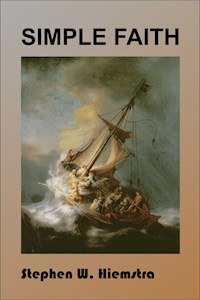
The Storm on the Sea of Galilee, 1633 (oil on canvas), Rembrandt Harmensz. van Rijn (1606-69) / ©Isabella Stewart Gardner Museum, Boston, MA, USA / Bridgeman Images (https://www.bridgemanimages.com)
Cover and layout designed by SWH
PREFACE
The New Testament pictures Jesus as someone who enters our life, calls us into discipleship, and invites us to participate in kingdom work. In Matthew’s Gospel, for example, Jesus finds Peter and Andrew fishing and calls them with these words: “Follow me, and I will make you fishers of men.” (Matt 4:19) As a rabbi, Jesus offers his lifestyle and teaching as a model to follow, but, unlike other rabbis, Jesus seeks out his students. Their response is remarkable—they drop their nets and follow Jesus (Matt 4:20)—because their simple faith in Jesus amounts to only two things: obedience (responding to Jesus’ invitation) and action (following Jesus). Other than obedience and action, they only know that he is a rabbi (Matt 4:17).
This model of simple faith—obedience and action—extends also to us, but how do we know what we know? In this age of suspicion and doubt, this question has particular significance because Jesus’ call—“follow me”—comes to us second hand. We read an English text translated from Greek that was itself copied by hand for almost two thousand years after the Apostle Matthew wrote it. He wrote it based on the testimony of others, having himself been called later (Matt 9:9), and, then, only after the resurrection made it obvious that these events had eternal significance. The epistemological question—How do we know what we know?—is therefore a reasonable and interesting question worthy of study even in the absence of doubt.
A complete spirituality must answer four questions typically posed in philosophy:
Metaphysics—who is God?
Anthropology—who are we?
Epistemology—how do we know?
Ethics—what do we do about it? (Kreeft 2007, 6)
My first two books—A Christian Guide to Spirituality and Life in Tension—address the metaphysical question, and my third book—Called Along the Way—explores the anthropological question in the first person. In this book, I explore the epistemological question, writing not as one with specialized training in philosophy but as one cognizant of the need, both as a Christian and an author interested in Christian spirituality, to have a reasonable answer to the question—How do we know?
In approaching this question, it is easy to get lost in the weeds. It is interesting that Copernicus’ observation that the planets revolved around the sun simplified the mathematics of planetary motion, because the earth was not the true center of the solar system.1 In the same manner, our lives are simplified when we acknowledge that we are God’s creation, not the creators of our own universe.
The act of knowing makes us aware of our distance from a holy God, and our own weakness and vulnerability as human beings. Thinking sets us apart from the object of our reflection just like God was set apart from his creation, not part of it.2 Knowledge is also at the heart of sin, as we learn in Genesis 3 when Satan tempts Eve. Scripture praises knowledge when its object is God, but cautions us when it leads to pride.3 So we should take the attitude of the Apostle Paul, who vigorously defends the faith and points people to God (2 Cor 10:5-6).
In this writing project, I break the epistemological question into a series of questions:
How do we approach information, learning, and making decisions?
Who is God?
What are the arguments for God’s existence?
What does all this imply?
This last question may seem out of place in this discussion, but it is, in fact, critical to our evaluation of faith arguments. Faith is a life and death matter because, as human beings, we strive for meaning, cannot face life without it, and feel threatened when our assumptions about faith are questioned. When the Apostle Paul repeats an early Christian confession:
For I delivered to you as of first importance what I also received: that Christ died for our sins in accordance with the Scriptures, that he was buried, that he was raised on the third day in accordance with the Scriptures, and that he appeared to Cephas, then to the twelve. (1 Cor 15:3-5)
Here he starts by describing it as being “of first importance”. He is not writing about a philosophical hobby-horse—he is talking about a faith for which he was later martyred. Faith is both our anchor and our compass. Anything worth dying for is something worth living for.
Soli Deo Gloria.
INTRODUCTION
Overview
Our post-Christian, Western society challenges faith, strips life of meaning, and leaves us to sort what we know for ourselves, an epistemological problem. Much like the Great Recession created a need to learn more about personal finance, the postmodern4 crisis of faith has created a need to learn more about epistemology, the study of how we know what we know.
The need for confidence that what we know is true also arises because life is too short to test every assumption for ourselves. Imagine a world in which we argued about the definitions of red, yellow, and green every time we pulled up to a stoplight? In this ad hoc information age, it is important to examine basic assumptions in our thinking much like it is important to build a house on a solid foundation. Faith is not optional; neither is the epistemological task.
The need for confidence also depends on who we are as human beings. The New Testament teaches that the heart and mind are inseparable. Confidence is not a mind-game; it also depends on our emotional response. This interdependence implies that our epistemology depends on our interpretation of anthropology (theory of humanity).
Anxiety arises when we depend on knowledge that we cannot evaluate for ourselves. Our emotions reflect our assessment of threats to our being, social position, and livelihood. Who could concentrate on studying Einstein’s theory of relatively if you worried about the roof collapsing? Living in a complex, technological world where the consensus on basic values has broken down creates anxiety because we can no longer trust that the experts we rely on value our lives more than their own economic interests. This risk of loss increases our interest in the epistemological task.
Being part of a cause greater than ourselves provides security and meaning to life that we cannot attain as individuals. Only once we feel secure can we become creative and begin to explore other things. We care about the grand story of humanity, the meta-narrative, because it defines our role and our boundaries, giving life meaning and a sense of security. Because, as postmoderns, we no longer believe in objective truth that can be distilled easily into simple concepts, we are forced to ask who offers the best story of where we come from, who we are, and where we are headed.
Incentive to Examine Faith
Christians face an enormous challenge in living out their faith today because major tenets of Christian theology are being openly challenged in the media, schools, and the political arena. What are we to believe and, then, how are we to apply those beliefs in our daily decisions?
Epistemology is an intimidating subject normally reserved for those with a strong background in philosophy, but, like it or not, each of us has to answer these questions of faith without the benefit of a doctorate in philosophy. Regardless of our preparation to meet this challenge, three reasons force us to pay attention to epistemology.
First, the rapid rate of cultural change in this generation is a consequence of a fundamental shift in philosophy. Modernism is dead; postmodernism is unstable and appears to be breaking down into a form of tribalism (Veith 1994, 143-156). Philosophical change directly affects our understanding of theology and how to apply it. The breakdown of the division between church and state makes this change especially obvious because this division has been a fundamental boundary since long before the modern period.5
Second, when philosophical transitions occur, institutions leveraged on prior philosophical assumptions must seek new foundations. Modern democracy works well when citizens stay informed and vote based on their own self-interests, but flounders in a premodern traditional or postmodern tribal culture where citizens refuse to stay informed and vote based on their affinities. Evidence of this floundering can be seen when Congress typically cannot reach a consensus and the President or the Supreme Court needs to broker a new consensus. Institutions actively engaged in self-preservation frequently fail in their basic missions and offer little shelter to those dependent on them.
Third, the lost sense of God’s transcendence diminishes our own vision. Smith (2001, 1) observes:
In different ways, the East and the West are going through a single common crisis whose cause is the spiritual condition of the modern world. That condition is characterized by loss—the loss of religious certainties and of transcendence with its larger horizons…The world lost its human dimension and we began to lose control of it.
If God’s credibility suffers, then we look for answers to politicians, television personalities, and charlatans of all stripes—idols—who invariably let us down hard, as the Bible warns all idols do.
This same logic applies to churches and denominations which becomes obvious when, in the name of self-preservation, they deviate substantively from biblical teaching and fail to offer thoughtful and faithful answers to questions that arise. Forced to answer fundamental questions of faith for themselves, individuals often reject faith, leaving one open to unreflective acceptance of pseudo-religious alternatives, atheism, or syncretistic practices. Everyone has a belief system; not everyone is equipped to reflect systematically on what they believe.
Now, some of you may be thinking: Why do I bother myself? Why can’t I just apply scripture and be done with it?
Of course, you can. However, if you do this on Sunday morning and forget about it on Monday morning, then do you honestly believe your church’s teachings or are they simply an interesting mental exercise? Blind acceptance of faith invariably leads to beliefs only tentatively held and of little use when life’s challenges arise. Epistemology provides a lens for viewing the current age through the eyes of scripture so that it is more meaningful and easier to apply.
How We Learn
We most frequently follow one of three approaches to learning: the behavioral approach, the rational approach, and the authoritative approach. In the behavior approach, we follow the path of least resistance—we do more of things that have positive reinforcement and less of things with negative reinforcement. In the rational approach, we explore the alternatives presented and chose the best alternative based on our exploration of all available information. In the authoritative approach, we may start with either the behavioral or the rational approach, but we limit our exploration to options suggested by a mentor.
An example of the authoritative approach is found in Luke 8 following the Parable of the Sower, where Jesus gives his disciples a lesson:
Now the parable is this: The seed is the word of God. The ones along the path are those who have heard; then the devil comes and takes away the word from their hearts, so that they may not believe and be saved. And the ones on the rock are those who, when they hear the word, receive it with joy. But these have no root; they believe for a while, and in time of testing fall away. And as for what fell among the thorns, they are those who hear, but as they go on their way they are choked by the cares and riches and pleasures of life, and their fruit does not mature. As for that in the good soil, they are those who, hearing the word, hold it fast in an honest and good heart, and bear fruit with patience. (Luke 8:11-15)
In this context, how do we know what we know? In the passage, Jesus gives us an interpretive key: “The seed is the word of God.” We understand and accept the lesson in this passage for two reasons. First, the key comes from a reliable source: Jesus. As Christians, we trust the Bible to tell us about Jesus who is known to use parables in his teaching. Second, the key itself, like the Copernican mathematics of planetary motion, makes intrinsic sense—the parable which was posed as a riddle suddenly becomes meaningful like a lock opened with a key.
While not all problems that we are confronted with take the form of a riddle unlocked with a key, Jesus’ laconic (use of few words) parable demonstrates the value of the authoritative approach in learning. Most learning both inside and outside the church follows the authoritative approach, in part, because it accelerates our learning.
Our discomfort in the present age arises because we have many more choices than tools for selecting among them, and we have been convinced that we should prefer the rational approach, even though even the best scientists rely on the informed opinion of others. Just like good seminary students apprentice themselves to the best pastors and theologians, the best scientists compete to be students in the best universities and with the best professors. It seems to be no accident that Dietrich Bonhoeffer, one of the most influential theologians of the twentieth century, was the son of Germany’s finest psychologists of that day.6 The question as to whether the authoritative approach is a valid approach to learning is moot because everyone uses it.
If we try to avoid the authoritative approach, we actually put ourselves at risk. If we adopt the behavioral approach to every problem, for example, the positive reinforcement of addictive substances and addictive circumstances will lead us to self-destruction. Alternatively, if we adopt a rational approach to every problem, analysis paralysis will lead us into burnout, and untimely decisions will cause us to miss opportunities. In this context, trusting a divine mentor can lead us to limit our choices to better choices.7
The Parable of the Sower offers at least one other insight into our learning process. Jesus tells his disciples a story in the form of a parable. Storytelling accomplishes at least three things relevant to the learning process. Stories are:
Easily understood and remembered.
Suggest insights into how the world works indirectly, which does an end-run around our natural, human resistance to taking advice.
8
Provide context for the words used in the story, defeating the criticism that the meaning of words depends solely on the social context of the reader.
9
Far from being unsophisticated, Jesus’ use of parables suggests a level of sophistication seldom equaled in the modern and postmodern eras, even in mass media.
Consider what Geisler and Zukeran (2009, 197) refer to as parabolic apologetics—using a story to convey a truth. Characteristics of this method found the Gospel of John include:
The use of the story form,
The teaching through an indirect approach—the audience affirms the point before realizing they themselves are in focus,
The logic is
afortiori
—a truth from everyday life applies also to spiritual matters,
The parable uses self-discovery to give the audience a sense of ownership of the message,
The parable is sensitive to those caught in sin (Geisler and Zukeran 2009, 188-89).
The Bible pictures God as a god willing to reason with us. “Come now, let us reason together, says the LORD” (Isa 1:18). Still, humility requires that God be willing to argue a case, not force one, on reluctant sinners.
Importance of Meta-narrative
A meta-narrative is a grand story that contains and explains our personal stories.10 The meta-narrative of scripture, for example, is often described as a three-act play: creation, fall, and redemption (e.g., Wolters 2005). Continuing the analogy to the theatrical model, Vanhoozer (2016, 98) argues for five acts:
Act 1: Creation, the setting for everything that follows (Gen 1-11)
Act 2: Election of Abraham/Israel (Gen 12-Mal)
Act 3: Sending of the Son/Jesus (the Gospels)
Act 4: Sending of the Spirit/Church (Acts—Jude)
Act 5: Return of the King/day of the Lord/consummation/new creation (Rev).
Other authors describe the meta-narrative of scripture in terms of covenants, such as the covenants with Adam, Noah, Abraham, Moses, David, and Jesus, which provide insight into our relationship with God (e.g., Hahn 2009). Each of these frameworks have a slightly different focus, but all serve to offer meaning within the narrative of scripture to the relationship between God and his creation.
The Book of Genesis begins with a picture of a creator God whose sovereignty rests on the act of creation and who creates us in his image as heirs to this created kingdom. Describing God as creator implies that he transcends creation where transcendence implies standing apart from and sovereign over creation. This act of creation implies love because God allows creation to continue existing after the fall and even promises redemption (Gen 3:15).
This picture of a sovereign God is key to understanding both God’s role in our lives and who we are, especially in the postmodern age because God’s sovereignty depends on God transcending our personal worlds. When faith is viewed as a private, personal preference rather than acknowledging our place in the meta-narrative of scripture, then all meaning is lost. If God is no longer transcendent, God is also no longer sovereign. As the Apostle Paul writes: “And if Christ has not been raised [from the dead by a transcendent God], then our preaching is in vain and your faith is in vain.” (1 Cor 15:14) Jesus’ resurrection validates God’s transcendence; if you do not believe in miracle of resurrection, then scripture is only of historical interest.
But you say—That’s not true; we still worship God and still believe in his sovereignty.
Yes, but the words are hollow if Sunday morning worship serves only to jazz us up, but our Monday morning lives differ little from the atheist in the next cubical. If God is not transcendent, then he is also not immanent—not in our thinking, not in our daily lives. A Sunday morning god is no god at all.
Phillips (1997, 7) wrote:
The trouble with many people today is that they have not found a God big enough for modern needs. While their experience of life has grown in a score of directions, and their mental horizons have been expanded to the point of bewilderment by world events and by scientific discoveries, their ideas of God have remained largely static. It is obviously impossible for an adult to worship the conception of God that exists in the mind of a child of Sunday-school age, unless he is prepared to deny his own experience of life.
While public ridicule of faith was common in the modern age,11 in our modern institutions have simply begun to crumble as Christian presuppositions have been removed.12 Smith (2001, 48) observes: “Today we do not live under a sacred canopy; it is marketing that forms the backdrop of our culture.” Modern institutions, such as the mega church, public schools, democracy, corporations, and professions, presume objective truth, personal discipline, integrity, and human rights—all products of the Christian meta-narrative that function poorly, if at all, in the absence of that narrative.
As Bonhoeffer (1997, 163) observes: “The right to live is a matter of the essence and not of any values. In the sight of God there is no life that is not worth living; for life itself is valued by God.” Secular values are a poor substitute for a Christian character because they are lightly held, not deeply ingrained—they are like a house built on a flood-plain with a foundation of sand (Matt 7:24-29).
Think about the modern corporation. Chandler (2002, 1) writes: “Modern business enterprise is easily defined. …it has two specific characteristics: it contains many distinct operating units and it is managed by a hierarchy of salaried executives.” How could operating units function if employees refused to show up on time? How could managers manage other managers without a basic level of trust? No middle managers existed before 1840 because the first modern corporations were railroad companies organized in the 1850s (Chandler 2002, 3, 81-82). In other words, the modern corporation is a product of the modern era when the belief in objective truth allowed professional managers to evolve.
In this sense, the postmodern age is in the middle of a transition when our culture no longer looks to our past to find meaning and a new age has yet to emerge on the horizon, giving our lives an end-time feel. To use an Old Testament analogy, we find ourselves wandering in the desert having left Egypt, but not yet having entered the Promised Land (Bridges 2003, 43). The Good News is that the desert is where the people of Israel truly came to know, experience, and rely on God (Card 2005, 16).
Challenges to Faith
One of the most seductive arguments against belief in God is the idea that faith is optional. While it is important to understand the reasons for faith, the context for disbelief is equally important. Otherwise, we find ourselves debating primarily with ourselves. Does the disbeliever honestly seek to understand or are the arguments for disbelief a smoke screen for obstinance, laziness, self-centeredness, or some other agenda?
Karl Marx and Sigmund Freud gave two of most famous excuses for why many people believe that God does not exist. Marx (1843) commented that: “Religion is the sigh of the oppressed creature, the heart of a heartless world, and the soul of soulless conditions. It is the opium of the people.” By contrast, Freud (1961, 30) characterized religion as an illusion, a kind of wish fulfillment. While both Marx and Freud are considered authority figures, the thrust of their argument is not due to a lengthy scientific analysis, but is presented more as simple slander, acceptable primarily as an excuse for decisions reached for other reasons.13 In a context of a rational decision process, simple slander does not warrant further investigation because the burden of proof lies with those advancing a particular argument to make their case.
Faith undergirds modern science. Knowledge based on the scientific method follows a distinct method for testing knowledge’s veracity. These steps are usually employed: a need is felt, a problem is defined, observations are taken, analysis is done, a decision rule is imposed, an action is taken, and responsibility is borne. The first step in the scientific methods (felt need) requires taking assumptions about the current state of knowledge and forming a hypothesis.14 These assumptions are faith statements for which no testing is normally done.
The key role played in problem definition arose out of research work done after the Second World War. Before the war, American scientists had the best funding and equipment in the world, but their research lagged behind their European colleagues. After the war, American productivity took off with the immigration of European scientists, primarily Jewish refugees. Polanyi’s 1962 study of this reversal suggested that these immigrants brought with them the unpublished, indescribable expertise that only the best scientists could muster. In other words, the intuition required to turn a felt need into problem definition proved to be an intangible skill that only master craftsmen,15 like those making Stradivarius violins, possessed and passed only to their apprentices.
If we treat faith as optional, we undervalue faith and are susceptible to idolatry. The problem of idolatry today has less to do with worshiping statues of pagan gods than with misplaced priorities. We commit idolatry whenever we place anything other than God as the number one priority in our lives. Idoaltry is a sin because it breaks the First Commandment: “You shall have no other gods before me.” (Exod 20:3). The sin of idolatry is often taken lightly, but this a mistake because idolatry is life threatening.
If the threat of idolatry is not obvious, consider what happens when alternatives to God become our first priority. Common today, for example, is to place work as the number one priority in our life. What happens when we lose our job or our ability to work? Americans, particularly men, are prone to depression and suicide when a job is lost.16 People who cannot work, like the mentally disabled, the young, the old, the uneducated, are treated badly. When we neglect our faith in God, we end up committing idolatry, which threatens our self-esteem and our relationship with people we should care for.
For the most part, postmodern critiques of Christianity offer criticism without providing an equally wholistic alternative worldview or lobby for rights, but not responsibilities for their particular client groups. Either position is morally reprehensible because they leave many people hopeless and abandoned. Yet, powerful groups have advanced such changes primarily to enrich themselves at the expense of others.17
It is illegal to advertise tobacco or alcohol products to minors, but what is the effect of promoting hedonistic lifestyles hourly to adults on national television and every other form of media? Or what about pharmaceutical companies that sell expensive AIDS medications18 while seeking to expand their markets through lobbying efforts in the media and halls of Congress to promote alternative lifestyles? (Kaufman 2017) Or what about the cynical businesses and churches that simply cater to upscale demographics, regardless of implications? (Wallace 2015) Moral failure is nothing new, but the institutionalization of such failures today is unprecedented and clearly not an accident.
These challenges to faith are repeated daily in the media, in our schools, and in society, yet they lack merit as an alternative to faith and cause significant harm to many people through their promotion of idolatry and other sins that isolate people from God, from themselves, and even from the science that has brought humanity numerous benefits. Many of these challenges to faith either promote or allege deviations from proper mental function making it important to be aware of and mitigate such impacts.
As Christians, we have inherited a worldview that is quite capable of interpreting the world as we know it. In fact, Western civilization is built on premises advanced from the Christian worldview. The question for those who advance criticism of that worldview, normally by picking on some of its assumptions (or disputing its ethical requirements), is not how can we accept those assumptions. Rather, because those assumptions form a coherence and ethically defensible system, the question is whether an alternative assumption can be used to construct a better system.
Why We Care About Epistemology
Our concern with epistemology is simple: faith is a lifesaver whose absence can cause great suffering.
Viktor Frankl offers interesting insights into faith and the meaning of life. In his book, Man’s Search for Meaning, Frankl shares both his concentration camp experiences during the Holocaust and his observations as a logotherapist (meaning therapist), observing:
Every age has its own collective neurosis, and every age needs its own psychotherapy to cope with it. The existential vacuum which is the mass neurosis of the present time can be described as a private and personal form of nihilism; for nihilism can be defined as a contention that being has no meaning. (Frankl 2008, 31)
He defines neurosis as an “excessive and irrational anxiety or obsession,” while an existential vacuum (lack of meaning in life) “manifests itself mainly in a state of boredom,” which afflicts a quarter of European students and about two-thirds of American students, according to Frankl’s own statistics. He concludes that meaning comes not from looking inside one’s self, but from transcending one’s self (Frankl 2009, 110, 131). In his book, he repeatedly associates this existential vacuum with despair and suicide, based on his experience both as a concentration camp survivor and a professional psychiatrist.
If our culture obsesses about individual freedoms, encourages individuals to look within themselves for meaning, and rejects faith out of hand,19 then Frankl suggests that we should observe epidemic levels of anxiety, depression, and suicide, as we observe. Lucado (2009, 5) puts it most succinctly: “ordinary children today are more fearful than psychiatric patients were in the 1950s.” Frankl and Lucado’s observations about the emotional state of a society are hard to quantify in a statistical sense, but the New York Times recently reported that suicide rates in the United States had reached a thirty year high.20
How did we reach this point?
Part of this story is one of a stagnant economy where about half of all Americans have seen no increase in real income since about 1980 (e.g., Desilver 2018). Families under economic pressure have increasingly both spouses working full time which implies both smaller families and fewer economic and emotional reserves, especially for those with only a college degree or less. When both spouses work, it is harder to set aside Sundays for family and church, reducing spiritual reserves. When a crisis emerges for families already stretched to the limit, the absence of reserves—economic, emotional, and spiritual—can be stressful. Remove faith from this mix, and the absence of reserves can be devastating. Faith is more than a spiritual reserve, but it is certainly no less.
In reality, faith is primal. Our faith informs our work ethic and our devotion to marriage, which implies it is logically a precondition for economic and emotional vitality. Attacks on our faith are the most basic threats to our life both here and now, and eternally. So we should care about epistemology because our lives depend on maintaining our faith.
Limits to a Cognitive Approach
Epistemology asks how we know what we know and assumes a cognitive approach to learning. The presumption is that human beings are essentially rational and that faith itself is a rational undertaking. The Bible suggests, however, that this cognitive approach has two important limitations when we discuss faith.
Creation Influences Thought




