


7,60 €
Mehr erfahren.
- Herausgeber: Simply Charly
- Kategorie: Religion und Spiritualität
- Serie: Great Lives
- Sprache: Englisch
"David Sterritt is widely recognized as one of the most knowledgeable, perceptive, and accessible commentators on Alfred Hitchcock’s career. He makes a convincing case for the charm, technical innovativeness, and often perverse wit of Hitchcock’s films and television shows while, at the same time, not shying away from exploring troubling aspects of his career. Relax with this delightful book and prepare for the illumination and sheer pleasure it delivers."
—William Luhr, author of Thinking About Movies: Watching, Questioning, Enjoying and Professor of English at Saint Peter's University
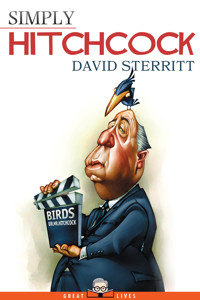
From Dial M for Murder and Vertigo to North by Northwest, Psycho, and The Birds, Alfred Hitchcock (1899–1980) made some of the most memorable thrillers in the history of cinema. Acclaimed for both his daring artistic innovations and his irrepressible showmanship, Hitchcock blended suspense, humor, and psychologically unsettling themes to create an extraordinary body of work.
In Simply Hitchcock, author and movie critic David Sterritt explores the celebrated director’s entire career, from its beginnings in the British silent film industry to its glory days in Hollywood. He shows Hitchcock as a consummate artist who dealt with deep existential and psychological issues, as well as a mischievous prankster who loved playing tricks on the audience and never lost a chance to pull a dead rabbit out of a hat.
With wit and erudition, Simply Hitchcock paints a comprehensive portrait of a brilliant and complex man, who not only made indelible films, but also succeeded in establishing himself as the most instantly recognizable movie director of all time.
Das E-Book können Sie in Legimi-Apps oder einer beliebigen App lesen, die das folgende Format unterstützen:
Seitenzahl: 269
Veröffentlichungsjahr: 2017
Ähnliche






Simply Hitchcock
David Sterritt
Simply Charly
New York
Copyright © 2017 by David Sterritt
Cover Illustration by Vladymyr LukashCover Design by Scarlett Rugers
All rights reserved. No part of this publication may be reproduced, distributed, or transmitted in any form or by any means, including photocopying, recording, or other electronic or mechanical methods, without the prior written permission of the publisher, except in the case of brief quotations embodied in critical reviews and certain other noncommercial uses permitted by copyright law. For permission requests, write to the publisher at the address below.
ISBN: 978-1-943657-29-2
Brought to you by http://simplycharly.com
1
Dedicated to Mikita,
Jeremy and Tanya,
Craig and Kim,
and Oliver, of course
Contents
DedicationPraise for Simply HitchcockOther Great LivesSeries Editor's ForewordPrefaceAcknowledgements 1. Hitch 2. Silents Are Golden 3. Talkies, Theatricality, and the Low Ebb 4. The Classic Thriller Sextet 5. Hollywood 6. The Fabulous 1950s 7. From Psycho to Family Plot 8. EpilogueEndnotesSuggested ReadingAbout the AuthorA Word from the Publisher2
Praise for Simply Hitchcock
“With his customary style and brilliance, David Sterritt neatly unpacks Hitchcock’s long career with a sympathetic but sharply observant eye. As one of the cinema’s most perceptive critics, Sterritt is uniquely qualified to write this concise and compact volume, which is the best quick overview of Hitchcock’s work to date—written with both the cineaste and the general reader in mind. Rich in detail and observation, this is a book that unlocks the hidden terrain of Hitchcock’s work, written with the lifetime experience of a master.”
—Wheeler Winston Dixon, author of Black and White Cinema: A Short History and Ryan Professor of Film Studies at the University of Nebraska, Lincoln
“The faster the flow of publications on aspects of Hitchcock’s work—specific films and themes and periods—the greater the need for a clear and concise overview of all that he did and of just what has made him into such a central figure. David Sterritt delivers precisely this, in a form that is thoughtful, readable, and cogent: it is an ideal primer on Hitchcock, and full of insights for those who think they know all about him already.”
—Charles Barr, author of Vertigo in the BFI Classics series and Emeritus Professor at the University of East Anglia
“For everything you always wanted to know about Alfred Hitchcock, turn to David Sterritt, who shares his extensive knowledge of the acclaimed director’s life and career in an elegantly concise style. Simply put, this is a great book.”
—Jan Olsson, author of Hitchcock à la Carte and Professor in Cinema Studies at Stockholm University
“David Sterritt packs incisive analyses of every Hitchcock film into a slim volume bursting with ideas, some startlingly new, others inventive variations on Hitchcock tropes. The result is a seasoned, highly readable exploration of Hitchcock as a whole—the myth, the reality, the major themes, the incomparable style, the personal idiosyncrasies, the staggeringly sustained achievement over six decades. Sterritt is especially deft at capturing Hitchcock’s paradoxes: his casual juxtaposition of the ordinary with the exotic, the real with the surreal, the cerebral with the theatrical. There is not a better place to start for those who are new to Hitchcock, but Hitchcockians will merit by having a work that synthesizes all of Sterritt’s well-known qualities—his elegance, erudition, and ability to pack complex ideas into entertaining commentaries. Like Hitchcock, Sterritt has the rare ability to speak to the specialist and the general audience. Not since Donald Spoto’s The Art of Alfred Hitchcock, published well before academia’s obsession with Hitchcock, has there been a work of such broad appeal.”
—Jack Sullivan, author of Hitchcock’s Music
“David Sterritt is widely recognized as one of the most knowledgeable, perceptive, and accessible commentators on Alfred Hitchcock’s career. He makes a convincing case for the charm, technical innovativeness, and often perverse wit of Hitchcock’s films and television shows while, at the same time, not shying away from exploring troubling aspects of his career. Relax with this delightful book and prepare for the illumination and sheer pleasure it delivers.”
—William Luhr, author of Thinking About Movies: Watching, Questioning, Enjoying and Professor of English at Saint Peter’s University
“Do we really need a new book on Hitchcock? David Sterritt shows that we do, as he brings his keen wit and penetrating intelligence to a study of the interconnections of Hitchcock’s life and art. Simply Hitchcock is a kind of guidebook on the director’s major themes that is both authoritative and fun to read.”
—Christopher Sharrett, Professor of Visual and Sound Media at Seton Hall University
“Simply Hitchcock is an incisive introduction to the master’s work. Erudite and accessible, Sterritt provides not only an overview of the career but vivid snapshots of the individual movies. The best way to read this book is alongside Hitchcock’s films: watch one or two, referring to Sterritt’s illuminating historical context as well as close analysis. Hitchcock set the standard for suspense, and this book helps us understand the reasons for his enduring impact.”
—Annette Insdorf, author of Francois Truffaut and Professor of the Graduate Film Program & Director of Undergraduate Film Studies at Columbia University
“Concise, even-handed, and always as enjoyable as it is informative, Simply Hitchcock is the book to have in hand when beginning to explore the vast and often imposing territory of Alfred Hitchcock’s life and works. David Sterritt handles the daunting task of surveying Hitchcock’s career of more than 50 years and more than 50 films elegantly and efficiently. We learn what to watch for—including curiously attractive and sympathetic villains, vulnerable and beleaguered but complexly resourceful women, eroticized murders, and murderous intimacies—even as we are advised to expect the unexpected from a filmmaker devoted to showing that the familiar is dangerous and strange. Well attuned to the technical virtuosity of one of cinema’s great stylists and the philosophical depths of one of its great thinkers, Sterritt skillfully prepares his readers for the challenges and delights of Hitchcock’s films, which he patiently demonstrates are evident in not only the acknowledged masterpieces but also in many of his lesser-known films that readers of this book should—and undoubtedly will—immediately add to their viewing queue.”
—Sidney Gottlieb, Professor of Communication and Media Studies, Sacred Heart University and Co-editor of the Hitchcock Annual
“It’s hard to imagine a better introduction to the work of that most enduring and popular of film auteurs than Simply Hitchcock. David Sterritt gets the balance just right: one learns about the technician, the producer, the businessman, the media personality as well as the artist who created some of the richest, most profound works in the history of cinema. The tone is lively and engaging, and there’s more than enough here to delight and surprise even those who swore they’d never read another word about Hitch.”
—Richard Peña, Professor of Film, Columbia University and former Director of the New York Film Festival
3
Other Great Lives
Simply Austenby Joan Klingel RaySimply Beckettby Katherine WeissSimply Beethoven by Leon PlantingaSimply Chekhov by Carol ApollonioSimply Chomskyby Raphael SalkieSimply Chopinby William SmialekSimply Darwinby Michael RuseSimply Descartesby Kurt SmithSimply Dickensby Paul SchlickeSimply Diracby Helge KraghSimply Einsteinby Jimena CanalesSimply Eliot by Joseph MaddreySimply Euler by Robert E. BradleySimply Faulkner by Philip WeinsteinSimply Fitzgerald by Kim MorelandSimply Freud by Stephen FroshSimply Gödel by Richard TieszenSimply Hegel by Robert L. WicksSimply Joyce by Margot NorrisSimply Machiavelli by Robert FredonaSimply Napoleonby J. David Markham & Matthew ZarzecznySimply Nietzsche by Peter KailSimply Proust by Jack JordanSimply Riemann by Jeremy GraySimply Sartre by David DetmerSimply Tolstoy by Donna Tussing OrwinSimply Stravinsky by Pieter van den ToornSimply Turing by Michael OlinickSimply Wagner by Thomas S. GreySimply Wittgenstein by James C. Klagge
4
Series Editor's Foreword
Simply Charly’s “Great Lives” series offers brief but authoritative introductions to the world’s most influential people—scientists, artists, writers, economists, and other historical figures whose contributions have had a meaningful and enduring impact on our society.
Each book provides an illuminating look at the works, ideas, personal lives, and the legacies these individuals left behind, also shedding light on the thought processes, specific events, and experiences that led these remarkable people to their groundbreaking discoveries or other achievements. Additionally, every volume explores various challenges they had to face and overcome to make history in their respective fields, as well as the little-known character traits, quirks, strengths, and frailties, myths, and controversies that sometimes surrounded these personalities.
Our authors are prominent scholars and other top experts who have dedicated their careers to exploring each facet of their subjects’ work and personal lives.
Unlike many other works that are merely descriptions of the major milestones in a person’s life, the “Great Lives” series goes above and beyond the standard format and content. It brings substance, depth, and clarity to the sometimes-complex lives and works of history’s most powerful and influential people.
We hope that by exploring this series, readers will not only gain new knowledge and understanding of what drove these geniuses, but also find inspiration for their own lives. Isn’t this what a great book is supposed to do?
Charles Carlini, Simply Charly New York City
5
Preface
Alfred Hitchcock was a legendary director, producer, impresario, entertainer, celebrity, and filmic philosopher. He was also an elegant host. On the weekly television program that bore his name, he welcomed viewers into every episode with a dignified “Good evening,” followed by a wry little speech or mini-skit that connected in a whimsical way to the drama about to begin. In that spirit, I’ll start this book about the Master of Suspense not in one of the places usually linked with him—his native England or his beloved Hollywood—but rather in the vaults of the New Zealand Film Archive, where a very Hitchcockian discovery made international news in 2010.
What researchers found there were three film reels that everyone thought had been lost, destroyed, or allowed to disintegrate decades earlier. The reels contained the first half of The White Shadow, a 1924 feature to which the 24-year-old Hitchcock, then a rising young talent in the British film industry, had energetically contributed.
It’s hard to say exactly how footage from this English production ended up in a New Zealand film vault. But this was an era when movies were regarded as mere commodities, to be tossed in the rubbish when their commercial possibilities were exhausted. If a print was in the hands of a faraway exhibitor when its prospects ran dry, the distributor might see no point in paying for return shipping. New Zealand is a long way from London and Los Angeles, so it’s easy to imagine a British or American company writing off copies of The White Shadow when no more theaters were in the market for them. A partly intact copy found its way to the New Zealand archive, where it was misidentified as an American movie—the titles and credits were missing, and it bore the mark of Lewis J. Selznick Enterprises, a Hollywood-based distributor—and stored under a generic title.
The White Shadow attracted enormous attention when the National Film Preservation Foundation (NFPF) in Washington, DC, brought the picture (and other works with American ties) from New Zealand to the United States, energetically publicizing the Hitchcock connection. Public excitement about the discovery testified to the continuing magic of Hitchcock’s name—strong magic indeed, since only half of the movie was unearthed, and properly speaking, it isn’t even a Hitchcock picture. He worked on it as an assistant to Graham Cutts, the veteran British filmmaker who actually directed it.
The important point here is Hitchcock’s ability to make news 30 years after his death. Media outlets ranging from CNN to Radio Scotland and New Zealand’s own Newstalk ZB covered the discovery of The White Shadow, and when the NFPF slated 176 recovered pictures for preservation to 35mm film and digital video, the opus by Cutts and Hitchcock was one of a dozen items released on a DVD called Lost and Found: American Treasures from the New Zealand Film Archive.1 Shortly afterward it joined a longer list of selections streamed on the Internet for all to see. The White Shadow was out of the shadows for good, and admirers now hope the second half of the film will turn up in some other archive where it’s been resting in obscurity since the age of silent cinema.
Turning to Hitchcock’s career more broadly, his most famous contribution to the verbal lexicon of film is the word “MacGuffin,” which he explained repeatedly over the years. In a 1968 essay, he described it thus: “It’s something that the characters in the film care a lot about, but the audience doesn’t worry about it too much…. As a matter of fact I refuse to use the kind of thing [for MacGuffin material] which most people think is very important.”2
Critics and scholars have glossed, paraphrased, and expanded on the word. Ken Mogg, editor of The MacGuffin and author of The Alfred Hitchcock Story, notes that it originated with Angus MacPhail, one of the director’s screenwriter friends. Mogg continues:
The term [refers to] something that sets the film’s plot revolving…. It’s really just an excuse and a diversion. In a whimsical anecdote told by Hitchcock, he compared the MacGuffin to a mythical ‘apparatus for trapping lions in the Scottish Highlands’. In other words, it could be anything—or nothing—at all. In Notorious, it’s just a lot of fizz: uranium-ore hidden in [wine] bottles. In North by Northwest, it’s ‘government secrets’, whatever they may be. (Hitchcock considered that this was his ‘best’ MacGuffin, because virtually non-existent.) Actually North by Northwest turns out to be one vast MacGuffin, being full of ‘nothings’ like the ‘O’ in Roger O. Thornhill’s name, or the empty prairie, or the non-existent agent named Kaplan. In effect, the function of a MacGuffin is like the ‘meaning’ of a poem—which T. S. Eliot compared to the bone thrown by a burglar to distract the watchdog of the mind while the poem goes about its own, deeper business. Hitchcock’s most prescient MacGuffin is in Torn Curtain, whose ‘Gamma Five’ project, concerning an anti-missile missile, anticipated by more than a decade President Reagan’s ‘Star Wars’ project.3
Hitchcock’s analysis was correct: something must be at stake for the people in the story, but for the audience that “something” matters far less than the challenges, relationships, triumphs, and defeats of the characters who experience them.
It’s also true, however, that some moviegoers care more about narrative details than about character psychology. For them, the MacGuffin’s inconsequentiality is a defect in Hitchcock’s films. They want to know who put the uranium into the bottles in Notorious, what’s on the strip of microfilm in North by Northwest, who taught the aircraft plans to Mr. Memory in The 39 Steps, just how Harry died in The Trouble with Harry, and for what possible reason The Birds are suddenly attacking the human race. Hitchcock had a word for moviegoers like these: he called them “Plausibles,” and he didn’t hold their opinions in high regard. For him, it was pointless to fuss over details that don’t seem “realistic,” as if anything is truly “realistic” in a motion picture, that artificial beast with two dimensions and straight-edged borders.
Hitchcock dismissed such nitpicking cheerfully and also thoughtfully. “I’m not concerned with plausibility,” he told French film director François Truffaut in one of their interview sessions; “that’s the easiest part of it, so why bother?” He then remarked on the imperatives of his kind of cinema, contrasting the Hitchcock approach with the documentary method that had influenced but not taken over his style:
There’s quite a difference, you see, between the creation of a film and the making of a documentary. In the documentary, the basic material has been created by God, whereas in the fiction film the director is the god; he must create life. And in the process of that creation, there are lots of feelings, forms of expression, and viewpoints that have to be juxtaposed. We should have total freedom to do as we like, just so long as it’s not dull. A critic who talks to me about plausibility is a dull fellow.4
On another occasion, he summed it up in a sentence: “For me, the cinema is not a slice of life, but a piece of cake.”5
David Sterritt Baltimore, MD
6
Acknowledgements
Thanks to all the critics, scholars, cinephiles, and friends who have enriched my appreciation of Alfred Hitchcock’s work through books, essays, articles, and discussions for lo these many decades. Naming them all is impossible, but the most insightful in their views and helpful to my thinking include Sid Gottlieb, Tom Doherty, Chris Sharrett, Bill Luhr, Tom Leitch, Pat McGilligan, Jan Olsson, James Naremore, Richard Allen, Bill Rothman, Andrew Sarris, Donald Spoto, Paula Marantz Cohen, Lesley Brill, Christopher Brookhouse, Robin Wood, and many more. Special thanks to the exemplary Hitchcock scholar Charles Barr for advice way above the call of duty, and to Charles Carlini for inviting me to embark on this enjoyable project.
1
Hitch
What accounts for the power and persistence of the Hitchcock mystique? What’s the breadth and depth of his appeal, which reaches out to moviegoers of every kind, from Saturday-night entertainment seekers to connoisseurs of cinematic art?
There’s no single answer to those questions, no unified theory to explain Hitchcock’s popularity. One reason for his enduring sway is the consistency of his commitment to the suspense film, a genre that’s both perennially alluring and flexible enough to accommodate changing public tastes in movie style and content.
Another is his ability to deploy iconic movie stars in ways that either foreground their most charismatic traits—think Cary Grant’s inextinguishable charm in Notorious (1946) and North by Northwest (1959), or Grace Kelly in Rear Window (1954) and To Catch a Thief (1955)—or play them daringly against type, as James Stewart does in Rope (1948) and Vertigo (1958) and Doris Day does in The Man Who Knew Too Much (1956). Still, another is the remarkable durability of his own celebrity image, which he devised and cultivated as ingeniously as he designed, crafted, and promoted his films, television shows, and public appearances. To this day, his doughy face and fleshy figure are instantly recognizable symbols of mainstream entertainment with a thrilling, romantic tang.
In my view, though, the most important single factor in Hitchcock’s unending popularity is something more profound—his never-ending fascination with the unresolvable tension between order and chaos, a fundamental concern of modern art and of modern life. Hitchcock was sometimes explicit about this, as when he acknowledged that The Birds (1963) is meant to show anarchic turmoil overtaking the forces of regularity, stability, and predictability that we normally take for granted in the world; this usurpation of power may be the inevitable outcome of humanity’s “messing about” with the age-old balances of our natural environment, but it may just as easily be something else, or—the most frightening prospect—it might be caused by nothing we can explain, or understand, or even know.1
The danger of being thrust from the everyday world into a chaos world (to borrow critic Robin Wood’s suggestive term) was a philosophical issue of deep interest for the filmmaker.2 It was also a psychological and spiritual issue that stirred him to his bones. The threat, the likelihood, or even the possibility of a plunge into disorder, turmoil, anarchy, or madness was never far from his thoughts, as both his movies and his biography attest. He appears to have lived, labored, and dreamed in a state of half-repressed anxiety that was no less visceral for being largely bottled up behind a double façade of traditional British propriety and up-to-the-minute American achievement. Creative work was his safety valve, and the ability to communicate his half-hidden fears in universally meaningful forms was his saving grace.
Soviets, documentaries, and the London Film Society
Many factors played into the evolution of Hitchcock’s audiovisual style. Perhaps the most significant was the theory of film editing put forward by pioneering Soviet filmmakers—Sergei M. Eisenstein, Vsevolod Pudovkin, Aleksandr Dovzhenko, Dziga Vertov—in the 1920s. The greatest of these trailblazers was Eisenstein, who believed that individual shots should not follow each other like links in a chain but should contrast, conflict with, and even contradict one another from moment to moment, encouraging active thought in the spectator and offering visual excitement on the screen. A marvelous example of how brilliantly Hitchcock used this technique is the opening sequence of Strangers on a Train, where shots of walking feet build up a tense yet humorous rhythm while introducing the main characters and foreshadowing the role that chance and synchronicity will play in the story to come.
Hitchcock also embraced what film scholars call the Kuleshov effect, named after Lev Kuleshov’s experiments with the ordering of shots to produce particular reactions in the audience. Hitchcock concisely explained this in a 1964 television appearance, linking it to the “pure cinematics” that he valued so highly:
I have a close-up [of a character’s face]. Now I show what he sees, and let’s assume he sees a woman holding a baby in her arms. Now we cut back to his reaction to what he sees, and he smiles. Now what is he, as a character? He’s a kindly man; he’s sympathetic. Now let’s take the middle piece of film away—the woman with the child—but leave his two pieces of film as they were. And we’ll put in a piece of film with a girl in a bikini. He looks … he smiles. What is he now? A dirty old man, no longer the benign gentleman who loves babies! That’s what film can do for you.3
Rear Window most famously displays Kuleshov’s influence on Hitchcock as it cuts between what the main character sees and how he reacts to what he sees. But instances can be found in nearly all Hitchcock films, with the notable exception of Rope, in which the director experimented with an opposite technique, replacing normal shot-by-shot editing with unusually long takes, strategic camera movements, and hidden cuts disguised by objects blocking the frame. The results of that experiment were unsatisfactory, most notably to Hitchcock himself.4
Hitchcock spent many hours at screenings held by the London Film Society, where such innovative Soviet features as Eisenstein’s Battleship Potemkin (1925) and Pudovkin’s Mother (1926) could be seen and studied. The lessons he learned from Soviet montage stayed with him forever. When the Film Society of Lincoln Center devoted its annual gala tribute to him in 1974, a reel of Hitchcockian highlights brought together some of his most famous scenes, including the part of Dial M for Murder where Margot Mary Wendice (Grace Kelly) defends her life by killing Captain Lesgate (Anthony Dawson) with a pair of scissors. At the close of the tribute, Hitchcock gave his thank-you speech not in person (like recipients in other years) but on the screen, in a brief monologue filmed at Universal a few days earlier. When it was over, he rose in his box seat and spoke to the cheering audience: “As you have seen on the screen, scissors are the best way.” He was referring to Margot’s successful self-defense, of course, but he was also tipping his hat to the power of film editing, which he exploited as effectively as any director ever has.
Even as he studied the Soviet style, Hitchcock was fascinated by documentaries. Incorporating elements of realistic, documentary-like detail was a way of grounding the extreme, even bizarre aspects of his stories—the murders, misapprehensions, deceptions, chases, evasions, escapes, and so on—in the day-to-day realities of his audience, thus enhancing his films’ ability to push emotional buttons and make spectators squirm with suspense. In a 1937 article for Kine Weekly, Hitchcock spelled out his desire to put middle-class citizens, “that vital central stratum of British humanity,” onto the big screen. As a bonus, he hoped his fine-grained portraits of commonplace people and places would help him appeal more strongly to the vast American marketplace. Ideally, he wrote, he would “do unto America what they have done unto us, and make the cheerful man and girl of our middle class as colorful and dramatic to them as their ordinary everyday citizens are to the audiences of England.”5
That was Hitchcock’s stated aim in the 1930s, and his early films attest to his sincerity; as examples, the British critic and filmmaker Lindsay Anderson pointed to such gritty, workaday details as the restaurant and tobacco shops in Blackmail, the chapel in the first version of The Man Who Knew Too Much, the country house in The 39 Steps, and the movie house in Sabotage. Hitchcock never lost his mischievous wish to bring crime, violence, and menace out of the shadows and dark alleys and into the bright light of day. Think of Roger Thornhill running for his life through a Midwestern wheat field in North by Northwest, or the deadly assault in a dating-service office at lunchtime in Frenzy, or Marion Crane’s bloody murder in a sanitary motel bathroom in Psycho, and Hitchcock’s artful blending of the real and the outlandish stands out in high relief.
Influences from UFA and America
Hitchcock was similarly impressed with works by the expressionist filmmakers in Germany, such as Robert Wiene’s The Cabinet of Dr. Caligari (1919) and Fritz Lang’s Dr. Mabuse: The Gambler (1922), which tell stories of physical danger and mental derangement—as an offshoot of the Romantic movement, expressionism thrived on anything extreme, uncontrolled, or uncontrollable—through deliberately exaggerated visuals akin to those of Surrealist art. Expressionism strongly influenced the Hollywood horror films of the 1930s, the film-noir cycle of the 1940s and 1950s, and such enduring Hitchcock classics as The Lodger, with its fog-shrouded atmosphere and hallucinatory shot of the title character’s feet pacing above a transparent ceiling, and Spellbound, where Ballantyne’s revelatory nightmare is evoked through Salvador Dalí’s dreamlike set designs.
Hitchcock’s aesthetics were greatly affected by his experiences at Universum Film AG, better known as UFA, the towering German studio that nurtured such important and influential filmmakers as F. W. Murnau, Fritz Lang, William Dieterle, Ernst Lubitsch, and Robert Siodmak, to mention only directors who emigrated to the United States in the 1920s or 1930s and worked in the Hollywood system. (Leni Riefenstahl and Veit Harlan, who emerged in the 1930s and became notorious for their Nazi connections, are among the directors who stayed put.) An array of luminous stars—Marlene Dietrich, Emil Jannings, Pola Negri, Rudolf Klein-Rogge, Brigitte Helm, Conrad Veidt—also created major performances at UFA during the silent and early sound-film eras.
Hitchcock worked there on The Blackguard when the likes of Lang and Jannings were active and Murnau was making his 1924 classic The Last Laugh, which Hitchcock later called “almost the perfect film,” noting in particular—long before the term “pure cinema” entered his vocabulary—that it “told its story … entirely by the use of imagery.” He spent an afternoon observing and talking with Murnau, who explained how he used forced perspective to make a setting look more extensive than it actually was, and how a particular aspect of design—in this case, lines converging in the direction of a large railway-station clock—could both accentuate an element of décor (the clock) and suggest an unspoken or symbolic meaning (the significance of time). According to biographer Donald Spoto, these hours with Murnau influenced Hitchcock’s designs for The Blackguard the following day.6
In time to come, Hitchcock acknowledged that The Lodger, his breakthrough picture, displayed “a very Germanic influence … in lighting and setting and everything else.”7 Many other Hitchcock films, from Rich and Strange (1931) and Sabotage to The Wrong Man and Psycho, bear similarly forceful evidence of the impact German silent cinema exerted on him. “My models were forever after the German filmmakers of 1924 and 1925,” he said of the lessons UFA taught. “They were trying very hard to express ideas in purely visual terms.”8
American talents and techniques affected the young Hitchcock as well. His admiration of American directors dated from his viewings of D. W. Griffith’s major epics—The Birth of a Nation (1915), Intolerance: Love’s Struggle Throughout the Ages (1916), Way Down East (1920)—and Charles Chaplin’s winsome comedies, among which The Pilgrim (1923) was a favorite. American techniques started to influence him the moment he walked into British Famous Players-Lasky for his first job in the movie business. As the British branch of an American company, this enterprising studio aimed to showcase British subjects, themes, and personalities in pictures given an extra boost by American know-how and technical expertise.
Directors like George Fitzmaurice and John S. Robertson, writers like Jeanie Macpherson and Tom Geraghty, and many of the technicians had Hollywood credentials, and cameras and other equipment were American imports as well. Hitchcock had high regard for the sophisticated lighting, sense of photographic depth, and overall technical excellence of American movies, and he similarly admired the resourceful ideas of the “middle-aged American women,” as he called them, who dominated the studio’s scenario department. From them, he learned to “focus on actresses, emphasize the female characters, accent their performances, highlight their appearances,” in biographer Patrick McGilligan’s words, and “to have women surrounding him to help toward that goal.”9
Themes and motifs…
In a landmark volume called Hitchcock, first published in 1957, the young French film critics Claude Chabrol and Éric Rohmer set forth the first book-length study of the stories, themes, and techniques that transform Hitchcock’s movies from a string of merely entertaining thrillers into a sustained exploration of what it means to be human in a world where hopes and ambitions are so frequently outrun by misgivings, trepidations, and fears. Chabrol and Rohmer soon moved into their own illustrious careers as charter members of the revolutionary French New Wave, but many other critics have continued the work they so brilliantly began, teasing out and elaborating on the sophisticated pleasures and resonant ideas of Hitchcock’s cinematic universe. Here’s a quick look at some of the most important motifs that thread their way through almost every Hitchcock film, with brief examples for each:
The haziness of the lines that supposedly separate good from evil
Lifeboat (1944): The assorted American and British passengers seem very different from the German enemies who sank their ship, but the differences fade when they’re betrayed by a German captain they rescued.
Rope (1948): The schoolmaster taught his students to toy with murderous ideas, and now he’s shocked, shocked that they acted on what they learned.
The difficulty of distinguishing the guilty from the innocent
The Lodger: A Story of the London Fog (1927): A mysterious stranger (Ivor Novello) rents a room in a nice old couple’s house and becomes the chief suspect in neighborhood murders that he is trying to solve.
Spellbound (1945): Almost everyone thinks John Ballantyne (Gregory Peck) is a murderer, including John Ballantyne himself, but his psychiatrist (Ingrid Bergman) is convinced he’s completely innocent.
The transference of guilt from a wrongdoer to someone else
Blackmail (1929): After she kills a man who tried to rape her, Alice’s policeman boyfriend protects her by letting a sleazy ex-convict fall under suspicion for the slaying.
Shadow of a Doubt (1943): Learning that her visiting uncle is a serial killer, Young Charlie (Teresa Wright) hides the truth to preserve her mother’s peace of mind, which means she will be responsible if he murders again.
Seeing is very, very powerful…
Young and Innocent (1937): Erica (Nova Pilbeam) recognizes the villain by spotting his telltale twitch, twitch, twitch.
Foreign Correspondent (1940): Holland is full of windmills, but ace reporter John Jones (Joel McCrea) locates the spies by observing a peculiar characteristic of the one in which they’re hiding.
…but seeing is very, very unreliable…
North by Northwest: You can see Roger O. Thornhill (Grant) in the front-page photo, standing over the corpse with the knife in his hand, but he had nothing to do with the murder.
Marnie (1964): In the first scene she’s a brazen dark-haired burglar, but by the end, she’s the opposite in all three departments, and the latter Marnie is at least as authentic as the former one.
…and voyeurism is a very tempting vice
Rear Window




