


9,49 €
Mehr erfahren.
- Herausgeber: Chorabooks
- Kategorie: Religion und Spiritualität
- Sprache: Englisch
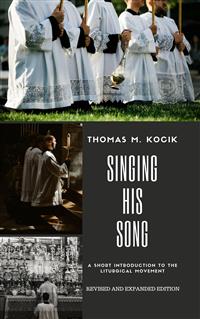
Catholics come to church with certain expectations not widely held by earlier generations when it comes to participation in the Church’s rituals. That is largely the result of the Liturgical Movement of the 20th century, which precipitated a major overhaul of the public worship that the Church offers to God. This study presents the history of the movement before and after the Second Vatican Council. The author distills and makes available to non-specialists some of the more technical studies of the ideas and policies that influenced Roman Catholic liturgical renewal in the 20th century. "In The Life of Little Saint Placid, Mother Gallois has Jesus saying to the novice, "The liturgy means spending your life passing into my life," and prompting Placid in turn to this maxim: "Singing His life so as to live my song." That is the kind of singing I propose: not simply producing sounds with the voice in regular vibrations, but being "in tune" with the life of Christ by nourishing and living our faith through the Church's sacred liturgy". This short book is an introduction to the Liturgical Movement, its evolution and recent developments.
Das E-Book können Sie in Legimi-Apps oder einer beliebigen App lesen, die das folgende Format unterstützen:
Veröffentlichungsjahr: 2019
Ähnliche






Thomas M. Kocik
SINGING HIS SONG
Copyright © 2016, 2019 Chorabooks, a division of Choralife Publisher Ltd.
All rights reserved.
14/F office A. Bangkok Bank Building
No.28 Des Voeux Road Central
Hong Kong
First eBook edition: March 2016
Second Ebook edition: January 2019
Indice dei contenuti
Introduction
The First Phase: Recovering Lost Treasures
The Second Phase: The Movement Comes of Age
The Third Phase: Vatican II
The Fourth Phase: Towards a “New Liturgical Movement”
Conclusion: A Liturgical “Examen”
Suggested Reading
Introduction
I once asked a college student to describe what it means to be a Christian. After a long pause she replied, “Being good.” Not a perfect answer, but one that shows an instinct for the truth, for to be a Christian means to enter the life of God who is Goodness itself. As Jesus reminds us: “No one is good but God alone” (Mark 10:18).
At the same time, Jesus indicated that goodness is no longer exclusively God’s domain. “You, therefore, must be perfect, as your heavenly Father is perfect” (Matthew 5:48). Never one for empty rhetoric, Jesus must have seen God’s goodness as somehow accessible to the general public. In fact, He made it accessible, for a great part of His own mission was to share God’s goodness with men and women created in the divine image but fallen from grace. To be a Christian, therefore, means to be good with the goodness of God by entering somehow into Christ Himself – or, in that fine phrase of St. Paul, to “put on the Lord Jesus Christ” (Romans 13:14).
But what exactly is it that we put on when we put on Christ? To answer this, we must look at what we have received in Christ. In Him we have received salvation: the free pardon of sin and participation in the divine life. So, in putting on Christ we are putting on salvation, we are being saved. And our salvation consists of entering into Christ’s life – all of it, from Bethlehem and Nazareth to Calvary and Heaven; the entire time and distance of His “passover” from the home of the Virgin Mary and St. Joseph to the home of God the Father. This is what we must enter, what we must “put on” if we would share in the divine life that Christ, as God the Son, has lived from all eternity. How do we do that?
By singing.
Yes, you read that right. In the 1950s a French Benedictine nun and artist named Geneviève Gallois wrote a little book about a legendary saint known as Little Placid, a young disciple of St. Benedict. In The Life of Little Saint Placid, Mother Gallois has Jesus saying to the novice, “My son, prayer is spending your life passing into My Life,” and prompting Placid in turn to this maxim: “To sing one’s life and live one’s song.” That is the kind of singing I propose: being in tune with the life of Christ by nourishing and living our faith through the Church’s sacred liturgy. In the liturgy the events of Christ’s life are made present to us and we live them with Him. By “liturgy” is meant the prayer of the whole Church united with Christ her Head. Immediately we think of the celebration of the Eucharist, that is, Holy Mass, which for the Catholic laity is the most familiar form of liturgy. At a deeper level, the Mass is also the greatest form of worship, for it is the Sacrifice of Christ on the Cross, sacramentally made present on our altars and offered up to God for the world’s salvation. But the sacred liturgy also includes the other sacramental rites of the Church, as well as the Church’s official daily prayer (the Divine Office, or Liturgy of the Hours), the funeral rites, and various blessings and exorcisms.
Roman Catholics today take many features of their liturgical worship for granted. They generally expect to hear the biblical readings and prayers in their own languages. Regardless of their individual musical tastes or abilities, it seems normal to them that the congregation is expected to sing certain acclamations and hymns that are part of the liturgy, such as the Gloria or the Sanctus. It comes as no surprise when the priest (or deacon) preaches on the Gospel reading of the day. On the other hand, they would be puzzled if Holy Communion were administered to the faithful after Mass rather than during Mass.
None of these things could be taken for granted during much of the twentieth century and for several centuries prior. The liturgical landscape to which most Catholics are now accustomed is largely the result of the Liturgical Movement that began in Western Europe a few years before the First World War (1914–18), spread to America after the war, reached its fruition in 1963 at the Second Vatican Council, and thereafter transformed Catholic religious imagination and practice.
In its origins, the Liturgical Movement sought to restore liturgical piety to the very heart of Christian life. The liturgy, with its complex of words and ceremonies, had largely ceased to be what it was always meant to be: the primary source of instruction and nourishment for the faithful. It was, in the popular imagination, a sacred but mysterious heirloom, having no vital meaning for everyday life. For this reason, the early pioneers of the Liturgical Movement sought to reawaken people’s consciousness, including that of the clergy, to the Church’s traditional spiritual treasury. Years later, the movement began to press for changes in the liturgy itself.




