


3,50 €
Mehr erfahren.
- Herausgeber: Edizioni Aurora Boreale
- Kategorie: Bildung
- Sprache: Englisch
Francis Bacon (1561-1626) was an English philosopher and statesman who served as Attorney General and Lord Chancellor of England under King James I. Stuart. A great scholar and an initiate of many ancient schools of wisdom, Bacon argued for the importance of Natural Philosophy, guided by scientific method, and his works remained influential throughout the Scientific Revolution.
Francis Bacon's alleged connection to the Rosicrucians and Freemasonry has been widely discussed by authors and scholars in many books. Although there is no substantial evidence of Bacon's affiliation with Freemasonry, there are several elements that connect him with the Rosicrucian brotherhood and the highly secret Pythagorean Order.
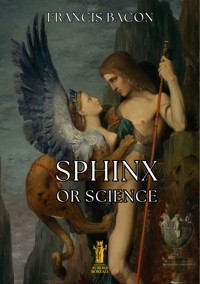
The Bacon’s study Sphinx, or Science. Explained of the Sciences, which we propose to our readers today, is taken from The Wisdom of the Ancients, a philosophical treatise written by the English philosopher in the early 17th century. It is a collection of ancient myths and fables from various cultures, including Greek, Roman, and Egyptian. Bacon uses these stories to illustrate his philosophical ideas and teachings, drawing parallels between the ancient wisdom and contemporary knowledge.
Sphinx is said to propose various difficult questions and riddles to men, which she received from the Muses; and these questions, so long as they remain with the Muses, may very well be unaccompanied with severity, for while there is no other end of contemplation and inquiry but that of knowledge alone, the understanding is not oppressed, or driven to straits and difficulties, but expatiates and ranges at large, and even receives a degree of pleasure from doubt and variety; but after the Muses have given over their riddles to Sphinx, that is, to practice, which urges and impels to action, choice, and determination, then it is that they become torturing, severe, and trying, and, unless solved and interpreted, strangely perplex and harass the human mind, rend it every way, and perfectly tear it to pieces. All the riddles of Sphinx, therefore, leave two conditions annexed, viz., dilaceration to those who do not solve them, and empire to those that do. For he who understands the thing proposed obtains his end, and every artificer rules over his work.
Das E-Book können Sie in Legimi-Apps oder einer beliebigen App lesen, die das folgende Format unterstützen:
Veröffentlichungsjahr: 2025
Ähnliche












SYMBOLS & MYTHS
FRANCIS BACON
SPHINX, OR SCIENCE
Edizioni Aurora Boreale
Title:Sphinx, or Science. Explained of the Sciences
Author: Francis Bacon
Publishing series: Symbols & Myths
Editing by Nicola Bizzi
ISBN e-book edition: 979-12-5504-821-3
Edizioni Aurora Boreale
© 2025 Edizioni Aurora Boreale
Via del Fiordaliso 14 - 59100 Prato - Italia
www.auroraboreale-edizioni.com
INTRODUCTION BY THE PUBLISHER
Francis Bacon (1561-1626), 1st Viscount of St. Alban, 1st Baron of Verulam, was an English philosopher and statesman who served as Attorney General and Lord Chancellor of England under King James I. Stuart. A great scholar and an initiate of many ancient schools of wisdom, Bacon argued for the importance of natural philosophy, guided by scientific method, and his works remained influential throughout the Scientific Revolution.
Bacon has been called the father of empiricism. He argued for the possibility of scientific knowledge based only upon inductive reasoning and careful observation of events in nature. He believed that science could be achieved by the use of a sceptical and methodical approach whereby scientists aim to avoid misleading themselves. Although his most specific proposals about such a method, the Baconian method, did not have long-lasting influence, the general idea of the importance and possibility of a sceptical methodology makes Bacon one of the later founders of the scientific method. His portion of the method based in scepticism was a new rhetorical and theoretical framework for science, whose practical details are still central to debates on science and methodology. He is famous for his role in the scientific revolution, promoting scientific experimentation as a way of glorifying God and fulfilling scripture.




