


Erhalten Sie Zugang zu diesem und mehr als 300000 Büchern ab EUR 5,99 monatlich.
- Herausgeber: New Island
- Kategorie: Fremdsprachen
- Sprache: Englisch
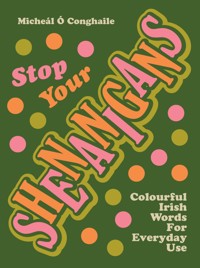
In Ireland, the art of conversation / crua-chaint is highly valued. We like to 'put a skin on a story' / craiceann a chur ar scéal because words are not just words to us. They are alive, carrying echoes of where they've been and taking us and the English language to new places. Writer Micheál Ó Conghaile has chosen his favourite everyday Irish words and he shows you how to weave them into your own crua-chaint. Some will surprise you with their Irish origins – galore, hooligan and, of course, shenanigans. And some, such as amadán / fool, bacaidí / bockety, fústar / busy, grá / love and rírá / uproar, will take your Irish conversation to the next level.
Sie lesen das E-Book in den Legimi-Apps auf:
Seitenzahl: 89
Veröffentlichungsjahr: 2026
Das E-Book (TTS) können Sie hören im Abo „Legimi Premium” in Legimi-Apps auf:
Ähnliche



STOP YOUR SHENANIGANS
First published in 2026 by
New Island Books
Glenshesk House
10 Richview Office Park
Clonskeagh
Dublin D14 V8C4
Republic of Ireland
newisland.ie
Copyright © Micheál Ó Conghaile, 2026
The right of Micheál Ó Conghaile to be identified as the author of this work has been asserted in accordance with the provisions of the Copyright and Related Rights Act, 2000.
Print ISBN: 978-1-84840-864-7
eBook ISBN: 978-1-83594-020-4
All rights reserved. The material in this publication is protected by copyright law. Except as may be permitted by law, no part of the material may be reproduced (including by storage in a retrieval system) or transmitted in any form or by any means; adapted; rented or lent without the written permission of the copyright owners.
British Library Cataloguing in Publication Data.
A CIP catalogue record for this book is available from the British Library.
Product safety queries can be addressed to New Island Books at the above postal address or at [email protected].
Irish-language editing by Jenifer Ní Ghrádaigh
Cover design by Niall McCormack, hitone.ie
New Island Books is a member of Publishing Ireland and the Independent Publishers Guild.
For Brian Ó Conchubhair & Tara MacLeod
Contents
Introduction
A note on phonetics
A
B
C
D
E
F
G
H
I
J
L
M
N
O
P
R
S
T
U
Y
Acknowledgements
About the author
Introduction
For me words are very much alive. They have, and have had, a life of their own before we meet them. A sort of biography, being shaped and reshaped over the ages. They grow. And, just like people, they have a story to tell. A history, a backstory, as many of them have travelled a long way.
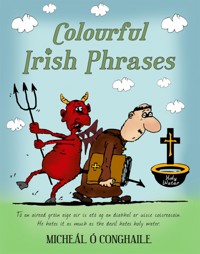
I am a native Irish speaker from Connemara and the words I have chosen for this book are favourites of mine that I would like to introduce and share with a wider audience. They are words I hear every day in my community but would also be spoken in many parts of Ireland, perhaps more so in rural Ireland. A lot of them, such as meitheal, cumann, feis, plámas and fáilte, are Irish-language words that have come to be used by English speakers in Ireland every day. Others are spoken in anglicised forms – such as colleen, galore, shebeen, poteen and banshee – by English speakers who may often be unaware of their origins in the Irish language, or are English-language words originating from Irish history. Also included are a number of Irish phrases, including an béal bocht, Tadhg an dá thaobh and uisce faoi thalamh, that can often be heard sprinkled into English-language conversation in Ireland. It’s in such phrases that many Irish words really come alive, so my hope is that this can be read as a companion to my other book Colourful Irish Phrases (Mercier Press, 2018), which offers a fuller picture of the unique turns of phrase, sayings and proverbs that have their roots in the Irish language.
These words and phrases have made a home in the English language as it’s spoken in Ireland, making it more interesting, unique, rich, different, funny and colourful by their presence. Any selection such as this is personal, and the words gathered here are far from the only ones I could have chosen – but I hope that Irish people will find them interesting, as well as the many new migrants and visitors to our country who might not have heard them before. As a person who has been promoting the Irish language all my life, I also hope this book will inspire others to learn more about the Irish language and the way it bleeds through the English language as it’s spoken in Ireland. I have included phonetic spellings for the aid of readers encountering these words for the first time, and, as pronunciation can vary across Ireland, these are based on the Irish spoken in my own locality in Galway.
The art of conversation is highly valued in Ireland in both languages, what we call crua-chaint – a phrase that literally translates as hard conversation, but refers more specifically to the art of good conversation or to conversation in which the meanings of words are brought under discussion and teased out – even more so. We also have the phrase craiceann a chur ar scéal, meaning to put a skin or hide on a story or to embellish it and make it better. Words are admired because they are not just words, they are sometimes echoes of other or older words. Highly expressive phrases are cherished in Ireland, enjoyed and dissected, polished and repeated with relish. They are often kept at hand to enrich conversations or to get one up on another speaker as if in a contest.
Although the words selected for this book are now inserted into everyday English-language conversations, they reflect a different cultural and linguistic history – separate but side-by-side. They contain within them a sort of history of Ireland, one that’s very much part of what we were and, more importantly, part of what we still are. Many Irish people use them daily without being aware that they do not originate in standard English, and those who claim to struggle with the Irish language will be surprised to learn of some of their origins. Throughout our history, these words have renewed the English language as spoken in Ireland and English has not only adopted them but maintained and nourished them for many generations.
Life is full of comings and goings, however, and the same is true of words. A quick Google search tells me that the Oxford English Dictionary includes about 171,000 words that are in current use, as well as 47,000 words now obsolete. That is the story of most languages. Some of the words in this collection will be obsolete to some readers and others will probably be on their last legs. But many more are very much alive and will be, hopefully, for many generations to come. My hope is that this little book will help them survive so that future generations can know and use them with ease and fun and hold onto them. To lose them would be a loss to the English and Irish languages alike, and would make for a less colourful life.
A note on phonetics
In the interests of accessibility, reader-friendly transcriptions of the headwords have been included here for non-native speakers, with use of the English-language alphabet and hyphenation to help clarify pronunciation and avoid ambiguities. Due to phonetic differences between Irish and English, these are necessarily imprecise, and as they are based on the author’s own pronunciation, may not always reflect standard or local pronunciation.
Recordings of individual words by native speakers may be found at focloir.ie. AI-assisted text-to-speech can be found at abair.ie.
A
Abú
h-boo
Meaning forever (also go deo), this is a rallying call, often heard today at GAA matches and seen as part of slogans such as Gaillimh Abú!, Galway Forever! or Galway to win. It also turns up in several of our songs, such as ‘O’Donnell Abú!’, a song about Red Hugh O’Donnell (1752–1602) who ruled Tír Chonaill (the land of Conall, aka Donegal). The lyrics were written by a Fenian, Joseph McCann, in 1843 and the last line urges, ‘Strike for your country! O’Donnell Abú!’
A chroí, mo chroí
h-cree, muh-cree
This is one of the many terms of endearment we have in the Irish language, meaning my dear, my beloved one or literally my heart. One of our most famous traditional emigrant songs begins with, ‘A stór mo chroí, when you’re far away.’
A chuisle
h-cwish-luh
Cuisle, another term of endearment, is the word for a pulse in Irish. You would often hear a chuisle (geal) mo chroí, (fair) pulse of my heart.
A rún is another word of endearment meaning dear one or loved one, although rún on its own means a secret. But, of course, there have been many times when love had to be kept a secret.
A similar word is a stór, which means my darling or my dear. Stór, on its own, means treasure, stock or store, i.e. wealth. Riocárd Bairéad in his poetry talks about his landlord and how he was ‘ag cruinniú stóir, gathering or hoarding wealth’ instead of helping the poor people. There is another term of endearment, mostly used in Ulster Irish, a thaisce, which also means riches.
One of our most celebrated sean-nós (traditional unaccompanied singing in Irish) songs begins with ‘A chuisle is a stór, ná pós an seanduine liath, ach pós an fear óg, go deo muna maireann sé ach bliain. A chuisle, a stór, don’t marry the grey-haired old man but marry the young man, forever, though he might only live for a year.’ Sound advice, perhaps, but would surely be regarded as ageist nowadays.
Aerach
ir-ukh
This means buoyant, light-hearted, lively, frolicsome, gay or in good spirits. The English translation is airy. When I was young it was also used in the opposite or sarcastic sense to describe a person whom you might not expect to be aerach, such as a widow or an old person! It was also a word associated with the fairies: ‘they say it was an airy place, that the fairies were seen there.’
An tOileán Aerach, the Airy Island, is another name for Inis Bearachain, a small island in Ceantar na nOileán off the Galway coast, as it was famous for its music, singing and dancing. As there were no guards stationed on these smaller islands they were often popular to go to for ‘late drinking hours’. A village might also be known as a baile aerach, a lively, fun-loving village.
In the last forty years or so, aerach has become the Irish word most often used for gay or homosexual. Just as the English-speaking LGBTQ community have reclaimed the words gay and queer, so too the Irish-speaking gay community has followed suit with the word aerach. Tá mo dhuine aerach, your man is gay.
Aililiú
l-lal-lew
This is a word that can indicate excitement, delight, bewilderment or even sorrow. Good gracious! It’s mostly used in the Munster dialect and possibly made more famous by its use in ‘An Poc ar Buile’, a lively traditional song about a puck goat that’s gone mad. A 1960s rendition by the wonderful Cork singer Seán Ó Sé was one of the few Irish-language songs to ever make it into the Irish charts.




