


Erhalten Sie Zugang zu diesem und mehr als 300000 Büchern ab EUR 5,99 monatlich.
- Herausgeber: Mercier Press
- Kategorie: Geisteswissenschaft
- Sprache: Englisch
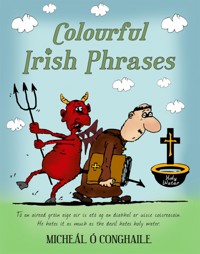
The Irish language has made a huge contribution to the English language as it's spoken in Ireland and beyond. Micheál Ó Conghaile's 'Colourful Irish Phrases' is a small compendium of characteristic phrases that will alert the reader to the unmistakable difference between our native language and English. Even the most basic words are expressed so differently. Please in Irish is más é do thoil é (if it is your will), and thanks becomes go raibh maith agat (may you receive good). There are many phrases that when translated, word for word, they sound different, unusual and sometimes funny. But above all, they are rich and deeply rooted. Visitors to Ireland who want to get some notion of our native identity will find these phrases both instructive and revealing. Topics covered range across subjects as diverse as insults and put-downs, being human and the gift of the gab.
Sie lesen das E-Book in den Legimi-Apps auf:
Seitenzahl: 66
Veröffentlichungsjahr: 2018
Das E-Book (TTS) können Sie hören im Abo „Legimi Premium” in Legimi-Apps auf:
Ähnliche

















MERCIER PRESS
3B Oak House, Bessboro Rd
Blackrock, Cork, Ireland.
www.mercierpress.ie
www.twitter.com/IrishPublisher
www.facebook.com/mercier.press
© Micheál Ó Conghaile, 2018
Published in association with Cló Iar-Chonnacht
ISBN: 978 1 78117 555 2
Epub ISBN: 978 1 78117 556 9
Mobi ISBN: 978 1 78117 557 6
This eBook is copyright material and must not be copied, reproduced, transferred, distributed, leased, licensed or publicly performed or used in any way except as specifically permitted in writing by the publishers, as allowed under the terms and conditions under which it was purchased or as strictly permitted by applicable copyright law. Any unauthorised distribution or use of this text may be a direct infringement of the author’s and publisher’s rights and those responsible may be liable in law accordingly.
Introduction
I remember not being able to speak English. Growing up in the 1960s on a small island, Inis Treabhair, off the Connemara coast, Irish was the everyday language of its dwindling population of about forty people. Six households in all. The reason I remember so clearly not being able to speak English is the summer visits when our first cousins from London and Galway city would come to spend a few weeks with us. I must have been three or four years old at the time. As kids, they spoke only English. I spoke only Irish. But we got along and played together, communicating with each other as children from different backgrounds do. I picked up some English from them and later learned English at school, where every subject except English was taught through Irish. When I entered the island’s national school in 1966 there were twenty-one students enrolled there; when I left in 1975 the number had dwindled to five. The school doors were locked for the last time in 1980, the numbers having fallen to two.
The same fate awaited life on the island. In the 1870s when its population peaked, 171 people lived there. A couple of years ago the last native islander, Patsy Lydon, left the island to live with family members on the mainland, bringing an end to island life which had gone on unbroken for at least 200 years.
So much dies with the death of island life. Even in the future, if other people go to live there, the chain or the link to the original inhabitants will be forever broken. It was the islanders and their forefathers who named and knew every field and hillock on the island; its strands, inlets, shores and rocks; the surrounding tides and currents and waves they had to navigate in all sorts of weather; the joys and pains of hundreds of years of continued life; the local lore, songs, poems and stories. And the language – the language that brought everything to life. In this case it was Irish.
The Irish language phrases in this book are ones that I mostly grew up with. Others I picked up over the years. Most of them were part of what we were, of our daily speech and lives. Perhaps some of them originated on the island. Most of them can be heard from native Irish speakers from all Gaeltachtaí in Ireland, still very much alive and in use. We don’t know for sure how old they are. Some of them may have been used for over 1,000 years, originating in Old Irish before the ninth century, living through Middle Irish, 900–1200, through Classical Irish, 1200–1600, and still to the fore in Modern Irish, surviving through the Great Famine of the 1840s and the decline of the language in most parts of the country. We know for sure that one of them, the phrase Fáilte Uí Cheallaigh, the O’Kelly welcome, is nearly 700 years old and it’s still very much in use.
I am grateful to John Spillane at Mercier Press for asking me to put this collection of phrases together. Growing up with these phrases, I had taken them for granted and did not think much of them. After all, most of the time we use language just to communicate. That’s all. Until I did a little research, I was not aware that most of these phrases were not familiar to English speakers in Ireland. Very few of them have made their way into everyday English usage. They were not translated or collected. When translated, word for word, they sound different, unusual and sometimes funny, as John pointed out to me. But above all, they are rich and deeply rooted. They have a history. They come from somewhere deep and have travelled on a long, narrow, winding path. They have meaning and often a story to tell or snatches of history to reveal, just like most of our Irish language logainmneacha or place names. I have included some of these stories and backgrounds in the notes. Where there is no accepted theory, I have sometimes included some speculation on my part. I’m open to be corrected in such cases and, indeed, to suggestions. As the seanfhocal says, ‘Ní haon ualach an t-eolas’ (‘Knowledge is no burden’).
We are all aware of the great contribution the Irish language has made to the English language as it’s spoken in Ireland and, indeed, beyond. It makes it richer and more colourful. It may seem small, but it’s like the yeast in a cake making the English language rise and expand into fullness and goodness. Most of our great writers in English have taken advantage of this and it has enriched their writings and world literature in English. The likes of Joyce, Beckett and Heaney come to mind. They all dug deep and mined for golden nuggets here and there, and they delivered the goods. Of course, in Irish we have our own great writers, like Ó Cadhain, Ó Direáin and Ó Ríordáin, who immersed themselves fully in the language, its history and lore. And they faced the same odds as Joyce, Beckett and Heaney, but with one big difference. As Ó Cadhain once said, it’s difficult to write in a language that will probably be dead before you. But that did not stop him from giving it all he had, like all great writers. And he knew where he and, indeed, many other Irish language writers were coming from: ‘Tá aois na Caillí Béara agam, aois Bhrú na Bóinne, aois na heilite móire. Tá dhá mhíle bliain den chráin bhréan sin arb í Éire í, ag dul timpeall i mo chluasa, i mo bhéal, i mo cheann, i mo bhrionglóidí.’ (‘I’m as ancient as the Hag of Beara, as old as Newgrange, as timeless as the hornless doe. Two thousand years of Ireland, that filthy sow, echo in my ears, in my mouth, in my head, in my dreams.’)
For over 700 years now, both languages have lived side by side in this country, in people’s hearts and minds. Writer and scholar Fr Peadar Ó Laoghaire (1839–1920) called it an dá arm aigne (the two armies of the mind). They have competed and bounced off each other over the centuries but they have also infiltrated and enriched each other. An army can fight and kill, but it can also defend and protect, and help the weak survive.
Irish writers in both languages are welcome to draw from this book. To reuse, recycle and reinvent if they feel it colours their language. After all, that’s what writers do, or try to do. I would also hope that learners of the language, at whatever stage they are at, would find these phrases usable, and that a younger generation of native Irish speakers, who are not familiar with these expressions and idioms, would benefit from this word hoard. Visitors to our country who want to get some notion of our native identity will find these phrases both instructive and revealing. This small compendium of characteristic phrases will alert them to the unmistakable difference between our native language and English. Even the most basic words are expressed so differently. Please, in Irish, is más é do thoil é (if it is your will) and thanks becomes




