


Erhalten Sie Zugang zu diesem und mehr als 300000 Büchern ab EUR 5,99 monatlich.
- Herausgeber: Paraclete Press
- Kategorie: Religion und Spiritualität
- Serie: Voices from the Monastery
- Sprache: Englisch
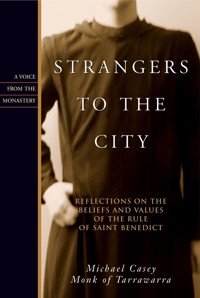
Michael Casey, a monk and scholar who has been publishing his wise teachings on the Rule of St. Benedict for decades, turns to the particular Benedictine values that he considers most urgent for Christians to incorporate into their lives today. Eloquent and incisive, Casey invites readers to accept that gospel living - seen in the light of the Rule - involves accepting the challenge of being different from the secular culture around us. He encourages readers to set clear goals and objectives, to be honest about the practical ways in which priorities may have to change to meet these goals, and to have the courage to implement these changes both daily and for the future. Casey presents thoughtful reflections on the beliefs and values of asceticism, silence, leisure, reading, chastity, and poverty - putting these traditional Benedictine values into the context of modern life and the spiritual aspirations of people today. Strangers to the City is a book for all who are interested in learning more about the dynamics of spiritual growth from the monastic experience.
Sie lesen das E-Book in den Legimi-Apps auf:
Seitenzahl: 327
Veröffentlichungsjahr: 2013
Das E-Book (TTS) können Sie hören im Abo „Legimi Premium” in Legimi-Apps auf:
Ähnliche













STRANGERSTO THECITY
STRANGERS
TO THE
CITY
REFLECTIONS ON THEBELIEFS AND VALUESOF THE RULEOF SAINT BENEDICT
Michael Casey, ocso Monk of Tarrawarra
PARACLETE PRESS
BREWSTER, MASSACHUSETTS
Strangers to the City: Reflections on the Beliefs and Values of the Rule of Saint Benedict
2008 Third Printing 2006 Second Printing 2005 First Printing
© 2005 by Michael Casey
ISBN: 978-1-55725-460-3
Library of Congress Cataloging-in-Publication Data
Casey, Michael, 1942–
Strangers to the city : reflections on the beliefs and values of the Rule of Saint Benedict / Michael Casey.
p. cm.
ISBN 978-1-55725-460-3
1.Benedict, Saint, Abbot of Monte Cassino. Regula.
2.Benedictines—Rules. I. Title.
BX3004.Z5C339 2005
255'.106—dc222005010809
The Scripture translations were made directly from the Greek or Hebrew by the author.
The translations of The Rule of St. Benedict were also made directly from the Latin by the author.
10 9 8 7 6 5 4 3
All rights reserved. No portion of this book may be reproduced, stored in an electronic retrieval system, or transmitted in any form or by any means—electronic, mechanical, photocopy, recording, or any other—except for brief quotations in printed reviews, without the prior permission of the publisher.
Published by Paraclete Press Brewster, Massachusettswww.paracletepress.com Printed in the United States of America
In memory ofHelen Lombard1936 – 2000Sister of the Good SamaritanA Lover of the Rule
Contents
Preface
1 Distinctiveness
1. Why Are You Here?
2. Making the Break
3. Frontiers
4. Benedict’s Contribution
2 Asceticism
1. St. Benedict’s Approach to Asceticism
2. Giving Priority to Interiority
3 Leisure
1. Leisure as Silence
2. Room to Breathe
3. The Enemies of Leisure
4 Reading
1. Escape from Meaning
2. In a Nook with a Book
3. Lectio Divina
5 Chastity
1. Understanding Chastity
2. A Spirituality of Chastity
6 Dispossession
1. Material Poverty
2. Poverty of Spirit
3. The Fragility of Life
7 Antecedent Willingness
1. God or Self?
2. Laying the Foundation
3. Accepting Correction
8 Mutuality
1. The Struggle for Community
2. Mutuality and Equality
3. From Empathy to Intimacy
9 Generativity
1. A Generative Community
2. Monastic Subculture
3. Utopia?
10 Christ
1. Affective Religion
2. Historical Development
3. The Qualities of Love for Christ
11 Contemplation
1. Mystical Monks?
2. Prayer Integrated in Living
3. The Variety of Mystical Experience
12 Holiness
1. Communio and Communitas
2. The Primacy of Liturgy
3. A Lifestyle Worthy of the Gospel
13 Perseverance
1. Sacred Space
2. Not Giving Up
3. Reaping the Benefits
Notes
Preface
When monks and nuns commit themselves entirely to God in the solemn act of monastic profession it is as though they change their citizenship. Now they are citizens of heaven, living in an extraterritorial outpost that medieval authors termed the “cloistral paradise.” Monastic living is, however, more than a question of location. Beyond prolonged residence in the place, commitment is demanded. This, in turn, implies more than mere punctiliousness in obeying the laws and observing local customs. It asks us to take on a new identity and to be reshaped according to a different culture. This refashioning must come from within. It cannot be superimposed by external pressure on an otherwise recalcitrant individuality. From the very beginning the candidate to monastic life is asked to consent to a different world-view, where previous priorities are turned upside down and a lifelong process of unlearning, learning, and relearning is initiated.
The transformation that occurs in monasteries is God’s work, and no human effort can bring it about. Nevertheless it is a work in which the monk or nun has a role to play. There is an active phase in monastic growth where much effort needs to be expended. St. Benedict envisages the monk as a good tradesman, persevering in his task and making use of whatever implements are required to perform it well. In Chapter 4 he lists no less than seventy-three implements to be found in the monastic workshop—some of them more important than others, but all available should the need arise. The skilled worker is one who is able to recognize when a particular implement is called for and has the ability to use it appropriately.
In this book I am going to reflect on a number of the monastic means to holiness that I find in the Rule of St. Benedict and that to me seem particularly relevant not only to monasteries but to the Church as a whole. What Benedict presents to us is no more than a digest of gospel teaching applied to a particular situation. I hope to reflect on his words in a way that will enable you, the reader, to apply this doctrine to your own circumstances and perhaps find in the ancient writings words that are life-giving.
The key idea of this book is expressed in its title. Benedict advises his monks “to make themselves strangers to the actions of the age”—to become strangers to the city. This is done first by living somewhat apart, morally more than physically. The purpose of this “separation from the world” is to facilitate a distinctive lifestyle, based on distinctive premises and priorities. It must be obvious, moreover, that the maintenance of this particular way of life depends on an infrastructure of beliefs and values: Without personal convictions monastic living is no more than a pious charade. The monastic sub-culture, like every other, includes a good measure of theory as well as practice. Apart from this theory monastic living lacks integrity and is liable to exhaust itself in mindless virtue. There is, as has often been said, nothing so practical as good theory.
Most monastic people understand that the realistic living of monastic life (or conversatio) demands more than doing good and avoiding evil. It asks for a progressive and substantial change in attitude. We have constantly to take on board new beliefs and values, and submit to question some aspects of the philosophy of life we have built since our youth. This is the ongoing conversion that is demanded of us: more and more to view things with the eyes of Christ and to leave behind the self-serving individualism that has become our regular mainstay in thought and action.
This is a program of life so demanding that we readily seek meritorious distractions from its severity. We must beware. If we indulge in too much escapist behavior our whole life becomes fuzzy and we lose a sense of its direction. It is much better to be clear about what life is meant to be even when we fall far short of our ideal. That way, and with God’s grace, we keep trying and, perhaps, with the passage of time our hearts become purer and our lives simpler. At least that is the way it is supposed to be!
The service rendered to the Church by fervent followers of St. Benedict is their stable and persevering effort to live lives shaped by the gospel. They aspire to create in the common microcosm of the monastery a miniature church where the universal struggle of divine grace and human sinfulness is played out. Only the outsider can perceive which way the battle is going. The insider is aware mainly of the grim reality of weakness and precariousness on every side. Hope in the victory of Christ is not yet seen, but clung to in faith.
In this book I am inviting you to enter with me into the monastic experience where, as in your own experience, life and death contend. Your experience will not be the same as mine. I am a male, a monk, an Australian, and probably in the final quadrant of my life. I speak as one formed in a specifically Cistercian approach to the Rule. Chances are that your CV scarcely overlaps with mine. That could be an asset. What I see from my vantage point is probably different from what you see from yours. With a bit of effort a fusion of horizons may occur so that from these pages you might see something in the Rule that you did not notice previously. I hope that a fuller contact with the life-enriching vision of St. Benedict will be a means of greater access to the evangelical wisdom that he taught through his Rule and through the form of monastic living that he established.
This book started life as an address given to a gathering of the Communio Internationalis Benedicinarum on 14 September 2003. It was published in Tjurunga 66 (2004), pp. 34–47. Since then the material has been workshopped with various monastic groups around the world. I am very grateful to all who have given me feedback and encouraged me to keep expanding the topic.
Michael Casey11 July–25 December 2004
1
Distinctiveness
To make oneself a stranger tothe actions of this ageRB 4:20
St. Benedict finds those who are to become his followers in the midst of the multitude of people (Prol. 14), but in calling them to undertake the journey to the kingdom (Prol. 21), he necessarily invites them to come out from that multitude. Henceforth “this world” or, better, “this age”—Benedict uses saeculum rather than mundus—becomes a symbol of apostasy. “This age” and all its works are what we have left behind in following our vocation.1 What is beyond the monastic sphere of influence is not good for our souls (66:7), it is destruction (destructio: 67:5). The danger, however, is not the world outside, as it were the Goths at the gates, but the world brought inside the monastery in the heads and hearts of monks and nuns.
It seems to me that the first and foremost call that comes to us today from Benedict’s Rule is to become what we are meant to be. To embrace whole-heartedly our Benedictine and monastic identity, and to assert our distinctiveness in respect of “this age,” the ambient culture that espouses so very few of the values that characterize our seeking of God. Our citizenship and conversatio are heavenly (Phil. 3:20). Despite the fact that a previous Abbot Primate has stated that Benedict “has no place for fuga mundi,”2 it is only by keeping a certain distance from society that we can hope to have some positive impact on it. The Gospel images of salt and leaven are reminders to us that our influence depends on our being different, on our remaining faithful to our vocation to be distinctive. “Salt is a good thing, but if salt becomes unsalty, how can you season it?” (Mk. 9:50). Abbot Parry pungently restates this ancient idea.
The need to break visibly with the ways of the world, and to assert something more definitely by one’s life-style, becomes more and more urgent as our society plunges morally into the abyss, and socially into disruption. The need is for witnesses whose witness is both intelligible and unmistakable, for witnesses who know how to reject and rebuke evil however disguised, and likewise proclaim what is good.3
This assertion of identity must be more than mere “contempt for the world,” although some may believe that today there is much in many societies that is contemptible. It must derive from a certain clarity about our ultimate ideal and our goals, and also about the means necessary if we are to form succeeding generations so that they have some chance of persevering in their quest for God.4
1. Why Are You Here?
The first question Benedict addresses to a prospective disciple concerns motivation. “Friend, for what purpose have you come?” (RB 60:3). Oddly, it is almost the same challenge that Jesus put to Judas in the garden of Gethsemane (Mt. 26:50). A similar question is repeated in the ritual of monastic initiation: Quid petis? “For what do you seek?” Today, when this query is made of those who are attracted to the monastic way, many different responses are given depending on how extensive has been the candidate’s exposure to the appropriate theological vocabulary. The replies are not necessarily insincere, but very often they reflect only what is happening at a conscious level. These overt aspirations do not always reveal the deeper drives that have brought candidates to the monastery door. It may be years later, sometimes only as they end their monastic career, that such persons become somewhat aware of the hidden motivations that were subtly influencing the choices they made.
Over recent decades there has been some evolution in the reasons given for wanting to enter a monastery. In the past, monastic life was seen as offering a chance to do penance for sins committed or, alternatively, for those whose lives were less blameworthy, the opportunity to make reparation for the sins of the world. There was also the idea of making intercession through the multiplication of prayers, good works, and acts of self-denial, and much reference was made to the “hidden apostolate” of contemplatives, in terms drawn from Pius XI’s much-quoted letter to the Carthusians, Umbratilem. Others were initially attracted by the various services offered by particular monasteries, and wanted to participate in such sacred utility. Despite the acclaim offered to the “witness value” of monastic life, I do not know that this was an ideal that drew people into joining. More subtle motivations also operated: an attraction to the monastic ambiance, the good example of particular members of the community, or books read that lit a fire. In this last instance, it is well known that many were drawn to Cistercian monasticism by the writings of Thomas Merton.
At a deeper level, most genuine candidates find themselves somewhere on a continuum between uncomprehending obedience to the perceived will of God and the hope that monasticism will be for them a path to self-realization. Becoming aware of a “vocation” happens in many ways: Sometimes the call seems to be in continuity with a previous life, sometimes a “conversion” is demanded and a new beginning made. To some extent most of those who present themselves at the door of the monastery are fired by a vision of a misty alternative future—they see monastic life as a means to fulfilling their ultimate potential, as it were realizing their destiny. In this connection many older people used to speak about religious life as a means of “seeking the way to perfection.”
Whatever brings a person to embrace the monastic way, it is unlikely to be sufficient for a lifetime. The transition into monasticism usually causes a degree of regression: Entrants may find themselves without the support of their carefully cultivated persona and, for a while, may wallow in the confusion of childish reactions.5 The reality of community life brings to the surface many hidden needs and dynamics. Very quickly, a more searching motivation will be needed to assure survival.
Monastic life is not really about self-realization, in the immediate sense of these words: It is more about self-transcendence. These are noble words, but the reality they describe is a lifetime of feeling out of one’s depth: confused, bewildered, and not a little affronted by the mysterious ways of God. This is why those who persevere and are buried in the monastic cemetery can rarely be described as perfectly integrated human beings. Far from it. We live and mostly die with our imperfections intact. Accepting this means letting go of efforts to manage one’s self-definition and to control events in accordance with it. It means living in the insecurity of God’s mercy and that of the community.
Self-transcendence is a relentlessly grinding process. It makes each one of us the anti-hero in the drama of our own life: unknowing, incompetent, bumbling. To persevere in such an unpoetic existence requires unusual skills, if they may be so called, and strong motivation. If persons are unaware of why they have decided to orient their lives in a particular direction, it will be very difficult for them to keep discerning the choices that further this endeavor.
This is why one of the early tasks confronting newcomers to monastic life is to understand by what dynamism Providence has led them to take this step. Once this has been done, they can sit back and wait for their newly crafted vision to fall apart. Then they can start again, re-assembling the pieces, with God’s help, into an approach that will serve them for another few years. And so the process of re-definition continues. Even St. Bernard, we are told, used frequently to muse on his motives, as though to suggest that initial inspirations are not always sufficient to carry us through the variety of experiences by which our life is continually and creatively reconstituted.
Today, probably more than ever, entering a monastery is a major transition. Nobody slips unthinkingly into monastic life for the lack of a better alternative. Too many obstacles are encountered both before entry and in the years that follow it. We have to be very solidly convinced that we are following the right course, and our wills must be fully fixed on a distant goal. Monastic life is the diametric opposite of aimless living. It has a goal and it has a tried and ordered network of means by which that goal is realized. The train is running on tracks to a single destination; if you don’t want to go there, you had better get off at the next stop.
The crucial issue for people involved in the monastic enterprise is finality. What is its ultimate purpose? Where is it leading? The goal of monastic life needs to be decided before any discussion about suitable means of attaining it. It is the end that renders the means meaningful. The question of goal is one addressed by John Cassian in his first Conference. His response is well-known. The monk aims, above all, for the kingdom of God. But his more immediate ambition is to rid his heart of complexity so that he seeks that goal in simplicity and without mixed motives. His most pressing task, therefore, is purity of heart. This means he uses anything that reduces the level of inner division. He embraces a disciplined lifestyle, he allows many of his options to be decided by others, he opens his heart to an experienced mentor, he submits in faith to the providential disturbances that he meets on his journey. As he makes progress, invisible though it is to himself, he connects more completely with the most purifying power of them all, the inward action of the Holy Spirit. By this peculiar conjunction of divine grace and human struggle, transformation occurs.
Those who embrace the monastic means as the determining elements in their behavior gradually acquire a new identity. This is something that grows from within. It is not a role played for whatever reason. It is not a temporary phase that will soon be abandoned. This monastic identity accompanies monks and nuns wherever they go, whatever they do. Sometimes this homing instinct points out to them life-giving byways and, when (not if) they go astray, it serves as a beacon to guide them back to integrity. But there is a choice to be made. Long before such an identity is formed, those who enter the monastic way are obliged to reorient their lives radically. According to ancient usage, the first step in becoming a monk is conversion.
2. Making the Break
Benedict calls his followers, as we have said, to come out from the multitude. This is how it is with every monastic vocation. We are born into a family, a culture, and an ambiance, and our attitudes are largely shaped by those with whom we have had contact. By and large, our priorities are not so different from those of our peers and contemporaries. Our future is relatively predictable based on our social class, our character and talents, our education. With each passing year the possibilities narrow. For most of us the announcement of a monastic interest caused surprise and shock to those who thought they knew us. What they did not know was that something had been happening deep inside us that impelled us to evaluate issues differently, and to turn aside from the future that others so confidently predicted for us.
What was this inner earthquake? Most of us would have found it hard to describe—at the time we were not so familiar with our interior landscape that we could easily discourse about it. We lacked a vocabulary adequate to convey our experience. Its component elements seemed trivial and banal—too insubstantial to bear the weight of their eventual consequences. When we think of conversion experiences we often imagine something dramatic happening as it did to St. Paul on the Damascus road. Yes, some conversions seem to be sudden, but often upon investigation we discover that the process had been brewing over a long period. It is only when the gathering force suddenly ruptures the shell of habit and erupts into ordinary life to change it irreversibly, that we see it. But it had long been working its magic underground.6
The principal and permanent effect of this inner experience was to bring about a change in our perceptual horizons. This is to say that we began to see issues in a different light. We were no longer under the full thrall of appearances, but we had begun to glimpse something of the reality underlying human affairs. The more clearly we saw, the more differently we evaluated possibilities. Once we made the radical choice to submit to this secret summons, we now questioned goals and assumptions that previously seemed routine, and a great ferment resulted. We had a sense that we were being impelled toward a different future, though we did not always know clearly what shape that future would assume.
Because the world looked different, it slowly became clear that a different lifestyle was demanded of us. There may have been elements of guilt and shame about our past, but the primary feeling was one of joy and exhilaration. This made us bold in confronting negativity in our own life and around us. Often we were overly severe on ourselves and others at this phase. It was easier to reject what was obviously dissonant with our new dream than to know what might lead to its realization. Only with the passing of time and, perhaps, the waning of enthusiasm did realistic possibilities begin to open up before us. None of them was a perfect fit, but one stood out as offering a skeleton around which a new self could be formed.
And so we came to the monastery.
3. Frontiers
Few of us will ever forget the day we crossed the monastic threshold to begin a new life. It was a solemn moment of entering a new environment and leaving behind much of what had become second nature to us. It was almost like a new birth. We were infants, unable to predict or control what would happen next, feeling that our presence contributed little to the functioning of this well-oiled machine, constantly wondering whether we had made the right decision.
As we recovered from that initial sense of displacement we discovered a whole new world of strangeness. The monastery operated on principles different from those to which we were accustomed. We found a community strong on antique ritual and symbolism and often indifferent to fashion and efficiency and somewhat removed from the banalities of suburban concern and conversation. At a deeper level our conviction that cause and effect were related seemed challenged at ever turn. Things happened without apparent reason, not only in the petty details of daily life, but even at important junctures of spiritual development. Perhaps with a rising panic we became aware that in a monastery we would never be in control—especially if we happened to become a superior. Underlying the reasonable and ordered facade was a frothy chaos that seemed ever on the point of overwhelming the community, but in fact never did. Our own identity too was in a state of flux. The primacy of self had been displaced, and there did not seem much to take its stead. Especially at the beginning, but, for some, sporadically through life, we seemed to be living in a foreign country. In the monastic world we felt ourselves as resident aliens. At times like this we may have been surprised to feel a little homesick and experience a certain nostalgia for the life we had abandoned with so much alacrity.
It is important to recognize that the abnormality of the monastic lifestyle is not a mere accident of recent history. Certain aspects of it may be unduly quaint or archaic, but the corporate lifestyle as a whole needs to be different from that of normal society “outside” because it embodies and expresses different beliefs and values. Individual members are supported and formed in living their distinctive philosophy not so much by intense personal direction as by participation in the common life, the common work, and the network of common relationships that together constitute the community. By being with others of the same persuasion, by acting in concert with them and by permitting the free flow of thought and feeling, we absorb the community identity. Simultaneously we become more ourselves, not in isolation, but ourselves in relation with others.
We live in a period in which religious practice is becoming progressively more privatized and more the object of personal choice. It is sometimes hard to give up the idea of a designer religion, in which everything is tailored to my present needs and aspirations. Delivering oneself into the hands of a community of relative strangers and asking to be formed does not seem like a very good idea. Yielding control does not come easily to me; I don’t always appreciate the fact that self-transcendence is impossible so long as the self remains in the driver’s seat. Even if I can learn to discern the difference between life-giving choices and those that lead nowhere, I am still bedeviled by deeper impulses that so often guide my actions but escape the scrutiny of my conscious mind. Even the most sincerely pious searchers after God harbor within themselves much hazardous material that, if disregarded, may eventually poison their best efforts. The fact that so many of our contemporaries do not recognize is that the higher our religious aspirations, the more we need the guidance and support of other people. If we intend merely to coast along the low roads, maybe we can do it alone. If we are heading for the mountains, the support of others is indispensable.
The lifestyle of the community we entered is not simply the sum total of individual neuroses. It is a community that stands in a tradition that has perdured for a millennium and a half. The basic parameters of the lifestyle, which no “Benedictine” can abandon, have their constitutional basis in the Rule of Benedict. Although Benedict is open to other input, his basic insight is that this fundamental law of community life is to be interpreted and applied by those who have experience in living it and the capacity to communicate this experience to others. No priority is given to bright ideas. Everything has to be measured against experience. The result can sometimes seem a bit stodgy, as we fail to keep up with the latest trends. The monastic tradition is so extensive that it does not give itself to easy maneuverability, but there is something solid about it. Its very archaism can serve to protect us from fads and “novelties” that hold sway for a season and then disappear. The rhythms of the monastic day are dictated by specific monastic goals; they do not have to conform to the preferences of those who seek something else.
It is important to note, at this juncture, that accepting to live monastic conversatio is not a matter of going back to live in a previous century. It is much more radical than that. The sixth century has no more claim on us than our own. Benedict does not recommend his own century to us, he teaches us to leave it behind and to try something different. We are citizens of heaven, and, knowing this, we try to live in accordance with heavenly standards as these are conveyed to us in the Gospels.
4. Benedict’s Contribution
As far as we can make his acquaintance, Benedict seems like an attractive person—much more so than the Master, for instance. But we need to respect his historical distinctiveness. We need to beware of turning him into a glove puppet spouting the preferred platitudes of our own generation. We should not attempt to co-opt Benedict as the spokesman for our twenty-first-century agenda. He is his own man. And he is not slow to make solid demands of those who would become his followers.
The community as envisaged by Benedict does not operate according to the standards of this age. Many of us would find his provisions too severe and unyielding. While it is true that Benedict is sensitive to weakness, he expects the “strong” to pull their weight and maintain a solid degree of monastic observance. Some of his precepts seem unreasonably hard to us. But Benedict is convinced that this apparent harshness is the way that leads to God (58:8) by blocking the tyranny of self-will, making provision for the extinguishment of vices and giving scope for the flowering of love (Prol. 47).
Let us look at some of the texts that we find hard, distasteful, or difficult to understand. Benedict resists any tendency which would lead his monks to do any of the following:
• to be more concerned about “transitory earthly trifles” than the kingdom (2:33–36),
• to become protective of private property (33:1–8, 55:16–18),
• to be pleased to receive gifts (54:1–5),
• to be responsive to hospitality when traveling (51:1-2),
• to be happy to make extra profit from their work (57:7-8),
• to be hopeful for an inheritance (59:6),
• to pay attention to worldly rank (2:18),
• to insist on clerical privilege (60:5–7),
• to be prejudiced in favor of blood relatives (69:2),
• to claim the right to grumble when things go against them (5:17-18, 34:6-7, 40:9),
• to remain enthralled by self-congratulation (elatio: 4:69),
• to engage in self-promotion (exaltatio: 7:2, 7:7),7
• to keep their options open (58:15-16),
• to indulge in laughter (6:8, 7:59),
• to exercise initiative (31:4, 49:9, 67:7),
• to eat more than sparingly (39:7–10)8 and
• to want to bathe frequently (36:8).
Most of these actions would be considered normal behavior in secular society—and, indeed, they may seem harmless enough. They become reprehensible only in the context of the holy community that Benedict is establishing—the school of the Lord’s service, to recall the phrase with which we are all familiar. In such a lifestyle there are new demands because there is a substantial discontinuity with the manner of living evidenced all around us. Benedict is establishing a second and more specific level of morality. This is why actions and attitudes that are “unmonastic” such as laughter, grumbling, and drinking to satiety, evoke from him a greater wrath than those that are merely immoral. That is why the complex of attitudes Benedict collects under the umbrella of “humility” makes little sense and holds little appeal outside the context of a fervent commitment to the monastic ideal.
Such provisions are not mere archaism to be explained away and abandoned without regret. They are indications that Benedict’s community lives according to norms different from those typical of “this age.” Chronological inculturation and aggiornamento are fine unless they begin to undermine the radical distinctiveness of monastic conversatio. In the process of updating of monastic life it is important that we seek not only new ways of relating to the age in which we live, but also new ways of expressing our essential distinctiveness.
There will always be a problem in deciding where to locate the boundaries between the monastery and the world. Within the Benedictine tradition there have been many different solutions accepted by different groups and yielding good results. If the monastery is to develop a nurturing and creative sub-culture it seems that some balance needs to be achieved between distinctiveness and porosity. I am not recommending constructing a cultural chasm between ourselves and the age in which we live. Nor do I believe this to have been Benedict’s intention. But we need sufficient distance to generate the freedom to create our own enculturated sub-culture. Too much “openness” can lead to a loss of symbols, a decline in morale, and maybe eventually to near-indistinguishability. Walls that are too impermeable, on the other hand, can lead to the creation of a “social fantasy system” in which reality “inside” begins to have more weight than reality “outside,” and people are hurt. Defining appropriate frontiers is an area where discernment is especially vital.
Before we arrive at the point of legislating for material separation, it is necessary to ensure that there is a more fundamental differentiation. In the chapters that follow we will explore different aspects of a monastic outlook that define and identify the followers of St. Benedict.
2
Asceticism
To deny oneself to oneselfin order to follow ChristRB 4:10
Monasticism without renunciation is meaningless. The greedy, lazy, and self-indulgent monk is a figure of fun in many medieval stories. Wherever we find genuine monasticism, there is an emphasis on a simple, austere way of life in which normal human desires are but scantily fulfilled. Monks serve as a reminder that a life of ease and pleasure is not the best way to find ultimate fulfillment. In a Christian setting those who practise monastic renunciation point to the existence of a richer and fuller life beyond death in eternity.
Benedict recognizes that implementing the attraction to pursue the way that leads to life (Prol. 20) necessarily involves discipline and renunciation. John Cassian’s third Conference clearly sets forth an experiential teaching that shows how the different levels of renunciation are woven into the very texture of monastic life. Without some channeling of energies there is no possibility of attaining the goals that monasticism places before itself. “He is badly deceived who thinks that while he lives in this mortal body that he has no need of bodily exercises.”9 Following Christ is impossible without shouldering his cross. It does not take much observation to come to the conclusion that systematic lack of renunciation is the root cause of many familiar situations of malaise, signaled by narcissistic attitudes, tepidity, behavior inconsistent with monastic profession, a chronic tendency to conflict, acedia, or a generalized lack of commitment.
Finality is crucial. Practices that involve the curtailment of desire have never been enjoyable. Any approach to life that would recommend such an approach to life must be anathema especially to an age in which self-gratification is seen as the normal mode of human existence. Although sexual abstinence, sleep-deprivation, fasting, poverty, and various forms of austerity are widely attested among ascetical groups in all the world religions, mere statistical support is not enough to encourage people to undertake them. Only a bent disposition would renounce gratification and choose suffering unless some proportionate advantage could be expected. If the pain leads to gain, there is no problem. Champion athletes and professionals in every sphere of life understand that purpose-driven renunciation is essential in any pursuit of excellence. Most are not motivated to asceticism if they cannot see any purpose in it. Finality is crucial; there must be a purpose in mortification.
“Asceticism is necessary first of all for creative action of any kind, for prayer, for love: in other words, it is needed by each of us throughout our entire life…. Every Christian is an ascetic.” Without asceticism none of us is authentically human.10
In inculcating the values of the ascetic life, it is necessary that we are able to demonstrate their finality: We fast, we obey, we are celibate, for this reason or for that, not because it is the rule or the tradition, but because it is perceived to produce good effects in our life.11 The fact that we sometimes find it difficult to come up with convincing reasons for many customary observances may indicate that our own values may need deepening. The much-chronicled loss of the sense of sin12 has effectively invalidated penance as a motivation, since the link between personal guilt and penitential practices has been considerably weakened. For many people, even for those who embrace monastic life, this reluctance is not so much due to a lack of generosity or fervor, but derives from a general inability to understand why denying pleasure to myself can be a benefit to me or to anyone else.
One approach is to emphasize the cenobitic forms of self-restraint. By limiting my level of self-gratification I make fewer demands on others in the community. I appropriate less of the common resources. I am available to be at the service of brothers or sisters and to play second fiddle to their virtuoso performances. Probably I will be friendlier and more cooperative in general, more manageable in work situations and less competitive on less structured occasions. I can be reasonably sure that nobody in my community would complain if I become less self-gratifying. For those of an altruistic disposition, this rationale can work well. For others it can sometimes lead to the querulous plaint, “Why should I be the one always to deny myself? What about me?”
The approach taken by Abba Paphnutius in Cassian’s third Conference is more direct. He sees three levels of renunciation in the life of the monk.
a) By the first renunciation he departs from family and possessions and embraces the monastic lifestyle.
b) By the second renunciation, which engages his energies for most of his life, he struggles to find freedom from the slavery of his past life and the vices of both body and spirit.
c) The third renunciation allows him so fully to let go of this familiar world that he is drawn into the sphere of the spirit and begins to experience here on earth the reality of heavenly bliss.
Beginning at the end, as the first Conference




