


9,99 €
Mehr erfahren.
- Herausgeber: BrightSummaries.com
- Kategorie: Bildung
- Serie: BrightSummaries.com
- Sprache: Englisch
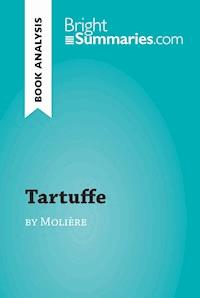
Unlock the more straightforward side of Tartuffe with this concise and insightful summary and analysis!
This engaging summary presents an analysis of
Tartuffe by Molière, which is the most performed classical play of all time. This work humorously tells the story of a religious hypocrite who worms his way into a naïve man’s good graces and ends up becoming a threat towards him. Upon its release, it caused great controversy with the many groups that were offended by the play, from upper-class French society members to the French Roman Catholic Church. Yet Molière justified his work and claimed it was simply a new approach to comedy that explored good and evil, right and wrong. To understand more about the controversy and to see why
Tartuffe is still so popular today, this is an unmissable read.
Find out everything you need to know about
Tartuffe in a fraction of the time!
This in-depth and informative reading guide brings you:
• A complete plot summary
• Character studies
• Key themes and symbols
• Questions for further reflection
Why choose BrightSummaries.com?
Available in print and digital format, our publications are designed to accompany you in your reading journey. The clear and concise style makes for easy understanding, providing the perfect opportunity to improve your literary knowledge in no time.
See the very best of literature in a whole new light with BrightSummaries.com!
Das E-Book können Sie in Legimi-Apps oder einer beliebigen App lesen, die das folgende Format unterstützen:
Seitenzahl: 21
Veröffentlichungsjahr: 2016
Ähnliche








Molière
French playwright, actor and stage manager
Born in Paris in 1622Died there in 1673 Notable works:Dom Juan (1665), comedyThe Miser (1668), comedyThe Bourgeois Gentleman (1670), comédie-balletAn author, director, stage manager and actor, Molière (whose real name was Jean-Baptiste Poquelin) was born in Paris in 1622 into the affluent bourgeoisie. Very early on he decided to pursue a career in the theater and founded, along with actress Madeleine Béjart, the Illustre Théâtre company. After twelve years of travelling theater in the provinces, he returned to Paris where he was noticed by Louis XIV who took him into his service.
He wrote mainly comedies in which, under the cover of humor, he highlighted the defects of his contemporaries (preciosity, pedantry, avarice, etc.) and criticized 17th century society (authoritarian fathers, religious hypocrisy, quack doctors, etc.). His many plays are still influential today, making Molière one of the most important authors of the classical century.
He died in Paris in 1673.
Tartuffe, or the Hypocrite
A comedy in the form of a tragedy
Genre: comedyReference edition: Molière (2005) Tartuffe. Stilwell: Digireads.com Publishing.First edition: 1664Themes: hypocrisy, clergy, devotees, marriage, education, morality, religionIn 1664, the devout Catholics had the first two versions of the play forbidden. The third version, Tartuffe, or the Hypocrite, was not allowed until 1669 and became tremendously successful (it was performed 77 times during the author’s lifetime and overall, more than 3000 times at the Comédie-Française, which makes it one of the most performed classical plays ever). This comedy tells the story of Orgon, a dignitary who has taken an absurd liking to Tartuffe, a false devout. Orgon offers his daughter’s hand to Tartuffe, while Tartuffe is trying to seduce Orgon’s wife. Trapped and unmasked, Tartuffe tries to chase Orgon from his home, taking advantage of the fact that Orgon gave him some of his goods and using some compromising documents he has in his possession.
Summary
Act I




