


3,99 €
Mehr erfahren.
- Herausgeber: Bastei Entertainment
- Kategorie: Krimi
- Serie: A Cosy Crime Mystery Series with Nathalie Ames
- Sprache: Englisch
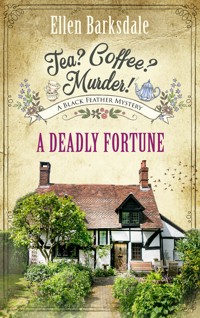
What is going on in old Mr Stevenson’s house? After his death, the remote cottage was bought at auction by a Bolivian man, Carlos Ramon Álvarez, for a dream price. And strange things have been happening there ever since. Nathalie and Louise are suspicious. They find out something astonishing: Álvarez and old Mr Stevenson knew each other. And Stevenson had more money than anyone ever imagined. Nathalie and Louise pull off a daring stunt to gain access to the cottage. But what they discover behind the façade of the picturesque country house are crimes, of which money laundering and arms smuggling are just the tip of the iceberg.
About the series: There was nothing in the will about this ...
Cottages, English roses and rolling hills: that’s Earlsraven. In the middle of it all: the "Black Feather”. Not only does young Nathalie Ames unexpectedly inherit this cosy inn from her aunt, she also falls heir to her aunt’s secret double life! She solved criminal cases together with her cook Louise, a former agent of the British Crown. And while Nathalie is still trying to warm up to the quirky villagers, she discovers that sleuthing runs in the family.
Das E-Book können Sie in Legimi-Apps oder einer beliebigen App lesen, die das folgende Format unterstützen:
Seitenzahl: 210
Veröffentlichungsjahr: 2024
Ähnliche




















Contents
Cover
Tea? Coffee? Murder! — The series
About this episode
Title
Prologue
Chapter One
Chapter Two
Chapter Three
Chapter Four
Chapter Five
Chapter Six
Chapter Seven
Chapter Eight
Chapter Nine
Chapter Ten
Epilogue
About the author
Next Episode
Copyright
Tea? Coffee? Murder! — The series
There was nothing about that in the will …
Cottages, English roses and gently rolling hills: that is Earlsraven. In the middle of it all: the “Black Feather”. Young Nathalie Ames unexpectedly inherits this cosy café from her aunt — and her aunt’s secret double life! Henrietta solved criminal cases together with her cook Louise, a former agent of the British Crown. And while Nathalie is still trying to warm up to the quirky villagers, she discovers that sleuthing runs in the family …
About this episode
What is going on in old Mr Stevenson’s house? After his death, the remote cottage was bought at auction by a Bolivian man, Carlos Ramon Álvarez, for a dream price. And strange things have been happening there ever since. Nathalie and Louise are suspicious. They find out something astonishing: Álvarez and old Mr Stevenson knew each other. And Stevenson had more money than anyone ever imagined. Nathalie and Louise pull off a daring stunt to gain access to the cottage. But what they discover behind the façade of the picturesque country house are crimes, of which money laundering and arms smuggling are just the tip of the iceberg.
Ellen Barksdale
A DEADLY FORTUNE
Prologue, in which it becomes clearthat it is better to look a gift horse in the mouth
Earlsraven 1988,on a rainy afternoon at the Stevensons’ house
“Yes … yes, I understand,” said Ron Stevenson. “Goodbye!” He hung up the phone and stood next to the sideboard for a while, his eyes fixed on the phone’s dial.
“Who was that, darling?” his wife Susan called out from the living room. Before he could answer, she said, “Wow, Steve Davis got the frame! Come on, Steve!”
“Uh-huh,” Ron said, without really listening, and went into the kitchen. He took a bottle of whisky out of the cupboard. He reached for a glass, poured it and took a big gulp to calm his nerves. It didn’t help. He had a second whisky. A soothing warmth spread through Ron’s body, and briefly counteracted the chill of the conversation.
For three years he had waited for this call. Dreaded it. Sometimes he had even managed to forget all about it — convince himself that the issue had long since been resolved.
Suddenly, everything was different.
See you tonight.
It had now become a reality.
He put the glass in the sink and returned to the living room to sit with his wife, who was still spellbound by the snooker. Only when he didn’t respond to her umpteenth comment about the game, did she turn to look at him.
“Is something wrong?” she asked. “Who called?”
“You don’t really want to know,” he mumbled, staring blankly at the green baize onscreen.
“Was that …?” she began.
Ron nodded weakly. They both knew all too well what was meant.
Sighing, Susan slumped backwards. “I told you from the start that we shouldn’t get involved.”
“After the fact,” he said. “You realised the catch just as late as I did. And now we have to live with it.”
Susan lowered her head onto the backrest. “Can’t we just …?”
“No, we can’t,” he said.
He knew what she had wanted to ask. They had gone over and over the subject at the beginning, until they couldn’t bear it any longer. “None of this exists in black and white. We can’t prove anything, but he could put us downstairs with whatever else is down there.” Ron shrugged his shoulders. “We simply have no other choice.”
“Well, then I guess we can only hope it doesn’t turn out that bad,” said Susan. “Or maybe we should expect the worst so that we’re pleasantly surprised when it doesn’t happen.”
“Yes, maybe we should do that,” said Ron.
At the same moment, thunderous cheers erupted on the television, as if people were applauding Susan and him for their decision. The opposite would have been the case if they had known the truth.
Chapter One, in which two unusually good offers are made
“Three … two … one … tah-dah!” shouted the troupe of artists in chorus. Then Belle Starr pulled the cloth from the façade. The sign Local Roots wasrevealed, which looked even better above the entrance of the country market than it had on paper. Like the drawing, which had been Belle’s design, the individual letters of the sign were formed from a network of roots, vines, tubers and leaves of all shapes and sizes. This gave the impression that the name had grown like a plant. Everything was now three-dimensional and there was something unique to see from every angle.
“Wow! You’ve really outdone yourselves!” said Nathalie and applauded enthusiastically.
Her friend Louise Cartham joined in the applause, as did Ronald Strutner, the constable responsible for the Earlsraven area. Also attending the unveiling that Thursday morning were forensic scientist Jean-Louis Talreja, sometimes known as J.L. for short, solicitor Martin Lazebnik, who’d moved to Earlsraven only a short while ago, and bookseller Paige Starling.
And shooting lots of photos for the Raven Times, was Akiel Williams, the young reporter of the recently resurrected local newspaper.
Belle, who had dyed her long hair moss green to match the occasion, bowed. Her artist colleagues also responded to the prolonged applause with bows and smiles.
Evan Joyce, a talented artist from this bohemian group, winked at Nathalie. His beaming smile was only for her. Nathalie was putting a lot of trust in this group of artists in running her new venture — a community supermarket — and none more so than the charming Evan, who seemed to have no end of skills and abilities. Kissing being one of them.
After the applause had died down, Akiel approached Nathalie for a quote. “Miss Ames, can you tell me when you’ll be opening?”
“I’d love to tell you, Akiel, but I don’t know yet. Our brilliant artists are working round the clock to complete the interior of the market. But there’s still a lot to do. You can be sure it’s going to look amazing though.”
“I bet local farmers are impatient for the work to finish and for the market to open,” said the young reporter. “What would you like to tell them?”
“Yes, there’s a lot of enthusiasm, which I’m thrilled about. Their involvement is crucial. It will be worth the wait, you know? We’re nearly there. And I’m excited to offer something positive to our farming community,” she replied.
“Thank you, Miss Ames,” he said. “I still have to interview the artists.”
“Okay. Thanks, Akiel,” she replied. “And I’ll want to advertise with the Raven Times when we finally get that opening date.”
She watched him as he approached Evan, who stood out from the group just as much as the green-haired Belle.
“So, is Akiel doing a good job?”
Nathalie turned to see Louise standing next to her — her cook at the Black Feather, and now, undoubtedly, her best friend. Louise’s short grey hair and striking features often reminded Nathalie of Judi Dench or Helen Mirren. The two comparisons were also apt for Louise for another reason, because the actresses had both played roles as spies — and Louise had actually worked for the intelligence service. Anything more on that subject was her secret. Perhaps Nathalie would find out more one day.
“Akiel’s doing great. I’m grateful for the coverage,” said Nathalie. “However, one crucial bit of information he can’t report on is our opening date.”
“I think there’s a lot of enthusiasm for this new venture of yours. Don’t worry too much. It’s coming together. But it might not hurt to put a bit of pressure on your artists to get a move on with the practical stuff.”
The cook turned round, noticing a Jaguar which, at that moment, was pulling up on the other side of the road.
The man who got out of the car looked as if he had money. A neat side-parting, glasses, clean-shaven, and a brightly coloured suit that looked two sizes too small, even though he was very slender.
“That shade of blue is very Smurf, don’t you think?” Louise muttered, glancing at the Jaguar driver, who was taking another briefcase out of the boot and looking around.
Nathalie gave him the side-eye. “Ooft. And I bet that suit was expensive as hell.”
“I bet. He’s looking this way. Looks like he wants to see you,” said Louise.
“Oh dear. Are you going to abandon me?”
“Well, Akiel is heading for the market, and I want to stop our eager young reporter from photographing the stalls before we’re good and ready to reveal everything.”
“Oh yes, good thinking! I’ll go with you …”
But she was interrupted by the man in the blue suit.
“Miss Ames?” he called out — loud enough that Nathalie could not claim to not have heard him.
She turned to face him. “Yes?”
“Frank Vaughn,” he said. “I negotiate commercial property sales for various clients.”
“I see.” Nathalie didn’t say any more, but she didn’t have to. Vaughn was not the type to wait for an invitation to talk.
“This is your project?” he asked.
“Yes, a country market,” she replied. “A supermarket only for products from farms and small businesses in the region. Nothing imported, nothing genetically modified, nothing from factory farming.”
Vaughn nodded appreciatively. “Well, I admire your entrepreneurial spirit, Miss Ames, I’ll be honest about that. But I have to tell you, just as openly and honestly, that I wouldn’t invest a penny in your idea.”
“Okay,” she replied in a tone that made it clear that she wasn’t interested in his opinion.
“Such a supermarket has no future.”
“Uh-huh,” she said. One more insult and she’d send the guy packing.
“But it’s your lucky day, because with what I’m proposing, not only will you save money, you’ll also make a lot of money.”
“If you hadn’t already introduced yourself, I’d ask you if you were from the National Lottery,” she replied.
Vaughn smiled, but it was only a pretence of politeness. “You see, Miss Ames, my client is offering you double the amount you invested in the building, the land and the remodelling. Plus, five thousand pounds for the transfer of all rights to the name ‘Local Roots’.”
“Why?”
“Because my client thinks and acts globally.”
“What? He wants to open branches worldwide?”
“Unfortunately, I can’t tell you about my client’s plans because I don’t know them myself. But if I did know, I would be sworn to secrecy.”
“So it’s also possible that he’s just buying the name from me to chuck it in a drawer and forget about it?”
“I can’t deny it’s possible, Miss Ames,” Vaughn said with a shrug.
“Then I can be grateful that I also own the land and that your client has no way of driving me out.”
Vaughn thought about it for a moment, then raised an eyebrow. “Does that mean you’re refusing the offer?”
“Very perceptive, Mr Vaughn. I can see why they pay you the big bucks,” she said. “I’m refusing the offer.”
He looked at her for a moment, then nodded. “Very well, Miss Ames. Three times the amount and fifteen thousand pounds for the name.”
Nathalie had already turned away from him when he said that. She turned back. “What was that?”
Vaughn seemed to miss that her tone did not indicate awakened interest, but annoyance at not being taken seriously.
“My respect, Miss Ames,” he continued. “You realised immediately that this was only an initial offer. Many others would have jumped in immediately.”
“I declined because I’m not interested,” she said, “not because I want to haggle with you. I’m not selling!”
“But—”
“Come back in ten years, when I’ve opened branches all over the country,” she said. “Then we’ll see if your client has enough money to take them all over.”
Vaughn shook his head. “I … I don’t understand.”
“I’m not interested. That’s all. I assume your client was convinced that I would sell. I’m sorry to disappoint you.”
He scratched his head. “All right, then. I didn’t expect this, Miss Ames. Keep my card anyway, perhaps you’ll come to a different conclusion when you’ve slept on it. Goodbye.”
“Goodbye, Mr Vaughn!” she replied, watching him as he walked, visibly dejected, to his car, got in and drove off.
“Didn’t you say you wanted to come with us, Nathalie?” shouted Louise, who had just walked around the corner of the supermarket and brought the reporter with her. He looked embarrassed. Apparently, Louise had caught him trying to sneak into the shop. “And where did the slim guy in the Smurf suit go?”
“He left after I made it clear to him that I didn’t want to sell my country market,” Nathalie replied.
“What do you want to sell?” asked the constable, who had just joined them.
“I don’t want to sell anything, Ronald.” She handed him Vaughn’s business card. “Can you do a background check on this bloke? He’s offered me several hundred thousand pounds more than I paid if I let his client have my property and the rights to the name ‘Local Roots’.”
“Hmm, I wouldn’t be surprised if our dear Sir Alfred Battersfield is behind this,” Ronald replied, and put the business card in the breast pocket of his uniform jacket.
“Agreed,” said Louise. “We knew this would get his attention. If he wants to buy the market from you this badly, then he must be very sure that he’ll get the green light for this ‘Raven’s Gate’ project.”
Raven’s Gate was a luxury residential neighbourhood planned near Earlsraven on the site of a disused airport. In order to clear space for the properties, surrounding woodland areas would have to be destroyed, but these were home to numerous protected species. A study that Nathalie and Louise came across proved this, but hardly anyone knew about it because its distribution had been suppressed. The investigation had come to the attention of investigative reporter Ewan Forrester, who shortly afterwards fell victim to a contract killer. During the search for Forrester’s murderer, they had discovered a connection between the killer and local politician Sir Alfred Battersfield. It wasn’t enough to use as evidence that the politician had commissioned the murder, but it was their strong suspicion that this was the case.
Battersfield would reap a big profit if Raven’s Gate became a reality. Nathalie’s market stood in the way of the planned access road. Any alternative route would mean a considerable diversion for the future residents of Raven’s Gate, which would put a damper on the attractiveness of this supposedly luxury neighbourhood.
“Fortunately, we still have some time before the idea is presented,” said Ronald. “And even then, we’ll only be voting on a declaration of intent to have Raven’s Gate in the first place. By then, we should have enough solid evidence against Sir Alfred to put an end to his career as a politician.”
“I admire your confidence,” Louise said, a little sceptically.
“We can still spread the word about the suppressed study,” said Nathalie. “Even if we can’t find any evidence that Battersfield is the one who buried it, its appearance should still cause a stir.”
“Right,” said the constable. “And now that we have a local paper again, we can be sure that we’ll make it onto the front page, not on page twenty just below the obituaries.”
Nathalie looked round and spotted the reporter sitting on his Vespa and putting on his crash helmet. As he looked around to see if the road was clear, he noticed Nathalie, waved to her, and drove off, probably to write his next article on ‘Local Roots’ in the still very small and spartanly furnished editorial office of the Raven Times.
She waved back.
“What’s this? You flirting with younger men?”
Nathalie turned round and saw Evan.
“Every chance I get,” she said.
“Fair enough,” said Evan, laughing. “Keeping on the right side of the Press.”
He smoothed out his black T-shirt, which was covered in all kinds of paint splashes, and reached for the overalls he had thrown over the old bicycle stand in front of the entrance of the market.
“Does no harm to have a contact at the local paper.”
“I have to admit,” said Evan, “he wrote a pretty good article about our work in the theatre.”
“Will I see you later?”
Evan shook his head. “We want to finish your market, and that means all we do right now is work and sleep. And occasionally eat, if someone brings us a snack. Hint, hint.” He smiled tenderly at her.
“You’re all perfectionists,” she said. “It’s a blessing and a curse.”
“And this perfectionist thinks you, madam, are perfect,” he replied pulling Nathalie towards him. She had to tilt her head back to look at his face.
Nathalie stood on tiptoe, gave him a quick kiss on the lips, and then wiggled free in a playful way. “That’s your lot, pal. Until you finish my market.”
“Most unfair. Who do I speak to in HR?” he said.
“Me, unfortunately.”
“Okay, I’ll be making an appointment with you when this is all over. HR meeting with a bottle of red wine and a curry?”
“It’s a date. Now get in there and sort that shelving out.”
“Where are you off to now?”
“I’m going with Louise to the auctioneers,” Nathalie replied. “Old Stevenson’s house is going up today. Louise doesn’t want to miss it and I said I’d go with her.”
“Ooh, I love an auction. Have fun. But please don’t buy any more buildings that you’ll need me to renovate.”
*
When they reached the auctioneers shortly before half-past twelve, between thirty and forty people had already gathered there.
“Didn’t Stevenson have any relatives?” asked Nathalie as she got out of her car.
“His wife divorced him years ago. They didn’t have any children, and apparently no other relative can be traced. So, when he died, the property went back to the bank.”
“I can’t wait to see what happens, I’ve never been to a property auction.”
From the picture in the catalogue, it could be seen that the house was surrounded by a high wall. The driveway was set back a little in front of a large metal gate. And there was a big garden being suffocated by ivy and other wild growth.
“So, what’s the story with this place. Why are you interested?” Nathalie asked Louise. “You going to bid?”
“There’s a lot of interest in this house. And it has a history. I’ve heard things on my grapevine that Stevenson wasn’t as boring as he appeared, but I have no details. I want to see who’s interested in it and who eventually buys it.”
A swinging door opened and a rotund man with thinning hair and a beard strode in. He was wearing a loose-fitting suit that was failing to conceal a pot belly.
As he took to the stand, gavel in hand, there was a loud noise from the back of the hall as the door slammed shut.
The latecomer took off a bike helmet to reveal Akiel Williams from the Raven Times.
“Someone has made quite the entrance,” Louise remarked with amusement.
Nathalie laughed. “Investigative reporters are usually a bit more stealthy than that.”
“I wonder if Akiel is here for the same reason as me?” said Louise.
“I wish you’d spill the beans, Louise.”
“I wish I knew more to tell you, my dear. I’m being nosy, more than anything.”
Akiel walked to the front of the hall, had a few words with the auctioneer and then took up a position where he could take photos and make notes.
The auctioneer was talking to a few interested parties, but so quietly that Nathalie couldn’t hear anything.
There were six properties for auction in the catalogue, and the Stevenson house was the final lot that day.
Nathalie found the atmosphere quite exciting as bids flew fast and furiously and the auctioneer exhibited an energy that belied his portly figure.
“All done at eighty thousand?” He smacked his gavel on the podium. “Sold!”
The next few lots flew by quicker than Nathalie had anticipated, with phone bidders and internet bids in the mix too.
The auctioneer raised his voice and announced lot six. “A solid two-storey property built in the 1950s, in need of much modernisation but with a decent home report. There is a reserve today, so if the minimum bid is not reached, it is at the bank’s discretion whether to accept the highest bid or to organise a new auction. Can we start at ten thousand pounds? Do I hear ten thousand? Fifteen? Twenty. Twenty-five …”
Despite Nathalie’s best efforts to keep up, the auctioneer rattled off sums at a speed she couldn’t cope with. At the same time, his index finger kept twitching back and forth between five interested parties, who each indicated, with a minuscule hand signal or a tiny nod, that they wanted to add another five thousand pounds to the current bid. The sums came over the auctioneer’s lips in a wild staccato. At one point Nathalie thought she heard “three hundred thousand”, but that might have been a mistake. She looked at Louise, who immediately shook her head.
“I have no idea how he does it and how the bidders know how much he’s doing,” said Louise. “I’m waiting for the slow-motion replay.”
Nathalie had to smile. Then she saw one of the bidders give up. A second bidder also withdrew, but, even with only three people still in the game, Nathalie couldn’t make out who had placed which bid.
Suddenly, two bidders shook their heads and the auctioneer shouted while pointing at the third man: “Four hundred and twenty-five thousand going once. Four hundred and twenty-five thousand going—”
Someone burst into the room. The noise silenced the auctioneer in mid-sentence.
“Stop!”
A man with jet-black hair, bushy black moustache and dark complexion leapt onto a vacant chair at the back of the room. Then he called out with a clear Spanish accent: “I’ll outbid any bid by fifty thousand pounds. Any bid!”
Chapter Two, in which doubts are expressed about a man’s intentions
A murmur went through the crowd and everyone stared at the man.
When he got down from the chair, he turned out to be quite small.
He walked up to the auctioneer and held out his hand. “You must be Mr Gower, right?”
“Yes. Who are you?”
“Carlos Ramon Álvarez,” he announced. “The new owner of this little gem … in a few minutes. This is an open auction, isn’t it? Where anyone can bid — not just invited bidders, right?”
“Yes, that’s right,” Gower confirmed, a little irritated. “But it’s advised that bidders should be present from the start. You also didn’t take part in the inspection tour and don’t know anything about the condition of the building.”
“But it’s not a mandatory requirement, is it?” said Álvarez.
“No.”
“Then my bid stands,” concluded the man.
The auctioneer nodded, but the smartly dressed man, who was only a few syllables away from winning the bid, spoke up indignantly.
“Wait a minute! We were bidding in increments of five thousand.”
Álvarez looked at the man calmly. “I’m just trying to save us time.”
“And how do you know I won’t offer more than you?” said the other.
“He must not have listened carefully to Álvarez’s performance,” Louise whispered to Nathalie, who was watching this unexpected spectacle with fascination.
“Or he doesn’t believe him,” said Nathalie.
“You’re free to offer more, Mr Stark,” interjected Gower, who wanted to prevent an argument between the two men.
“I’ll do that,” said Stark. “Where were we?”
“Four hundred and twenty-five thousand, plus Mr Álvarez’s fifty thousand, so, four hundred and seventy-five thousand.”
Stark nodded. “Four-eighty.”
“Four-eighty,” Gower began. “Do I hear four-ninety?” Despite his fast pace of speech, Álvarez beat him to it.
“Five hundred and thirty thousand.”
Stark shrugged his shoulders as if none of this could touch him. “Five hundred and …” He pressed his lips together and widened his eyes in shock. He looked at Álvarez in disbelief. “Did you really bid five hundred and thirty thousand?” he asked.
Álvarez nodded. “I told you I’d raise every bid by fifty thousand.”
“I’m bid five hundred and thirty thousand,” said the auctioneer. “Please don’t make any agreements between yourselves, gentlemen.” When the two turned to him, he repeated his question: “Any advance on five hundred and thirty thousand?”
Sighing, Stark shook his head. The two other bidders also withdrew.
“Sold! To Mr Álvarez for five hundred and thirty thousand pounds.” The auctioneer turned to Álvarez. “The amount is payable in full today. Please see our cashier.”
“Of course,” he replied, smiling brightly, then had his driver hand him a cheque book.




