


0,00 €
Mehr erfahren.
- Herausgeber: D.L. Lang
- Kategorie: Poesie und Drama
- Sprache: Englisch
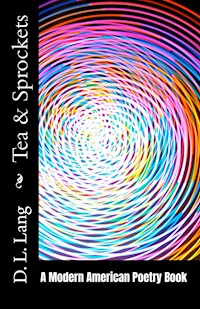
Tea & Sprockets: A Modern American Poetry Book is the debut poetry collection by modern American poet D.L. Lang. This 150 page single author anthology spans 15 years of work encompassing poems from 1995 to 2010. Across the 106 selected poems, Lang weaves together themes of love and friendship, death and loss, war and peace.
Das E-Book können Sie in Legimi-Apps oder einer beliebigen App lesen, die das folgende Format unterstützen:
Veröffentlichungsjahr: 2021
Ähnliche











Tea & Sprockets
D.L. Lang
Copyright © 2011, 2017 Diana L. Lang
All rights reserved. No part of this publication may be reproduced, distributed, or transmitted in any form or by any means, including photocopying, recording, or other electronic or mechanical methods, without the prior written permission of the publisher, except in the case of brief quotations embodied in critical reviews and certain other noncommercial uses permitted by copyright law. For permission requests, write to the author at the email address below:
poetryebook.com
Table of Contents
Copyright Page
Foreword & Preface
Where?
The War
[the monologue?]
Unexnon
Unbalanced Versifier
Tunnel
Tranquoizier
Words to Say
Time
I Won't
Why?
Surf Clown
Stepping Stone
Smile
Short
Sheep
Shaft
Salad
Rumours
Rows
Rood
Roman Clock
Ridin’
Revolve
Return
Restlessness
Real
The Race
Quest of Questions
Quartered
Puppet Masters
Priority
Perceptions
Pense For Pence
Naive Observations of a Situational Pacifist
The Outsider
Wishing For the Old Times
Now, Never, And Whenever
Not Today
Nothing to Do With Me
Nosirrom Te Nampa[H]Ch
No More Sanity
Memoimich
Misunderstood Word Smith
Midnight Sunset
Meop Koobeton
Fountain (1935)
Last Chance Disaster
Anger
1:13 AM
Back, But Forth
Do I Know?
Drowning
Earth Vanish
Eluded Illusions Of The Delusional Diluted Disillusionment
Exist
Focused
When It All Goes Away
Good
Goodbye
Wind In The Grass
Haze
Intrigued
Itisismolationology
Learned
Synthetic Lies
Life Live
Lost
Seemingly
The Rest Seven
Dead End Heroes of Age
The Experience Of Technical Difficulties
Life Cubed
The Vacuum
925
The Rat Race
Universal Youth
Nail Clipper
Chameleon
Hallucination Office Supply
The Youth
Silenced
The Wordsmith's Disease
Earth
When The Clouds Were Crying
Notice
Rough Draft
Rainy Day
My My
Poetry
Scum
Unspoken Message
Believe and Receive
I Am Amatalia
Pedal The Bicycle On
The Empty Soul
Blinded From Speech
Blinding Light
Blue Zone
Bright Ideas
Yahrzeit
Your Wonder
180°
My Reflection
Wondering Where We're Wandering
L'Adonai
About the Author
Tea & Sprockets
To fully know me now, one must know something of my past.
To know something of my past is to open the door
into wounds and treasures.
To not open that door is to be left in a cloud of mystery.
To know oneself is the greater treasure
than to know all others.
To achieve this sense of knowing oneself takes a lifetime.
To take a lifetime and not know others is a shame.
Such is the beauty of knowing others
that one forgets to know oneself.
Such mystery in one's own life makes it hard
to write about oneself.
Such is my own case and so I change
in every aspect as I continue in life.
Such poetic nonsense in which I babble to you
now is one aspect of me.
Such form makes you believe that I am a writer,
and I mark you correct.
Such an assumption I should say
does not make me a good writer.
It is for you to judge if I am a good writer.
It is something that cannot be decided by the poet himself.
It is not my place to be caught up in judging my own work.
It is something, which happens before each word is written.
It is a natural process for me to write my soul on a page.
It changes, however, every day, and the words have flexible meanings.
Take this as you wish to take it.
Take it in jest or in pure seriousness.
Take it in its purest simplistic nature.
Take the time to see what you can learn from me.
Take the time to notice that I do not intend to teach.
Take this however you wish to take it, but lightly.
Foreword
I am a poet. It is something ingrained in my soul. In this age of the Internet where wisdom is a freely flowing fountain, I know that one may not see the value in paying for a poetry book by an unknown poet when one can obtain fairly easily the works of the great masters.
By purchasing my books, you support an indie poet; you give life to the words that echoed throughout my soul until they found their way into the hundreds of poems that comprise my books. You breathe life and new meaning into these poems. It is my life’s work, and I am grateful to each one of you for reading.
Is poetry fiction, or is it non-fiction? In my case, it is a bit of both. And so I invite you into a journey of imagination and perceptions of reality, of life, of love, of loss, and of your own creation. These poems mean what you understand them to mean, and that is the beauty of poetry!
It was always a dream of mine to publish a poetry book. I’ve been writing poetry since I was 11 years old. The oldest poems in this book are "Surf Clown" and "The Outsider." Most of the poetry before age 13 is lost.
The title refers to my writing process. I am an avid tea drinker. If you drink a cup of hot tea, you are forced to slow down and appreciate the tea. It is almost a meditative process. Poetry can have a similar contemplative quality about it, but then there’s the sprockets: the every day routine where your mind is constantly churning and the world is constantly turning. You can read poetry in this way as well translated into music or film there is a speedy quality. When I write sometimes the poetry is a direct flowing of my soul so fast that my pen cannot keep up: that is the sprockets. Other times, this is the result of meditation on a theme or word–there’s your tea.
To me, poetry is a coping mechanism, spiritual journey, humorous observation, and linguistic exploration, but what it truly is: my soul on a page. The mystery of poetry is that the reader never truly knows what the writer was thinking, so it takes on a meaning of its own to each person who reads it and relates, or not, to it. It's your poetry now. You'll find poems you love, some that just fall flat, and maybe some you hate, and it's all okay.
Preface
What can I say about Tea & Sprockets? This book has been through several incarnations, containing the largely uncensored thoughts of an adolescent poet between the ages of 12 and 25, skewing more towards the teenager side than the 20-something.
In 1994 I was sitting in my Enid, Oklahoma bedroom reading Moses Horowitz's book, Moe Howard and the Three Stooges, absorbing all of his vaudevillian and slapstick memories, when I came across a passage about his decision to start acting at age 11.
Imagine that! I too, was 11 years old! What did I want to be? I wanted to be a writer. Sure, I also wanted to be a cartoonist and an actress, but I knew that I loved to write. I started out writing elaborate fan fiction stories using members of my favorite bands or favorite comedy troupes as characters across various time periods. I also toyed with writing a western and a young adult novel.
The only poem in this book from age 11 is “Surf Clown,” which came to me at Champlin Pool in Enid while my friends and I were using the floatation devices floating as underwater surfboards. It was inspired by my love of '60s surfer music and came to me in a form that can only be described as a surf rap song. I recall a teacher writing on a copy of the poem, "Brian Wilson would be proud!"
When I was 14, our 1992 DOS computer decided to implode, and I learned a valuable lesson—always back up your writing! This sparked a desire to preserve my writing for posterity, publishing poetry collections for myself above all, regardless of sales.
Due to the rap format, I had memorized “Surf Clown,” and following the computer crash, was able to rewrite it quite easily. At age 26 I tried to attempt this sort of surfing again, and got in trouble with the life guards at the local JCC, as the board kept popping up above the water, leading to a couple near misses with swimmers’ heads!
"The Outsider" is one of my favorite poems from this period. I decided to take pride in my not fitting in with this poem. It is thanks to my 7th grade science teacher that I even have a copy. She had loved the poem so much that she asked for a copy, so I wrote to her when my computer crashed years later. I was sitting in 10th grade French class, when I received a paper copy, for which I am grateful.
By 13 I had further developed a penchant for ‘60s music, and my thinking was forever altered by the introduction of the surrealist and pacifist-leaning lyrics of the 1960s, sparking my own creative renaissance at 13, so for all the pre-teen poetry that was lost, it did not take long to generate more.
As with most teenagers, especially ones who face bullying and suffer from low self-esteem as I did, my poetry at the time expresses a lot of angst. I find many of these poems to be a painful read 20 years later. I might not have ever published many of the sad poems within this volume if this now 30-something poet was the original editor, yet I leave them here to honor who I was at the time, for it was my struggles that formed the foundations of the person I am today, leaving me with a greater sense of gratitude for just how far I've come.
When I make references to insanity, I am merely referring to the emotional rollercoaster I was riding due to life events that were out of my control. Despite being bullied, I did not wish to inflict harm on others, so I rarely verbally stood up for myself or defended myself physically. Poetry was often my only outlet for these feelings. I wrote numerous poems to cheer myself up or process events. I continued this practice long after the bullying subsided.
At age 17, I wrote my own autobiography, a fascinating relic that speaks volumes of my own personal psychology at the time. That manuscript is likely to remain unpublished, yet the foreword to it is the "know something of my past" text that appears at the beginning of Tea & Sprockets.
"Last Chance Disaster" came to me as a song in 2004 with an entirely different melody than the song that was later produced by my musician friends, Jon, Grey, and Mikey in 2011. The poems "Perceptions," "My My," "Chameleon," and "Unexnon" later became the lyrics to Grey's song, "Oh, My Chameleon Perceptions."
"The Rest Seven" was written extremely fast in July of 2005 as a sort of a stream of consciousness experiment. It was a linguistic flood similar to how [The Monologue] came to me as a teenager. "The War" was my teenage understanding of how every human has the capacity for both good and evil, and it remains one of my favorite poems.
After teaching myself how to make websites in 1997 at age 14, I began hand coding each poem with HTML, one poem per page for publication on my personal website. By the time I was in college, after having lost more poems due to several computer crashes, website deletions, and the extinction of my zip drive, I decided I needed to keep my poems in a traditional format.
In 2004, I was sitting in the library at the University of Oklahoma, where my latest creative detour had taken me to study film. I was waiting for a classmate to study with when I decided to self-publish for the first time using a print on demand feature offered by Cafepress. For the next nine years, I printed several copies for friends and sold none. My first publication of a Tea & Sprockets eBook was uploaded on October 10, 2009.
Prior to 2011 the book was an ongoing work in progress with various poems being included or cut. Having worked several years post-college as a word processor, I knew just enough tricks to make a professional looking paperback. The previous edition in 2004 had no TOC, for example. I decided to finalize it, publishing the paperback formally with an ISBN on October 31st, 2011, and shortly thereafter distributing the eBook on several different platforms. There are no additional poems between the 2011 and later versions, although since 2013 the order is slightly different.
Having gone through several different career paths only to have them ultimately become dead ends, I returned to my first love in 2013. The paperback editions of my book were called Tea & Sprockets: Poetic Nonsense. For the 2013 eBook edition, I changed the title to Tea & Sprockets: A Modern American Poetry Book. For about two months early that year, I began promoting my book online for a couple hours after work, which resulted in giving away many free eBooks, garnering several positive customer reviews.
––––––––
I unpublished my eBooks in 2015 due to the extensive formatting needed for poetry proving difficult with my sore hands, which by then had been worn out from years of the data entry that had kept me financially afloat while my creative endeavors had not.
It is due to these many different revisions that I cannot easily say which edition number this 2017 re-edit actually is. If I had to guess, I'd say it's the 6th paperback version of these poems to have ever been in print.
At the time that I wrote "Earth," I was in my early twenties, and although I had some left of liberal leanings, I was not as educated on the topics I was attempting to address. Therefore, I'd like to apologize for the line about colorblindness, as at that time I was under the impression that that was the anti-racist stance. It was a twenty-something's attempt at speaking out when she didn't yet have the language to do so.
The point I was trying to make was that if on the verge of apocalypse, we were granted a second chance, would we then finally choose to treat each other with kindness? Although I've chosen to edit this line in the 2017 version of the book, the original remains on my album and in previous printings, so I felt it necessary to address that edit here.
What else is different about this edition? I have since written eight other poetry books, and over time, my style has changed in that I no longer use the traditional approach of first letter capitalization, and I add more spacing in my stanzas.
In addition, despite so many printings, due to other life obligations, most of the poems had rarely been edited since their first drafts, and the teenage poet who wrote them thought every line, regardless of grammar needed a comma at the end as well as mid-sentence first letter capitalization.
Given that I now perform many of my poems to an audience, I find this all a bit jarring to read, so I decided that an update in formatting to this book was needed in order to be consistent with later works.
D.L. Lang
2017
Where?
Running from the past,
yet holding on.
Hoping it would last,
but fleeing gone.
Cannot take the failure.
Haven't had much success.
Thinking that you're sure,
while hoping for the best.
When will it all end?
It's all in the mind, y'know.
Looking for a good friend,
but where to search or go?




