


9,28 €
Mehr erfahren.
- Herausgeber: Proisle Publishing Services
- Kategorie: Religion und Spiritualität
- Sprache: Englisch
Before Vatican II Catholic faith and practice were strong, rooted in the Gospels, their authenticity and sequence affirmed by Irenaeus. He was taught by Polycarp who was martyred rather than deny what he had learned about Christ from the apostles, in particular John. (Adv. Haer. III, I, 1).
Since Vatican II, however, Catholic seminaries and universities have promoted an ahistorical “Markan Priority” theory that, at this writing, indefensibly deems it “untenable” that apostle Matthew wrote The Gospel according to Matthew and reduces all four Gospels to probable unwitnessed hearsay: usccb.org/bible/matthew/0, mark/0, luke/0, john/0, last paragraphs — uncertainty that may explain why few homilies now include the “hard sayings” of Jesus upon which salvation may well depend.
The key claim of this theory is that because “You are Peter …” (Mt 16:18-19) is not in Mark (8:27-30), Jesus never gave primacy to Peter. But Irenaeus wrote, “Mark, the disciple and interpreter of Peter, did also hand down to us in writing what had been preached by Peter.” (Adv. Haer. III, I, 1). With Nero’s agents listening, Peter would not have ended his ministry by proclaiming a “kingdom” to which he held the Keys.
Sie lesen das E-Book in den Legimi-Apps auf:
Seitenzahl: 2
Veröffentlichungsjahr: 2022
Ähnliche






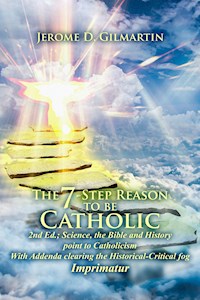
The 7-Step Reason to be Catholic
2nd Ed.: Science, the Bible and History point to Catholicism with Addenda clearing the Historical-Critical Fog Imprimatur
An Important Supplement to Catholic teaching in:
Catholic universities
Home Schooling
Catechesis
Bible study
Evangelization
High schools Campus ministry RCIA
Apologetics Prison ministry
The 7-Step Reason to be Catholic, 2nd Ed.: Science, the Bible
and History point to Catholicism.
With Addenda clearing the Historical-Critical Fog
Copyright © 1998, 2001, 2008, 2022 by Jerome D. Gilmartin.
All rights reserved.
Digital/e-book ISBN: 978-1-959449-57-7
Paperback ISBN: 979-8-9868665-3-6 Except as noted below, no part of this book may be reproduced, stored in a retrieval system, or transmitted by any means, electronic, mechanical, photocopying, recording, or other, without the written permission of the copyright owner.
Summaries and Wallet Outlines may be reproduced in their entirety only, with attribution.
Scripture is taken from the HOLY BIBLE, NEW INTERNATIONAL VERSION®. Copyright © 1973, 1978, 1984 International Bible Society. Used by permission of Zondervan. All rights reserved.
With the passage of time, footnoted Web sites may change or become inoperative. If this occurs, the information can generally be found by entering keywords in Google or another search engine.
Imprimatur: + Most Reverend Joseph F. Martino, D.D., Hist. E.D.
Bishop of Scranton, October 29, 2007
Nihil Obstat: Father Charles P. Connor, Censor Librorum
October 22, 2007
The Nihil Obstat and Imprimatur are official declarations that a book or pamphlet is free of doctrinal or moral error. No implication is contained therein that those who have granted the Nihil Obstat or Imprimatur agree with the contents, claims, opinions, or statements expressed. The Nihil Obstat and Imprimatur given to this book do not extend to the books noted in the bibliography, Internet Web sites, the non-English text of this book, or the Addenda, which have not been reviewed for these purposes.
The views expressed in this work are solely those of the author and do not necessarily reflect the views of the publisher, and the publisher disclaims any responsibility for them.
To order additional copies of this book, contact:
Proisle Publishing Services LLC 1177 6th Ave 5th Floor
New York, NY 10036, USA Phone: (+1 347-922-3779)
info@proislepublishing. com
“Follow the argument wherever it leads”
Socrates, from Plato’s The Republic, ca 400 B.C.
“Go therefore and make disciples of all nations, baptizing them in the name of the Father, and of the Son, and of the Holy Spirit, teaching them to observe all that I have commanded you”
Jesus Christ, risen; from Matthew.
Chapter 28, verses 19-20.
ca A.D. 33
“Always be prepared to make a defense to anyone who calls you to account for the hope that is in you, yet do it with gentleness
and reverence”
Peter; from his first letter, Chapter 3, verse 15.
ca A.D. 60
“In ecumenical work, Catholics must assuredly be concerned for their separated brethren, praying for them, keeping them informed about the Church, making the first approaches toward them.”
Vatican II; Decree on Ecumenism - Unitatis Redintegratio -
Document 32, Chapter I, Section 4.
November 21, 1964
“To invite all people in the United States, whatever their social or cultural background, to hear the message of salvation in Jesus Christ so they may come to join us in the fullness of the Catholic faith.”
Goal 2 of the statement of the United States Conference of Catholic Bishops Secretariat for Evangelization.
June 3, 2003
“Jesus’ mission concerns all humanityThe Church must never be
satisfied with the ranks of those whom she has reached at a certain point or say that others are fine as they are”
Pope Benedict XVI - Ordination Homily, St. Peter’s Basilica
© 2006, Libreria Editrice Vaticana [adapted].
May 10, 2005
“I know that most men, including those at ease with problems of the greatest complexity, can seldom accept even the simplest and most obvious truth if it be such as would oblige them to admit the falsity of conclusions which they have delighted in explaining to colleagues, which they have proudly taught to others, and which they have woven, thread by thread, into the fabric of their lives.”
Leo Tolstoy (1828 - 1910)
Dedication / Acknowledgments
This book is dedicated to our daughter Ann, who said:
Dad, you just can 7 say that Jesus is any more important than any of the other founders of the great religions.
Ann (who again attends Mass and graciously gave her permission for this quotation) was then in a graduate anthropology program at a state university, having had eleven years of education in Catholic schools. The book is also dedicated to our daughter Joan, who, like her sister and most of their generation, came under the influence of many who saw the Gospels as largely myth and legend and doubted the existence of God.
My hope and prayer is that this book will help them, their fine husbands, our grandchildren Shannon and Charlotte, and many others gain a new appreciation of the science-based case for an intelligently designed universe, the historical truth of the Gospels, the uncontested fact that Jesus is unique among all founders of a religion; and that Jesus personally founded one Church that, through the Apostles, he promised to be with always.
Lastly, I dedicate this book to our daughters Johanna and Mary, who went to heaven soon after their premature birth and Baptism.
During the twelve years since I began writing what has become The 7-Step Reason to be Catholic, 2nd Ed., I have received encouragement from many people.
First I would like to thank Dr. Scott Hahn for taking the time to read my first book-length effort. Scott, your words of encouragement at that time were invaluable. My thanks also to Fr. Benedict J. Groeschel, C.F.R., who took the time to suggest publishers for the book. A special thanks to you, Fr. Benedict, for taking time out of your busy schedule to write the brief section in the Introduction alluding to Newman, Aquinas, and our need to fall silent before the Lord.
My thanks to you, Jeff Ziegler, for your kind letter indicating that you found the first edition of this book “extraordinarily well reasoned.”
To you, Professor Charles E. Rice, Esq. of the University of Notre Dame Law School, a particular word of thanks for your candor in calling one of my earlier literary efforts a non-starter. That disapproval made it all the more meaningful when you later said of the first edition of 7-Step Reason, “You’re on the right track with this one” and gave me permission to distribute a summary of it at two conferences at which you were speaking.
My thanks to you, Rev. Msgr. David Bohr, S.T.D., for your construc tive comments on the first edition of this book as Censor Librorum.
I am especially grateful to you, Fr. Edward B. Connolly, pastor of St. Joseph Parish, Pottsville, and St. Francis de Sales Parish Mt. Carbon, PA, for your continuing encouragement and for your recom mendations at several key points in the development of both editions of the book. I am also most grateful to you, Jorge A. Topete, Ph.D., for translating into Spanish the first edition of 7-Step Reason, as well as the Wallet Outline and Summary. Thanks also to you, Carol Ridenour (Mrs. Jorge) Topete, for assisting in that daunting task. Thanks to Edward J. Capestany, Ph.D., for reviewing this book.
Thanks to you as well, Sr. M. Franchise De Smet, MC, for the initial translation of the Summary into French; your work is much appreciated.
A special word of thanks to you, Marie-Christine Ceruti-Cendrier, author of Les Evangiles sont des reportages n 'en deplaise a certains - The Gospels are the work of Reporters; too bad if that upsets some people (French; translation into English planned). Although you helped from afar (Minsk, Belarus; Lugano, Switzerland; Rome and Lusaka, Zambia), you provided very important information on the compelling evidence that the Gospels originated with “reporters” and translated the modification of the French Summary and Wallet Outline of The 7-Step Reason to be Catholic, 2nd Ed.
And my very special thanks to you, Fr. H. Vernon Sattler, C.S.S.R. You were one of the first to read my work, and your suggestions were invaluable until that day, not so long ago, when God took you from this earthly life.
To you, Most Reverend John M. Dougherty, Auxiliary Bishop of Scranton, my heartfelt thanks. With a true understanding of my primary reason for writing, you encouraged me to seek the Imprimatur. For your support and that of Bishop Timlin and Bishop Martino I will be forever grateful.
A special word of thanks to Christopher Wong, who developed The Catholic Apologist's Scriptural Response Guide and allowed me to include it as an Appendix to this book. Thanks to your comprehensive Guide, Chris, readers can readily appreciate the sound biblical basis for Catholic teaching.
My thanks also to the late Patrick Ferraro, M.D., to Dean Clerico, M.D., and to Kenneth Pondo, fellow members of the Apologetics Committee of the Diocese of Scranton during the years it was active; to Frank Morriss, John W. Blewett and Karen Pautler of The Wanderer Forum; to Joseph and Margaret Dillenburg, who so ably represent Catholics United for the Faith and Lighthouse Catholic Media in
n
Scranton; to Fr. Luke Anderson, O. Cist.; to Gerry Wargo for his many insights into alternative views of Christian history; to Frank J. Germain, Deacon John Pogash, Alix Fils-Aime, Deacon and Attorney Sam Jennings, Deacon Glenn Biagi, James Scoblick, Joseph Alinoski, Raymond Totten, Attorney Ann Miller, Web consultant Michael D. Austin and the many others whose thoughts and prayers helped to make 7-Step Reason a reality. I am also grateful to a number of people of other faiths and of no particular faith, whose critiques of the original 7- Step Reason and this second edition have done much to ensure that the book does not misrepresent their beliefs. Though some of my Protestant, Muslim, Wiccan, Atheist and other contacts may prefer to remain anonymous, I am nonetheless in their debt.
A special word of thanks to you, John McGrath, for your critical
review of Step 1. As a biology educator/administrator - and one of that select group of contributors to the New York State Core Curriculum on the Living Environment - your recommendations were of particular value. Question 1, for example, with its excerpt from that curriculum, is a result of your suggestion.
My thanks to you, Marcus Grodi, Founder and Director of The Coming Home Network International, for listing the first edition of the book in the CHNI online Catalogue and for your support as the second edition was being developed.
My sincere thanks also to you, Raymond de Souza, for translating the Wallet Outline into Portuguese, and to all who so diligently trans lated the Wallet Outline and Summary into Spanish, French, Russian, Chinese, Indonesian, Arabic, Hindi, Bengali, Tamil and Telugu and, in particular, to all whose endorsements appear on the back cover.
A special word of thanks to you, Msgr. Michael J. Wrenn, and to you, Kenneth D. Whitehead, for your valuable insights into the im portance of the work done by scholars studying Semitisms9, studies that so strongly support early date / eyewitness origins of the Gospels. My thanks to you as well, Fr. Mitch Pacwa, for affirming the importance of SemzVzsm-based exegesis, in particular that of Claude Tresmontant.
Re: Quotations from The Language of God: A Scientist Presents Evidence for Belief ISBN: 0-7432-8639-1: Reprinted with the permission of The Free Press, a Division of Simon & Schuster Adult Publishing Group, from THE LANGUAGE OF GOD: A Scientist Presents Evidence for Belief, by Francis S. Collins. Copyright © 2006 by Francis S. Collins. All rights reserved.
Lastly my most sincere thanks to Marie, my dear wife of 41 years, without whose love and support this book would not have been possible.
Jerome D. Gilmartin
Permissions
My thanks to the following publishers and authors for granting permission (including fair use acknowledgment), to quote from their publications in this and / or the first edition:
Augsburg Fortress Publishers; Fr. Kenneth Baker, S.J., Homiletic and Pastoral Review; Basilica Press; Beth Mardutho: The Syriac Institute; Michael J. Behe, Lehigh University; Biblical Archaeology Society, Biblical Archaeology Review;
L. Brent Bozell III, Media Research Center; Christendom Press; Francis S. Collins, author of The Language of God; Crisis Magazine; The Daily Star - Lebanon Wire; Envoy Magazine; Joseph Farah, WorldNetDaily.com; Fikrun wa Fann / Art & Thought; Franciscan Press; Marcus Grodi, Coming Home Network International; HarperCollins Publishers; Houghton Mifflin Company; Ignatius Press; Inside the Vatican; Intervarsity Press; Journal for Dialogue with the Muslim World; The Latin Mass: The Journal of Catholic Culture and Tradition; The Liturgical Press; Msgr. John F. McCarthy, Roman Theological Forum; The McGraw Hill Companies; Mike McManus, “Ethics and Religion” column, New York Times Syndicate; Moody Publishers; National Catholic Register; Origins: Catholic News Service Documentary Service; Random House, Inc.; Phyllis Schlafly, Eagle Forum; Fr. Michael Schooyans, writing for Inside the Vatican; Simon & Schuster, Inc.; Emily Stimpson, writing for Our Sunday Visitor; The United States Conference of Catholic Bishops; The United States Province of Sulpicians, Baltimore, MD; the University of Chicago; George Weigel, Senior Fellow of the Ethics and Public Policy Center in Washington, D.C.; Jonathan Wells, Discovery Institute; John G. West, Discovery Institute; Benjamin D. Wiker, Franciscan University of Steubenville and Christopher Wong, The Catholic Apologist’s Scriptural Response Guide;
The permission to reproduce copyrighted materials for use was also extended by Our Sunday Visitor, www.osv.com. No other use of this O.S.V. material is authorized.
The Catholic Edition of the Revised Standard Version of the Bible, copyright 1965, 1966 by the Division of Christian Education of the National Council of the Churches of Christ in the United States of America. Used by permission. All rights reserved.
Scripture quotations marked NLT are taken from the Holy Bible, New Living Translation, copyright 1996. Used by permission of Tyndale House Publishers, Inc., Wheaton, Illinois 60189. All rights reserved.
A special note of thanks to the Christian Classics Ethereal Library, Calvin College, Grand Rapids, Michigan. CCEL makes available online a vast library of classic Christian writings, including those of Early Church Fathers, most of which are in the public domain: www.ccel.org.
“For what does it profit a man, if he gain the whole world, but suffer the loss of his own soul?” (Mark 8:36), quoted in the book and on the back cover, is from The New Testament, a revision of the Challoner-Rheims Version; Confraternity of Christian Doctrine, © 1941, St. Anthony Guild Press.
The Seven Ultimate Questions
If, as we shall see, the answer to each of these questions is YES, is Christ’s call to embrace Catholicism not clear?
Does strong scientific evidence point to the intelligent design of the universe?
Is it true that no Non-Christian religious body credibly claims that its founder is comparable to Jesus in fulfilling the Messianic prophecies and manifesting the power of an Intelligent Designer/Creator, including power over death?
Are the biblical and other historical accounts of Christ’s ministry and miracles authentic?
Did Jesus found only one Church, pray for unity within it, and - through those commissioned with his authority - promise to be with that one Church always?
Did the risen Jesus personally commission only his eleven Apostles to baptize, teach, and make disciples of all nations, after giving one of them primacy?
Through the “solemn laying on of hands” by the Apostles and their successors, do Catholic bishops today, as true successors of the Apostles, act with Christ’s own authority? *
Is it true that the Bible includes no “escape clause” to reject the one, holy, catholic and apostolic Church Jesus founded and promised to be with always?
Orthodox Christian bishops also have valid orders and thus valid Sacraments. However, beginning in the 11th century, Orthodox Patriarchies rejected the primacy Christ gave to Peter and his successors in the papacy, thus rejecting the unity called for by Christ.
Foreword
Help! I’m attracted to Catholicism!
I have the impression that many non-Catholics who begin to look favorably on Catholicism don’t reveal this to family and friends until they are well along the path to conversion. Often the result is loss of friends, and resentment or worse on the part of family members.
The better way, it seems to me, is to alert family, friends and your pastor or other spiritual leader at the first sign of your serious interest in Catholicism (except when conversion may jeopardize your employment or personal safety). Let them walk with you through the steps presented in this book and other Catholic sources. Thoughtfully and prayerfully consider their objections, consulting the Catechism of the Catholic Church (2nd ed.), writings of the Early Church Fathers, the apologists at Catholic Answers and the extensive written and audio information available at www.Catholic.com/,http://ewtn.com/ and other sources.
Those closest to you may well join you on the path to conversion. Even if they do not, they will remember that you reached out to them as you sought to discern God’s will in this vitally important matter.
Since The 7-Step Reason to be Catholic was first published in May, 2001, the United States has been shaken by two great tragedies, the effects of which will long be with us; the horrific series of attacks on 9/11/01 by militant Islamic elements and, beginning about five months later, the news of the sexual molestation scandals that have shaken the Church. This second edition includes added or revised commentary on these topics, as well as the following:
The section on scientific challenges to evolution by natural se lection has been expanded. The Web site of the National Center for Science Education has been added. Web sites of organiza tions that reject Intelligent Design have been added, as well as Web sites on which Intelligent Design scientists refute a variety of challenges to ID.
An overview of Pascal’s Wager has been added.
Quotes by Fr. Jean Carmignac, Claude Tresmontant, Jacqueline Genot-Bismuth, Marie-ChristineCeruti-Cendrier,Carsten Thiede and other researchers who challenge the prevailing his torical-critical, late-date / no eyewitness view of the origin of the Gospels have been added. These researchers make a com pelling case for very early dates of origin of the Gospels based
on Semitisms, philology, papyrology and archaeology. These important Hebrew / Aramaic-based and other studies strongly support the Gospels, including the miracles, as historically au thentic.
Further comments have been added exploring the extent to which the commonly held late-date / no-eyewitness view of the Gospels may have weakened the faith of some in the priest hood, thus lessening the moral constraints against scandalous behavior.
In view of the greatly increased interest in Islam, Part III of the book now includes commentary on Christoph Luxenberg’s Die syro-aramaeische Lesart des Koran (The Syro-Aramaic Read ing of the Koran) as well as a number of additional Bible-based claims of authoritative Islamic apologists and a Catholic re sponse to each.
More than 200 questions have been added to make the book more useful in classroom settings, from high school through university levels, as well as for home schooling and group dis cussion.
The Web site of the National Catholic Register has been added. It provides current information on implementation of the man datum, the oath of fidelity, separate male and female dorms and other topics of interest to those evaluating the orthodoxy of Catholic colleges and universities in the United States.
The etymological meaning of the root of believe (to love) fur ther explained, in light of Jn 3:16 and other verses.
Resolving the difficulties of historical-critical interpretation using the Neo-Patristic Method - the work of the Roman Theo logical Forum.
Dominus Iesus and its applicability in the context of this book.
The Coming Home Network International; its purpose and rap id growth.
The five new luminous mysteries added. Freely choosing hell further explained.
Evil of abortion further explained, biblical prohibition added.
Introduction
In Story of a Soul St. Therese of Lisieux expresses her deep, God given desire to ascend the mountain to the summit of sainthood despite her conviction that she could never complete such an arduous climb. Instead, she sought “some means of going to heaven by a little way which is very short and very straight, a little way that is quite new.”
The 7-Step Reason to be Catholic, 2nd Ed. is my prayerful effort to provide another “little way,” a “very short and very straight” way to Catholicism - the base camp, so to speak, from which St. Therese began her remarkable ascent.
As a pre-Vatican II son of devout Catholic parents, I can’t remember a time when my faith wasn’t an important part of my life. That faith was developed and reinforced first by some very special Immaculate Heart of Mary nuns, with the help of the Baltimore Catechism and, from 1955 to 1961, by Jesuits at the University of Scranton and Ford ham Graduate School.
In the late 1960s, however, I began to experience the “liberation” of the “Spirit of Vatican II.” I remember being told by a trusted priest to forget what I’d learned about Catholicism at the University of Scranton and Fordham; the Church had changed. It was not uncommon to hear that we (the laity) were now the Church; that the hierarchical pyramid had been turned upside down.
I read the statement of the theologians who dissented openly from Humanae Vitae. At the time it seemed to me that, since so many Catholic theologians publicly opposed the Pope in regard to artificial birth control, surely this encyclical could not be truly binding in conscience on Catholics.
On three occasions between 1980 and 1991 our family moved in connection with my employment. We always attended Mass regularly. However, with each move I selected a Catholic parish based on per ceived friendliness rather than indications of Catholic orthodoxy.
In the early 1990s another priest whom I knew well told me that scholars concluded that no apostle or other eyewitness to the ministry of Jesus was the author of a Gospel. All four were written late in the first century and probably included substantial embellishment, he said. Among the embellishments by the unknown author of Matthew were surely the words of Jesus designating Peter as the Rock on whom he would build his Church and to whom he would give the keys of the kingdom of heaven. The priest explained that this meant that the Pope has no more authority than any other Bishop; his true authority is
The 7-Step Reason to be Catholic, 2nd Ed.
limited to Rome. This and other discussions with priests and religious opened my eyes to the widespread dissent in the Church. The Church may have been holy, catholic and apostolic, but at that time it seemed no longer “one.”
This concern, and indications that our daughters were drifting away from the Church, prompted me to shift my Catholic reading from books, newspapers and magazines that were generally liberal to those that were well-grounded in loyalty to the Pope and Magisterium.
Rumblings of dissent within the Church and some of its lay ad juncts are evident today. A Catholic News Service article dated Febru ary 8, 2005 stated that the Vatican forbade a U.S. Jesuit to continue to teach as a Catholic theologian. The Doctrinal Congregation concluded that his book, published in 2000, contained doctrinal errors. The charges included downplaying or denying that Jesus was divine, and that in Jesus the biblical Word became flesh. Rather than bring his book into compliance, he left his teaching position in 2004.
Perhaps the most disturbing aspect of this story is that, when published in 2000, the errant book won an award as the “year’s best book on theology” by the Catholic Press Association. It was also a selection of the Catholic Book Club, which is operated by America Press.1
Such a report will test the faith of more than a few Catholics and discourage others from becoming Catholic. Why would this learned theologian - a Catholic priest - downplay or deny the very divinity of Jesus? And why would the Catholic Press Association and America Press hold that book in such high regard?
Surely this theologian believed in the divinity of Jesus when he entered the priesthood. What may have influenced him to lose his faith in Christ as our divine Savior? The news article did not address this question.
In many cases, however, dissent originates with misuse of the widely used historical-critical method of biblical exegesis. Step 3 of this book addresses the inherent limitations of this method. It also includes an overview of the compelling case for Catholic orthodoxy based on the Early Church Fathers, archaeology, papyrology, and more than four centuries of Semitism-based biblical scholarship. Part II of this book provides further information on the various aspects of dissent and how to graciously bring this concern to the attention of a priest,
“Vatican forbids U.S. Jesuit to teach as Catholic theologian,” by John Thavis and Cindy Wooden, Catholic News Service, February 5, 2005. www.catholicnews.com
instructor or other person who is under its influence.
In regard to the broad topic of religion it seems natural to ask, "‘What should I believe?” But many highly intelligent people who have spent a lifetime studying religion disagree among themselves about what to believe. The more prudent question, it seems to me, is, “Whom should I believe?”
For example, of all the founders of the various religions, so many of which have teachings that are mutually contradictory, which of these founders manifested the power of the Creator, and thus would have power, in the hereafter, to keep his promises? Was Jesus unique in manifesting such power? And what about the claims of many scientists that faith in God is pointless and that evolution can account for all human and other life? On what basis do many biblical scholars question the authenticity of the Gospels? Have other biblical scholars refuted that view and established the Gospels as solidly authentic? And what about the Protestant Reformation? Is there biblical support for it?
As the pages of this book indicate, the answers to these and many other questions point surely to the Catholic Church and to the Cate chism of the Catholic Church, the “sure norm” summarizing its teach ing.
Let me note here at the outset that I write not as a biblical scholar
or scientist but as one reporting on the work of others in various fields. Many fine books describe what it means to be Catholic and outline, in greater or lesser detail, the essential teachings of the Church, its special call to holiness, its history and much more. This book is only inci dentally about what it means to be Catholic. Instead it provides a wide- ranging but concise, easily learned, seven-step answer to the question “Why be Catholic!”
These steps fall into the categories of science, the Bible and history. For many, faith is like the roadway on a pontoon bridge - easily severed by debris from the storms of life. For the Catholic, however, that roadway of faith can be lifted high above the river on the sturdy piers of science, the Bible and history. Anchored in prayer and sound Catechism-b&SQ(\ teaching, this faith will endure, no matter what may slam into those supports below.2
7-Step Reason originated not as a book but as a wallet-sized leaflet. Realizing that few Catholics can convincingly answer the question “Why be Catholic?,” I set out to write a concise, science / Bible / history-based wallet outline, an updated version of which is in the
Catechism of the Catholic Church, 2nd Ed.
The 7-Step Reason to be Catholic, 2nd Ed.
Appendix section of this book in English, Spanish, French, Russian, Portuguese, Chinese, Indonesian, Arabic, Hindi, Bengali, Tamil and Telugu. It is also on the Internet in these languages at http://7step.catholic.org.
A more complete answer was needed for any serious discussion, of course, resulting eventually in the 7-Step Summary. The Summary is included in the Appendix section in English and Spanish and, at this writing, can be downloaded from the 7step Web site in seven lan guages.
As noted in the Foreword, the first edition of this book, intended for general use, was published in 2001, before the widespread publication of the sexual abuse scandals within the Church and before the devastat ing events of September 11, 2001 turned the attention of the world toward militants within Islam. This edition takes these events into account, includes many discussion questions and provides a more in- depth treatment of most topics covered in the first edition.
Among the most important new topics is the philological and other evidence that strongly indicates: (a) early authorship of the Gospel according to Matthew in Hebrew or Aramaic; (b) early authorship in Hebrew or Aramaic of the Gospel according to Mark, possibly by Peter himself; (c) that the Greek of the Gospel according to John is the Greek of translation from a Hebrew or Aramaic original; (d) that the sources of the Gospel according to Luke were written in Hebrew or Aramaic [or that the entire Gospel according to Luke was translated from a Hebrew or Aramaic original except the introduction].
Fr. Jean Carmignac has shown that these early-date / eyewitness conclusions cannot be refuted by attributing them to the author’s attempt to imitate the Septuagint or to the influence of the author’s native language.
Late-date conjecture notwithstanding, such findings strongly support the view that the Gospel accounts originated with eyewitnesses within a few decades of the Resurrection, and are therefore highly credible history. Most of all, they give very strong support to Jesus Christ as our Divine Savior and risen Redeemer, who said “no one comes to the Father, but by me” (Jn 14:6). The study of Semitisms, of course, casts serious doubt on the prevailing late-date / no eyewitness (i.e., post-A.D. 67) view of the origin of the Gospels held by the large majority of biblical scholars today, both Catholic and non-Catholic.
Part II addresses Revitalizing Faith in the Wake of Scandal and Dissent. The material is disturbing, but timely, and, I believe, relevant to efforts to understand and begin to resolve these problems.
Part III is, for the most part, an extension of Step 2. It was prompt ed by the widespread view among Catholics today that, although it is important to have faith, it doesn’t really matter very much which Christian or non-Christian faith one practices (or doesn’t practice). The focus in this section is not so much on the many and varied beliefs and practices of the other major religions but on the particular aspects of belief that make them incompatible with Catholicism.
Questions at the end of each section are designed to prompt lively discussion. Many Internet-based and other references are included.
To readers who would say that this book is quite out of balance - that Step 3, for example, covers many pages but Steps 5, 6 and 7 few, and that a similar lack of balance is evident in Part III - I can only respond, “Guilty as charged.” In my defense I can say only that, for Catholics and others in this first decade of the third millennium, I tried to shed more scientific, biblical and historical light on the topics that seem most in need of illumination.
On June 3, 1963, while on military leave, I was approaching Rome on a bus from the airport when traffic came to a standstill. Our beloved Pope, John XXIII, had died. That afternoon I visited a virtually desert ed St. Peter’s Basilica. Occupying much of the nave were the multi tiered seats erected for the Second Vatican Council. The second session opened in September 1963, under the direction of Pope Paul VI, and the Council ended December 8, 1965.
Many changes have since come about in the Church, including new programs of catechesis which began within a decade after Vatican II in virtually every Catholic parish. However, in conversations with a number of Catholics, I find that few today can convincingly answer this question:
Why should anyone be a Catholic rather than an adherent of some other religion or none?
The difficulty may be due in part to a misunderstanding of what our Church means by ecumenism. The opening sentence of the Introduction to the Decree on Ecumenism, Unitatis Redintegratio; Documents of Vatican 77, reads as follows: “1. The restoration of unity among all Christians is one of the principal concerns of the Second Vatican Council”3
Then, in Chapter I, par. 2, the Council Fathers state, “Christ entrusted to the College of the Twelve the task of teaching, ruling and
Vatican Council II, Vol. I, The Conciliar and Post Conciliar Documents', New Revised Edition, 452.
The 7-Step Reason to be Catholic, 2nd Ed.
sanctifying,” having earlier stated that on Peter Christ would build his Church and that it was Peter to whom he would give the keys of the kingdom of heaven.4 “Nevertheless, our separated brethren, whether considered as individuals or as communities and churches, are not blessed with that unity which Jesus Christ wished to bestow on all to whom he has given new birth into one body ”5 6
After encouraging dialogue among competent experts from differ ent churches, cooperation in social programs and, where permitted, common prayer, the document states: “In ecumenical work, Catholics must assuredly be concerned for their separated brethren, praying for them, keeping them informed about the Church, making the first approaches toward them’* (Emphasis added).
As indicated in the Catechism of the Catholic Church, 2nd Ed., the Council did not intend that ecumenism be pursued at the expense of the doctrine of our 2,000-year-old Church, nor with any compromise of its unique position as the only Church founded by Christ himself: “The sole Church of Christ [is that] which our Savior, after his Resurrection, entrusted to Peter's pastoral care, commissioning him and the other apostles to extend and rule it ....” This Church, constituted and orga nized as a society in the present world, subsists in {subsistit in) the Catholic Church, which is governed by the successor of Peter and by the bishops in communion with him. [CCC par. 816; Lumen gentium 8, par. 2]
Some, however, hold that subsists in is not an exclusive term and that, by using it, the Council was indicating that the “sole Church of [founded by] Christ” could also subsist in other Christian churches.
This “subsists in other Christian churches” view becomes untenable in light of the first part of L.G. 8, 2, where “This Church” - the sole Church of Christ - is defined as the one that meets all three of these criteria: (a) the one “which in the Creed we profess to be one, holy, catholic and apostolic”; (b) the one “which Our Savior, after his resurrection, entrusted to Peter’s pastoral care, commissioning him and the other apostles to extend and rule it”; (c) the one “which he raised up for all ages as the pillar and mainstay of the truth” (1 Tim 3:15). [L.G.
8]-
Clearly, only the Catholic Church meets all three of these criteria.
Any doubt on this matter is removed by the following: “Basing itself on
4 Ibid., 454.
5 Ibid., 456.
6 Ibid., 457.
Scripture and tradition, it [the Council] teaches that the [Catholic] Church ... is necessary for salvation.” [L.G. 14]. A fuller explanation of this statement follows in L.G. 14-16 and in CCC 846-848.
Nor was ecumenism to diminish in any way the obligation of the Church to evangelize:
Although in ways known to himself God can lead those who, through no fault of their own, are ignorant of the Gospel, to that faith without which it is impossible to please him, the Church still has the obligation and also the sacred right to evangelize all men. [Ad gentes divinitus CCC par. 848].
The following thought is attributed to Saint Francis of Assisi (11827-1226): “At all times preach the Gospel; when necessary, use words.” If St. Francis did express this thought, he did so when, throughout Western Europe, the word “Christian” meant the one Petrine Church founded by Jesus - the Catholic Church. That changed dramatically three centuries later with the Reformation.
If St. Francis were with us today, surely he would encourage every Catholic to “use words” often - both spoken and written - to draw others to the Church, as Mother Teresa did so effectively on the following occasion: After hearing a talk Mother Teresa gave at Har vard, a Protestant made this comment:
Oh well, when it’s all said and done, I guess the Lord needs some people in the Catholic Church and some people in the other churches.
Mother Teresa replied, “No, he doesn’t.” [See Dominus Iesus (Au gust 6, 2000) and Responses to Some Questions Regarding Certain Aspects of the Doctrine on the Church (June 29, 2007)]7.
This incident at Harvard was related by Tom Howard, a convert to Catholicism, to Sara McLaughlin. “These words pierced my heart,” wrote McLaughlin; “I knew that moment, in the summer of 1991, I was called to be Catholic.”8
Pope John Paul II, in his encyclical Tertio Millennio Adveniente (As the Third Millennium Draws Near) called our attention to the encycli cal Redemptoris Missio and noted:
The more the West is becoming estranged from its Christian roots the more it is becoming mission territory (T.AC4., par. 57).
www.vatican/va
Sara McLaughlin, “Holy Osmosis, ” Envoy Magazine, July/August 1998, 20.
The 7-Step Reason to be Catholic, 2nd Ed.
My hope is that this book will be of some value in the formation of the "missionaries’' of which our late Pope spoke - and contribute in some small way to their success both within and outside our Church.
Another reason why few Catholics can defend their faith is that apologetics - the study of w/zy we believe as we do and of how to give a well-reasoned defense of the faith - has not been taught in most Catholic universities for several decades.
For these reasons and others, many who were raised as Catholics have only a vague understanding of our faith and have never become aware of its inestimable spiritual value in comparison to other faiths. Is it any wonder that, after completing high school, so many leave the Church, some eventually to join other churches and many to give up all association with formal religion?
Further complicating the picture is the idea that the Christian unity we see today is the unity that God intended. The number of separate Christian denominations worldwide today exceeds 33,000.9 This proliferation of non-Catholic denominations since the Reformation has, as its source, individual interpretation of the Bible based on what one believes to be the inspiration of the Holy Spirit.
Many non-Catholic Christians maintain that this diversity of belief within the “one invisible Christian Church” is what Jesus had in mind when, in the presence of the eleven apostles (all but Judas), he prayed to the Father: “I do not pray for these only, but also for those who believe in me through their word, that they may all be one; even as thou, Father, art in me, and I in thee (Jn 17:20-21).
But can anyone maintain that the diversity of Christian belief today has a parallel in the Trinity? For example, before his incarnation, could Jesus have said the following?
Father, I go gladly to become Redeemer and Savior. But, though my love for you is infinite, you are mistaken on some important points. In my earthly ministry I will make the necessary correc tions.
No one familiar with the Bible could believe that such discord could exist within the Trinity. Clearly then, the “one, invisible Chris tian church,” a concept that originated with the Reformation, with its many leaders and inherent diversity, cannot represent the true unity that the Father, Jesus and the Holy Spirit intend for their Church.
The Church acknowledges that not all popes of history proved
World Christian Encyclopedia, 2001.
personally worthy of the office. But, as with Judas Iscariot, Jesus did not suppress the free will of Peter, the other apostles, or their successor popes / bishops. But no pope has destroyed the fabric of doctrine of the one 2,000-year-old Church Jesus entrusted to the Holy Spirit and promised to be with always.
Official Papal / Magisterial Church teaching is summarized in the Catechism of the Catholic Church, 2nd Ed. Pope John Paul II has also stated:
The Catechism was also indispensable in order that all the rich ness of the teaching of the Church following the Second Vatican Council could be preserved in a new synthesis and be given a new direction. Without the Catechism of the universal Church this would not have been accomplished.™
In 2006, Compendium; Catechism of the Catholic Church was published. In the Motu Proprio on this important book, Pope Benedict XVI, successor of Pope John Paul II, included the following:
The Compendium, which I now present to the Universal Church, is a faithful and sure synthesis of the Catechism of the Catholic Church .... I entrust this Compendium above all to the entire Church and, in particular, to every Christian, in order that it may awaken in the Church of the third millennium renewed zeal for evangelization and education in the faith, which ought to character ize every community in the Church and every Christian believer, regardless of age or nationality. [The Compendium} is directed to every human being, who, in a world of distractions and multifari ous messages, desires to know the Way of Life, the Truth, entrust ed by God to his Son’s Church.10 11
The case for Catholicism, properly documented, is uniquely compelling and, in fact, without parallel. For many of our separated brethren, doubts about the biblical and extra-biblical basis for the papacy, apostolic succession and papal infallibility are major obstacles to a proper understanding of the Church. One book in particular stands out as having removed those doubts to a remarkable degree. That book is Jesus, Peter & the Keys, co-authored by Scott Butler, Norman Dahlgren and David Hess.
Kenneth J. Howell, Ph.D., a Presbyterian Minister from 1978 to 1996,
noted that he found Jesus, Peter & the Keys the source of a great deal of
Crossing the Threshold of Hope, 164. 11 Compendium of the Catholic Church, xii.
The 7-Step Reason to be Catholic, 2nd Ed.
important information as he struggled with Catholic dogma. So over whelming was the information that Dr. Howell realized he could no longer claim invincible ignorance and he entered the Catholic Church.
As the outline suggests, The 7-Step Reason to Be Catholic, 2nd Ed., “casts the net broadly” by: (a) establishing the reasonableness of belief in an Almighty Creator; (b) showing that Jesus was the only founder of a religion who lived among us and, being God, spoke and acted with the authority of the Almighty Creator; (c) pointing out that the Bible is historically authentic and provides no “escape clause” - no basis for forming or joining any church other than the one founded by Christ and led by Peter and his successors; (d) contrasting true Catholicism with its modernist counterfeit; (e) identifying key non-Christian and pseudo Christian teachings that are irreconcilable with the teachings of the Church founded by Jesus.
Reason, of course, is no substitute for faith and the grace of God. For many, however, a lack of knowledge or mistaken information about the Church can be an obstacle to grace. My hope is that this overview of Catholicism in contrast to other Christian and non-Christian faiths will eliminate such obstacles and lead to a Catholic faith that is gra ciously but firmly held, reverently practiced and ably defended; to the point where the reader will one day hear these words: “Well done, good and faithful servant... enter into the joy of your Master.”
As a work of apologetics, The 7-Step Reason to be Catholic, 2nd Edition is not intended to take the place of books and other sources that provide specific answers to the many questions asked of Catholics by Protestants and others. It simply suggests a sound, seven-step, Scrip ture-based answer to the question, Why should anyone be Catholic?
It is important to me to retain the friendship of my Protestant, Jewish, Orthodox, Muslim, Hindu, Buddhist, Jehovah’s Witness, Mormon and other friends and acquaintances. However, I believe that none of us is well served, ultimately, unless we can all start at the beginning - the very origins of the beliefs we hold - and examine closely the reasons why we believe as we do.
In the final analysis, however, true Faith is not something we arrive at by reason alone. In a homily given at a Defending the Faith Confer ence in Steubenville in 2001, Fr. Benedict Groeschel, C.F.R., referred to the writings of Ven. John Henry Newman, drawn from the book Healing the Wound of Humanity; The Spirituality of John Henry Newman, by Fr. Ian Ker. Fr. Benedict gave Newman’s analysis of belief as follows:
We come to accept belief by reason of a congruence of probabili ties, a succession of insights that leads to an intellectual conclu sion. However, for many who realized belief in this manner, the condition is not necessarily a supernatural gift of faith.
A person called by rational arguments must prepare to come to the point where they can’t go any further, where they must stop in si lence before the mystery of God. An example of this is the silent four months of St. Thomas Aquinas before his death. When he of fered Mass on the feast of St. Nicholas he fell into silence and later told his secretary, Br. Reginald, “Such things have been revealed to me in prayer that everything I have written seems to me stub ble.”
Theories, which are insights of intelligence, are helpful. They assist us toward belief and also can be used to help others to come to be lief. They guide the interpretation of beliefs and make sure our ad herence to scripture and tradition is consistent and sound. But ulti mately, faith is a gift ....
My hope is that you, the reader of this book, will consider its many appeals to the intellect and use them as you see fit in the service of our Lord and his Church. My prayer is that, with Thomas and so many other great saints, we too may receive the grace to fall silent - where possible in the presence of the Blessed Sacrament. And let us then remember the words of the psalmist: “Be still, and know that I am God” (Ps 46:10).
The 7-Step Reason to be Catholic, 2nd Ed.
The Card-Carrying Catholic™ - Instant Apologetics
Becoming a skilled apologist (defender) of Catholicism takes considerable study - prayerful study. We can all learn much from Catholic apologists such as Karl Keating, Jimmy Akin and Tim Staples of Catholic Answers, as well as from Scott Hahn, Fr. Mitch Pacwa, Colin Donovan, Patrick Madrid, Marcus Grodi, Steve Ray, Fr. John Trigilio, Fr. Robert Levis, Rosalind Moss, John Martignoni, Marcellino D’Ambrosio and many others who come to us through EWTN, Catho lic Radio and other Catholic sources. Few Catholics are skilled enough to conduct call-in programs and engage in public debates as do these preeminent Catholic apologists.
What we Catholics can do, in as little as one minute, is to each become a Card-Carrying Catholic ™. In effect, we can each become a Catholic “G.P.A.” - General Practitioner of Apologetics - consulting specialists such as those noted above for questions we are not yet able to answer.
The “Card” (Wallet Outline) can be downloaded free in twelve languages at http://7step.catholic.org, or photocopied from the Appendix section of this book. With this Wallet Outline, whether on card stock or paper, all Catholics - certainly those of high school age and older - can take part in the New Evangelization, even those who know little about Catholicism.
In response to an invitation to consider another religion (or none), the novice Catholic apologist might say:
“I don’t know my faith very well, but I have this Bible-based Wallet Outline of The 7-Step Reason to be Catholic. It’s sci ence and history-based too. Can we begin with this and see where it takes us?
Next, invite the other person to read the Summary (14 pages in English). Download it free in English, Spanish, French, Russian, Chinese, Indonesian or Arabic at http://7step.catholic.org, or photo copy it from the Appendix section of this book in English or Spanish.
You might then invite your non-Catholic friend to refer to this book, beginning with the Contents and Index pages. If he or she is a sola scriptura (Bible-only) Christian, Chris Wong’s The Catholic Apologist's Scriptural Response Guide will be of particular interest (Appendix P).
The 7-Step Reason to be Catholic, 2nd Ed.
In talking with former Catholics, you might begin by asking them to share with you: (a) what it was, exactly, that resulted in their leaving the Church and, (b) what they now see as their reasons for not return ing. Hopefully, the Contents and Index pages of this book will provide a sound starting point for resolving those difficulties.
If the person is an agnostic or atheist who believes that science will someday explain all “miracles,” I suggest that you begin by asking him or her to consider the restoration of normal vision to young Gemma di Giorgi after Padre (now Saint) Pio prayed over her, although it re mained physically impossible for her to see (pp. 41-42). Step 1 of this book should then deepen the realization that there is no incompatibility between science and Catholicism.
As a Catholic “G.P.A.,” you can refer others to the many apologet ics “specialists” listed under Questions? in the Summary, as well as to others noted above.
www.catholic.com is a remarkable apologetics / evangelization Web site. It offers more than 100 free tracts and more than 2,000 free archived audio programs featuring Catholic Answers founder Karl Keating, his staff apologists and guests. The “Catholic Answers Live” call-in radio program can be heard live on-line each weekday, 3 to 5
p.m. Pacific time. For local radio stations, click on www.ewtn.com > Stations. Staff apologists at Catholic Answers headquarters in San Diego, CA can be reached at 619 387-7200 from 9 a.m. to 5 p.m. Pacific time.
Part I
The 7-Step Reason to be Catholic
Step 1. Strong scientific evidence points to the intelligent design of the universe.
Introductory Comments
During the seven years since the first edition of this book was pub lished Intelligent Design (ID) has come under intense criticism.
Seeing an oil-soaked bird flapping at the shoreline after a spill, many will walk by, saying, “That bird can’t fly.” Others, however, will remove the oil and only then observe the bird to see if it can or can’t
fly-
Before deciding whether or not ID can “fly,” it is essential that strict separation of the two primary categories of analysis - scientific (material) and religious (immaterial) - be maintained. Much of the disagreement on the subject seems due to failure to differentiate between the two.
Although Wikipedia strives for objectivity, their currently posted Web article “Intelligent design” seems to exemplify the problem. The first paragraph, which would normally set the stage for discussion, notes that the primary proponents of ID are all members of the Discov ery Institute and believe that the Abrahamic God is the “designer.” This article, including footnotes, uses the word God 39 times, religion or religious 52 times, Creator 12 times, Christian 21 times, theistic 14 times - a total of 138 references to religion, not counting several uses of the words Catholic. Presbyterian. Muslim and Jew.
Are scientific arguments against ID so weak that they must be linked to religion? No scientist worthy of the name would answer, “Yes.” Scientific conclusions are based on what is observable and measurable. They are what they are. Whether pro or con, they deserve a fair and unbiased hearing.
Challenging Darwinian Theory, more than 600 scientists have now signed this Scientific Dissent from Darwinism statement:
We are skeptical of claims for the ability of random mutation and natural selection to account for the complexity of life. Careful examination of the evidence for Darwinian Theory should be encouraged.12
Scientific Dissent from Darwinism, www.dissentfromdarwin.org. “Dissent From “Darwinism ‘Goes Global’ as Over 600 Scientists Around the World Express Their
The 7-Step Reason to be Catholic, 2nd Ed.
The Discovery Institute invites those who agree with this statement and hold a Ph.D. in engineering, mathematics, computer science, biology, chemistry, or one of the other natural sciences, to contact them at [email protected]. The Discovery Institute further states: “The list is growing and includes scientists from the U.S. National Academy of Sciences, Russian, Hungarian and Czech National Academies, as well as from universities such as Yale, Princeton, Stanford, MIT, UC Berkeley, UCLA, and others.”
Medical doctors who are skeptical of Darwinian evolution are in vited to visit Physicians and Surgeons for Scientific Integrity at www.doctorsdoubtingdarwin.com and sign their list for doctors who dissent.
Suppose six civil engineers declared, “We are skeptical that this well-traveled bridge can continue to safely carry traffic.” What respon sible official would not immediately close the bridge and deal with the issue?
In the case of the “bridge” of Darwinian Theory, not six but more than six hundred scientists have declared themselves skeptical regard ing the science supporting it. Why is that skepticism not made known in every science classroom? And why are public educators not free to discuss with students statements such as the following by mathemati cian and ID proponent William A. Dembski:
[TJhere are natural systems that cannot be adequately ex plained in terms of undirected natural forces and that exhibit features which in any other circumstance we would attribute to intelligenceP
The Scientific Dissent from Darwinism statement and Dembski’s statement suggest several questions: (a) Are there, in fact, natural systems that cannot be adequately explained in terms of undirected natural forces? As noted, more than 600 scientists have answered, “Yes.” (b) Would scientists, in any other circumstance, attribute intelligence to those features? Clearly, yes; scientists readily attribute features of far less complex systems (e.g., a pencil, ball-point pen, ruler) to an intelligent source, (c) In doubting that “random mutation and natural selection ” can account for the complexity of life, are these scientists not suggesting that such mutation and selection may be *
Doubts About Darwinian Evolution.” The Discovery Institute, June 21, 2006.
www.discovery.org/scripts/viewDB/index.php7command =view&id=3622
The Design Revolution. 27. (2004).
purposeful? (d) If so, can purposeful mutation and selection be at tributed to other than an intelligent mutator / selector? (e) Since these complex systems range from sub-microscopic to galactic, could such a mutator / selector be other than the supernatural Creator whom people throughout history have called God?
Questions (a) and (b), since they deal with observable phenomena, are within the realm of science. To this point, the “bird” at the shoreline is in pristine condition. The DNA, amino acids, complex proteins and other features that result in its circulatory, respiratory, muscular, immune, nervous, digestive, reproductive and other systems - as well as the finely tuned interaction of all its systems in one superbly inte grated flying “system” - can be studied.
As noted, hundreds of scientists doubt that Darwinian Theory can explain such complexity. And yet such doubt - although purely science based - is banned from discussion in the public science classroom. Why? Could it be because students, aware of that doubt, might raise such questions as (c) through (e) and begin to develop a science-based belief in God?
A number of evolution-only proponents defend their anti-ID view with arguments in support of macroevolution.^ In this edition, I note some of these arguments against the teaching of ID in public schools and provide Web sites for others.
I am told that most scientists in academia believe that macroevolu tion is a sound explanation for the existence of life. However, Jonathan Wells, author of Icons of Evolution, expresses the hope that biologists will give a fair hearing to the case for Intelligent Design; he notes that most do not work in the field of evolutionary biology and are influ enced by what they read in their professional journals which, as a rule, do not objectively present the case for ID.
For an introduction to both sides of this issue, I recommend a special report reprinted from Natural History magazine, published by the American Museum of Natural History.14 15 On this Web site pro-ID conclusions by three of the most prominent ID scientists are followed by science-based rebuttals by three well-qualified peers. The article does not include follow-up pro and con arguments. However, it in cludes links to Web sites chosen by each participant in support of his / her views.
In fairness to scientists who defend macroevolution theory against
The formation of new taxonomic groups (categories of organisms) over time. 15 www.actionbioscience.org/evolution/nhmag.html
The 7-Step Reason to be Catholic, 2nd Ed.
ID, many do not deny the possibility of a Creator / Designer.
I do not have the science credentials to evaluate claims for Intelli gent Design. Where I express my own views in these pages they are simply those of one whose university and graduate study of the scienc es included one to three courses each of math, physics, biology, chemistry, and probability & statistics. However, The ID scientists I quote are well qualified; each holds a Ph.D. in his or her area of specialization.
Taking into account probability, ID scientists conclude that the complexity of certain organic and inorganic entities and / or systems found in nature cannot be explained scientifically.
Undaunted by colleagues who have faith that science will one day explain everything that now seems inexplicable, ID scientists note that science is replete with discoveries that have challenged randomness with ever-more-improbable ordered complexity; e.g., the atom, the universe, DNA, chaos theory, and the biochemical brain as the seat of the mind of man.
ID scientists are not to be confused with Creationists, whose views
- although they may include scientific references - are primarily Bible based.
Can science say nothing about the supernatural, but “point” to it?
The prestigious National Academy of Sciences states: “Science can say nothing about the supernatural. Whether God exists or not is a question about which science is neutral.”™
Is this first step therefore unscientific in stating that “Strong scientific evidence points to the intelligent design of the universe?” No, it is not. The simple fact is that the purely scientific material evidence presented in this step points to, or suggests, a reality that is immaterial and therefore lies outside the realm of science.
As a parallel, historians would rely on archaeologists, paleontolo gists and others to verify compelling written evidence pointing to an unknown ancient civilization. Is the written evidence any less histori cal, or less important, because these historians look outside their discipline for its validation? Obviously, the answer is no. Similarly, scientific evidence suggesting Intelligent Design is no less scientific and no less important because it points outside science for validation.
Teaching about Evolution and the Nature of Science. National Academy Press, Chapter 5, “Frequently Asked Questions About Evolution and Science;” Religious Issues section, http://search.nap.edu/readingroom/books/evolution98evol5.html
U.S. and State governments
The U.S. Government does not deny the existence of a Creator. Nor do state governments or other governments of the free world. It is true that the U.S. Supreme Court has ruled that creation of the universe by “God” cannot be taught in public schools, at the expense of taxpayers. But this applies only in public schools, not in private schools and elsewhere. Legal challenges notwithstanding, the traditional view of the
U.S. Government has long been reflected in the motto it stamps on our coins: ’’In God we trust.”




