


Erhalten Sie Zugang zu diesem und mehr als 300000 Büchern ab EUR 5,99 monatlich.
- Herausgeber: Saqi Books
- Kategorie: Religion und Spiritualität
- Sprache: Englisch
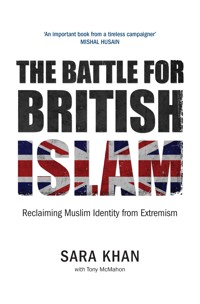
Across Britain, Muslims are caught up in a battle over the very nature of their faith. And extremists appear to be gaining the upper hand. Sara Khan has spent the past decade campaigning for tolerance and equal rights within Muslim communities, and is now engaged in a new struggle for justice and understanding - the urgent need to counter Islamist-inspired extremism.In this timely and courageous book, Khan shows how previously antagonistic groups of fundamentalist Muslims have joined forces, creating pressures that British society has never before encountered. What is more, identity politics and the attitudes of both the far Right and ultra-Left have combined to give the Islamists ever-increasing power to spread their message. Unafraid to tackle some of the pressing issues of our time, Sara Khan addresses the question of how to break the cycle of extremism without alienating British Muslims. She calls for all Britons to reject divisive ideologies and introduces us to those individuals who are striving to build a safer future.
Sie lesen das E-Book in den Legimi-Apps auf:
Seitenzahl: 361
Veröffentlichungsjahr: 2016
Das E-Book (TTS) können Sie hören im Abo „Legimi Premium” in Legimi-Apps auf:
Ähnliche














The Battle for British Islam
The Battle for British Islam
Reclaiming Muslim Identity from Extremism
SARA KHAN
with Tony McMahon
SAQI
To my daughters, Maryam and Hannah
Stand up for something, even if it means standing alone. Because often the one who flies solo has the strongest wings.
She who is brave is free.
CONTENTS
Acknowledgements
A Note on Terms
Introduction
1. Race to your Caliphate: The Rise of Islamist Extremism
2. British Salafists and Islamists: The Growing Convergence
3. The Islamist-Led Assault on Prevent
4. Identity Politics: Islamism and the Ultra Left, the Far Right and Feminists
5. Voices from the Frontline
Conclusion: Winning the Battle against Extremism
About the Authors
Notes
Bibliography
Index
ACKNOWLEDGEMENTS
I would like to thank all the people I interviewed for this book. I am indebted to each person who was willing to share insights and experiences with me. Many of these people are doing incredible work.
A special thanks to Rashad Ali and Usama Hasan, who were always at the end of a phone or email.
I would also like to thank my mother-in-law, Hamida, and my sister-in-law Afshan who both helped take care of my children as I devoted my time and energy to this book. I thank my husband, Mohsin, for his long-standing patience, encouragement and support in all that I do; and my brother Anis and sister-in-law Mehwish for their continual support and help. You have always been there for me no matter what time or day.
A special thank you to my younger brother, Adeeb, for supporting me in the early days, and Kalsoom Bashir for her friendship, laughter and love of cake, which kept us both sane in times of darkness.
Finally, I am forever indebted to my parents. You gave me the best gifts one can give a daughter: an education and independence. And to my sister, Sabin, who encouraged me to believe in myself. She is one of the most remarkable, resilient and awe-inspiring women I know.
A NOTE ON TERMS
Many of these terms hold different meanings for different people. Here are the definitions that will guide usage in The Battle for British Islam.
Extremism
The primary focus will be on Islamist extremism and other forms of Muslim extremism, though the far Right of British politics will also be covered. My definition of extremism includes any who incite violence, hatred or discrimination for political, religious or ideological causes. This can often include undermining the rule of law and democracy.
Extremism is not just about violence. In the twenty-first century, universal human rights norms should be the means by which we judge extremism. My definition is also based on contemporary Muslim scholarship on notions of citizenship and equality.
Moderate
The label ‘moderate Muslim’ is ambiguous and subjective and will be avoided in this book. Individuals of all faiths should be judged on whether they subscribe to accepted human rights and values.
Conservative
Conservative interpretations of Islam should not be conflated with extremist belief, as it often is. Muslims may hold certain conservative opinions on homosexuality, for example, and be protected under Article 9 of the European Convention on Human Rights guaranteeing religious belief. However, although the legislation recognises the right to make one’s religious belief manifest, there are limitations to what is allowed. This especially applies when hate, discrimination or violence are advocated in the name of religion.
Conservative Islamic interpretations should not be considered to be especially authentic. Liberal interpretations are just as valid. Historically, Islamic jurisprudence has always produced diverse opinions; conservative interpretations have to take their place among many equally other legitimate views that exist in Islam.
Islamism
Islamism is a political ideology; it is not synonymous with the faith of Islam. Islamism defines Islam as a socio-political system and advocates an expansionist Islamic state governed by sharia law. There are different types of Islamism. Some are violent, others not.
Non-Muslims
‘Non-Muslims’ refers to people outside the Muslim faith. It is a crude term, used reluctantly for the purposes of this book as alternatives were considered too clumsy or long-winded.
ISIS
Daesh, Islamic State, ISIS and ISIL have all been used in the media to describe the so-called Islamic State. ISIS is still a commonly used term, and we have used it in this book. This does not suggest any recognition of the ISIS claim to be an Islamic state.
Islamophobia
Islamophobia is a problematic and loaded term. Used as originally intended, it is there to protect or defend Muslims from abuse, attacks and discrimination. However, in recent years it has been extended by some to include a prohibition on criticising Islamist ideology and shutting down discussion on theological matters within Islam. Alternative terms have been used in this book to characterise attacks, hatred or discrimination against Muslims.
INTRODUCTION
A tumultuous crisis has engulfed contemporary Islam as the faith struggles to escape the clutches of extremists. News of Muslim terrorists murdering and engaging in suicide bombing, claiming that their actions are ‘Islamic’, has become a daily occurrence. Many Muslims painstakingly and repeatedly stress that these acts of terror have no justification in the Islamic faith. Other Muslims disagree; across the world thousands have joined Islamist terror groups. ISIS’s leader Abu Bakr al-Baghdadi rebuffs the notion that Islam is a peaceful religion. Instead he asserts ‘Islam was never a religion of peace. Islam is the religion of fighting.’1
In this highly divisive environment, what can be agreed on is that the word ‘Islamic’ clearly means very different things to Muslims across the world. The result is a furious battle to claim or reclaim what Islam stands for in the twenty-first century. The controversial idea of a clash of civilisations, between Islam and the West, is continuously debated. But the real clash taking place now is within Islam. It is pitting Muslims against each other with competing claims of what values and principles the faith stands for. The consequence of this bitter conflict will impact on not just the lives of over a billion Muslims but all of us, and future generations.
Often the focus of this battle is analysed with primary reference to terrorism. In an era of global Islamist extremism, this is inevitable. From Boko Haram in Nigeria, to Tehreek-e-Taliban in Pakistan, al-Qa‘ida, al-Shabaab in Somalia, and of course ISIS, Muslims and non-Muslims alike are being murdered. The sheer brutality and scale of Islamist terrorism engulf us all. That is the case whether the atrocities occur in a concert hall in Paris, at Friday prayers at a mosque in Nigeria or at a funeral in Baghdad. We are not seeing any diminution to this violent threat. The unfortunate truth is that Islamist-inspired terrorism, for the time being at least, is here to stay.
The battle within Islam, however, encompasses much more than just the challenge of terrorism. At its heart is a conflict of ideas and a question as to whether Muslims believe Islam is reconcilable with pluralism and human rights. Or do Muslims, instead, hold religious supremacist ideas over and above notions of equality and citizenship? These debates are taking place every day in communities, mosques, homes and on social media across the UK as well as around the world. These disputes among British Muslims define the battle for British Islam.
There are just under 3 million Muslims in the UK. While only a fifth of the UK’s population as a whole is under fifteen, this age group makes up a third of Muslims in Britain.2 The term ‘British Muslim’ does not adequately reflect the ethnic, sectarian, linguistic, class and ideological diversity of this faith group. South-Asian Muslims still dominate the ethnic profile of British Muslims (68 per cent), but this heterogeneous section of society also encompasses Arabs, Somalis, Kurdish, Kosovans, Turkish, Afghan, English, Welsh and many more.3
The same heterogeneity exists in the workforce. Unemployment is higher among Muslims than any other religious group and particularly among women. At the other end of the scale, it is estimated that there are more than 10,000 Muslim millionaires in Britain, with liquid assets of more than £3.6 billion. There are 13,400 Muslim-owned businesses in London, creating more than 70,000 jobs and representing just over 33 per cent of Small to Medium Enterprises in the capital alone.4 Research has also indicated that, of all faith groups, British Muslims donate the most to charity.5
Most opinion polls among Muslims evidence a strong endorsement of being British. A study by the think tank Demos showed that British Muslims tend to be more patriotic than the average citizen.6 This may be the case, but a parallel trend over the past twenty-five years has seen some British Muslims become ever more conservative on social and equality issues.7
More worryingly, hundreds of British Muslims have pledged allegiance to terrorist groups. Despite being born and raised here, some have been convicted of planning to carry out atrocities in the UK, in the hope of killing ordinary Britons, whom they perceive to be the enemy. This has brought an uncomfortable reality to the fore: rather than an identity crisis, there appears to be an identity catastrophe among a small but significant section of Britain’s Muslims.
Ever since I was a teenager, I have witnessed how Islamist extremism has wreaked havoc on the lives of British Muslims. In my work over the past eight years as co-founder and director of Inspire, a counter-extremism organisation, I have seen at first hand how this ideology has ripped families apart, turning daughters against mothers and sons against fathers. It has robbed kids of their childhood and their promising futures, and has even groomed teenagers to be killers.
It has encouraged intolerance and the dehumanisation of both non-Muslims and other Muslims, furthering sectarianism, acts of excommunication and even violence. Islamist extremism provokes anti-Muslim hatred and creates polarised communities; yet despite the damage it causes it continues to thrive among some Muslims in the UK.
The seemingly unstoppable growth of puritanical and Islamist ideology in Muslim communities troubles me deeply. I still meet many young Muslims who believe that Islamism is authentic Islam. What it actually represents is a politicised ideology that has emerged mainly in the twentieth century. Islamism advocates the belief of an expansionist Islamic state governed by sharia law. Rejecting ‘man-made’ concepts such as gender equality and democracy, Islamists also often endorse hudood punishments, with the death penalty for adultery and apostasy.
Since the nineteenth century, an austere and puritanical form of Islam known as Salafism has also grown in popularity across the world. The Salafists desire a return to what they regard as the ways of the earliest followers of Islam through a literal reading of Islam’s religious texts. Both Salafism and Islamism have won over an increasing number of the younger generation as they seek to define their identity in a post-9/11 world. As will be seen in this book, the reason for the growth of these ideologies is the relentless activism of Salafi and Islamist groups on campuses, in communities and on social media. While promoting a compelling victimhood grievance narrative to this 9/11 generation, both Salafism and Islamism present themselves to these young people – who increasingly view themselves through the prism of their faith identity – as ‘normative’ or orthodox Islam.
The spectrum of Islamist extremism is wide. Not all Islamists advocate violence, but what many Islamists share is an ideological worldview. Core assumptions about the ultimate goal of creating a caliphate, the codification of sharia law, gender inequality and an opposition to internationally recognised human rights are shared across this Islamist spectrum. As a result of its growing influence, interpretations of Islam that were once regarded as fringe and extreme have now become mainstream.
This book seeks to examine how Salafi-Islamism has become such a major influence within British Islam, crowding out voices that advocate a more reconciled British Muslim identity. In contrast with the situation in the 1990s, a process has been under way since the dawn of the new millennium in which previously competing strands of opinion – Salafism and Islamism – have become intertwined.
Salafi-Islamists seek to influence not only British Muslims but also wider society, engaging with unions, academics, the media and even politicians. The situation would not be so dire if there was an equally strong counter-movement that could provide an alternative to puritanical and Islamist ideologies, but this is currently not the case. The phenomenon and activism of Salafi-Islamism are not well understood amongst Britain’s Muslims and non-Muslims; too many believe they represent Islam outright. But understanding the dynamics of this movement is fundamental to grasping the direction of travel of British Islam.
Inevitably there is much trepidation among non-Muslims about Islam and Muslims. They wonder if this religion can ever be compatible with the British way of life. This was borne out by a March 2015 survey conducted by the YouGov-Cambridge Programme revealing that over half of British voters (55 per cent) believed ‘there is a fundamental clash between Islam and the values of British society’, compared with just 22 per cent who said Islam and British values were ‘generally compatible’.8 Such emotional responses are further exploited by the far Right to nurture anti-Muslim hatred.
However, the unifying sentiment across both sides of the argument is fear. Non-Muslims fear the threat of terrorism, particularly from home-grown Muslim extremists. These extremists appear to despise Britain and its values, despite having been born and raised in this country. Muslims worry about being viewed as a suspect community and about what the future holds for them and their children in Britain, fearing rejection by their home country due to the actions of a minority. They worry that they too could be killed by Islamist terrorists. They see on the one hand increasing sectarianism and hard-line interpretations of Islam within Muslim communities, and on the other hand growing anti-Muslim prejudice.
This does not point to a bright future. There is a real problem with young people drifting to ideological extremes: some white kids gravitate to the far Right and some Muslim kids to Islamist views. The former speak the language of white supremacism while the latter speak disdainfully about the ‘filthy kuffar’ (non-believer). This shows the emergence of a worrying symbiotic relationship between Islamist extremism and far-Right extremism. As the former gains a footing, so does the latter – both feeding off fear and hate. The result is an increasingly divided and potentially violent society. It is incumbent on people on both sides to halt this drift to extremism.
It is therefore of critical importance how we respond to these puritanical and Islamist extreme ideologies. My organisation Inspire has for a number of years engaged with the Government’s Counter-Terrorism ‘Prevent’ strategy as a civil society group. Our anti-ISIS campaign #MakingAStand, launched after the declaration of ISIS’s so-called Islamic State, was an example of a Prevent project that was aimed at empowering Muslim women. My direct involvement with Prevent enables me to share my observations of this arm of the Government’s counter-terrorism strategy, both negative and positive, and I do so in an independent capacity outside of my role as director of Inspire.
The ‘Prevent’ strategy aims to stop people becoming terrorists or supporting terrorism, but it has attracted much public criticism. Prevent has often been described as ‘toxic’. A perception exists that it seeks to criminalise British Muslims, spy on Muslim children and close down debate within school classes. So much can be written about the achievements and shortcomings of Prevent. My focus in this book, however, is an area that has not been discussed enough, which is how British Salafi-Islamists have led and delivered a highly effective strategy to derail Prevent on account of their own ideological beliefs and for reasons of self-preservation.
Despite the urgent need to prevent people from being drawn into either far Right or Islamist extremism, what has become obvious is that engaging in the counter-terrorism and counter-extremism arena is akin to walking into a minefield. It is a deeply divided and polarised space where everybody has a strong opinion on the best way forward. Entering the fray results in being attacked by all sides.
While I have been working with countless schools, Muslim communities and statutory agencies championing human rights and challenging extremism, my work as director of Inspire has resulted in me experiencing abuse, harassment, threats, online stalking and character assassination on a scale even I could never have imagined. I have seen British Islamists and extremist Muslims regularly denigrating counter-extremist Muslim voices on their social media platforms with the hope of pushing these voices to the fringe of British Islam. At the same time these extremists claim that they ‘represent the vast majority of British Muslims’. If this is the case, then British Islam faces a calamity.
As a Muslim countering Islamist extremists who justify hatred and violence in the name of my faith, I am accused of being an ‘Islamophobe’. I am a ‘sell out’ or a ‘native informant’ because I have delivered projects supported by the UK authorities to dissuade young Muslims from joining ISIS. Speaking out against institutions in this country that have bowed to pressure from the Islamists has led to my being declared an apostate, alongside my two young children.
When I turned to liberals and some on the Left for solidarity, instead I found painful rejection; some had clearly allied themselves with Islamists. Those on the Right wondered why I even bothered to be a Muslim in the first place when my faith was so ‘backward’. The leading light of New Atheism, Richard Dawkins, tweeted in October 2014 that there was nothing to ‘reclaim’ in Islam after I wrote a national newspaper op-ed about the ISIS murder of British aid worker Alan Henning by the notorious British terrorist ‘Jihadi John’.
You pick your peaceful verses, but ISIS can find verses to justify their vile acts. Why not just give up your faith and join the 21stcentury.9
Finding myself in such a predicament often left me wondering: why struggle when the odds are stacked up against you? The situation seemed hopeless. Yet while navigating my way through this hostile terrain, I have realised that clarity at a time of confusion has never been more important. Sections of the Left and Right are both wrong. Muslim voices championing human rights are needed, otherwise the extremists are the ones who will be left to define British Islam. The Left, Right and liberals need to realise that, if they want to prevent our society becoming more polarised, they must stand with Muslims who are fighting Islamism. This also means understanding how the flourishing of identity politics in Britain today fosters a sullen insularity and hampers the development of a British Islam, as it instead bolsters Islamists and far-Right ideologies.
Those Muslims who believe in engaging fully with British society, supporting gender equality and human rights, condemning violence in the name of religion, promoting inter-faith dialogue and standing against all forms of sectarianism within Islam, find themselves a beleaguered group these days. No insult is out of bounds in the bully pulpit of social media. Even violence and threats towards their person seem to be regarded as an acceptable form of discourse. But they soldier on, providing valuable community services in our country, such as youth leadership courses and hate-crime monitoring, as well as rebutting the arguments of Islamist ideology. They often pursue this work with the minimum of financial and moral support.
My motivation, first and foremost, in writing this book is a sense of obligation and principle as a Muslim. Throughout my life, Islam has been and continues to be a core part of my identity and has framed my humanistic outlook. I care deeply about the direction of travel that contemporary Islam finds itself in and the violence and ugliness that are often justified by Muslims. Truth be told there were times when the actions of ISIS and the inhumanity of Muslim extremists rocked my own faith. In their pursuit of hate and violence, not only are these extremists helping to create a divided British society, they are also toxifying Islam, turning the faith whose cornerstone advocated compassion, mercy and justice into a religion of death, despair, inhumanity and brutality.
I firmly agree with the sentiment by theologian and academic Khaled Abou El Fadl:10
It is a profound injustice for a Muslim to remain oblivious, when his or her religion and tradition are being hijacked and corrupted. In part, this is a question of love and loyalty: if Islam is supposed to be a universal moral message to humanity but this very same message has become associated in the minds of many human beings with violence and ugliness, what are the obligations and duties of a Muslim toward his religion? I believe that if a Muslim loves his religion and is loyal to it, his first and foremost obligation becomes to save and reclaim his faith.
My second reason for writing this book is this: because I have spent my life working with Muslim communities and in particular young Muslims, I care passionately about their future. So many of Britain’s Muslim youth are incredibly aspirational, positive and thoughtful. Whether their involvement is in the arts, youth politics, music or drama, I am always left feeling optimistic for the future, despite the numerous challenges and pressures that face them from all sides. These young hopefuls belong to Britain, and Britain belongs to them.
I have worked with young Muslims whose lives have been ruined by predatory radicalisers who have sought to destroy their future by enticing them towards extremism, through binary and falsely constructed paradigms of identity and belonging. I feel it is imperative that we do what we can to help them. These promising young people, who have so much to contribute to our country, are being let down. They suffer from a lack of strong and visionary Muslim leadership, a disconnect from mosques, a rising Islamist movement in the UK, alongside growing anti-Muslim hatred. As a mother it pains me greatly to see this happen; we cannot allow it to continue.
My co-author is Tony McMahon, an independent consultant who has worked with civil society groups and Government on projects concerning youth safeguarding and community cohesion. We met in late 2013 and this book evolved from conversations about why so many young people were going to Syria. We share a deep concern on this issue and wanted to examine the roots of the problem. Over a two-year period we have pooled our expertise and knowledge into this book.
While recognising the huge challenges that lie ahead I hope to share my understanding of a British Islam that opposes extremism and rejects the dehumanisation of others. Muslims must define what Islam stands for in the contemporary era. Equally, non-Muslims have an essential role to play in supporting Muslims who are on the frontline speaking out against Islamist extremism. To do so will place us all on the side of human rights and pluralism in recognition of our shared humanity.
I write this book with a call for reason and hope, because I believe we can forge a better path to a future based on human rights, shared values, compassion and co-existence, prizing such aspirations over discrimination, hatred and supremacy. The question is whether we are brave enough.
This is the battle for British Islam.
ONE
RACE TO YOUR CALIPHATE: THE RISE OF ISLAMIST EXTREMISM
‘Islamic Disneyland’
Muneera told Leila that living in the ISIS caliphate would be like something she referred to as an ‘Islamic Disneyland’.1 Leila, a Muslim woman in her thirties, had been assigned to be Muneera’s intervention provider under the UK Government’s counter-terrorism programme. Her role was to provide support to individuals at risk of joining ISIS and travelling to Syria. Her charge, Muneera (whose name we have changed), was just thirteen years old.
The teenager was a third-generation British Muslim, born and raised in the UK. Her family was originally from Pakistan but had now settled in Birmingham, Britain’s second city. Her father was a mechanic in his forties, while her thirty-something mother stayed at home with the younger siblings. There was no adolescent rebelliousness with Muneera. She was very close and loving to her parents. Leila describes Muneera’s home set-up as that of a regular British Asian family.
Muneera was home-schooled but had friends in the neighbourhood and was not shy or introverted. In early 2015 her mother had become acutely ill during a sixth pregnancy and the teenager, left to her own devices, retreated to her bedroom to spend a growing amount of time online. One evening she had watched a TV news report on ISIS and logged on to her new mobile phone to find out more about this so-called caliphate in Syria and Iraq.
She began asking questions on Twitter and was excited when responses began to appear along the lines of ‘saw your tweet, tell you more about it’. A support network of seemingly like-minded people from all over the world swarmed round her on social media, telling Muneera not to trust the official media and the lies they spread about ISIS. Other girls chatted about how they were thinking of going to Syria and the great life that awaited them.
Bit by bit, Muneera formed a very strong friendship triangle with a fifteen-year-old girl in Wembley and a fourteen-year-old boy in Blackburn. Leila notes that they became ‘really weirdly close’:
This was a fast-track radicalisation happening in just a matter of weeks.
The fourteen-year-old in Blackburn turned out to be a remarkably hardened terrorist operator. From his suburban bedroom in northwest England he was already plotting a massacre of army veterans at the 2015 Anzac Day parade in Australia.2 When his case eventually went to court, the boy would be the youngest Briton to be found guilty of a terrorist offence.
It was later revealed that he had displayed an early taste for ultra-violence. His own classmates dubbed him ‘the terrorist’ because of his stated wish to behead his own teachers.3 Incredibly, across thousands of miles, this boy was already radicalising an eighteen-year-old in Melbourne through an encrypted Voice-Over Internet Protocol (VOIP). VOIP allows the user to send voice information over the internet instead of the telephone.
His radicalisation target, Sevdet Besim, aged eighteen, was an ethnic Albanian teenager from Macedonia who had emigrated to Australia with his family. A seasoned Australian ISIS fighter called Abu Khalid al-Cambodi, given this name on account of his family’s Cambodian roots, had drawn Besim and his friends towards ISIS.4 Al-Cambodi’s former name was Neil Prakash;5 he was one of the top international ISIS recruiters up until his death in a US military airstrike in early 2016.6 His online tactic was to work through various Twitter accounts, find people like Muneera or the Blackburn boy then direct them to his private messaging account for one-on-one discussions.7 In the Blackburn boy, he had found a very willing disciple.
In court, the transcript of the youngster from Blackburn’s conversations was made public. They made for grim reading. It became clear that he had transitioned with remarkable ease from experiencing raw grievance to embracing an ultra-violent Islamist ideology:
Blackburn Boy:Ok now listen. Im going to tell you what you are.
Mr Besim:Whats that
Boy:You are a lone wolf, a wolf that begs Allah for forgiveness a wolf that doesn’t fear blame of the blamers. I’m I right?
Mr Besim:Pretty much.
Boy:Mashalla [what God wills].
Mr Besim:I’m ready to fight these dogs on there doorstep. The more equipment im provided with the better but ill still go with just a knife in my hand. I want to be among those that allah laughs at...
Boy:So listen akhi [my brother]. I want you to do this on your own. Just you no one else.
Mr Besim:ok.
Boy:Im here for any advice anything you may need to know that im here, I’ll plan something in sha allah [God willing]. Also you will have to make a video and snd it to abu kambozz to snd to al hayat [a media arm of Islamic State].8
The Blackburn youth had immersed himself in online extremist material, citing Osama bin Laden as a hero. The young terrorist became an ISIS celebrity ‘fanboy’, gaining 24,000 followers within two weeks of setting up a Twitter account.9 Not only was he sending thousands of online messages to Besim down in Melbourne but he was also tweeting and messaging Muneera in Birmingham and her new friend in Wembley. In no time both girls were desperate to leave for ISIS. When this precocious young jihadist was eventually put on trial, Mr Justice Saunders who sentenced him described how chilling it was that someone who was only fourteen years old at the time could have become ‘so radicalised that he was prepared to carry out this role intending and wishing that people should die’.10
Muneera and the girl in Wembley were increasingly enthusiastic to pack their bags and go to Syria. Leila says that Muneera told her the Blackburn boy was much more hesitant about leaving the UK, saying they should wait or take their time. In contrast, the Wembley girl was ‘100 per cent committed to ISIS’ and determined to get to Syria as quickly as possible.
She urged Muneera to join her. The only problem for the thirteen-year-old was that her father had now become rather suspicious of her behaviour. When she begged to be given her passport, he locked it away. Muneera then went on a hunger strike in an attempt to emotionally blackmail her parents into giving her the passport, but without success.
By contrast, the Wembley girl grabbed her passport and without her parents’ knowledge tried to leave the UK – on two separate occasions. However, on the second attempt she was stopped at the airport by the police. They examined her phone and discovered the many messages to Muneera. Very soon there was a firm knock on the door of Muneera’s family home.
Intervention
Muneera and the Wembley girl were given an intervention provider through the Prevent counter-terrorism programme; this is pre-criminal, so they were not put on trial. Leila, as an intervention provider, works for a programme called Channel. Sitting under Prevent, Channel is about deradicalising those who have expressed sympathy for terrorist causes without crossing the line into criminality. With Muneera, this has involved getting her to express creatively what was going on in her mind when she considered joining the Wembley girl and fleeing to Syria.
A unique insight into what a thirteen-year-old is thinking when she considers fleeing to Syria is provided by a poem that Muneera wrote about the experience. She and Leila agreed to share it:
They took me towards a path I’m glad I never went down,
At first it was a paradise,
A place where all my dreams were to come true,
I was told I’d live like a princess,
But it was all a trap I was falling into,
Thinking it’s an adventure,
Painting over the real picture, Avoiding the truth,
With their lies I was drowning deep,
Convinced I was picking a rose without any thorns,
Coating every fault,
Assuming I was gathering fresh honey from a hive,
Thinking the bees will not bite,
With their bribes I was led astray,
I was believing everything said,
Not knowing I had lost my Mind,
Till I finally realise to what I was thinking at the time,
Knowing I was not all there,
The escape route was fading, yet still visible,
Now was my chance to stay away from this nightmare,
How could I have ever let this disaster overthrow?
I’m relieved to know I’m now safe,
It could have been worse,
If the star wasn’t there to guide my way,
Now every day I pray,
So something like this doesn’t come your way,
Hoping you will see the truth behind their lies,
And help save others from this distress.11
The Wembley girl took longer to deradicalise, but she and Muneera are now back at school and piecing their lives together again. Both feel angry about their experience. Their fate was a lot better than that of the Blackburn boy, whose advanced terrorist planning landed him in court and resulted in a life sentence. For the first five years he will be given a chance to demonstrate his contrition and deradicalisation; but, if the evidence is not forthcoming, he will be deemed too dangerous ever to be released.12
In spite of what emerged during his trial, the girls think the Blackburn boy was a pawn being controlled by jihadists in Australia. He was like a young gang member trying to impress the older males. In his trial, it was asserted that he adopted the style of an older teenager in his messages. However, here was a boy whose advice to Besim included developing a taste for beheading by testing it out on any loner he chanced upon.
Muneera was Leila’s youngest-ever case. But she embodied a growing trend for ISIS to target teenage girls, grooming them online to persuade them to leave their homes.13 Facilitators guide the girls through the process of getting to Syria and avoiding being caught. Research has shown they mix extremist messaging with cooking recipes or even images of kittens and coffee, to make life in ISIS territory seem relatively normal.14
Seclusion and sacrifice
In January 2015, a document appeared online titled ‘Women of the Islamic State: Manifesto and Case Study’.15 This was a conscious attempt to paint a positive picture of ISIS to potential female recruits. The all-female al-Khansaa Brigade’s media wing uploaded the text in Arabic, so it is unlikely Muneera ever read this document. However, many of the Brigade’s arguments would have been used to sway Muneera and other girls. This ISIS unit has become notorious for its harsh measures against other women in Syria, even for minor infractions.
In short, this document presented ISIS as an empowering force for Muslim women while condemning feminism as a ‘Western programme’. The role of women is entirely distinct from men, it argued. Women are not equal, but different. Their roles are divinely ordained. They must be sedentary, secluded and preferably hidden from view, while men are the opposite, exhibiting ‘movement and flux’. If roles are exchanged, ‘the base of society is shaken, its foundations crumble and its walls collapse’.16
Even though she is secluded and hidden, a woman has a central role to play in the caliphate as a mother and wife. She can study, but only theology. The manifesto did welcome female doctors and teachers, though their education in these fields would have undoubtedly taken place outside of ISIS territory. It stressed that women are not expected to be illiterate, in spite of their constrained role. In extreme circumstances, women can fight when the situation is desperate. The ISIS document made a curious analogy with the world of film production to explain the role of a female in their self-proclaimed caliphate:
It is always preferable for a woman to remain hidden and veiled, to maintain society from behind this veil. This, which is always the most difficult role, is akin to that of a director, the most important person in a media production, who is behind the scenes organising.17
To recruit young women in the West, ISIS uses its female operatives to radicalise their peer group. Leila has spoken to girls who received messages saying ‘you’ll be given a house’ and ‘you’ll be treated like a queen’. The notion of a sisterhood fulfilling its religious duty, and its members supporting each other, is held out as better than life in the West. Even the prospect of finding romance with a fighter husband is on offer. The same ISIS propaganda points out he may die – but this will be a singular honour for his teenage widow.18
One of the most notorious female radicalisers based in Syria has been the Scottish radiography student Aqsa Mahmood, who took the name Umm Layth after fleeing her Glasgow home in November 2013. Via Tumblr and Twitter she has posted rather girly messages about life under ISIS, including food recipes and pictures of clothes shops. She advised British teenagers not to worry about shampoo and other necessities as these are available in ISIS territory; but makeup and jewellery, especially for those who intend to be married, should be brought from the West.
Mahmood, writing as Umm Layth, used the kind of language to be found in the ISIS manifesto for women. This is an example of a rallying call she sent out to girls like Muneera:
Our role is even more important as women in Islam, since if we don’t have sisters with the correct Aqeedah [creed] and understanding who are willing to sacrifice all their desires and give up their families and lives in the west in order to make Hijrah [migration to live in the house of Islam] and please Allah, then who will raise the next generation of Lions?19
The Scottish jihadist became a member of the al-Khansaa Brigade. Various horror stories have emerged about this brigade, including one report that a woman in the Syrian city of Raqqa was summarily executed for breastfeeding her baby in public, even though she had been doing this under her burqa.20 It is believed that up to seventy British women may be members of al-Khanssaa, meting out a variety of punishments for infractions of ISIS’s take on sharia law.
This kind of brutality clearly takes a toll on those involved. Aqsa Mahmood’s tweets eventually lost any semblance of teenage fun and descended into distinctly unpleasant ramblings.21 After terrorist attacks on three continents on a single day saw thirty-eight people killed at a beach resort in Tunisia, a Shi‘i mosque bombed in Kuwait and a man beheaded in France, Aqsa Mahmood posted a poem on her Tumblr account glorifying the acts in the cause of ‘change, freedom and revenge’.22
Knowing that the reality of a harsher life under ISIS might get through to Muneera, her female ISIS facilitators warned her off western media, which they said were working to an agenda to denigrate Islam. They would counter stories of the beheading of female captives by alleging they were spies or asserting that the mass rape and sale in slave markets of Yazidi girls was a practice justified in Islam. (The Yazidis are an ethnically Kurdish religious group persecuted by ISIS.) Radicalisers often prey on natural teenage rebelliousness and an unwillingness to accept answers from voices of authority, be those the media or their own parents. They give this rebelliousness an Islamist dimension.
It is hard to put an exact figure on how many western-born Muslim girls have joined ISIS. One estimate is that 10 per cent of foreign recruits from Europe, the US and Australia are women. Many may have been attracted by the pseudo-empowerment that ISIS appears to offer women. Examples are the opportunity to join the all-female al-Khansaa Brigade or train at the ISIS Al-Zawra school, which mixes lessons in sewing (to mend your husband’s uniform) with speeches on suicide bombing.
While this empowerment and sense of sisterhood may seem attractive, they tend to gloss over ISIS practices such as male fighters being polygamous and acquiring sex slaves, sometimes in public auctions. One Yazidi girl recounted how she had been bought by the self-proclaimed ISIS caliph himself, Abu Bakr al-Baghdadi, at a slave auction in ‘a white palace… between the mountain and the sea’.23The sixteen-year-old managed to escape, having witnessed Baghdadi personally torturing the US hostage Kayla Mueller, a young aid worker captured in 2013.
ISIS has even produced a manual, in a Q&A format, on how its male fighters can ‘enjoy’ their slaves:
Question 13: Is it permissible to have intercourse with a female slave who has not reached puberty?
It is permissible to have intercourse with the female slave who hasn’t reached puberty if she is fit for intercourse; however if she is not fit for intercourse, then it is enough to enjoy her without intercourse.24
If Muneera had made it to Syria, she would have been forced to burn her passport. Then she would have been married off to a male fighter and introduced to her life of sedentary seclusion with possible service in al-Khanssaa. Should she have decided that this life was not what she had expected and attempted to escape, then the fate of Austrian teenager Samra Kesinovic is instructive.
In 2014, the Bosnian-heritage youth fled Vienna with her friend Sabina, ending up in Raqqa, Syria. Sabina died shortly afterwards during fighting in the city and Samra contacted her family saying she wanted to leave because of ISIS brutality. Eventually, she attempted to make her escape. According to media reports, she was caught and beaten to death by ISIS thugs in November 2015.25
Muneera has come to realise that she was brainwashed, comparing it to being in a hypnotic state. She is now in her mid-teens and back at school, ostensibly an ordinary pupil putting a very unfortunate episode behind her. Leila believes that what happened to Muneera was grounded in a quest for identity that made her vulnerable to Islamist propaganda. Her powers of critical thinking were not strong enough to withstand the online ideologues with their violent interpretation of Islam. They successfully played on her sense of grievance and led Muneera towards the terrorist outlook.
Bitten by the Islamist bug
Leila emphasises that anti-British and anti-Western sentiments have been professed by every one of the girls she has worked with who have been ‘hit by the ISIS bug’.
They repeatedly hear that the kuffar [disbelievers] hate you, that Britain is a kuffar country, you cannot live there as a Muslim as God has warned that if you die in such a land you will die as a disbeliever. The kuffar hate your religion and they want to eradicate Islam.
How have young British Muslims come to think like this?
One leading analyst posed the question in 2015: ‘The roots of radicalisation?’ And then answered: ‘It’s identity stupid.’ How else, he explained, can you find a common factor among UK Islamist extremists and link ‘a white Englishman from Buckinghamshire with a second generation British-Asian man born in Dewsbury and a missing family of twelve from Bradford’?26 Strip away all the individual triggers and grievances and what you discover is a crisis of identity.
The desperate search for identity undertaken by many Muslims can lead to a cognitive opening through which the outlook of their parents’ generation is rejected while extreme ideas enter. Since the 1990s, the cultural and ethnically based Islam of Muslims who arrived and lived in Britain in the post-war decades has lost ground to a globalised Islamist identity that is transnational and hostile to integration and assimilation. It dismisses British values, the nation state, democracy and gender equality as man-made concepts, because Allah – they contend – commands the faithful to fight for a caliphate, the perfect expression of Muslim rule.
Islamism forces a choice between British values and Islamic values. Muneera felt she had to reject Britain to be a good Muslim. Leila, her intervention provider, understands what her young charge was going through, having been involved in an Islamist movement when she was a student at university. Leila was a member of Hizb ut-Tahrir (the Islamic Liberation Party) (HT), a group that agitates for the return of an Islamic caliphate but rejects the ISIS claim to have established one.




