


5,99 €
Mehr erfahren.
- Herausgeber: Chorabooks
- Kategorie: Religion und Spiritualität
- Sprache: Englisch
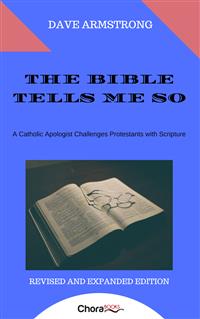
Veteran Catholic apologist Dave Armstrong (author of 49 books, including the bestsellers, A Biblical Defense of Catholicism, The One-Minute Apologist, The New Catholic Answer Bible, and The Catholic Verses) tackles the hottest issue in Catholic-Protestant apologetics discussion: the relationship of the Bible to sacred tradition and the Church. Indeed, Dave's specialty in his 25 years of Catholic apologetics, has been "biblical evidence for Catholicism" (the name of his popular blog). In thirty succinct, right-to-the-point chapters, he addresses questions such as the Catholic Church's approach to the Bible through the centuries, the Bible's "perspicuity" (i.e., alleged self-evident clearness in the main), the seven deuterocanonical or so-called "apocryphal" books, Catholics and Bible-reading, the alleged necessity of explicit biblical "proof texts", aspects of the interpretation of Scripture, the question of whether the Catholic Church views itself as "above" the Bible, and the Protestant rule of faith, known as sola Scriptura or "Scripture Alone" (as the final infallible authority in theology), along with many more Bible-related topics. The book serves as a helpful and handy clarification for Catholics who need to better learn their own Church's teaching, in order to confidently reply to Protestant challenges, and for Protestants who may be misinformed regarding the Catholic Church's true opinions about Holy Scripture. In the final analysis, it is happily demonstrated that the two sides have far more in common in this regard, than disagreement.
Das E-Book können Sie in Legimi-Apps oder einer beliebigen App lesen, die das folgende Format unterstützen:
Veröffentlichungsjahr: 2019
Ähnliche






Dave Armstrong
THE BIBLE TELLS ME SO
Copyright © 2016, 2019 Chorabooks, a division of Choralife Publisher Ltd.
All rights reserved.
14/F office A. Bangkok Bank Building
No.28 Des Voeux Road Central
Hong Kong
First eBook edition: August 2016
Second Ebook edition: January 2019
Biblical citations are taken from the Revised Standard Version of the Bible (© 1971 by the Division of Christian Education of the National Council of the Churches of Christ in the United States of America, unless otherwise noted. All emphases added.
Indice dei contenuti
1. Fictional Dialogue on Scripture Alone
2. Tradition is Not a “Dirty Word”; it's a Great Gift!
3. Must Every Doctrine Have Explicit Proof in the Bible?
4. The Perspicuity (Clarity) of Holy Scripture
5. Ten-Point Biblical Refutation of Sola Scriptura
6. Does the Catholic Church Claim to be "Above" the Bible and Its "Creator"?
7. "Why Don't Catholics Read Their Bibles?"
8. Did Luther Rescue the Bible in German from Utter Obscurity?
9. Has the Catholic Church Historically Been an "Enemy" of the Bible?
10. Are All the Books in the Bible Self-Evidently Inspired?
11. Sola Scriptura, the Old Testament, and Ancient Jewish Practice
12. St. Paul’s Word Selection vs. Sola Scriptura
13. Sola Scriptura, 2 Timothy 3:16-17, and “Man of God”
14. 1 Timothy 3:15: Sola Scriptura or Visible Church Authority?
15. Reply to William Whitaker’s Sola Scriptura Arguments
16. Catholic Bible Interpretation: Debunking the Myths
17. Why Do Catholic Bibles Have Seven More Books?
18. Scripture Alone Cannot Establish the Biblical Canon
19. New Testament Canon as a “Late” Doctrine (Protestant Difficulties)
20. St. Augustine’s Position on Bible and Tradition Documented
21. Did St. Athanasius Believe in Sola Scriptura?
22. Martin Luther’s Remarkably “Pro-Tradition” Strain of Thought
23. Arbitrary Bias in the NIV Bible Translation Against “Tradition”
24. Sola Scriptura is Logically Circular
25. Apostolic Succession as Seen in the Jerusalem Council
26. C. S. Lewis vs. St. Paul Regarding Future Binding Church Authority
27. Mass Baptisms in Acts and Infallible, Binding Church Doctrine
28. The Analogy of an Infallible Bible to an Infallible Church
29. Catholic Binding Authority and Old Testament Analogies
30. Biblical Arguments for Apostolic Succession
1. Fictional Dialogue on Scripture Alone
Observant Catholics accept the Bible and also Church authority and apostolic tradition (all harmonious with each other), whereas Protestants "pick and choose" traditions, on the basis of their rule of faith, called sola Scriptura (Scripture Alone): in which the Bible is believed to be the only infallible authority. This is quite problematic, as I think is shown in the following hypothetical dialogue:
Protestant (P): X is a true, biblical doctrine. Catholic (C): According to which denominational tradition? P: Ours. C: How do you know your tradition and belief is true, while others are false? P: Because we are the most biblical. C: How do you know yours is the most biblical? P: Our exegesis is the most plausible and consistent, and true to the clear teaching of Scripture. C: But other Protestant traditions claim the same superiority . . . P: I must say in love that they are wrong. C: How do you know they're wrong? Aren't Protestants supposed to be tolerant of each other, especially in "secondary" issues? P: Well, they have a faulty hermeneutic and exegesis, and I must stand firm for biblical truth. Nothing personal . . . C: How do you know they have a faulty method of interpretation? P: By Scripture and linguistic study, and the consensus of scholarly commentaries. C: But again, others claim the same prerogative and abilities. P: When they're wrong, they're blinded by their presuppositional biases, or else by sin. C: How do you know that? P: Because they come to the wrong conclusions about the perspicuous ["clear"] biblical data! C: Frankly, I would say that that is circular reasoning. But, even granting your contention for the sake of argument, how does an uneducated seeker of Christian truth choose which denomination is true to the Bible? P: The one which is most biblical . . . C: Now, don't start that again [smiling]! They all claim that. P: [perplexed look] Well, then, the one which has roots in the early Church. C: Ah! So now the Church fathers must be studied in order to determine who has the early "apostolic" tradition? P: Yes, I suppose so [frowning]. C: But what if it is found that the great majority of fathers have an opinion on doctrine X contrary to yours? P: Then they are wrong on that point. C: How can you say that?! P: By studying Scripture. C: So when all is said and done, it's irrelevant what the early Church, or the fathers, or the Church from 500 to 1500 believed? P: I wouldn't say that, but I must judge their beliefs from Scripture. C: Therefore you are -- in the final analysis -- the ultimate arbiter of true Christian tradition? P: Well, if you must put it in those blunt terms, yes. C: Isn't that a bit arrogant? P: Not as much as the pope and a bunch of celibate old men in red hats and dresses telling me what I should believe [suddenly scowling and hyperventilating]. C: You make yourself the arbiter of all true doctrine, yet you object to a popes and councils that make an ex cathedra pronouncements every hundred years or so?! Is that not "being your own pope"? P: We call it the primacy of the individual conscience. C: So you think that your own individual opinion and "conscience" is more trustworthy than the combined consensus of nearly two thousand years of Church history, papal pronouncements, apostolic tradition, ecumenical councils, etc.? P: Yes, because if a doctrine is biblical, I must denounce any tradition of men that is otherwise. C: For that matter, how do you know what the Bible is? P: The Bible is self-authenticated. Faith requires no reasons. The Holy Spirit makes it clear. C: Well, that's a whole 'nother ball of wax. But as to the biblical canon, Scripture never states what its own books are. This is clearly shown in the divergences in the early Church on the question of which works were canonical. P: There was a broad consensus among the fathers. C: I grant you that . . . very broad. But there was more than enough difference to require an authoritative decree by the Church to put the matter to rest. P: God specifically guided those Christians because His Word was at stake. C: Oh? Good. So you agree that God guided the early Church. That's apostolic tradition! But not in all matters? P: No, not when they talked about the papacy, Mary, the Real Presence, communion of saints, penance, purgatory, infused justification, confession, absolution, apostolic succession, and many other erroneous doctrines. C: How do you know that? P: Because those doctrines clearly aren't biblical. C: According to which "clear" denominational tradition? P: Ours! C: [smacks forehead, then throws hands up and gazes toward the heavens, wincing in frustration]
2. Tradition is Not a “Dirty Word”; it's a Great Gift!
One might loosely define tradition as the authoritative and authentic Christian history of theological doctrines and devotional practices. Christianity is fundamentally grounded in the earth-shattering historical events in the life of Jesus Christ (His incarnation, preaching, miracles, passion, crucifixion, resurrection, and ascension).
Eyewitnesses (Lk 1:1-2; Acts 1:1-3; 2 Pet 1:16-18) communicated these true stories to the early Christians, who in turn passed them on to other Christians (under the guidance of the Church's authority) down through the ages. Therefore, Christian tradition, defined as authentic Church history, is unavoidable, and is a very good thing: not a “bad” thing at all.
Many read the accounts of Jesus' conflicts with the Pharisees and get the idea that He was utterly opposed to all tradition whatsoever. This is not true.
A close reading of passages such as Matthew 15:3-9 and Mark 7:8-13 will reveal that He only condemned corrupt traditions of men, not tradition per se. He uses qualifying phrases like “ your tradition,” “precepts ofmen,” “tradition of men,” as opposed to “word of God” or “the commandment of God” and so forth. St. Paul makes exactly the same contrast:
Colossians 2:8 See to it that no one makes a prey of you by philosophy and empty deceit, according to human tradition, according to the elemental spirits of the universe, and not according to Christ.
The New Testament explicitly teaches that traditions can be either good (from God) or bad (from men, when against God's true traditions). Corrupt traditions from the Pharisees were bad; though many of their legitimate teachings were recognized by Jesus (see, e.g., Mt 23:3).
The spoken gospel and the apostolic writings (some eventually formulated as Holy Scripture; some not) were altogether good: the authentic Christian tradition as revealed by the incarnate God to the apostles, and “ratified” by the Church.
The Greek word for “tradition” in the New Testament is paradosis. It occurs in Colossians 2:8, and in the following three passages (among others):
1 Corinthians 11:2 . . . maintain the traditions even as I have delivered them to you.
2 Thessalonians 2:15 . . . stand firm and hold to the traditions which you were taught by us, either by word of mouth or by letter.
2 Thessalonians 3:6 . . . the tradition that you received from us.
St. Paul makes no distinction between written and oral tradition. He doesn't regard oral Christian tradition as bad and undesirable. This is made even more clear in two other statements to Timothy:
2 Timothy 1:13 Follow the pattern of the sound words which you have heard from me, . . .
2 Timothy 2:2 and what you have heard from me before many witnesses entrust to faithful men who will be able to teach others also.
St. Paul is here urging Timothy not only to “follow” his oral teaching which “heard from” him, but to also pass it on to others. This is a clear picture of authentic historical continuity of Christian doctrine: precisely what the Catholic Church calls sacred tradition, or, when emphasizing the teaching authority of bishops in the Church, “apostolic succession.”
The phrase “deposit of faith” is also used when describing the original gospel teaching as handed over or delivered to the apostles (see, e.g., Acts 2:42, Jude 3). The Catholic Church considers itself merely the “custodian” or “guardian” of this public revelation or “deposit” from God, because we believe that God set up His Church (Matthew 16), making St. Peter the leader, and that it has continued through history ever since. It's all God's doing, not ours. We participate in His plan by His grace and mercy.
When the first Christians went out and preached the gospel of Jesus Christ after Pentecost, this was an oral tradition. Some of it was recorded in the Bible (e.g., in Acts 2) but most was not, and indeed could not be, for sheer volume (see John 20:30, 21:25). It was primarily this oral Christian tradition that turned the world upside down, not the text of the New Testament (many if not most people couldn't read then anyway).
Accordingly, when the phrases “word of God” or “word of the Lord” occur in Acts and the epistles, they almost always refer to oral preaching, not to the written word of the Bible, as many Protestants (and a lot of Catholics, too) casually assume.
The New Testament itself is a record of primitive, apostolic Christianity. It is a development, so to speak, of both the Old Testament and early oral Christian preaching and teaching and tradition. The process of canonization of the New Testament took over 300 years and involved taking into account human opinions and traditions as to which books were believed to be Scripture. It was not immediately obvious to all Christians (as some foolishly assume or argue).
Many notable Church fathers accepted books as part of Scripture which are not now so recognized (e.g., The Shepherd of Hermas, the Didache, epistle of Barnabas, 1 Clement). Many others didn't accept certain canonical books until very late (e.g., Hebrews, James, 2 Peter, and Revelation). Thus, the Bible cannot be separated and isolated from tradition and a developmental process.
In Catholicism, Scripture and tradition are intrinsically interwoven. They have been described as “twin fonts of the one divine well-spring” (revelation), and cannot be separated, any more than can two wings of a bird, two sides of a coin, or two blades of a pair of scissors.
The Church also has strong authority, so that the Catholic rule of faith consists of Scripture, tradition, and the Church. This may be conceived in a word-picture as a “three-legged stool.” If you remove any one of the legs, the stool collapses; all three are equally necessary for it to stand up.
That is Catholicism: and (in case anyone is wondering) all these notions are firmly backed up by Scripture itself, without any contradiction as regards Catholic tradition or Church dogma and doctrine.
3. Must Every Doctrine Have Explicit Proof in the Bible?
In one of the Facebook theological groups I am involved with, a Protestant stated that "Jesus nowhere explicitly commanded us to use ashes" and "There's no Lent in the Bible, either."
This person wanted to quibble about Lent: where every major component is discussed repeatedly in Scripture, as I have demonstrated in two lengthy posts, consisting of many scores of Bible passages.
Yet a curious double standard seems to be in play here: whether intended or not. The New Testament never mentions a host of things that Protestants of various stripes believe in. For example, it knows nothing of an "altar call" or the typical "sinner's prayer" of evangelicals. It doesn't mention church buildings; never uses the word "Trinity" or the frequently mentioned evangelical terminology of "personal relationship with Jesus."
It never lists its own books (the biblical canon comes from the authority and proclamations of the Catholic Church and tradition). It doesn't teach sola Scriptura, or the concept that the Bible is the only infallible source of authority (over against Church and sacred tradition). I've written two entire books specifically about that issue alone! It's absolutely absent from Holy Scripture, and often contradicted. Yet – oddly enough – this is one of the very "pillars" of the Protestant worldview.
Other beliefs or practices not explicitly mentioned in the Bible are Bible studies, separating young people during church services, grape juice as an element to be consecrated for communion (rather than wine), "asking Jesus into one's heart," a "body of believers," Scripture interpreting Scripture (the more clear helping to understand the less clear), agreeing on "essential" or "primary" doctrines and permitted relativism regarding "non-essential" or "secondary" doctrines, denominations (vs. the biblical "one Church").
Of course, this very idea that one must find explicit biblical proof for every doctrine or it can't / mustn't be believed (even with high selectivity or rank inconsistency) is not found in the Bible anywhere, either. It's (irony of all ironies!) a mere tradition of men.
Some popular Protestant (and also often Catholic) words or phrases that do not appear in the Bible are rapture, invisible church, incarnation, virgin birth, holy communion, Lord's prayer, Bible, original sin, fall of man, theology, go[ing] to church, grace alone, [total] depravity, unconditional election, limited atonement, irresistible grace, perseverance of the saints, spirituality, Scripture alone, pray for guidance, pray for direction, spiritual warfare, and sin nature. Faith alone only appears once:
James 2:24 " You see that a man is justified by works and not by faith alone."
Protestants manage to believe all these things (or use these words) with no problem whatever. Why? Or, more specifically, why do they believe these things, which are absent from or non-explicit in the Bible, while giving Catholics misery for similar things, or else doctrines and practices with far more indication of various sorts than the things above, that Protestants accept? Or is it just that the Protestants who sling these sorts of "arguments" about, never think about them very deeply, or have never met a Catholic who can show that they are very weak arguments indeed?
The Catholic view on these matters is totally consistent and sensible. Here is how I expressed it in the Introduction of my first book, A Biblical Defense of Catholicism (2003):
"Catholics need only to show the harmony of a doctrine with holy Scripture. It is not our view that every tenet of the Christian Faith must appear whole, explicit, and often in the pages of the Bible. We also acknowledge sacred Tradition, the authority of the Church, and the development of understanding of essentially unchanging Christian truths, as is to be expected with a living organism (the Body of Christ) guided by the Holy Spirit. A belief implicitly biblical is not necessarily antibiblical or unbiblical. But we maintain that the Protestant principle of sola Scriptura (' Scripture alone' ), on the other hand, is incoherent and – I dare say – quite unbiblical.
" In fact, many doctrines accepted by Protestants are either not found in the Bible at all (for example, sola Scriptura and the Canon of Scripture), are based on only a very few direct passages (for example, the Virgin Birth), or are indirectly deduced from many implicit passages (for example, the Trinity, the two natures of Jesus, and many attributes of God, such as His omnipresence and omniscience)."
Let me be clear about the exact nature of my argument. I distinguished above between some things that are not in the Bible at all, in word or concept, and particular words that aren't in the Bible, whereas the concepts certainly are.




