


1,99 €
Mehr erfahren.
- Herausgeber: Quickie Classics
- Kategorie: Gesellschafts- und Liebesromane
- Sprache: Englisch
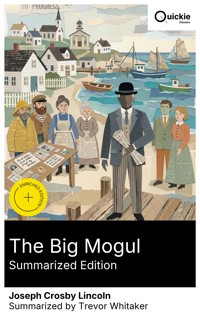
Set on Lincoln's beloved Cape Cod, The Big Mogul tracks the comic and unsettling ripples when a self-styled mogul tries to bend a tide-hardened village to his schemes. Town-meeting skirmishes, kitchen-table alliances, and a modest romance test Yankee thrift and neighborly duty. Lincoln's genial satire, salted with dialect and nautical metaphor, situates the tale within American regionalism, probing how modern money and publicity collide with customary ways. Joseph Crosby Lincoln (1870–1944), a Brewster, Massachusetts native, made a career of rendering Cape life with fidelity and wit. Drawing on childhood memory, town-meeting lore, and the talk of skippers and shopkeepers, he turned observation into moral comedy. Writing for popular magazines while tourism and commerce remade the peninsula, he had both nostalgia and firsthand evidence for the pressures he dramatizes. Readers who prize humane wit, sharply etched local color, and shrewd social observation will find The Big Mogul bracing and restorative. It is recommended to students of American regional literature, lovers of New England storytelling, and anyone curious about the perennial contest between success and stewardship. Quickie Classics summarizes timeless works with precision, preserving the author's voice and keeping the prose clear, fast, and readable—distilled, never diluted. Enriched Edition extras: Introduction · Synopsis · Historical Context · Brief Analysis · 4 Reflection Q&As · Editorial Footnotes.
Das E-Book können Sie in Legimi-Apps oder einer beliebigen App lesen, die das folgende Format unterstützen:
Veröffentlichungsjahr: 2026
Ähnliche



















The Big Mogul (Summarized Edition)
Table of Contents
Introduction
At its core, The Big Mogul weighs the glitter and pressure of outsized influence against the stubborn decency, shrewd humor, and everyday courage of ordinary people, testing whether success is measured by money, status, and spectacle or by the quieter currencies of responsibility, trust, and neighborly duty, and asking, through a sequence of choices that bruise pride and expose pretense without forfeiting compassion, how power changes those who wield it and those who live in its shadow, and what it might mean, after the bustle subsides, to come out prosperous in character as well as in purse.
The Big Mogul is a novel by American author Joseph Crosby Lincoln, a widely read writer of the early twentieth century whose books brought a genial, popular voice to American fiction. Situated within the era’s mainstream of domestic realism and light comic romance, the book reflects a publishing world shaped by magazines, serial storytelling, and accessible hardcover editions. Lincoln’s reputation rests on intimate portraits of community life, and this work participates in that tradition without demanding specialized knowledge of place or history. What orients the reader here is not geography so much as social scale: recognizable people negotiating rank, reputation, and responsibility.
Without disclosing turns best discovered in the reading, the story centers on the disturbances that arise when concentrated authority brushes against everyday habit. Whether embodied in a single personality, a household, or an institution, that influence acts as a catalyst, stirring alliances, rivalries, and unexpected generosities, while exposing fragile prides and stubborn loyalties. Progress comes through conversations, small bargains, and the steady pressure of circumstance more than through spectacle. Misunderstandings accumulate and clear, not without cost, as livelihoods and hopes are weighed against principle. The result is a plot that moves with deliberate clarity, inviting reflection instead of shock.
Lincoln’s narrative manner is genial and attentive, favoring clear scenes, vernacular rhythms, and dialogue that reveals character as much as it advances events. The narrator’s point of view is steady and forgiving, quick to notice foibles yet reluctant to scold, and the humor runs dry rather than raucous. Sentences are uncluttered, description is purposeful, and the prose gives room for the sound of ordinary speech. The tone remains hopeful even when prospects dim, and moral outcomes feel earned by cause and effect. Pacing privileges texture—errands, visits, letters, minor crises—so that the larger questions arrive naturally, not as lectures.
Thematically, the book engages the ethics of ambition and stewardship, exploring what leaders owe to those affected by their decisions and what neighbors owe to one another when fortunes rise or fall. It asks how status changes the way people listen, and whether influence can be exercised without blurring respect. It traces the uneasy traffic between private motives and public consequences, and it keeps watch on the quiet heroism of keeping one’s word. Comedy here is not an escape but a diagnostic tool, revealing the habits, hopes, and pretenses that allow a community to endure.
For readers today, the novel’s concerns are immediately recognizable: concentration of power, the friction between efficiency and fairness, and the difficulty of sustaining civility when stakes feel personal. Its scenes of negotiation, compromise, and conscience offer a counterweight to the quick outrage of modern discourse, suggesting that persuasion and patience can produce durable change. It treats leadership as a moral practice, not merely a technical one, and refuses to reduce people to positions. In a time of widening inequity and thinning trust, its faith in accountability, good humor, and mutual regard remains both bracing and practical.
Approached as character-centered storytelling rather than sensational exposé, The Big Mogul rewards attention to voices, incremental shifts of feeling, and the practical ethics of everyday trade-offs. Readers who enjoy gentle satire, intersecting subplots, and conclusions earned by temperament rather than by contrivance will find steady pleasures here. The book also offers a view into early twentieth-century American taste, when magazines and mainstream presses favored accessible prose and communal dramas. Most of all, it provides the quiet satisfaction of watching people sort through competing claims of duty and desire, and invites us to measure influence by the good it enables.
Synopsis
Joseph Crosby Lincoln’s The Big Mogul unfolds in a small Cape Cod community whose settled rhythms and tacit rules shape everyday life. Into this landscape arrives a powerful outsider from the city, a figure of wealth and influence whose presence quickly earns him the moniker that gives the book its title. Lincoln introduces townspeople with distinct temperaments—cautious, wry, independent—and sketches their interlocking loyalties. Early chapters establish a contrast between local custom and big-city ambition, as well as the quiet aspirations of younger characters. The tone blends humor and gentle irony, situating readers within a place that prizes decency, plain speech, and pragmatic common sense.
The newcomer’s plans, grander than anything the town is used to, stir anticipation and suspicion in equal measure. Promises of jobs, attention, and prosperity appeal to some, while others fear disruption, indebtedness, and a loss of dignity. Lincoln traces the community’s debate through meetings, gossip, and porch-side conversations, showing how opinion coalesces around personalities as much as principles. The “big mogul” is neither caricature nor saint; he is persuasive, strategic, and used to getting his way, yet genuinely curious about the people he aims to enlist. The town’s leaders, formal and informal, weigh whether accommodation or resistance best safeguards their neighbors.
As the outsider’s venture begins to take shape, negotiations move from pleasantries to particulars—access, permissions, and obligations. Lincoln uses these dealings to illuminate the subtle leverage of local expertise: tides, roads, weather, and kinship networks matter as much as contracts. Side plots emerge, including a tentative courtship that bridges insider and outsider worlds, and a generational disagreement about risk and reward. Humor punctuates misunderstandings, but stakes increase when small concessions hint at larger compromises. The mogul encounters a community whose cooperation cannot be bought wholesale, only earned piecemeal through respect, patience, and a willingness to listen to those who know the place best.
Midway, complications expose the limits of money and the resilience of habit. Practical obstacles—logistics, timing, and nature’s unpredictability—collide with social ones, such as pride, reputation, and old grievances. Lincoln lets tensions simmer rather than explode, giving minor characters decisive moments that reveal the town’s quiet solidarity. The mogul’s confidence is tested by delays and by interlocutors who refuse to be hurried. Meanwhile, the budding romance must navigate class expectations and divergent ambitions, as both parties discover what they are unwilling to give up. The work’s humor sharpens into satire, but without rancor, emphasizing character over spectacle.
Pressure intensifies when a misstep threatens to sour goodwill, prompting a reevaluation of terms on all sides. Lincoln allows the mogul to show adaptability as well as impatience, while locals demonstrate that steadfastness need not mean stubbornness. Compromise becomes a question of who defines it and for whose benefit. The town draws around its most vulnerable members, insisting that any bargain respect the common life they share. Personal loyalties are tested, and the romance deepens or falters in light of hard choices. The narrative balances competing interests, acknowledging the allure of opportunity while foregrounding the costs of acquiescence.
Approaching its resolution, the novel gathers its threads into a series of decisions that reflect character growth rather than grand reversals. A principled stand clarifies what cannot be bought, while a practical concession shows what can, under fair terms, be exchanged. Lincoln keeps the outcome measured and humane, leaving room for consequences without dwelling on triumph or defeat. The mogul’s image becomes more complex—neither vanquished nor triumphant—while the town, still itself, has learned to parlay its knowledge into leverage. The romance arrives at an earned understanding, suggesting futures shaped as much by place as by personal desire.
The Big Mogul endures as a portrait of modernity knocking at a traditional door and finding more than quaint scenery: a coherent social world with its own wisdom. Lincoln’s blend of comedy, local color, and moral inquiry shows how power meets character, and how community can negotiate change without surrendering identity. The book resonates beyond its setting, inviting reflection on what progress should preserve as well as what it should transform. By avoiding melodrama and honoring everyday decency, it offers a spoiler-safe assurance: that integrity, when shared, can recalibrate even the most asymmetrical encounters with wealth and influence.
Historical Context
Joseph Crosby Lincoln (1870–1944), a native of Brewster, Massachusetts, built his reputation writing regional fiction about Cape Cod. The Big Mogul belongs to his series of small-town narratives set in early twentieth-century New England villages modeled on Barnstable County communities. Lincoln’s stories typically follow residents of fictional harbors and commons, where retired sea captains, shopkeepers, and church committees shape civic life. He wrote for mass-circulation magazines before book publication, adopting a genial, satiric tone and Cape dialect. Readers encountered familiar institutions—town meetings, savings banks, and the local press—forming the social framework within which ambition, reputation, and communal responsibility are tested.
Economic change frames the setting. By the 1900s–1920s, Cape Cod’s nineteenth‑century maritime commerce had waned, while rail and automobile access fostered tourism and summer colonies. Cranberry cultivation, organized since the 1880s through growers’ associations, strengthened seasonal incomes alongside fishing and small coastal trade. Local savings banks and trust companies, chartered under Massachusetts law, financed homes, boats, and shops, and their officers often doubled as civic leaders. The Panic of 1907 and subsequent creation of the Federal Reserve System in 1913 shaped public expectations about banking stability, credit, and oversight—concerns that loom large in communities where reputation and solvency were inseparable from social standing.
New England’s town‑meeting governance and Congregational church life provide the civic and moral backdrop Lincoln favored. Annual warrants, budget votes, and elected selectmen expressed hyper‑local authority, while ministers, deacons, and women’s societies coordinated charity and social events. Fraternal lodges and veterans’ posts fostered solidarity and informal influence. The region’s public‑school tradition and academy culture prepared clerks, bankers, and tradesmen who staffed village institutions. Local weeklies reported debates, auctions, and shore rescues, reinforcing reputations in small populations where news traveled quickly. Such structures, rooted in colonial practice yet adapting to modern pressures, undergird conflicts over leadership, propriety, and the uses of wealth.
Transportation developments reshaped isolation into accessibility. The Old Colony Railroad, later controlled by the New York, New Haven and Hartford Railroad, had linked Cape towns by the late nineteenth century, and by the 1910s–1920s automobiles multiplied along improved state roads. The privately built Cape Cod Canal opened to traffic in 1914, shortening coastal routes; the United States purchased it in 1928, later enlarging it for safer navigation. Steamship excursions and rail timetables synchronized with summer schedules, bringing investors, visitors, and new ideas. These links enabled outside capital and seasonal populations to influence village decisions about land, business ventures, and local prestige.
National reform and regulation formed part of the moral climate. Progressive‑Era campaigns against municipal graft and monopolies filtered into small towns through newspapers, state commissions, and model‑charter debates. Massachusetts maintained strict oversight of savings banks and insurance, while federal antitrust actions signaled limits on concentrated power. War mobilization in 1917–1918 brought price controls, Liberty Loan drives, and home‑front committees that trained communities in collective finance and patriotic messaging. Afterward, veterans’ organizations and relief networks persisted. These experiences heightened sensitivity to the character and accountability of business leaders—questions that resonate when a powerful outsider or ambitious local asserts influence over money, property, and publicity.
The First World War’s aftermath and national Prohibition (1920–1933) altered coastal life. The United States Coast Guard, created in 1915 by merging the Life‑Saving Service and Revenue Cutter Service, patrolled nearby waters; in the 1920s, smuggling and enforcement brought federal authority into local view. Simultaneously, demobilization, inflationary spikes, and then relative prosperity changed employment and prices in fishing, retail, and lodging. Churches and civic groups mediated debates over modern amusements and temperance. Against this backdrop, questions of law, reputation, and communal order carried immediate consequences for merchants, selectmen, and investors whose fortunes depended on tourists’ trust and neighbors’ goodwill.
Mass culture expanded the audience for regional tales. By the 1910s and 1920s, magazines such as The Saturday Evening Post popularized fiction about local places, while radio and motion pictures unified tastes and spread celebrity. Cape Cod drew journalists and vacationers, and real‑estate ventures promoted subdivisions and hotels to metropolitan buyers. Chain stores and mail‑order houses challenged village merchants. Lincoln’s fiction, praised for humor and dialect, positioned Cape villagers as shrewd judges of character confronting fashionable visitors and persuasive promoters. This cultural marketplace rewarded stories that defended community standards while acknowledging the allure—and risk—of big money and modern publicity.




