


0,49 €
Mehr erfahren.
- Herausgeber: e-artnow
- Kategorie: Geisteswissenschaft
- Sprache: Englisch
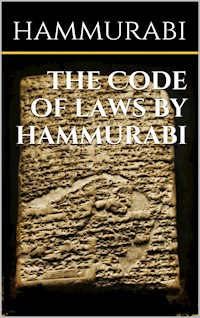
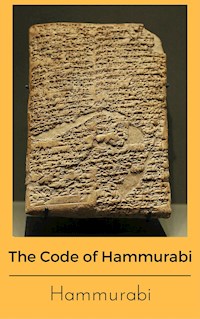
The Code of Hammurabi is a Babylonian legal text composed c. 1755–1750 BC. You will love reading the best-organized and best-preserved legal text from the ancient Near East. This important document was copied and studied by Mesopotamian scribes for over a millennium.
Das E-Book können Sie in Legimi-Apps oder einer beliebigen App lesen, die das folgende Format unterstützen:
Veröffentlichungsjahr: 2023
Ähnliche














The Code of Hammurabi
Table of Contents
English-language translations of The Code of Hammurabi include:
The Laws of Hammurabi, King of Babylonia
, as translated in 1903 by
H. Otto Sommer
The Code of Hammurabi (Harper translation)
, as translated in 1904 by
Robert Francis Harper
Codex Hammurabi (King translation)
, as translated in 1910 by
Leonard William King
Codex Hammurabi
, transliteration column from
Hammurabi's Gesetz
by
J. von Kohler
and
A. Ungnad
The Code of Hammurabi (Harper translation)
1. If a man bring an accusation against a man, and charge him with a (capital) crime, but cannot prove it, he, the accuser, shall be put to death.
2. If a man charge a man with sorcery, and cannot prove it, he who is charged with sorcery shall go to the river, into the river he shall throw himself and if the river overcome him, his accuser shall take to himself his house (estate). If the river show that man to be innocent and he come forth unharmed, he who charged him with sorcery shall be put to death. He who threw himself into the river shall take to himself the house of his accuser.
3. If a man, in a case (pending judgment), bear false (threatening) witness, or do not establish the testimony that he has given, if that case be a case involving life, that man shall be put to death.
4. If a man (in a case) bear witness for grain or money (as a bribe), he shall himself bear the penalty imposed in that case.
5. If a judge pronounce a judgment, render a decision, deliver a verdict duly signed and sealed and afterward alter his judgment, they shall call that judge to account for the alteration of the judgment which he had pronounced, and he shall pay twelve-fold the penalty which was in said judgment; and, in the assembly, they shall expel him from his seat of judgment, and he shall not return, and with the judges in a case he shall not take his seat.
6. If a man steal the property of a god (temple) or palace, that man shall be put to death; and he who receives from his hand the stolen (property) shall also be put to death.
7. If a man purchase silver or gold, manservant or maid servant, ox, sheep or ass, or anything else from a man's son, or a man's servant without witnesses or contracts, or if he receive (the same) in trust, that man shall be put to death as a thief.
8. If a man steal ox or sheep, ass or pig, or boat—if it be from a god (temple) or a palace, he shall restore thirtyfold; if it be from a freeman, he shall render tenfold. If the thief have nothing wherewith to pay he shall be put to death.
9. If a man, who has lost anything, find that which was lost in the possession of (another) man; and the man in whose possession the lost property is found say: "It was sold to me. I purchased it in the presence of witnesses:" and the owner of the lost property say: "I will bring witnesses to identify my lost property": if the purchaser produce the seller who has sold it to him and the witnesses in whose presence he purchased it, and the owner of the lost property produce witnesses to identify his lost property, the judges shall consider their evidence. The witnesses in whose presence the purchase was made and the witnesses to identify the lost property shall give their testimony in the presence of god. The seller shall be put to death as a thief; the owner of the lost property shall recover his loss; the purchaser shall recover from the estate of the seller the money which he paid out.
10. If the purchaser do not produce the seller who sold it to him, and the witnesses in whose presence he purchased it (and) if the owner of the lost property produce witnesses to identify his lost property, the purchaser shall be put to death as a thief; the owner of the lost property shall recover his loss.
11. If the owner (claimant) of the lost property do not produce witnesses to identify his lost property, he has attempted fraud (has lied), he has stirred up strife (calumny), he shall be put to death.
12. If the seller have gone to (his) fate (i.e., have died), the purchaser shall recover damages in said case fivefold from the estate of the seller.
13. If the witnesses of that man be not at hand, the judges shall declare a postponement for six months; and if he do not bring in his witnesses within the six months, that man has attempted fraud, he shall bear the penalty imposed in that case.
14. If a man steal a man's son, who is a minor, he shall be put to death.
15. If a man aid a male or female slave of the palace, or a male or female slave of a freeman to escape from the city gate, he shall be put to death.
16. If a man harbor in his house a male or female slave who has fled from the palace or from a freeman, and do not bring him (the slave) forth at the call of the commandment, the owner of that house shall be put to death.
17. If a man seize a male or female slave, a fugitive, in the field and bring that (slave) back to his owner, the owner of the slave shall pay him two shekels of silver.
18. If that slave will not name his owner, he shall bring him to the palace and they shall inquire into his antecedents and they shall return him to his owner.
19. If he detain that slave in his house and later the slave be found in his possession, that man shall be put to death.
20. If the slave escape from the hand of his captor, that man shall so declare, in the name of god, to the owner of the slave and shall go free.
21. If a man make a breach in a house, they shall put him to death in front of that breach and they shall thrust him therein.
22. If a man practice brigandage and be captured, that man shall be put to death.
23. If the brigand be not captured, the man who has been robbed, shall, in the presence of god, make an itemized statement of his loss, and the city and the governor, in whose province and jurisdiction the robbery was committed, shall compensate him for whatever was lost.
24. If it be a life (that is lost), the city and governor shall pay one mana of silver to his heirs.
25. If a fire break out in a man's house and a man who goes to extinguish it casts his eye on the furniture of the owner of the house, and take the furniture of the owner of the house, that man shall be thrown into that fire.
26. If either an officer or a constable, who is ordered to go on an errand of the king, do not go but hire a substitute and dispatch him in his stead, that officer or constable shall be put to death; his hired substitute shall take to himself his (the officer's) house.
27. If an officer or a constable, who is in a garrison of the king, be captured, and afterward they give his field and garden to another and he conduct his business—if the former return and arrive in his city, they shall restore to him his field and garden and he himself shall conduct his business.
28. If an officer or a constable, who is in a fortress of the king, be captured (and) his son be able to conduct the business, they shall give to him the field and garden and he shall conduct the business of his father.
29. If his son be too young and be not able to conduct the business of his father, they shall give one-third of the field and of the garden to his mother, and his mother shall rear him.




