


1,99 €
Mehr erfahren.
- Herausgeber: Booksell-Verlag
- Kategorie: Religion und Spiritualität
- Sprache: Englisch
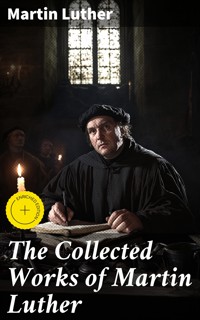
The Collected Works of Martin Luther presents a comprehensive anthology of the influential theologian's writings, encompassing his seminal discourses during the Protestant Reformation. The volumes reflect Luther's bold literary style, blending scripture-based argumentation with poignant personal reflections and a passionate call for ecclesiastical reform. Key texts such as the Ninety-Five Theses and the Large and Small Catechisms illustrate not only Luther's theological insights but also his skillful use of rhetoric, making complex ideas accessible to the laity. The work situates itself within the historical context of 16th-century Europe, capturing the fervor of a transformative era in Christianity. Martin Luther (1483-1546), a German monk and theologian, emerged as a central figure in the Reformation, driven by a profound quest for spiritual truth and reform within the Catholic Church. His intimate struggles with faith and doctrine compelled him to challenge the prevailing norms of his time, echoing the sentiments of growing dissatisfaction among believers. His writings reveal a deep understanding of scripture and a commitment to the principles of justification by faith, shaping the beliefs of countless followers in the centuries that followed. This collection is indispensable for scholars and lay readers alike, offering insights into the foundations of Protestant thought and the enduring relevance of Luther's theological contributions. It invites readers to engage with the historical narrative and appreciate the literary artistry that has influenced modern Christianity and Western thought. In this enriched edition, we have carefully created added value for your reading experience: - A comprehensive Introduction outlines these selected works' unifying features, themes, or stylistic evolutions. - The Author Biography highlights personal milestones and literary influences that shape the entire body of writing. - A Historical Context section situates the works in their broader era—social currents, cultural trends, and key events that underpin their creation. - A concise Synopsis (Selection) offers an accessible overview of the included texts, helping readers navigate plotlines and main ideas without revealing critical twists. - A unified Analysis examines recurring motifs and stylistic hallmarks across the collection, tying the stories together while spotlighting the different work's strengths. - Reflection questions inspire deeper contemplation of the author's overarching message, inviting readers to draw connections among different texts and relate them to modern contexts. - Lastly, our hand‐picked Memorable Quotes distill pivotal lines and turning points, serving as touchstones for the collection's central themes.
Das E-Book können Sie in Legimi-Apps oder einer beliebigen App lesen, die das folgende Format unterstützen:
Veröffentlichungsjahr: 2023
Ähnliche






The Collected Works of Martin Luther
Table of Contents
Introduction
The collection entitled 'The Collected Works of Martin Luther' serves as a holistic compendium of the influential writings of one of the most pivotal figures in Western history. This body of work encapsulates the theological, political, and social discourses initiated by Luther during the Reformation, portraying not only his revolutionary ideas but also the philosophical underpinnings that would resonate through the ages. By presenting a comprehensive anthology of Luther's reflections and teachings, the collection aims to provide readers with an unparalleled glimpse into the mind of a theologian and reformer who forever altered the landscape of Christianity and its relationship with the state, society, and culture.
This collection spans a rich tapestry of genres, offering insights into various text types that illuminate the breadth of Luther's intellectual contributions. It comprises theological treatises, catechisms, sermons, letters, and hymns, thereby providing a multidimensional perspective on his thought and its application to both personal faith and communal worship. The inclusion of sermons and pastoral letters gives readers access to Luther's direct engagement with laypeople and leaders alike, promoting understanding of his pastoral concerns, while the catechetical works serve as instructive tools designed for both instruction and inspiration in Christian practice.
A notable unifying theme throughout this collection is the essence of reform and renewal within the Christian faith. Luther’s writings consistently emphasize the return to scriptural fundamentals, advocating for a faith that is both personal and communal. His stylistic hallmark often features a vigorous, accessible language that invites lay readers into complex theological discussions, breaking down barriers between intellect and belief. The significance of these works transcends mere historical context; they continue to provide critical guidance on issues of freedom, grace, and the nature of true faith, thereby affirming their relevance in contemporary discourse.
Amidst the diversity of themes presented—from discussions on sin and salvation to reflections on civil authority and personal liberty—there lies a fundamental call to authenticity in faith. Luther’s exhortations resonate with readers seeking understanding amidst doubt and tumult. The accessibility of his prose, paired with his profound theological insights, invites the reader to engage deeply with the material. Therefore, as you embark on this journey through the works of Martin Luther, you are encouraged to savor each section of this collection, allowing the profound wisdom and passionate spirit of the Reformer to inspire your own quest for knowledge and spiritual growth.
Many readers will appreciate that 'The Collected Works of Martin Luther' embodies more than a mere academic undertaking; it serves as an invitation to understand the transformative power of faith as expressed through eloquent prose and passionate sermons. Each work included in this collection presents a critical commentary on the Christian experience, urging believers to confront their convictions and align their spiritual journey with the teachings of Christ. The multifaceted nature of this collection allows readers to grasp the extent of Luther’s influence on Christianity and the broader societal implications that emerged as a result.
The diversity of genres represented in this collection allows for various entry points into Luther's thought, catering to a wide array of readers, from scholars to laypersons. Treatises such as 'The Bondage of the Will' present intricate philosophical arguments, while the hymn 'A Mighty Fortress Is Our God' captures the emotional and spiritual fervor of the Reformation. This combination of intellectual rigor and heartfelt devotion underscores the dynamic character of Luther’s works and emphasizes the importance of both reason and experience in the faith journey, thus making them essential reading for any serious student of theology.
A prominent theme that emerges from Luther’s writings is the tension between faith and works, often epitomized in the dichotomy he draws in his essays and treatises. In 'A Treatise on Christian Liberty,' for example, he articulates the paradox of freedom through faith, emphasizing that true liberty is found not in the absence of obligations but in steadfast devotion to God’s commands. This theme is pivotal in understanding Luther’s revolutionary approach and how it challenged prevailing notions of piety and moral action, inviting readers to rethink the very foundations upon which the Church stood during his time.
Additionally, Luther’s dedication to translating the Scriptures into the vernacular speaks volumes about his commitment to making Christian doctrine accessible to all believers. In works like 'An Open Letter on Translating,' readers witness Luther’s earnest desire for both lay and clerical audiences to engage directly with the Word of God. This commitment to democratizing knowledge remains a vital theme in contemporary discussions regarding scriptural interpretation and the nature of authority within religious communities, making Luther's insights invaluable for modern theological exploration.
Moreover, the collection highlights Luther’s rhetorical skill, evident in works such as 'Table Talk,' where his conversations on theology and life illustrate his nuanced understanding of human experience. The informal nature of these dialogues allows readers to grasp the warmth and humanity of Luther—the man behind the doctrine. This blend of accessibility and profundity in his writing style remains a hallmark of his influence, asserting the idea that theology should not exist in an ivory tower but rather engage with real-world concerns and personal struggles.
In considering the historical context of these works, it is impossible to overlook the broader social upheavals that shaped Luther's writings. The collection captures a pivotal moment in history, one where the power of the Church was challenged by emerging political ideologies and a burgeoning emphasis on individual rights. By delving into works like 'To the Christian Nobility of the German Nation,' readers gain insight into Luther’s vision for a reformed Church that acknowledges and respects the roles of civil authorities—thus engaging with nascent ideas of religious freedom and social responsibility that continue to hold relevance today.
The profound theological debates captured within this collection also provoke thought on the interplay between tradition and innovation. Luther’s works, like 'The Large Catechism,' serve as both a reaffirmation of core tenets of Christianity and a critique of human traditions that had obscured the Gospel message. This duality invites readers to examine their own beliefs against the backdrop of reformative thought, making the exploration of these texts not merely an academic exercise but a deeply personal journey of faith.
The liturgical dimensions found within the collection—especially in works like 'The German Mass and Order of Divine Service'—reveal Luther’s thoughts on worship as an expression of faith that should be both communal and comprehensible. By reshaping worship practices to emphasize congregational participation, Luther aimed to create a vibrant faith community anchored in shared worship experiences. This focus on inclusivity speaks to broader contemporary discussions on worship and can inspire modern readers to re-evaluate their own communal practices.
As we explore themes of suffering, hope, and consolation within works like 'The Fourteen of Consolation' and 'Discussion of Confession,' readers are reminded of Luther's pastoral sensitivity in dealing with the human condition. His ability to engage with the complexities of sin, grace, and redemption resonates with those who seek solace and understanding amid their own struggles. These texts not only affirm the enduring nature of Luther's pastoral wisdom but also extend an invitation for readers to reflect on their faith in times of difficulty.
The incorporation of hymns showcases Luther’s genius in marrying theology with art. The collection features beloved hymns such as 'Dear Christians, One and All, Rejoice' and 'Savior of the Nations, Come' that encapsulate rich theological truths while being accessible and memorable. Luther's belief in the power of music as a vehicle for teaching and worship continues to have a profound impact on Christian practice today, illustrating the intersection of faith and creativity.
As we traverse this compilation, one cannot overlook the significant contributions found in Luther’s commentaries on biblical texts, such as 'Commentary on Genesis' and 'Commentary on the Epistle to the Galatians.' These works not only reveal Luther’s exegetical prowess but also serve as a testament to his belief in the centrality of Scripture in the life of believers. His interpretations challenge readers to reconsider traditional understandings, demonstrating how each passage of Scripture can speak anew in light of contemporary issues.
The diversity in subjects and genres within 'The Collected Works of Martin Luther' reflects the multifaceted nature of faith itself, encapsulating the joys and complexities of spiritual life. Each piece stands as a testament to Luther's unwavering commitment to a faith that is both deeply personal and universally applicable, inviting readers to question, reflect, and ultimately grow in their understanding of God. The dialogues, hymns, and essays are interwoven with themes of grace and redemption, creating a rich narrative that beckons exploration.
In conclusion, 'The Collected Works of Martin Luther' represents a unique opportunity to engage with the thoughts and writings of a central figure in Christian history. These works stand not only as historical artifacts but as living documents that continue to inspire and challenge believers of all backgrounds. We invite you, dear reader, to immerse yourself in the pages of this collection, embracing the chance to learn from, reflect upon, and be encouraged by the enduring messages of Martin Luther as you navigate your own spiritual journey.
Author Biography
Introduction
Martin Luther (1483–1546) was a German theologian, monk, and prolific author whose writings ignited the Protestant Reformation and reshaped Christianity and European culture. Best known for the Ninety-Five Theses challenging indulgence sales, he produced influential treatises, a landmark German translation of the Bible, catechisms, sermons, and hymns. His arguments for justification by faith, the authority of Scripture, and reform of church practice catalyzed religious debate, political realignments, and educational initiatives. A master of both learned Latin and vigorous vernacular prose, he reached broad audiences through the printing press. Luther’s career combined biblical scholarship, pastoral work, and polemical controversy, leaving a legacy both formative and contested.
Education and Literary Influences
Luther studied at the University of Erfurt, earning a master’s degree in the early 1500s before entering an Augustinian monastery in Erfurt. Ordained as a priest, he pursued advanced theological training and, after moving to Wittenberg, completed a doctorate in theology and became professor of biblical studies. His classroom lectures on the Psalms, Romans, Galatians, and Hebrews deepened his engagement with Scripture and shaped his emerging views on grace and salvation. Monastic discipline, intense reading, and pastoral duties combined to form his scholarly habits. The university setting and academic disputations provided the framework that later carried his critiques far beyond the classroom.
Intellectually, Luther drew on Augustine’s theology of grace and original sin, and on the apostle Paul’s letters, which he read with renewed urgency. He had been trained in late medieval scholastic methods, yet he embraced the humanist call to read sources at the origin, focusing on biblical languages and close exegesis. His spiritual mentor Johann von Staupitz guided him toward Christ-centered consolation. Luther engaged leading humanists, including Erasmus of Rotterdam, whose edition of the Greek New Testament aided biblical study; their later dispute over free will sharpened Luther’s emphasis on divine grace. These currents shaped his voice as commentator, preacher, and controversialist.
Literary Career
In 1517 Luther circulated the Ninety-Five Theses, a set of propositions criticizing the theology and practice of indulgences. Intended for academic debate, they quickly reached a wider public through pamphlets and reprints. Papal and imperial responses followed: he was condemned by papal bull, refused to recant at the Diet of Worms, and was placed under imperial ban. Sheltered for a period at the Wartburg, he began translating the New Testament into German, published in 1522. The episode established his public profile as a reformer and author whose scholarship, preaching, and polemics unfolded under intense scrutiny and accelerating print culture.
During 1520 Luther issued a trio of programmatic works: Address to the Christian Nobility of the German Nation, The Babylonian Captivity of the Church, and On the Freedom of a Christian. These texts attacked perceived abuses, reexamined sacraments, and articulated Christian liberty grounded in faith active in love. His style blended rigorous exegesis with sharp satire, memorable metaphors, and direct appeals to rulers and laypeople. He wrote in Latin for scholars and in German to reach broader audiences. Printers across German lands disseminated his works rapidly, eliciting rebuttals from theologians and officials and drawing both admiration and fierce condemnation.
Luther also produced enduring pastoral literature. His Small and Large Catechisms, published in 1529, provided concise instruction in the Ten Commandments, the Creed, the Lord’s Prayer, baptism, and the Lord’s Supper, shaping Protestant teaching for households and congregations. His complete German Bible appeared in 1534, after sustained work with colleagues on translation and revision. The clarity and cadence of his German prose and prefaces influenced the development of the language. He helped reform worship by promoting congregational singing and composed hymns, including "Ein feste Burg ist unser Gott" ("A Mighty Fortress Is Our God"), which became emblematic of evangelical piety.
Public controversies marked his career. He opposed radical reformers and insisted on orderly change under responsible authorities. In 1524–1525, during the Peasants’ War, he criticized social revolt and wrote harshly against insurgents, a stance that drew lasting criticism. Disagreements with other reformers surfaced at the Marburg Colloquy in 1529, where he defended Christ’s real presence in the Eucharist against symbolic interpretations. Working with city councils and territorial rulers, he helped shape church ordinances, education reforms, and visitation programs. Recognition from supportive princes secured space for reform, while opponents continued to challenge his claims in sermons, tracts, and academic rebuttals.
Beliefs and Advocacy
Luther’s theology coalesced around justification by faith alone, the sufficiency and clarity of Scripture, and the priesthood of all believers. He emphasized God’s initiative in salvation and the believer’s freedom from the law’s accusatory power, coupled with a call to serve neighbors through ordinary vocations. His reading of Scripture centered on Christ, with law and gospel distinguished yet both serving God’s redemptive purposes. He affirmed two kingdoms—God’s spiritual rule through the word and a civil realm for temporal order—while urging rulers to protect preaching and schools. These convictions animated his preaching, counseling, and the educational materials he prepared for laity.
On the sacraments, Luther retained baptism and the Lord’s Supper as instituted means of grace and rejected sacrificial understandings of the Mass. He denied transubstantiation’s philosophical explanation yet strongly affirmed Christ’s true bodily presence in the Eucharist, expressed as his sacramental union "in, with, and under" the bread and wine. His reforms supported clerical marriage and reshaped parish life around preaching, catechesis, and congregational song. Advocating literacy and schooling, he urged civic leaders to establish and fund education for the common good, arguing that communities needed trained pastors, informed citizens, and children taught the basics of faith and letters.
His polemical edge, however, often crossed into invective. He denounced the papacy as contrary to the gospel, and in the 1540s authored virulently anti-Jewish treatises, including On the Jews and Their Lies, which have been widely and rightly condemned. These writings stand in stark tension with his pastoral aims and have caused enduring harm; later antisemites misused them for their own purposes. Many church bodies influenced by Lutheran traditions have formally repudiated such views. Acknowledging this troubling dimension is essential to understanding Luther as a historical author whose legacy includes both profound reform and texts that require explicit moral rejection.
Final Years & Legacy
In his later years Luther continued to preach, teach, and publish, producing polemics, biblical prefaces, and confessional writings such as the Schmalkald Articles in 1537. He advised evangelical princes and cities amid shifting imperial politics and the formation of defensive alliances. Health problems increased, and domestic life with his wife, Katharina von Bora, provided a model for Protestant household piety. He traveled on ecclesiastical business shortly before his death and died in 1546 in Eisleben. He was buried in Wittenberg. Supporters mourned a courageous reformer; opponents viewed his passing through the lens of ongoing confessional conflict.
Luther’s long-term impact is vast. His catechisms and Bible translation shaped religious education and German prose. Confessional documents associated with the Lutheran tradition, later gathered in the Book of Concord, preserved themes from his teaching, alongside the Augsburg Confession authored by Philipp Melanchthon. His promotion of vernacular worship, congregational song, and the printing of accessible theology broadened participation in religious life and influenced literary culture. Modern scholarship continues to assess his contributions and controversies, while ecumenical dialogues have clarified areas of agreement and difference. Luther remains a central, debated figure whose writings continue to inform faith, culture, and historiography.
Historical Context
The 16th century was a period of profound upheaval in Europe, marked by the Renaissance and the Humanist movement. These cultural shifts encouraged a return to classical texts and emphasized individual reasoning and interpretation, fostering a climate in which traditional authorities—including the Catholic Church—came under increasing scrutiny. Within this context, Martin Luther, a German monk and theologian, called for reform based on his conviction that salvation comes through faith alone, a principle that challenged prevailing ecclesiastical structures.
The Church, which had maintained its authority through the Middle Ages, faced mounting criticism over its moral and financial practices—above all the sale of indulgences. In 1517, Luther published his Disputation on the Power and Efficacy of Indulgences (the Ninety-Five Theses), targeting those abuses and igniting a broad debate about faith, grace, repentance and forgiveness.
Political developments also played a key role. As early modern states consolidated power, rulers like Frederick the Wise of Saxony saw in Luther’s proposals an opportunity to assert greater autonomy from Rome. In his Address to the Christian Nobility of the German Nation, the reformer urged secular leaders to curb clerical privileges and to support changes aimed at restoring Christian teaching to its New Testament foundations.
The mid-15th-century invention of the printing press revolutionized the circulation of ideas. Luther’s tracts, sermons and catechisms—now rendered in the vernacular—were printed in large numbers, reaching audiences previously excluded from theological discourse and enabling laypersons to read and interpret Scripture for themselves.
Drawing on Scripture and the Church Fathers, Luther developed a new theological framework. His Small Catechism and Large Catechism provided households and congregations with concise explanations of faith, sacraments and prayer, reinforcing the notion that every believer shares in a “priesthood” before God and need not rely solely on ordained clergy.
Rapid social and economic changes accompanied these doctrinal debates. Some urban and merchant groups, chafing under Church taxes and seeking clearer ethical guidance for commercial life, found resonance in Luther’s On Christian Liberty, where he exhorted Christians to live out their faith in work, family and community.
Luther also addressed social concerns in a controversial pamphlet on vagrancy, reflecting contemporary anxieties about poverty and order. While he condemned itinerant beggars, his engagement with such issues revealed an awareness of the growing gap between rich and poor in a transforming economy.
Tensions spilled over into violence during the Peasants’ War of 1525. Although social rebels invoked reform rhetoric, Luther rejected the uprising and condemned its brutality in Against the Murderous, Thieving Hordes of Peasants. Nonetheless, his earlier writings on communal life and mutual responsibility had helped frame popular expectations of justice and reform.
The Church’s reaction to Luther was swift. In 1521 he was formally excommunicated and summoned to the Diet of Worms, where he refused to recant his positions. His defiance there cemented his role as a leader of the emerging Protestant movement and deepened the rift between reformers and Rome.
In the Heidelberg Disputation of 1518, Luther set out key distinctions between divine righteousness and human works, laying the groundwork for his doctrine of justification by faith. Central to his teaching was sola scriptura, the conviction that Scripture alone, not ecclesiastical tradition, constitutes the ultimate authority in matters of faith and practice.
Liturgy and sacramental life also underwent revision. In The German Mass and Order of Divine Service (1526) and in his writings on baptism, he proposed simpler worship centered on preaching and congregational participation, while retaining two sacraments—baptism and the Lord’s Supper—and stressing their spiritual significance.
Ethics, too, received careful attention. In On Good Works (1520) Luther argued that authentic service flows from faith itself rather than from a system of meritorious deeds—an explicit rebuttal to the idea that indulgences could buy divine favor.
Music became another vehicle for reform. Luther composed hymns such as “A Mighty Fortress Is Our God,” combining theological depth with congregational song and helping to forge a shared religious culture across German-speaking lands.
In On the Babylonian Captivity of the Church (1520), he criticized sacramental abuses and called for a return to apostolic simplicity, prompting renewed interest in the life and theology of the early Church.
His Commentary on Galatians (1535) and later writings offered sustained reflection on justification, freedom and Christian identity, shaping subsequent Protestant theology and continuing to inform debates over faith and works.
Over the following centuries, Luther’s insistence on individual conscience and direct access to Scripture influenced philosophical and political thought—contributing to evolving ideas about religious liberty, governance and the rights of the individual.
The collected works of Martin Luther thus encapsulate a transformative era. By challenging ecclesiastical authority and articulating a vision of personal faith, they helped to redefine the relationship between believer and church and to set in motion developments that remain central to Western religious and social thought.
Synopsis (Selection)
Introduction: Luther by John Acton
John Acton provides a contextual overview of Martin Luther's life and the profound impact of his theological contributions on Christianity and society.
Disputation on the Power and Efficacy of Indulgences (95 theses)
This seminal work critiques the sale of indulgences, asserting that salvation comes through faith alone, laying the groundwork for the Protestant Reformation.
The Bondage of the Will
Luther argues against the concept of free will in matters of salvation, emphasizing that human will is bound by sin and salvation is solely a work of divine grace.
To the Christian Nobility of the German Nation
In this treatise, Luther calls on the German nobility to reform the Church, advocating for the priesthood of all believers and challenging papal authority.
Prelude on the Babylonian Captivity of the Church
Luther critiques the sacramental system of the Church, arguing for a return to biblical principles and the liberation of the sacraments from ecclesiastical control.
A Treatise on Christian Liberty
This work explores the concept of Christian freedom, detailing how faith liberates believers from sin yet obliges them to love and serve others.
A Treatise of Good Works
Luther discusses the relationship between faith and good works, arguing that true faith naturally results in good deeds as a response to God's grace.
A Treatise on Baptism
In this treatise, Luther defends the sacrament of baptism as essential for salvation, emphasizing its significance as an act of God's grace.
Disputation on the Divinity and Humanity of Christ
Luther addresses Christological controversies, affirming the dual nature of Christ as both fully divine and fully human.
The Large Catechism
This extensive catechism serves as a guide for teaching Christian doctrine, covering the Ten Commandments, the Apostles' Creed, and the Lord's Prayer.
The Small Catechism
A succinct version of the Large Catechism aimed at laypeople, the Small Catechism is designed to facilitate understanding and practice of Christian faith.
Commentary on Genesis
In this commentary, Luther interprets the Book of Genesis, focusing on creation, the nature of humanity, and the unfolding of God's covenant.
On the Creation
Luther reflects on the biblical account of creation, emphasizing God's sovereignty and the inherent goodness of the created world.
On Sin and the Flood
This work discusses the nature of sin and God's judgment through the account of the Flood, underscoring themes of repentance and divine mercy.
Commentary on the Epistle to the Galatians
Luther's commentary addresses the themes of grace and justification, emphasizing salvation through faith rather than adherence to the Law.
The Epistles of St. Peter and St. Jude Preached and Explained
In this collection of sermons, Luther explains the messages of St. Peter and St. Jude, focusing on faith, perseverance, and the dangers of false teachings.
Epistle Sermons
A series of sermons based on New Testament letters that elucidate key theological themes and their applications for Christian life.
Epiphany, Easter and Pentecost
Luther's reflections on the liturgical seasons emphasize the significance of Christ's incarnation, resurrection, and the gifting of the Holy Spirit.
Trinity Sunday to Advent
These sermons cover the theological implications of the Trinity and prepare the faithful for the coming Advent season.
Table Talk
A compilation of Martin Luther's conversations and thoughts shared during meals with his students, offering insight into his ideas and personal reflections.
The Book of Vagabonds and Beggars
This treatise addresses the social issues surrounding vagabondage and begging, advocating for sympathy and care for the marginalized.
Discussion of Confession
Luther examines the practice of confession, promoting a return to personal accountability and emphasizing God's forgiveness.
The Fourteen of Consolation
A series of meditative writings aimed at comforting believers through the assurance of God's promises in times of distress.
Warning Against the Jews
In this controversial text, Luther expresses his vehement opposition to Jewish practices and beliefs, reflecting the complex and troubling aspects of his views on Judaism.
The Smalcald Articles
A foundational document for Lutheran doctrine, outlining key beliefs regarding salvation, sacraments, and the authority of the Church.
The German Mass and Order of Divine Service
This work proposes reforms to liturgical practices, aiming to make worship more accessible and centered on the Word of God.
An Open Letter on Translating
Luther argues for the necessity of translating the Bible into vernacular languages, emphasizing the importance of scripture for all believers.
Letter to Several Nuns
In this letter, Luther addresses a group of nuns, encouraging them to seek true liberation through faith and understanding of Christian doctrine.
Hymns
A collection of hymns penned by Luther that expresses Christian faith and doctrine, including influential works that remain popular in worship.
Dear Christians, One and All, Rejoice
A hymn celebrating the grace of God and the unity of believers, emphasizing the power of faith.
A Mighty Fortress Is Our God
This iconic hymn proclaims God's strength and protection, serving as an enduring anthem of the Reformation.
Savior of the Nations, Come
A hymn reflecting on the incarnation of Christ and the hope of salvation through His coming.
The Martyrs’ Hymn
A powerful hymn honoring those who have died for their faith, encouraging perseverance in the face of adversity.
The Collected Works of Martin Luther
Introduction: Lutherby John Acton
During the latter part of the Middle Ages, the desire for reform of the Church was constant. It was strongest and most apparent among laymen, for a famous monastic writer of the fourteenth century testified that the laity led better lives than the clergy. To the bulk of ordinary Christians reform meant morality in the priesthood. It became intolerable to them to see the Sacrament administered habitually by sacrilegious hands, or to let their daughters go to confession to an unclean priest. The discontent was deepest where men were best. They felt that the organisation provided for the salvation of souls was serving for their destruction, and that the more people sought the means of grace in the manner provided, the greater risk they incurred of imbibing corruption. In the days when celibacy was imposed under Gregory VII, it was argued that the validity of orders depended on conduct; and that idea of forfeiture by sin, essentially fatal to the whole hierarchical system, was not yet extinct. People learnt to think of virtue apart from the institutions of the Church, and the way was paved for a change which should reduce the part of the clergy in men's lives, and give them families of their own. The hope that a stricter discipline would be enforced by authority from within died away. When Eugenius IV. directed Cesarinito dissolve theCouncil of Bâle, the Cardinal replied that if he obeyed they would be thought to be mocking God and men, and to have abandoned the notion of reform, and the laity would have some reason to believe that it was a good deed to destroy, or at least to plunder, the clergy.
The religious influence of the Church was brought low by its record of failure. The scheme for governing the world by the hierarchy, pursued for three centuries, had terminated in disaster. For a whole generation no man knew whether the Papacy was in Italy or in France. The attempt to effect improvement through the Councils had been abandoned after many experiments, and the failure to reconcile the Greeks had established the Ottoman Empirein Europe. With the decline of the Church the State rose in power and prerogative, and exercised rights which for centuries had been claimed by the hierarchy. All this did not suggest Lutheranism to Luther, but it prepared the world for it.
Amidst the abuses and excesses of that epoch of lax discipline and indistinct theology, the point of breaking was supplied by a practice of very recent growth. Indulgences had long existed, and after a time they were applied to souls in purgatory. When, at last, plenary indulgences, that is, total remissions of penalty, were transferred to the dead, it meant that they were straightway released from purgatory and received into heaven. Five churches in Rome enjoyed the privilege that a soul was released as often as mass was said at one of the altars, technically known as privileged altars, or as often as certain prayers were said by persons visiting them. There were privileged altars at St. Peter's, at St Prassede, at Santa Pudentiana, at the Scala Santa. At one, five masses were required; at another, thirty. In the crypt of St. Sebastian one visit was enough. A particular prayer repeated during forty days remitted one-seventh of the punishment, and on the fortieth day the dead man would appear to his benefactor, to thank him. All the benefits available to a pilgrim visiting Rome could be enjoyed at a distance by the purchase of an indulgence from the friars sent round to sell them. Such an indulgence, published by Julius II. for the construction of St. Peter's, was revived by Leo X. in 1517, half the proceeds to go to the Archbishop of Mintz, that he might pay back a loan to Fugger of Augsburg. The banker's agent went round with the appointed preacher and kept the strong box. Tetzel, a Dominican, preached the indulgence in Saxony, though not in the territory of the elector, and he employed to the utmost the arguments authorised by the custom of the day. Speaking of him and of his colleagues, Benedict XIV. said that they were the cause of all the trouble that followed.
Many people thought the indulgences, as then practised, a mischief, because people took them as equivalent to absolution; and the general of the Augustinians spoke of them as an encouragement to sin. But the extreme point was the theory that payment of a few pence would rescue a soul from purgatory. Therefore, when Luther raised a protest against such propositions, he said no more than what many other people were saying, and less than some. And he had no idea that he was not speaking in thorough harmony with the entire Church, or that the ground he occupied was new. The Dominicans stood by Tetzel and made his cause their own. They were able to say of him that he had only uttered current doctrine, though it had not the sanction of former ages. Three hundred of them were present when he received a degree at Frankfort on the Oder, and the Dominicans at Rome defended even the most extreme and grotesque of the sayings attributed to him.
Leo committed the whole business to Silvester Prierias, Master of the Sacred Palace and official theologian of the Holy See. Prierias was not a reputable defender of any religious cause. In one of his books he advises a judge that he may obtain a confession by a promise of mercy, meaning mercy to the community, and charges the notary to put down in what sense the words were spoken. Accordingly he made the worst possible defence. St. Thomas, discussing indulgences as they were in his time, urges that they may be accepted as they are given by authority. Prierias, an ardent Thornist, regards this as a valid argument for the practices that were now contested. The problem of right is settled by the evidence of fact. The questors, as they were called, acted as legitimate agents of the Holy See. To deny what authority tacitly approves, is to deny authority; and to appeal from the Pope to the Bible, is to appeal from a higher authority to a lower. This was to ignore the difficulty and to make reforms impossible. The reason for this compendious evasion was that Leo, prior to his election, had taken an oath to revoke the indulgence of Julius II., and to supply otherwise the money required for St. Peter's. The capitulation was in March 1513. The breach of the capitulation, in March 1515. It was not desirable to raise a controversy as to the broken oath, or to let Luther appear as the supporter of the cardinals against the Pope, or of the Pope expecting the tiara against the Pope in possession of it. The effect was to deprive Luther of the hope that he was at issue with a too eager subordinate in Saxony, and to transfer his attack to Rome. It was now officially declared that whatever is is right, and that no improvement or reform is wanted in high places.
A graver personage came upon the scene when it was agreed that Luther should appear before the Legate at Augsburg. Cardinal Cajetan was the weightiest divine of the Court of Rome, and a man of original mind, who was denounced in his order as a dangerous innovator, and whose writings could not be reprinted without large omissions. He is commemorated, in political literature, among the advocates of tyrannicide. He was more dexterous than Prierias, although he also refused a revision of current practices. By putting forward a decree of Clement VI., he drove Luther to declare that no papal decree was a sufficient security for him. So that, having assailed authority in that which it tolerated or ignored, he assailed it now in that which it directly affirmed, and was no longer a mere intruder, proffering unwelcome advice, but a barbarian thundering at the gates of Rome. Cajetan dismissed him ungraciously; and having been warned that a Dominican cardinal might be perilous company in the circumstances, he went off secretly and made his way home. He was already a popular figure in Germany, and the Diet of Augsburg had complained that the drain caused by indulgences left no supplies for the Turkish war.
When Luther returned to Wittenberg he was aware that his ideas extended much farther than he had supposed. Since the refusal to listen to his remonstrance, he knew that he was involved in a conflict in which Rome would be against him. He knew also that many of his countrymen would be on his side. The same discovery was unexpectedly made by the next papal emissary, Miltitz, a Saxon layman, who was sent to convey the Golden Rose to Luther's patron, the elector Frederic. It was well understood at Rome that Cajetan, in pushing Luther one step beyond his original Thesis, by transferring the question from the discretion of Tetzel to the authority under which he acted, had mismanaged the affair. Uncompromising rigour having failed, the opposite treatment was now applied. Miltitz, finding the majority of Germans favourable to Luther, deposited the Golden Rose at Nuremberg, and came into his own country with a resolution to be conciliatory. The friends whom he saw on his way informed Luther, and urged him to meet his countryman in the same spirit. Miltitz saw Tetzel and silenced him; and the inauspicious preacher did not long survive his disgrace. Having given this proof that he entertained no adverse prejudice, that on the immediate problem they were in sympathy, Miltitz had a conference with Luther at Altenburg.
Luther followed the advice of his friends at Nuremberg. The specific evil he had denounced was now admitted by the authorised representative of the Holy See. He obtained, through him, a reassuring glimpse of Roman opinion, and the certainty that there were men on the spot, unlike Prierias and Cajetan, whose convictions in regard to unreformed abuses were as clear as his own, and whose opportunities were better. They came to an understanding. Luther was to publish an explanation and then the subject was to drop. It did not mean that he was approved; but dubious points were not pressed, for the sake of those on which the force of his case was felt. He wrote to a friend that he would suppress much rather than offend, and the whole thing would die out of itself. The contrast between Miltitz and Cajetan was such that he had reason to be satisfied. Miltitz also considered that he had done well, and had extinguished a conflagration that might have become serious. He advised the Elector not to send the Wittenberg professor out of the country. More eager spirits were impatient of so tame a conclusion; for there were some to whom plenary indulgences for the living or the dead were a drop of water in an ocean of controversy, whilst others thought that authority had been outraged on one side and surrendered on the other. Before the dispute was reopened Luther wrote a letter to Leo X., saying the ecclesiastical authority must be upheld to the utmost. This saying, of little account in his theology, is significant in his entire system of thought. What he meant was that the papal supremacy in the government of the Church had endured so long that the divine sanction was upon it. He did not trace it much farther back than the twelfth century. But that, he considered, constituted a legitimate claim.
Luther, who was a profound conservative and a reluctant innovator, and who felt the fascination that belongs to lapse of time, employed in behalf of the Papacy an argument by which Dante had defended the Empire. Machiavelli derived right from success, and Luther from duration. In reality he held both doctrines, for he thought Zwingli's death in battle an evident judgment on his low sacramental theory. Promoted at the same time by the two most powerful writers in the world, the idea that heaven is responsible for results acquired immense prestige, and long influenced European thinking. The argument by which he justified the Papacy amounted, in fact, to a negation of its claim to divine institution; and at the time when he produced it, early in 1519, he had come to reject not only the excesses of Tetzel, but the entire scheme of indulgences. Although he held to the Papacy only by an ingenious sophism, beyond the Pope there was the Council; and he might still deem himself a Catholic after the manner of Gerson and the Gallican divines of Constance, who depreciated Rome. That was possible, if nothing in the sequence of his views came into collision with any decree of a General Council.
This was now the question of the day, the question for the summer of 1519. The man who brought it to an issue was John Eck, a theologian of Ingolstadt University, who came to Leipzig to dispute with Luther's colleague Carlstadt, and ended by a disputation with Luther himself. He imagined that Luther did not perceive the consequences. Because he defied the Popes, it did not follow that he would defy the Councils, especially a Council held in Germany, under the protection of a German Emperor a Council zealous for reform and honoured by Germans, as their avenger on the national enemy John Hus. Luther had no special preference for an assembly which burnt an obnoxious professor of theology, and no great interest in reforms which he deemed external, and not making for inward change. He said that there were points on which Hus was right, and the sentence that condemned him wrong. He admitted, in the end, that Councils as well as Popes might be against him, and that the authority by which he stood was the divine revelation. That is how "the Bible, and the Bible only," became the religion of Protestants.
Having succeeded in forcing Luther from his original positions, Eck carried the matter to Rome. A theory so uncertain in its method, so imperfectly tested by the regulated comparison of authorities, might crumble to pieces if all its consequences were made manifest. It was conceivable that a man who had raised such a storm without looking up his books, without weighing the language of Councils or thinking out his thoughts, upon whom the very obvious objections of Cajetan and Eck came as a surprise, who at every step abandoned some previous proposition, might not feel absolutely and finally sure that he was right, or might even recognise the force of the saying that it is well to die for the truth, but not for every truth. Eck joined with Cajetan in urging the strongest measures of repression. A different line of policy suggested itself, in the spirit of Erasmus. It was to hail Luther as an auxiliary, as the most powerful leader in the work of eradicating evils which were a familiar scandal to all religious men, and the constant theme of ineffective Cardinals on every solemn occasion Then they might have confronted whatever was to follow with cleaner hands and a better conscience.
In June 1520, after a year's deliberation, Luther was condemned as the teacher of forty-one heresies; and in January, after he had made a bonfire of the Papal Bull and of the Canon Law, he was excommunicated. According to imperial constitutions three centuries old, the next step was that the civil magistrate, as the favourite phrase was, would send the culprit through the transitory flames of this world to the everlasting flames of the next. If that was not done, it might come to pass that the zeal of Prierias, Cajetan, and Eck would serve to inform the world that the medieval reign was over, and that the pen of an angry, rude, and not very learned monk was stronger than the Papacy and the Empire. It was known from the first that the Elector of Saxony would defend Luther, without being a Lutheran. Indeed, he shocked him by his zeal for indulgences and his collection of 19,000 relics. But he protected Luther as the most famous teacher of his university. They never met, and when the Elector on his deathbed sent for him, Luther was away. Since the Disputation of Leipzig he was the most conspicuously popular man in Germany. What he had said about the use and abuse of indulgences had not inflamed the nation. But the appeal to Scripture was definite and clear, and it met many objections and many causes of opposition.
When Luther was discussing the value of indulgences here and in the other world he meant no more and saw no farther. But now he saw the chasm, and possessed a principle on which to found his theology, his ethics, his politics, his theory of Church and State, and he proceeded to expound his ideas thoroughly in three celebrated works, known as his Reformation Tracts, which appeared in 1520. Luther's fundamental doctrine had come to him in early life, not from books, but from a friend. When all the efforts and resources of monastic criticism had led him only to despair, one of the brethren told him that his own works could not bring relief from the sense of unforgiven sin, but only faith in the merits of Christ. He found such comfort in this idea, which became the doctrine of imputation, and he grasped it with such energy that it has transformed the world. Predestination seemed to follow logically, and the rejection of free-will; and, as the office of the ordained priest became superfluous, the universal priesthood, with the denial of Prelacy. All this was fully worked out in the writings of 1520.
Luther was unconscious at first of the tremendous revolution he was preparing, because he found satisfaction in the strong language of St. Bernard. Under the shadow of the greatest doctor of the medieval church he felt assured of safety. And when he spoke of the Bible only, that was not textually more than had been said by Scotus and others, such as Erasmus, and quite lately the Bishop of Isernia at the Lateran Council. He did not start with a system or an apostolate; but now that his prodigious power as a writer of German had been revealed, he rejoiced in the conflict. He obtained his opportunity at the Diet of Worms. The young Emperor had come over from Spain to receive the crown, and he had accepted the Bull of Leo against Luther. At that moment he was on friendly terms with Rome, but his chancellor, Gattinara, warned him that the people throughout Germany favoured the reformer; and Tunstall wrote to Wolsey that 100,000 men would give their lives rather than let him be sacrificed to the Papacy. Even at Mentz, an episcopal city, the Nuncio Aleander was in danger of being stoned. "The conflicts of Church and State in the Middle Ages," he wrote, "were child's play to this." Therefore, although Luther had been condemned and excommunicated for forty heresies, although he had publicly thrown the Pope's Bull into the fire, and was worthy of death by ecclesiastical and municipal law, the Emperor gave him a free pass to the Diet and back, and sent a herald to arrange the journey.
At Erfurt, on his way, he learnt for the first time how the country was with him. When within sight of the towers and spires of Worms, he was warned by the Saxon minister Spalatin that his life would not be safe; and he returned the famous answer that he would go on if every tile in the city was a devil. At Oppenheim, almost the last stage, Bucer was waiting his arrival with a strange and unexpected message. A French Franciscan, Glapion, was the Emperor's confessor, and he was staying at Sickingen's castle, a few miles off, in company with Sickingen himself, the dreaded free-lance, with Ulrich von Hutten and with the unfrocked Dominican Bucer, who was to prove the ablest of the German reformers next to Luther. He sent Bucer, with an escort of Sickingen's troopers, to invite Luther to visit him there before he proceeded to Worms. It was clear that the Diet would end with a repulse for authority. The very presence there of a man who had written with such violence, and had been so solemnly condemned, was a defiance. Glapion was a reforming Catholic, and desired the assistance of Luther. He was clever enough to find ground in common with Erasmus, Ulrich von Hutten, and Bucer, and he was ready with far-reaching concessions to secure Luther. Then, he thought, his Emperor would be enabled to purify the Church. Bucer was of opinion that there was nothing to prevent agreement if Luther would interpret his contested writings as Bucer had explained them to Glapion. Gattinara was urgent for a reforming Council; the union of so many forces would be enough to invigorate the Italian cardinals, and they could carry Rome with them. It was the party of Reform attempting to conciliate the party of Reformation, that they might co-operate in saving the work of the Renaissance and renewing the Church from within. By renouncing "The Babylonish Captivity" alone of his numerous writings, Luther, who had already revoked so many utterances, might obtain acceptance for his main dogma, and bind the united Humanists and the Imperial government to his cause. Those were the terms of the proposed alliance. They were at once rejected.
Luther owed much to Erasmus, but they could never combine. He looked upon the purpose of the other as essentially rationalistic, Pelagian, and pagan. He foresaw that the coming struggle would be not with the old school, but with the new; that the obstacle to the Reformation was the Renaissance, and the enemy's name Erasmus. The Franciscan's profound and dazzling scheme miscarried, and Luther appeared before the Diet. Prompted by Glapion, the Imperial spokesman took no notice of Luther's own specific views, or of the Papal Bull against them. But he invited him to dissociate himself from Wyclif and John Hus on those matters which had been censured at Constance. That Council was the venerated safeguard of Catholic and Imperial reformers, and the strongest weapon of opposition to Rome. A Council which compelled the Emperor to burn a divine alive, after giving him a safe-conduct, was in no good odour just then with Luther, standing by the waves of Rhine, which swept the ashes of John Hus away into oblivion. They then represented to Luther that the Diet was, on his side, against Roman encroachments and the theory of penance; they praised his writings generally, and proposed that unsettled matters should be left to the decision of a future Council. To this he was willing to agree. But he stipulated that there should be no judgment except by the standard of Scripture. They replied that it stood to reason, and could not be made the object of a special condition. They meant different things, and the discussion came to naught. But important concessions had been made, and many opportunities had been offered, for the Diet was drawing up "the grievances of the German nation," and for that policy he was a desirable ally. Luther declined to concede anything, and a month later the Emperor signed the sentence of outlawry. In his Spanish dominions he was a jealous upholder of the Inquisition, even against the Pope, and of all the princes at Worms, secular or ecclesiastical, he was the most hostile and the most impatient.
Meanwhile Luther had gone back to Saxony, had preached on his way to the Benedictines of Hersfeld, and then disappeared in the Thuringian Forest. It was reported that he was dead; that his body had been found with a sword through it. When Charles V. was dying, a baffled and disappointed man, he is said to have lamented that he kept his word to the turbulent friar who had triumphantly defied him. But Leo X. sent orders that the passport should be respected and that the traveller should depart in peace.
Luther at Worms is the most pregnant and momentous fact in our history, and the problem is to know why he so rigidly repelled the advances of the confessor, of the Chancellor of Baden, and the Elector of Treves. Was it simply the compelling logic of Protestantism, or was there some private saltpetre of his own, a programme drawn from his personality and habits of mind? There was no question at issue which had not either been pronounced by him insufficient for separation, or which was not abandoned afterwards, or modified in a Catholic sense by the moderating hand of Melanchthon. That happened to every leading doctrine at Augsburg, at Ratisbon, or at Leipzig. Predestination was dropped. The necessity of good works, the freedom of the will, the hierarchical constitution, the authority of tradition, the seven sacraments, the Latin mass, were admitted. Melanchthon confessed that he held all Roman doctrine, and that there was no difference except as to the celibacy of the clergy and communion under both kinds; the rest was the work of agitators; and he bitterly resented Luther's tyrannical treatment. As Melanchthon had the making of the official statements of doctrine, it would almost appear as if Luther never became a Lutheran. And the truth is that he held one doctrine which he never succeeded in imposing, and which forbade all approach and all endeavours to explain. For he believed that the Pope was anti-Christ. The idea came to him from Lorenzo Valla, whose tract on the Donation was published in 1518 by Hutten. He became convinced almost immediately after writing to Leo that deferential letter which he had agreed upon with Miltitz. It obliged him to force on a breach at Worms. His main objection to the Confession of Augsburg was that this article was excluded from it.
Under the malediction of Church and State, Luther was lost sight of for some months. He was hidden in the Wartburg, the castle of his Elector, above Eisenach, disguised as a country gentleman. He wore a moustache, dined joyously, carried a sword, and shot a buck. Although his abode was unknown, he did not allow things to drift. The Archbishop of Mentz had been a heavy loser by the arrest of his indulgence, and he took advantage of the aggressor's disappearance to issue a new one. He was friendly to Luther, and repressed preaching against him; and the Elector of Saxony ordered that the controversy should not be revived. Luther replied that he would destroy the Elector rather than obey him; the Thesis had been posted in vain, and the spirit of Tetzel was abroad once more; he gave the Archbishop a fortnight, after which he would let the world see the difference between a bishop and a wolf. The prelate gave way, and having arrested one of his priests, who had married, he consented, at the reformer's request, to release him.
The most important result of the stay at the Wartburg was the translation of the New Testament, which was begun towards the end of the year, and was completed in about three months. There were already eighteen German Bibles, and he knew some of them, for a particular blunder is copied from an edition of 1466. All those that I have seen, and I have seen nearly all in Dr Ginsburg's collection, are unwieldy folios. Luther's translation was published at a florin and a half, and may now be had for sixty guineas. It was reprinted eighty-five times in eleven years. The text as we know it was revised by his friends twenty years later. It was his appeal to the masses, and removed the controversy from the Church and the school to the market-place. The language had to be modified for the people of the South, and almost rewritten for the North; but it ended by impressing central German as the normal type for the whole country. It was the first translation from the Greek, and it was the work of the greatest master of German.
During the eclipse at the Wartburg Leo X. was succeeded by Adrian of Utrecht, the Regent of Spain, a man of learning and devout life, who proceeded to reverse his predecessor's policy. He addressed a Brief to the Diet at Nuremberg, saying that of all those in authority at Rome none were without reproach, and the evils from which the Church was suffering had been caused and propagated by the papal court. To this memorable exhibition of integrity his envoy added that Luther deserved to be idolised if he had been content with the exposure of abuses, and that the real offender was Leo X. This change of front removed the charge from the outer branch to the centre. Luther had been hitting the wrong man. It was now avowed that the transgressor was not an obscure itinerant, but the sovereign pontiff himself, and that Luther's adversaries were in the wrong. Adrian had been Grand Inquisitor in four kingdoms, and he moderated expectation by inviting the Germans to be worthy of the illustrious example set by their ancestors, who burnt John Hus and Jerome of Prague. Therefore Erasmus, when summoned to Rome to advise with him, declined to come. "If they were going to shed blood," he said, "he would not be wanted."
When, at the end of a year, Luther came out of his retirement, he found that the world had changed. The seed that he had scattered was coming up with variations His own Saxon neighbours, led by Carlstadt, were disposed to ride favourite opinions to death, with the exaggeration and exclusiveness of enthusiasts. In Switzerland, Zwingli held doctrines differing widely from his own, with a republican and aggressive spirit that was hateful to him. The Anabaptists started from his impulse, but in their earnest striving after holiness adopted principles which involved a distinct reaction towards medieval religion, and carried the multitude away. Near the Swiss frontier, Zurich encouraged an agitation among the country people, that was fomented by Lutheran and Anabaptist teachers, and broke out soon after into anticipations of 1789. Luther turned from the foe beyond the mountains to the foe within the gates, and employed himself thenceforward in repressing misconceptions of his system to men who were in some sense his disciples. Against Rome the tide was manifestly rising. The danger was on his own side. This is variously called the reversal of original principle, the great surrender, the breach between Reformation and Revolution. Luther was acquiring caution and restraint. The creative period of the Reformation was over. All the ideas by which he so deeply moved the world had been produced in the first five years. Beyond the elementary notions that govern life, he lost interest in the further pursuit of theology. "Abraham," he said, "had faith; therefore Abraham was a good Christian." What else there might be in Christianity mattered less; and nearly all metaphysical inquiry, even on the Trinity, was neglected by the German reformers.
It is the extremity of his Conservatism that has put him wrong, even with those who regard politics as quite distinct from ethics. He defended Passive Obedience; he claimed to be the inventor of Divine Right; and the constitution of the Lutheran Churches contributed even more than the revival of the Civil Law to establish the absolute sovereignty of States. He proclaimed religious liberty, believing that Rome had never persecuted; then he denounced Jews and Anabaptists, and required that there should never be two religions in the same place. He denounced the ruling classes in his country with extreme violence; but when the peasants rose, with their just and reasonable demands, and threatened Saxony, he issued a tract insisting that they should be cut to pieces. He valued the royal prerogative so highly that he made it include polygamy. He advised Henry VIII. that the right way out of his perplexity was to marry a second wife without repudiating the first. And when the Landgrave Philip asked for leave to do the same thing, Luther gave it on condition that it was denied. He insisted on what he called a downright lie. The great fact which we have to recognise is that with all the intensity of his passion for authority he did more than any single man to make modern History the development of revolution.




