


0,99 €
Mehr erfahren.
- Herausgeber: Augustine of Hippo
- Kategorie: Religion und Spiritualität
- Sprache: Englisch
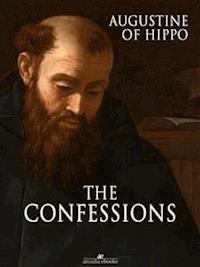
Confessions (Latin: Confessiones) is the name of an autobiographical work, consisting of 13 books, by St. Augustine of Hippo, written in Latin between AD 397 and 400. Its original title was Confessions in Thirteen Books, and it was composed to be read out loud with each book being a complete unit.The work outlines St. Augustine's sinful youth and his conversion to Christianity. It is widely seen as the first Western autobiography ever written, and was an influential model for Christian writers throughout the following 1,000 years, through the Middle Ages. It is generally considered one of Augustine's most important texts.
Das E-Book können Sie in Legimi-Apps oder einer beliebigen App lesen, die das folgende Format unterstützen:
Veröffentlichungsjahr: 2016
Ähnliche














Table of Contents
The Author
Augustine of Hippo (Latin: Aurelius Augustinus Hipponensis; 13 November 354 – 28 August 430), also known as Saint Augustine, Saint Austin, Blessed Augustine, and the Doctor of Grace (Latin: Doctor gratiae), was an early Christian theologian and philosopher whose writings influenced the development of Western Christianity and Western philosophy. He was the bishop of Hippo Regius (modern-day Annaba, Algeria), located in Numidia (Roman province of Africa). He is viewed as one of the most important Church Fathers in Western Christianity for his writings in the Patristic Era. Among his most important works are The City of God and Confessions.
According to his contemporary, Jerome, Augustine "established anew the ancient Faith." In his early years, he was heavily influenced by Manichaeism and afterward by the neo-Platonism of Plotinus. After his baptism and conversion to Christianity in 386, Augustine developed his own approach to philosophy and theology, accommodating a variety of methods and perspectives. Believing that the grace of Christ was indispensable to human freedom, he helped formulate the doctrine of original sin and made seminal contributions to the development of just war theory.
When the Western Roman Empire began to disintegrate, Augustine developed the concept of the Church as a spiritual City of God, distinct from the material Earthly City. His thoughts profoundly influenced the medieval worldview. The segment of the Church that adhered to the concept of the Trinity as defined by the Council of Nicaea and the Council of Constantinople closely identified with Augustine's City of God.
In the Catholic Church and the Anglican Communion, he is a saint, a preeminent Doctor of the Church, and the patron of the Augustinians. His memorial is celebrated on 28 August, the day of his death. He is the patron saint of brewers, printers, theologians, the alleviation of sore eyes, and a number of cities and dioceses. Many Protestants, especially Calvinists, consider him to be one of the theological fathers of the Protestant Reformation due to his teachings on salvation and divine grace.
In the East, some of his teachings are disputed and have in the 20th century in particular come under attack by such theologians as John Romanides. But other theologians and figures of the Eastern Orthodox Church have shown significant appropriation of his writings, chiefly Georges Florovsky. The most controversial doctrine surrounding his name is the filioque, which has been rejected by the Orthodox Church. Other disputed teachings include his views on original sin, the doctrine of grace, and predestination. Nevertheless, though considered to be mistaken on some points, he is still considered a saint, and has even had influence on some Eastern Church Fathers, most notably Saint Gregory Palamas. In the Orthodox Church his feast day is celebrated on 28 August, and he carries the title of Blessed.
Augustine was born in the year 354 AD in the municipium of Thagaste (now Souk Ahras, Algeria) in Roman Africa. His mother, Monica or Monnica, was a devout Christian; his father Patricius was a Pagan who converted to Christianity on his deathbed. Scholars generally agree that Augustine and his family were Berbers, an ethnic group indigenous to North Africa, but that they were heavily Romanized, speaking only Latin at home as a matter of pride and dignity. In his writings, Augustine leaves some information as to the consciousness of his African heritage. For example, he refers to Apuleius as "the most notorious of us Africans," to Ponticianus as "a country man of ours, insofar as being African," and to Faustus of Mileve as "an African Gentleman."
Augustine's family name, Aurelius, suggests that his father's ancestors were freedmen of the gens Aurelia given full Roman citizenship by the Edict of Caracalla in 212. Augustine's family had been Roman, from a legal standpoint, for at least a century when he was born. It is assumed that his mother, Monica, was of Berber origin, on the basis of her name, but as his family were honestiores, an upper class of citizens known as honorable men, Augustine's first language is likely to have been Latin.
At the age of 11, Augustine was sent to school at Madaurus (now M'Daourouch), a small Numidian city about 19 miles (31 km) south of Thagaste. There he became familiar with Latin literature, as well as pagan beliefs and practices. His first insight into the nature of sin occurred when he and a number of friends stole fruit they did not want from a neighborhood garden. He tells this story in his autobiography, The Confessions. He remembers that he did not steal the fruit because he was hungry, but because "it was not permitted." His very nature, he says, was flawed. 'It was foul, and I loved it. I loved my own error—not that for which I erred, but the error itself." From this incident he concluded the human person is naturally inclined to sin, and in need of the grace of Christ.
At the age of 17, through the generosity of his fellow citizen Romanianus, Augustine went to Carthage to continue his education in rhetoric. It was while he was a student in Carthage that he read Cicero's dialogue Hortensius (now lost), which he described as leaving a lasting impression and sparking his interest in philosophy. Although raised as a Christian, Augustine left the church to follow the Manichaean religion, much to his mother's despair. As a youth Augustine lived a hedonistic lifestyle for a time, associating with young men who boasted of their sexual exploits. The need to gain their acceptance forced inexperienced boys like Augustine to seek or make up stories about sexual experiences. It was during this period that he uttered his famous prayer, "Grant me chastity and continence, but not yet."
At about the age of 19, Augustine began an affair with a young woman in Carthage. Though his mother wanted him to marry a person of his class, the woman remained his lover for over fifteen years and gave birth to his son Adeodatus, who was viewed as extremely intelligent by his contemporaries. In 385, Augustine ended his relationship with his lover in order to prepare himself to marry a ten-year-old heiress. (He had to wait for two years because the legal age of marriage was twelve. By the time he was able to marry her, however, he instead decided to become a celibate priest.)
Augustine was from the beginning a brilliant student, with an eager intellectual curiosity, but he never mastered Greek —he tells us that his first Greek teacher was a brutal man who constantly beat his students, and Augustine rebelled and refused to study. By the time he realized that he needed to know Greek, it was too late; and although he acquired a smattering of the language, he was never eloquent with it. However, his mastery of Latin was another matter. He became an expert both in the eloquent use of the language and in the use of clever arguments to make his points.
Augustine taught grammar at Thagaste during 373 and 374. The following year he moved to Carthage to conduct a school of rhetoric and would remain there for the next nine years. Disturbed by unruly students in Carthage, he moved to establish a school in Rome, where he believed the best and brightest rhetoricians practiced, in 383. However, Augustine was disappointed with the apathetic reception. It was the custom for students to pay their fees to the professor on the last day of the term, and many students attended faithfully all term, and then did not pay. Manichaean friends introduced him to the prefect of the City of Rome, Symmachus, who had been asked by the imperial court at Milan to provide a rhetoric professor.
Augustine won the job and headed north to take his position in late 384. Thirty years old, he had won the most visible academic position in the Latin world at a time when such posts gave ready access to political careers. Although Augustine showed some fervour for Manichaeism, he was never an initiate or "elect", but an "auditor", the lowest level in the sect's hierarchy.
While still at Carthage a disappointing meeting with the Manichaean Bishop, Faustus of Mileve, a key exponent of Manichaean theology, started Augustine's scepticism of Manichaeanism. In Rome, he reportedly turned away from Manichaeanism, embracing the scepticism of the New Academy movement. Because of his education, Augustine had great rhetorical prowess and was very knowledgeable of the philosophies behind many faiths. At Milan, his mother's religiosity, Augustine's own studies in Neoplatonism, and his friend Simplicianus all urged him towards Christianity. Initially Augustine was not strongly influenced by Christianity and its ideologies, but after coming in contact with Ambrose of Milan, Augustine reevaluated himself and was forever changed.
Like Augustine, Ambrose was a master of rhetoric, but older and more experienced. Augustine was very much influenced by Ambrose, even more than by his own mother and others he admired. Augustine arrived in Milan and was immediately taken under the wing by Ambrose. Within his Confessions, Augustine states, "That man of God received me as a father would, and welcomed my coming as a good bishop should." Soon, their relationship grew, as Augustine wrote, "And I began to love him, of course, not at the first as a teacher of the truth, for I had entirely despaired of finding that in thy Church—but as a friendly man." Augustine visited Ambrose in order to see if Ambrose was one of the greatest speakers and rhetoricians in the world. More interested in his speaking skills than the topic of speech, Augustine quickly discovered that Ambrose was a spectacular orator. Eventually, Augustine says that through the unconscious, he was led into the faith of Christianity.
Augustine's mother had followed him to Milan and arranged a marriage for which he abandoned his concubine. Although Augustine accepted this marriage, Augustine was deeply hurt by the loss of his lover. He said, "My mistress being torn from my side as an impediment to my marriage, my heart, which clave to her, was racked, and wounded, and bleeding." Augustine confessed that he was not a lover of wedlock so much as a slave of lust, so he procured another concubine since he had to wait two years until his fiancée came of age. However, his wound was not healed, even began to fester.
There is evidence that Augustine may have considered this former relationship to be equivalent to marriage. In his Confessions, he admitted that the experience eventually produced a decreased sensitivity to pain. Augustine eventually broke off his engagement to his eleven-year-old fiancée, but never renewed his relationship with either of his concubines. Alypius of Thagaste steered Augustine away from marriage, saying that they could not live a life together in the love of wisdom if he married. Augustine looked back years later on the life at Cassiciacum, a villa outside of Milan where he gathered with his followers, and described it as Christianae vitae otium – the Christian life of leisure.
In the summer of 386, at the age of 31, after having heard and been inspired and moved by the story of Ponticianus's and his friends' first reading of the life of Saint Anthony of the Desert, Augustine converted to Christianity. As Augustine later told it, his conversion was prompted by a childlike voice he heard telling him to "take up and read" (Latin: tolle, lege), which he took as a divine command to open the Bible and read the first thing he saw. Augustine read from Paul's Epistle to the Romans – the "Transformation of Believers" section, consisting of chapters 12 through 15 – wherein Paul outlines how the Gospel transforms believers, and the believers' resulting behaviour. The specific part to which Augustine opened his Bible was Romans chapter 13, verses 13 and 14, to wit:
He later wrote an account of his conversion – his very transformation, as Paul described – in his Confessions (Latin: Confessiones), which has since become a classic of Christian theology and a key text in the history of autobiography. This work is an outpouring of thanksgiving and penitence. Although it is written as an account of his life, the Confessions also talks about the nature of time, causality, free will, and other important philosophical topics. The following is taken from that work:
Ambrose baptized Augustine, along with his son Adeodatus, on Easter Vigil in 387 in Milan. A year later, in 388, Augustine completed his apology On the Holiness of the Catholic Church. That year, also, Adeodatus and Augustine returned home to Africa. Augustine's mother Monica died at Ostia, Italy, as they prepared to embark for Africa. Upon their arrival, they began a life of aristocratic leisure at Augustine's family's property. Soon after, Adeodatus, too, died. Augustine then sold his patrimony and gave the money to the poor. The only thing he kept was the family house, which he converted into a monastic foundation for himself and a group of friends.
Much of Augustine's conversion is dramatized in Johann Adolph Hasse's oratorio La conversione di Sant' Agostino. In the libretto for the oratorio by Duchess Maria Antonia of Bavaria, Augustine's mother Monica is presented as a prominent character that is worried that Augustine might not convert to Christianity. The Duchess took a five-part drama by Franciscus Neumayr and condensed it for the purposes of the oratorio. As Dr. Andrea Palent says:
Throughout the oratorio Augustine shows his willingness to turn to God, but the burden of the act of conversion weighs heavily on him. This is displayed by Hasse through extended recitative passages.
In 391 Augustine was ordained a priest in Hippo Regius (now Annaba), in Algeria. He became a famous preacher (more than 350 preserved sermons are believed to be authentic), and was noted for combating the Manichaean religion, to which he had formerly adhered.
In 395 he was made coadjutor Bishop of Hippo, and became full Bishop shortly thereafter, hence the name "Augustine of Hippo"; and he gave his property to the church of Thagaste. He remained in that position until his death in 430. He wrote his autobiographical Confessions in 397-398. His work The City of God was written to console his fellow Christians shortly after the Visigoths had sacked Rome in 410.
Augustine worked tirelessly in trying to convince the people of Hippo to convert to Christianity. Though he had left his monastery, he continued to lead a monastic life in the episcopal residence. He left a regula for his monastery that led to his designation as the "patron saint of regular clergy."
Much of Augustine's later life was recorded by his friend Possidius, bishop of Calama (present-day Guelma, Algeria), in his Sancti Augustini Vita. Possidius admired Augustine as a man of powerful intellect and a stirring orator who took every opportunity to defend Christianity against its detractors. Possidius also described Augustine's personal traits in detail, drawing a portrait of a man who ate sparingly, worked tirelessly, despised gossip, shunned the temptations of the flesh, and exercised prudence in the financial stewardship of his see.
Shortly before Augustine's death the Vandals, a Germanic tribe that had converted to Arianism, invaded Roman Africa. The Vandals besieged Hippo in the spring of 430, when Augustine entered his final illness. According to Possidius, one of the few miracles attributed to Augustine, the healing of an ill man, took place during the siege. According to Possidius, Augustine spent his final days in prayer and repentance, requesting that the penitential Psalms of David be hung on his walls so that he could read them. He directed that the library of the church in Hippo and all the books therein should be carefully preserved. He died on 28 August 430. Shortly after his death, the Vandals lifted the siege of Hippo, but they returned not long thereafter and burned the city. They destroyed all of it but Augustine's cathedral and library, which they left untouched.
Augustine was canonized by popular acclaim, and later recognized as a Doctor of the Church in 1298 by Pope Boniface VIII. His feast day is 28 August, the day on which he died. He is considered the patron saint of brewers, printers, theologians, sore eyes, and a number of cities and dioceses.
According to Bede's True Martyrology, Augustine's body was later translated or moved to Cagliari, Sardinia, by the Catholic bishops expelled from North Africa by Huneric. Around 720, his remains were transported again by Peter, bishop of Pavia and uncle of the Lombard king Liutprand, to the church of San Pietro in Ciel d'Oro in Pavia, in order to save them from frequent coastal raids by Muslims. In January 1327, Pope John XXII issued the papal bull Veneranda Santorum Patrum, in which he appointed the Augustinians guardians of the tomb of Augustine (called Arca), which was remade in 1362 and elaborately carved with bas-reliefs of scenes from Augustine's life.
In October 1695, some workmen in the Church of San Pietro in Ciel d'Oro in Pavia discovered a marble box containing some human bones (including part of a skull). A dispute arose between the Augustinian hermits (Order of Saint Augustine) and the regular canons (Canons Regular of Saint Augustine) as to whether these were the bones of Augustine. The hermits did not believe so; the canons affirmed that they were. Eventually Pope Benedict XIII (1724–1730) directed the Bishop of Pavia, Monsignor Pertusati, to make a determination. The bishop declared that, in his opinion, the bones were those of Saint Augustine.
The Augustinians were expelled from Pavia in 1700, taking refuge in Milan with the relics of Augustine, and the disassembled Arca, which were removed to the cathedral there. San Pietro fell into disrepair, but was finally rebuilt in the 1870s, under the urging of Agostino Gaetano Riboldi, and reconsecrated in 1896 when the relics of Augustine and the shrine were once again reinstalled.
(source wikipedia.org)
Augustine of Hippo
THE CONFESSIONS
Translated by Edward Bouverie Pusey
Arcadia Ebooks 2016
www.arcadiaebooks.altervista.org
THE CONFESSIONS
Lesen Sie weiter in der vollständigen Ausgabe!
Lesen Sie weiter in der vollständigen Ausgabe!
Lesen Sie weiter in der vollständigen Ausgabe!
Lesen Sie weiter in der vollständigen Ausgabe!
Lesen Sie weiter in der vollständigen Ausgabe!
Lesen Sie weiter in der vollständigen Ausgabe!
Lesen Sie weiter in der vollständigen Ausgabe!
Lesen Sie weiter in der vollständigen Ausgabe!
Lesen Sie weiter in der vollständigen Ausgabe!
Lesen Sie weiter in der vollständigen Ausgabe!
Lesen Sie weiter in der vollständigen Ausgabe!
Lesen Sie weiter in der vollständigen Ausgabe!




