


33,67 €
Mehr erfahren.
- Herausgeber: Crossroad Publishing
- Kategorie: Religion und Spiritualität
- Sprache: Englisch
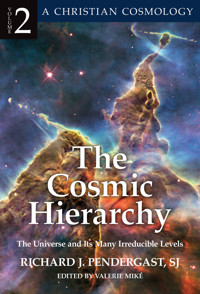
The Catholic Church does not have a formal teaching on evolution at this time. But people wonder about the meaning of their lives as experienced in their own culture, which today is dominated by science. Charles Darwin’s theory of evolution has raised many questions and led to diverse claims. In this work addressed to the general reader, the author discusses what has been reliably established by science, distinguishing it from interpretations of the theory guided by philosophical assumptions. Seeking a coherent view of the world, he integrates our scientific knowledge with what we have in Sacred Scripture and lays the foundation of a Christian cosmology. It is the beginning of a venture for generations.
Das E-Book können Sie in Legimi-Apps oder einer beliebigen App lesen, die das folgende Format unterstützen:
Veröffentlichungsjahr: 2024
Ähnliche










THE COSMIC HIERARCHY
A Christian Cosmology,
dedicated to the honor of
Pope St. John Paul II
in the year 2020,
the centenary of his birth
A CHRISTIAN COSMOLOGY
by
Richard J. Pendergast, SJ
Edited by
Valerie Miké
Dates on Volumes 1–5 indicate year of completion of the book manuscript.
Volume 1.THE COSMIC HIERARCHY:
God’s Plan for the Evolution of the Universe(2012)
Introduction to a Christian cosmology, an integration of modern science and divine revelation, with the aim of achieving a coherent view of the universe. The focus here is on the key scientific issues.
Volume 2.THE COSMIC HIERARCHY:
The Universe and Its Many Irreducible Levels(2007)
A Christian cosmology, the integration of modern science and divine revelation. Analysis of scientific issues in the full context of insights offered by philosophy and theology.
Volume 3.A VISION FOR OUR TIMES:
In the Sadness of the Modern World(1988)
Response to the need for a cosmology that incorporates modern science into a religious view of the world and offers meaning. Use is made of new concepts of physics (quantum mechanics) and philosophy (process thought).
Volume 4.THE LIVING UNIVERSE:
An Organic Theory of Mind and Matter(1990)
An interpretation of quantum mechanics with the synthesis of Aristotelian and Whiteheadian concepts results in a process cosmology. The relationship of the cosmos to the transcendent reality of God.
Volume 5.CREATION, EVIL, AND THE TRINITY:
A Christian Process Theology(1990)
Integration of the new cosmol ogy into a wider theological synthesis shows Christian revelation on this process basis to illuminate the fundamental nature of reality in a fresh way.
Volume 6.THE MASS ON THE WORLD:
A Modern Theory of Transubstantiation(2008)
Reprint in three languages (English, German, and Spanish) of the author’s study concerning the teaching of the Catholic Church on the real presence of Christ in the Eucharist.
Richard J. Pendergast, SJ 1927–2012
A collaboration with The Ethics of Evidence Foundation, Inc.
A Herder & Herder Book
The Crossroad Publishing Company
www.crossroadpublishing.com
Copyright © 2024 The Ethics of Evidence Foundation, Inc., with consent of the USA East Province of the Society of Jesus
Crossroad, Herder & Herder, and the crossed C logo/colophon are registered trademarks of The Crossroad Publishing Company.
All rights reserved. No part of this book may be copied, scanned, reproduced in any way, or stored in a retrieval system, or transmitted, in any form or by any means, electronic, mechanical, photocopying, recording, or otherwise, without the written permission of The Crossroad Publishing Company. For permission please write to [email protected].
In continuation of our 200-year tradition of independent publishing, The Crossroad Publishing Company proudly offers a variety of books with strong, original voices and diverse perspectives. The viewpoints expressed in our books are not necessarily those of The Crossroad Publishing Company, any of its imprints or of its employees, executives, or owners. Although the author and publisher have made every effort to ensure that the information in this book was correct at press time, the author and publisher do not assume and hereby disclaim any liability to any party for any loss, damage, or disruption caused by errors or omissions, whether such errors or omissions result from negligence, accident, or any other cause. No claims are made or responsibility assumed for any health or other benefits.
Cover design by George Foster after the original of John Miké
Hubble Telescope image of a star formation region in jet HH901 of the Carina Nebula
Library of Congress Cataloging-in-Publication Data available from the Library of Congress.
ISBN 9780824503758 tradepaper
ISBN 9780824501990 cloth
ISBN 9780824502003 epub
Books published by The Crossroad Publishing Company may be purchased at special quantity discount rates for classes and institutional use. For information, please e-mail [email protected].
. . . the revelation of the mystery that was kept secret for long ages . . .
ROMANS 16:25
Contents
Foreword to Volume 2by Valerie Miké
Foreword to Volume 1: A Man with a Missionby Valerie Miké
Preface
PART ONE: SETTING THE SCENE
Chapter 1. Introduction
1 • The Present Crisis
2 • John Paul II on Science, Philosophy, and Theology
3 • Recalling Etienne Gilson
4 • Christian Cosmology
5 • The Faith of Scientists
6 • Different Ways of Knowing
Chapter 2. Creation and Evolution
1 • Creation and the Big Bang
2 • Simultaneity
3 • General Relativity
4 • Creationism and Neo-Darwinism
5 • The Christian Doctrine of Creation
6 • Consilience
Chapter 3. Philosophical Concepts
1 • Philosophical Cosmology
2 • Being
3 • Objective and Tacit Knowledge
4 • Critical Realism
5 • Intentionality
6 • Being and Action
7 • Final and Telic Causality
8 • Insights from Whitehead and from Systems Theory
Chapter 4. Critical Scientific Realism
1 • Scientific Realism and Empiricism
2 • Analogy and Verisimilitude
3 • Conceptual Models
4 • Explanatory Power
5 • Tacit Knowledge
PART TWO: HIERARCHICAL STRUCTURE
Chapter 5. The Cosmic Hierarchy
1 • Theories of Matter
2 • Mayr versus Weinberg
3 • The Emergence of Consciousness
4 • Beings within Beings
5 • Conclusion
Chapter 6. Reductionism and Consciousness
1 • Artificial Intelligence
2 • The Limits of Neuroscience
3 • A Neuroscientific Model of Consciousness
4 • The Nature of Consciousness
5 • Philosophical Discussion of Consciousness
6 • Conclusion
PART THREE: QUANTUM MECHANICS
Chapter 7. Basic Concepts of Quantum Mechanics
1 • The Two-Slit Experiment
2 • Superposition
3 • Uncertainty and Complementarity
4 • The Processes U and R
5 • Entanglement
6 • The EPR Thought Experiment
7 • Bohm’s Improved Experiment
8 • Bell’s Theorem
Chapter 8. Diverse Interpretations of QM
1 • The Copenhagen Interpretation
2 • Hidden Variables
3 • Many-Worlds
4 • Consciousness
5 • Spontaneous Localization and the Role of Gravity
6 • Interpretations FAPP
7 • Consistent Histories
8 • The Propensity Interpretation
9 • The Transactional Interpretation
Chapter 9. The Nature of Time
1 • Past, Present, and Future
2 • The Discreteness of Time
3 • The Reality of the Past
4 • An Objection
5 • The Cosmic Tree
6 • Cosmology and Eschatology
Chapter 10. QM and the Cosmic Hierarchy
1 • More on the Cosmic Hierarchy
2 • Reinterpreting Cramer’s Interpretation
3 • Conclusion
Chapter 11. A Speculative Model
1 • The Level of the Elementary Entities
2 • Structure and Evolution of the Model
3 • Future Prospects
PART FOUR: BIOLOGICAL EVOLUTION
Chapter 12. Modest and Ambitious Darwinism
1 • Neo-Darwinism
2 • Modest versus Ambitious Darwinism
3 • The Two Darwinian Claims
4 • Teleology and the Cosmic Hierarchy
5 • The Glory of God Is Man Fully Alive
Chapter 13. The Intelligent Design Movement
1 • Irreducible Biochemical Mechanisms
2 • Probability and Information Theory
3 • The Multiverse
Chapter 14. The Nature of Evolution
1 • Seeking the Truth about Evolution
2 • Teleological Evolution
3 • Critique of Intelligent Design
4 • Atelic Naturalism
• Excursus: Editor’s Update on Intelligent Design
PART FIVE: THEOLOGY
Chapter 15. Evolution and Evil
1 • The Problem of Evil
2 • The Doctrine of Original Sin
3 • Ten Theses
4 • The Role of Cosmic Powers in Evolution
Chapter 16. Creation and the Trinity
1 • The Quest for Unity
2 • The Doctrine of the Trinity
3 • Transcendental Concepts
4 • The Interpersonal Model
5 • The Psychological Model
6 • Personalism and the Trinity
7 • The Trinity and the Act of Creation
8 • Creation Makes a Difference within the Trinity
9 • God’s Immutability
10 • The Economic Trinity, Deification, Incosmation
Chapter 17. The Future of Mankind
Reference List
Curriculum Vitae: Richard J. Pendergast, SJ
Index
About the Author
About the Editor
About the Publisher
FOREWORD TO VOLUME 2
The foreword to Volume 1, “A Man with a Mission,” tells the story of the six-volume Pendergast Series and is reprinted in this volume.
A Christian Cosmology studies the two books of God, the Bible and nature, to discern their consistent reading for our age. This volume, an expanded version of Volume 1, offers a framework of illu minating concepts of philosophy and theology, in which it develops in rich detail the author’s crystallized vision.
Richard Pendergast sees the world as a hierarchy of irreducible elements, the highest level being that of the Logos. From the search of ancient Greek philosophy for a unifying principle and its integration with Jewish thought in the Hellenistic era, he relates the emergence of the Christian doctrine of the Trinity and its study to the present day. Using scriptural sources, he makes explicit the concept of “incosmation,” pre ceding that of the Incarnation, and presents to us an immanent and transcendent Logos as head of the universe.
Volume 2 includes an analysis for the general reader of what science revealed in the twentieth century concerning the structure and origin of the world, described mainly by the theories of relativity and quantum mechanics. The book then moves on to biological evolution and the origin of the human race. Darwin’s theory, with the two basic factors of random mutation and natural selection, has become atheistic neo-Darwinism. Richard Pendergast speaks in terms of what he calls “modest” Darwinism, adding a third factor of purpose. This crucially important concept of modest Darwinism, meaning evolution with purpose, appears to be as yet unknown to a large segment of even the highly educated Christian public. It is, however, an integral part of the author’s coherent view of reality, the teleology of the cosmic hierarchy and of quantum mechanics.
An explanation here may be helpful. Chapter 2, on creation and evolution, identifies the source of what has become a serious mis understanding, resulting from the 1982 Arkansas creation trial, with its implied message that religion and science are not related and that evolution has no purpose. When the state of Arkansas passed a law requiring a balanced treatment of so-called “creation-science” (a term based on a literal interpretation of Genesis) and evolution science in public schools, the American Civil Liberties Union brought suit. The law was struck down on January 5, 1982, with the blanket endorsement of neo-Darwinism. How could this happen? There are influential religious communities in the United States who believe the story of creation as told in Genesis, but the teaching of religion in public schools is illegal. The consequences of this event would become global, leading to the spread of confusion, including the rejection of the Intelligent Design movement, an example of modest Darwinism.
Ernan McMullin, a Catholic priest and noted scholar of the history and philosophy of science, commented about the trial:
From the Christian standpoint the whole affair was a tragedy from beginning to end. Creationists acted in defense of their religious beliefs, but they succeeded only in making religion and science seem mutually exclusive. They tried to force a false choice on public school students, an either-or that even the smallest comprehension [of the history of the concepts of creation and evolution] would have shown to be ill-considered. . . .
A particularly unfortunate consequence of this controversy is that the term “creationist” has been rendered unusable by ordinary Christians, Jews or Muslims in describing their own beliefs. Yet they believe in God as creator; they profess the faith that the universe is God’s handiwork. They are all thus “creationist” in the most basic sense. But they are forced to disavow the extravagant doctrine that its protagonists (and the U.S. media) have agreed to call “creationism.” The entire notion of creation has been rendered suspect by an ill-advised literalism that would already have seemed out of place in Augustine’s day.
Augustine, indeed, perceived the dangers to the Christian community of precisely the sort of suspicion that the proponents of “creation-science” have fostered. Often, he says, Christians who do not understand some point about the earth, or the distances of the stars, or the orbits of the planets, or the nature of stones, or the like, will attempt to make their point by arguing as if it were Christian doctrine. The worst, he goes on, is not that such persons will be laughed at but that the Scriptures themselves will be brought into disrepute.1
The situation has become more serious even than McMullin predicted. A scientific theory of evolution that allows for teleology was conflated with this caricature of creationism and summarily dismissed, as has happened with Intelligent Design.
It is the genius of Richard Pendergast’s work that it opens the door to an intellectually honest and sound understanding of the world for our time and offers fresh insight into the meaning of Christian faith.
When Father Pendergast died in 2012, I assumed responsibility for the manuscripts he had left in my care. It is my privilege and joy to promote his message and to seek its wide distribution.
My “Editor’s Update on Intelligent Design” was included as an excursus in Volume 1. For greatest clarity, the updated material on biological evolution is reprinted in this volume as chapters 12–14.
In addition, as suggested by the publisher, to offer further clarification and insight into faith-science issues, I am preparing a companion volume based on a selection of my related work for an encyclopedia. To be released shortly, it is titled From Information to Insight: Toward a Consistent Reading of Science and Faith.2
Valerie Miké
President, The Ethics of Evidence Foundation
January 6, 2023
Acknowledgment. I am grateful to Msgr. Stuart W. Swetland, STD, for our discussions concerning theological themes explored in this volume.
REFERENCES
1. Ernan McMullin, “Introduction: Evolution and Creation,” in Evolution and Creation, ed. Ernan McMullin (Notre Dame, IN: University of Notre Dame Press, 1985), 1–56, here 47–48, citing Augustine, De Genesi ad litteram 1.19, in Augustine, The Literal Meaning of Genesis, trans. and annotated by John Hammond Taylor, S.J., 2 vols., Ancient Christian Writers 41–42 (New York: Newman Press, 1982), 1:43.
2. Valerie Miké, From Information to Insight: Toward a Consistent Reading of Science and Faith (New York: Crossroad, forthcoming 2023).
FOREWORD TO VOLUME 1
A Man with a Mission
Richard J. Pendergast, SJ, was my friend. Although we were both New Yorkers, our meeting in the summer of 1984 was not a chance encounter. Quite the contrary, it was for me the end result of a targeted search.
A native of Budapest, Hungary, I had lived through the Second World War as a child, and come to the United States in my teens with my family in the subsequent wave of refugees from East Central Europe. I attended public high school, and my early love of mathematics was joined by a growing interest in philosophy as I completed a broad liberal arts program on scholarship at Manhattanville College. Further support was provided by Bell Labs, where I worked in systems engineering while studying for a doctorate in mathematics at the Courant Institute of New York University. Readings in the history of science led to the desire to participate in the introduction of mathematical techniques in medicine.
By this time, I had been engaged in medical research and education for nearly two decades at a large medical center on the Upper East Side of Manhattan, where I also lived. My work was engrossing and meaningful, but I sensed with increasing intensity the absence of a dimension in the totally secular framework of my professional life: issues upon issues that cried out for exploration and analysis in the full context of our rich traditions that include the world of the spirit. I kept buying books, I kept reading. There was the recurring thought that perhaps I need not be alone, perhaps there were others somewhere, others I could join in a common quest. The two authors whose work had made a special impression on me were Teilhard de Chardin and Karl Rahner. Since both were Jesuits, I thought I should find out what the Jesuits were doing. But I did not know any Jesuits. Then one day, browsing in the literature rack in the vestibule of St. Ignatius Jesuit Church near my apartment, I came across the announcement of a one-week directed retreat to take place shortly at Loyola Retreat House in New Jersey, not far from Manhattan. I had no idea what a directed retreat was; I knew only about preached weekend retreats that I had attended. But it said here that participants had their personal director with whom they met for an hourly session each day. Speak with a Jesuit for an hour every day for a week? That seemed perfect for me, and I signed up. Under comments, I added that I would like an older director and I wanted to discuss my work.
My director was Father Harvey Haberstroh, a kind, gentle man in his early seventies. He listened intently as I told my story, then said that he would think about it. He suggested that in the meantime I enjoy the week ahead. And I did just that. It turned out that I was the only lay member of the group. The others were priests and nuns making their annual one-week retreats, and many seemed to know each other. But I was rapidly drawn into the spirit of the event. The beautiful setting of thirty acres of lawns and gardens, the open, friendly environment, the intimacy of daily Mass with the community gathered in the small chapel—a new experience for me, used to large city churches—contributed to a peaceful, joyous stay.
The day before the end of the retreat, Father Haberstroh returned to the subject of my visit. He said that he had been praying about it, to discern how to help me in my search. The best advice he could offer was that I should meet another Jesuit priest, Richard Pendergast, who had been on the staff here and had just been assigned to St. Ignatius in Manhattan. A few years older than I, he had a doctorate in physics and had published a book called Cosmos that was available in the retreat house library. “You should meet Dick Pendergast,” Father Haberstroh said, “because you are soulmates.” I did find a copy of Cosmos in the library. Its dedication read: “To Karl Rahner and Pierre Teilhard de Chardin, masters and older brothers in Christ.”
When I called Richard Pendergast shortly afterward, he had already heard about me from Father Haberstroh. We agreed to meet at St. Ignatius at one o’clock on a day later that week. He was waiting for me when I arrived at the rectory and we sat down in the parlor. The conversation flowed easily and became absorbing. So much so, that the next time I looked at my watch, I was surprised to see that it was six o’clock. He understood and responded to the issues I raised, and I in turn was familiar with concepts and titles he mentioned, books I had read on my own over the years. He spoke of the significance of The Cloud of Unknowing, the fourteenth-century English classic of mysticism, a work that I knew and owned. When I got home, I took the little book off the shelf and read it again that evening.
Although the circumstances and settings would vary, that first meeting set the pattern for the next twenty-eight years: five to six hours of rambling conversation, about anything and everything. We would generally meet every few weeks, with phone calls in between.
I asked him at the start what he was doing. He explained, and this I also knew, that the best exposition of Catholic doctrine was held to be that of St. Thomas Aquinas, based on the philosophy of Aristotle. But the latter has a static worldview, whereas science today thinks in terms of process, of evolution. An approach especially suited to properly modify the expression of Church teaching was the process philosophy of Alfred North Whitehead, who had important insights that had not been developed from a Catholic perspective. Making use of these to seek a modern synthesis of Thomistic thought based on reality as process was Richard Pendergast’s aim. I already knew of Whitehead as a major figure in mathematics, and all this made a lot of sense to me. People try to find the meaning of life as experienced in their own culture, and the eternal message of the Church is clearly most meaningful if pro claimed in the framework of a compatible cosmology.
In fact, to reconcile modern science and Christian faith was the reason Richard Pendergast became a Jesuit. He had served in the Navy, was an electrical engineer, had had a girlfriend. In the end, the desire to devote his life to seeking a resolution of conflict between science and religion became decisive, and he felt that he could best do that as a member of the Society of Jesus. By the time we met, however, he had been a Jesuit for over three decades and had a realistic picture of the situation. This was not an age of syntheses, he said; there was virtually no interest. The focus was entirely on science, its stunning feats and promises. His own hope now was to develop the synthesis outlined in his 1973 work Cosmos,1 publish his insights in a book and leave it for posterity, for the Lord to make use of it at the proper time as he willed.
Zachary Hayes, OFM, devotes a section of his book What AreThey Saying about Creation? to a review of Cosmos. “Perhaps the most sustained attempt to map out the contours of a new theological model is the little-known study by R. Pendergast entitled Cosmos (Fordham University Press, 1973). . . . Throughout he expresses the implications of the basic conviction that dynamic process is a fundamental feature of cosmic reality which theology ignores only at a great price.”2
The Cosmic Hierarchy, the title of Volumes 1 and 2, reflects the primary roles of the nature of time and of teleology in Richard Pendergast’s crystallized vision. He saw evolution as the progressive, step-by-step actualization of the successive levels of what he called the cosmic hierarchy (six or more levels from the smallest particles to living beings), with progress in terms of ontological value. He did not see aimless wandering through the space of all possible configurations of inanimate matter. An early draft of his manuscript was already in existence when we met. He gave me a copy to read, and I had the opportunity to see and discuss later versions as his material continued to develop.
An author significant in Richard Pendergast’s work who would become central to my own thinking about scientific activity was the scientist-philosopher Michael Polanyi. Challenging positivist con cepts of objectivity with his theory of personal knowledge, Polanyi argued that all explicit knowledge relies on tacit knowledge, a vast domain of tacit assumptions, perceptions, and commitments of the persons who hold them. Science is a more formalized type of knowledge, but not distinct in kind from other human knowledge. It is an affirmation of our beliefs; these must be responsible beliefs consistent with the evidence, but the ultimate commitment is that of personal judgment.
Polanyi’s thought complemented in my own mind the revolutionary insight of twentieth-century mathematics concerning the intrinsic limitations of scientific knowledge, achieved by Kurt Gödel’s incompleteness theorem. According to this theorem, any consistent mathematical system that includes even as little as the arithmetic of whole numbers contains statements that cannot be proved either true or false within the system. No mathematical system can encompass all truth; there will always be some truths that are beyond it. This means that science will never be able to explain all of reality.
My main focus was on issues of uncertainty and evidence in medicine, and I sought an approach that could be meaningful to all in our pluralistic culture. I called it the Ethics of Evidence.3 Why ethics? The aim of evidence is to promote some belief or action, and thus it has an intrinsic moral dimension. Evidence is complex and fragile, with standards that vary by discipline. Developed initially for medicine, the approach has since been seen to be widely applicable to other areas of decision making in human affairs. Summed up in two simple rules or imperatives, it calls for (1) the creation and use of the best possible evidence in each relevant field, and (2) increased awareness and acceptance of the extent and ultimately irreducible nature of uncertainty—scientific and existential uncertainty. The desired outcome is a conscious act of personal judgment.
After a year’s assignment at St. Ignatius, Richard Pendergast served for six years as chaplain at a retreat house on Long Island. In 1991, he suffered a major stroke, from which he recovered almost completely, but an existing heart condition turned more serious, and he became a permanent resident at Murray-Weigel Hall, the Jesuit infirmary on the Fordham University campus. He engaged in pastoral ministry nearby and continued his scholarly work. He had taught physics in college in his early years as a Jesuit but had left academic life by the time we met. Pastoral ministry combined with his own research and writing was what he wanted to do. His closest friends were devout Catholic couples with large families who welcomed him into their homes. His parents were deceased. He had a younger sister, a Dominican nun, whom he brought over to meet me on her next visit to New York; sadly, she died of cancer not long afterward. He had three cousins in New Jersey with whom he kept in touch. Through him I met other Jesuits, mostly at conferences we attended together.
When he came to Manhattan, at times we would go to see an exhibit at the nearby Metropolitan Museum of Art. When I visited him at Murray-Weigel, we attended the community Mass and had lunch with the community, then spent the afternoon at the New York Botanical Garden adjoining the Fordham campus. He enjoyed walking in the Garden and visited it almost every day.
When, calling him about something in the evening, I asked what he was doing, nearly always he was saying the Rosary. I asked him once how much time he spent in prayer each day, and he said three hours. During the 1995 papal visit to New York, when Pope John Paul II celebrated Mass in Central Park for 125,000, Richard Pendergast was one of two hundred priests concelebrating with the Holy Father and distributing Communion to the faithful.
On occasion we spent a weekend at my widowed mother’s home in New Jersey, where he celebrated Mass for us. Early risers both, they would engage in wide-ranging conversation at the kitchen table, as she offered him a rich menu for breakfast. He also enjoyed her fine Hungarian cuisine at the holiday dinners he came to share with us. He visited my mother regularly at Memorial Sloan-Kettering during her final illness, and he was with me at the hospital on the day she died.
In his 2012 autobiography, the distinguished German Catholic philosopher Robert Spaemann makes the statement that, in his view, the most significant work of metaphysics of the twentieth century was Process andReality by Alfred North Whitehead.4
But the situation was far from clear in America. A rejection letter Richard Pendergast received from a well-known Catholic publisher states, “I think that the topics covered are extremely important.” But . . . “we are not quite ready to stake out a claim in the hylomorphism wars.” There had been similar responses to previous attempts to have his book published. It may be, although I cannot of course be sure, that the reticence of Catholic publishers to get involved was based on the perceived conflict between modern physics, with related process thought, and Aristotle’s theory of matter, of substance as matter and form (hylomorphism), used in the philosophical formulation of the teaching of the Catholic Church on the Eucharist.
This important, highly specific theological topic did not appear in the Pendergast manuscript. He published a separate, long essay on the subject in a peer-reviewed journal of philosophy and theology. Titled “The Mass on the World,” this essay presents a comprehensive historical review and sketches a modern theory of transubstantiation that is consistent with Church doctrine.5
Briefly, it involves the cosmic hierarchy, a form of holism discussed by Richard Pendergast, and his use of the original Hegelian term aufheben, translated into English here as “to sublate.” (Hegel introduced this German word with its diverse contradictory meanings in everyday use, exemplified by “to cancel” and “to preserve,” into philosophical terminology. It has been employed by other scholars whose interest was in the word itself, unrelated to Hegelian philosophy.) When entities are sublated to a higher level of ontological value of the cosmic hierarchy, their own properties are preserved, while they themselves are integrated into the entity on the new level. In consecration, the Eucharistic bread and wine are sublated from their natural level to the highest level of the hierarchy and become the incarnate Word. The real presence of Christ in the Eucharist is a sign and promise of the final transformation of the world, and the essay here recalls the mystical prayer of Teilhard de Chardin reflected in its title.
Richard Pendergast had already published a study on his Thomistic-process theory of the Trinity,6 a process theory of creation,7 and a process Christology,8 with two more studies to follow.9, 10 At this point he decided on a radical revision of his manuscript. His primary aim had always been to reach a wide audience, the general public, readers seeking meaning in their own lives amid the fragmentation and noisy claims of the secular world. Retaining the main title of the book, he changed the subtitle from “The Universe and Its Many Irreducible Levels” (Volume 2) to “God’s Plan for the Evolution of the Universe” (Volume 1).
This new, condensed version focuses on the important current concerns of science—the nature of matter, the problem of human consciousness, the interpretation of quantum mechanics and of biological evolution—and with extensive review of the literature offers a coherent view that is compatible with scientific findings as well as divine revelation.
But since every conclusion is based on a philosophy, there is an appendix on philosophy, where the author describes his own position. His early training had been in the Aristotelian-Thomistic tradition, as it was understood by Etienne Gilson and other neo-Thomists of the day. He had also been influenced by the ideas of Karl Rahner, Michael Polanyi, Alfred North Whitehead, and others. He explains some of the concepts that are accepted by most, or at least many, contemporary Thomists, with certain modifications of his own. He was basically a Thomist.
My brother John, also a physicist, offered to prepare a pre publication edition of this new version, and Pendergast gladly accepted. He did not see the cover, designed by my brother using an image of a star formation region from the Hubble telescope, until the carton of books arrived by mail at Fordham. It was meant as a surprise, and he loved it.
They had begun working together on the index when he died. He called me late one evening to ask about the results of some tests concerning my deteriorating eyesight. His death was sudden, due to a heart attack or stroke, and appears to have occurred shortly after we spoke. His last words to me were words of consolation and hope.
Always an optimist brimming with ideas, my brother insisted that we could continue on our own, and plans to get the book published were our top priority in the months that followed. Then John himself, having completed a manuscript of his own in physics, suffered a massive stroke. He survived for three years but was totally incapacitated.
Out of this, for me, devastating situation emerged a thought that has become reality—a foundation to carry on our work, mine and theirs. It is the Ethics of Evidence Foundation, a not-for-profit corporation incorporated in the State of New York. Funded initially by my personal resources, it has been approved by the Internal Revenue Service as a 501(c)(3) tax-exempt corporation, so that others can contribute to support its mission of research and education. Richard Pendergast’s work pertains to cosmology: integrating notions from science, philosophy, and theology to yield a coherent view of the universe.
THE PENDERGAST SERIES
The Church does not have a formal teaching on evolution at this time. But in 1981 Joseph Cardinal Ratzinger preached a series of homilies in the Liebfrauendom, the cathedral of Munich, on the subject “In the Beginning: A Catholic Understanding of the Story of Creation and the Fall,” in which the future Pope Benedict XVI offered a symbolic interpretation of the Bible narrative.11
Richard Pendergast distinguishes between “ambitious” Darwinism, the theory that random variation and natural selection are sufficient to explain the evolution of the universe, and “modest” Darwinism, which includes the third factor of purpose. Examples of the latter are the cosmic vision of Teilhard de Chardin, with his by now classic essay on the interior life, The Divine Milieu,12 and the Intelligent Design (ID) movement of recent years.
In his 1996 address to the Pontifical Academy of Sciences, Pope John Paul II stated that “new knowledge has led to the recognition of the theory of evolution as more than a hypothesis. It is indeed remarkable that this theory has been progressively accepted by researchers, following a series of discoveries in various fields of knowledge.” But he added that there are in fact several theories, and he rejected those of the first category above, because they “are incompatible with the truth about man. Nor are they able to ground the dignity of the person.”13
Summing up this book, the first volume of the Series: With the theme expressed in the words of Pope John Paul II on science, philosophy, and theology in common quest for understanding, the author develops what he calls a Christian cosmology—the inte gration of science and divine revelation that reflects a dynamic worldview. He suggests that the horizon defined by specialization in science tends to limit more general awareness of reality. He observes the professed ambivalence of atheists concerning their personal experience of love. He notes that the reductionist claims of materialists in major areas of science have not been proved. He argues for teleology in quantum mechanics as well as biological evolution. The problems of evil, original sin, and evolution are discussed in the biblical context of cosmic powers, with the current crisis on Earth described as a ferocious guerilla war of these cosmic powers, which we know from revelation heaven has already won.14 Addressing both believers and non-believers, the author offers insight into problems that may disturb the faith of the former or impede the latter’s search for God. He presents a living universe, a vision of meaning and hope.
Since the story involves a number of intellectual disciplines, readers are advised to skip over any material they find too technical and to read on to follow the thread of the narrative. There has been some minor editing, and an update on the ID movement has been added at the end of chapter 10 (in Volume 1). Otherwise, the text and references have been left unchanged.
For those interested in further discussion, the Foundation is releasing, as the second volume, the full text of the original manuscript, seen here as an expanded edition of Volume 1.15 Its more detailed look at the scientific issues with insights from philosophy and theology illuminates the richness of the conceptual development. The table of contents and a synopsis of this Volume 2 are included at the end of the present Volume 1, and its bibliography has become the reference list of Volume 1.
Three manuscripts representing the author’s earlier work are being published as Volumes 3 to 5 of the Series. Volume 3 describes the present crisis and the need for a modern cosmology, introducing new concepts of physics and philosophy.16 In Volume 4, a philo sophical interpretation of quantum theory developed by the author leads to a synthesis of Aristotelian with Whiteheadian concepts in a new cosmology compatible with Christian revelation.17 Volume 5 seeks to integrate this cosmology into a wider theological syn thesis—a Thomistic process theology.18 Consisting of two parts, the latter is concerned with being and its trinitarian structure, and with the pathology of being, which is evil. The first part takes up the doctrines of the Trinity, Creation, Christology, Redemption, and the Eucharist. The second considers the Christian answer to the problem of evil, including original sin and eschatology.
The work of Richard Pendergast is offered in a Series of five volumes, with its main ideas already published in the peer-reviewed literature. The Series is complemented by Volume 6, a reprint in three lan guages (English, German, and Spanish) of the author’s essay on the Eucharist discussed above.19
As the fledgling Foundation grows and matures, plans call for the awarding of research grants to investigators who will carry on its mission. For what we are calling the Pendergast Project, this means continued study of the writings of the Jesuit scholar, with integration of emerging developments in science, for an ongoing synthesis that provides a coherent view of the universe.
It gives me joy to believe that the hope concerning his work, expressed to me by Richard Pendergast over thirty years ago, may in the end be realized.
Valerie Miké
President, The Ethics of Evidence Foundation
March 24, 2020
Acknowledgment. I had the opportunity to review Richard Pendergast’s work with Bishop Attila Miklósházy, SJ, professor emeritus of systematic theology at the Toronto School of Theology, and we discussed related theological issues. He read this manuscript, as well as the essay “The Mass on the World,” and advised me to proceed with publication of the Pendergast material. Bishop Miklósházy died on December 28, 2018.
REFERENCES
1. Richard J. Pendergast, Cosmos (New York: Fordham University Press, 1973).
2. Zachary Hayes, What Are They Saying about Creation? (New York: Paulist Press, 1980), 45–46.
3. Valerie Miké, “The Ethics of Evidence: A Call for Synthesis,” in Encyclopedia of Science, Technology, and Ethics, ed. Carl Mitcham, 4 vols. (Detroit: Macmillan Reference USA, 2005), 1:lii–lx.
4. Robert Spaemann, Über Gott und Welt: Eine Autobiographie in Gesprächen (Stuttgart: Klett-Cotta, 2012), 280.
5. Richard J. Pendergast, “The Mass on the World,” Heythrop Journal 49.2 (March 2008): 269–82.
6. Richard J. Pendergast, “A Thomistic Process Theory of the Trinity,” Science et Esprit 42.1 (1990): 35–59.
7. Richard J. Pendergast, “A Process Theory of Creation,” Science et Esprit 43.2 (1991): 135–60.
8. Richard J. Pendergast, “A Process Christology,” Science et Esprit 64.1 (1992): 45–66.
9. Richard J. Pendergast, “Evil, Original Sin, and Evolution,” Hey throp Journal 50.5 (September 2009): 833–45.
10. Richard J. Pendergast, “Quantum Mechanics and Teleology,” Heythrop Journal 52.2 (March 2011): 271–78.
11. Pope Benedict XVI [Joseph Ratzinger], In the Beginning: A Catholic Understanding of the Story of Creation and the Fall, trans. Boniface Ramsey, Ressourcement (Grand Rapids: Eerdmans, 1995). English translation of Im Anfang schuf Gott: Vier Münchener Fastenpredigten über Schöpfung und Fall, 3rd ed. (Einsiedeln: Johannes Verlag, 2014).
12. Pierre Teilhard de Chardin, The Divine Milieu, Harper Perennial Modern Classics (1960; New York: Harper, 2001).
13. Pope John Paul II, Address to Pontifical Academy of Sciences, October 22, 1996, see http://inters.org/John-Paul-II-Academy-Sciences-October-1996.
14. See ref. 9 above.
15. Richard J. Pendergast, The Cosmic Hierarchy: The Universe and Its Many Irreducible Levels (unpublished manuscript, 2007). Volume 2 of Series. [Published: A Herder & Herder Book (New York: Crossroad, 2023)].
16. Richard J. Pendergast, A Vision for Our Times: In the Sadness of the Modern World (unpublished manuscript, 1988). Volume 3 of Series.
17. Richard J. Pendergast, The Living Universe: An Organic Theory of Mind and Matter (unpublished manuscript, 1990). Volume 4 of Series.
18. Richard J. Pendergast, Creation, Evil, and the Trinity: A Christian Process Theology (unpublished manuscript, 1990). Volume 5 of Series.
19. See ref. 5 above.
A COMMENT ABOUT LANGUAGE
When these works were written, inclusive language with regard to gender was already a major concern of our culture, and the author attended to it as he thought appropriate. Reading the texts again after all this time, I continue to feel comfortable with his language, and specifically his use of the male personal pronoun with reference to God and to the human person in philosophical discourse. In the latter case, keeping the concept of “man” singular with the proper personal pronoun seems the most direct way to convey the arguments. As for reference to God, readers will know that the author means the ultimate, transcendent reality, for whom use of the male personal pronoun has been the tradition in the English language. I am keenly aware of this linguistic issue, as my native tongue, Hungarian, does not distinguish personal pronouns by gender. Given the clarity and simplicity of presentation, there was no compelling reason to change the author’s original style.
Preface
In 1973, I published a book titled Cosmos, and during the next thirty years or so I gave a great deal of time to thinking about the problems I discovered then. The present book is the fruit of my reflections. In it I discuss cosmology from a point of view shaped by theology, philosophy, and science, one that is motivated by the desire to integrate these fields as coherently as possible. Our scientific age needs a comprehensive vision to guide it. The core of that vision is the good news proclaimed to us two thousand years ago by Jesus Christ. But we also need to see how that divine revelation is related to the scientific understanding of the world that the human race has gained in the past few hundred years.
Persuading people to read a book of this type labors under some disadvantages. As the neuroscientist Antonio Damasio points out in his book Descartes’ Error, human reason is strongly influenced by emotion and feeling. What we consider reasonable depends in part upon what we love and hate. In a long historical process, part of the “Modern World” has come to a state of denial about God and its relationship to God. As a result it is sometimes difficult for many to assimilate basic intuitions that were once easily understood.
There are three fundamental kinds of truths. The first kind is supernatural truths that can be known with certainty only by faith. In contrast, the second kind can be known by our own natural powers without supernatural grace. The third kind is “mixed” truths that, in the abstract, human beings are capable of discovering for themselves but in the present sinful order of the world cannot do so, at least not with clarity and certainty. In his mercy, God has revealed to us some truths of this third kind. Having discovered them by faith, one can understand them rationally and may perhaps find oneself saying, how slow I was not to see it before.1
Most of the propositions I present in this essay belong to the second or third kind of knowledge. Nevertheless, I also discuss some of the first kind—that is, truths of faith. They are dealt with mainly in the final part of the book. I speak of them because I think that, without them, neither this book, nor any book, could present a plausible account of all we know about reality. Even though the Christian revelation does not compel the human mind, it provides us with a way of looking at our experience that makes an act of faith in God and his love for us eminently reasonable.
In the seventeenth century, at the dawn of the “Enlightenment” in France, Blaise Pascal (1623–1662) wrote,
there are only two classes of persons who can be called reasonable: those who serve God with all their heart because they know him and those who seek him with all their heart because they do not know him.2
This book is intended to provide both believers and non-believers with a coherent view of the universe, one that will help dissolve intellectual problems that disturb the faith of the former and impede the latter’s search for God. The class of people who have not yet found God but are consciously or unconsciously seeking him may be larger than one might think. Among them are many scientists and philosophers who expressly reject the concept of a personal God yet are at the same time earnestly seeking the truth. My hope is that the view presented here will both challenge and aid them in their search.
I have divided the chapters of this book into five parts. More of the details of each part are presented in their respective introduc tions. Here I discuss some of the main ideas of each.
Part One (chaps. 1–4) is introductory in character. I present a number of rather traditional positions, including what is sometimes called “critical realism.” My object here is not so much to convince the reader, as to persuade him that the topic is at least arguable and to go ahead assuming its truth in a provisional way.
The second part (chaps. 5–6) first explains the nature of the cosmic hierarchy, a principal theme of the book as a whole. Then I use it to argue against the positions of people who defend reductionism, especially those who believe in the possibility of artificial intelligence or who think that the mind is reducible to the brain.
In Part Three (chaps. 7–11) I explain the lower levels of the hierarchy, the ones that pertain to physics. First I outline some of the basic concepts and principal interpretations of quantum mechanics (QM). Then I discuss the nature of time and make use of it to show how QM should be interpreted. Finally, I propose a speculative scheme for the lowest level of the cosmic hierarchy that underlies the present “fundamental particles” of physics.
Quantum mechanics (QM) is certainly a remarkable algorithm that enables one to predict very accurately the trajectories of many physical systems. Nevertheless, it is poorly understood because the philosophical horizon in which it has been interpreted takes insufficient account of the nature of time, the distinct levels of the cosmic hierarchy, and the role of teleology in natural processes. My own interpretation of QM is based upon two earlier ones, one of which harks back to Heisenberg and has been developed by Henry Stapp, and the other of which originated with Wheeler and Feynman and was later developed by John Cramer.
In Part Four (chaps. 12–14) I discuss biological evolution and the intermediate levels of the hierarchy that pertain to it. I begin by emphasizing the distinction between the fact of evolution and the neo-Darwinian theory about the mechanism of evolution. The fact of evolution is, or at least ought to be, quite acceptable to orthodox Christians who are reasonably familiar with contemporary evolutionary biology. In my view, evolution is a progressive step-by-step actualization of the successive levels of the cosmic hierarchy. Rather than a mindless wandering through the space constituted by the possible configurations of inanimate matter, it is progress in terms of ontological value. The mysterious cause of evolution, which the biologist Richard Dawkins calls “The Blind Watchmaker,” is not blind at all. The nature of the interfaces between different levels of the hierarchy, in this case the ones that biology deals with, is crucial. In particular, the relationship of the level of human intelligence to the sensate and vital levels below it is very important for understanding the moral and religious aspects of our human existence.
As a result, I discuss at some length the work of William Dembski, Michael Behe, and their colleagues. On the basis of modern biochemistry and information theory they attempt to show that evolution can be adequately explained only by taking account of “Intelligent Design.” Even though their mathematical and scientific arguments are still controversial, I believe they show quite clearly that neo-Darwinian theory relies on unproven philosophical assumptions.
Part Four leads to the theological concepts of Part Five (chaps. 15–17). I begin by discussing the relationship between evolution and the problem of evil. From its very beginning the theory of evolution has been entangled with personal moral and religious considerations. Darwin himself was very much influenced by his personal experience of evil in the world and the temptation it presents to Christian faith. Neo-Darwinians argue that the imperfections and evils that mar the evolutionary process show that it cannot be the work of a divine Creator, or even a superhuman designer of any sort. I show that, to the contrary, Christian tradition suggests a plausible synthesis of modern science with Christian orthodoxy.
As the book of Job attests, the existence of evil in the world has always been a serious challenge to Judeo-Christian faith. It was one of the important reasons why Darwin lost faith in God’s goodness and omnipotence, and came to explain biological evolution in a non-teleological way. It is still one of the reasons that make neo-Darwinism plausible to many people. But my claim is that an updated version of Christian doctrine about evil and sin is quite capable of answering the objections raised against it.
Next I discuss the Christian doctrine of creation in connection with those of the Trinity and the Incarnation. It is clear that there must be a connection. The relationship between the three divine Persons is the root of the omnipotent power of the triune God who is the Creator of the universe. Moreover, the unity of the universe is due to its unity with the Second Person of the Trinity, the Word who was made flesh. How are we to understand these mysterious connections? We cannot understand them fully, but we can hope to do so at least to some extent.
Finally, I conclude Part Five, and the book, by speculating on the future of the human race in the light of Christian belief in Jesus Christ and his mission. The divine revelation that St. Paul called the “mystery hidden for ages in God,” one which had been given to him by revelation, has now in our age found its proper setting. That setting is our modern scientific discovery of the vast universe around us. This scientific view enables us to guess at the vastness of God’s plan for the whole of his creation.
Each of the five parts of this book contributes to a comprehensive understanding of reality. The first one lays down the metaphysical foundations; the second explains the overall structure of the whole; the third shows how its lower levels determine some of its basic principles; the fourth explains some of its higher levels and how they have evolved; the fifth deals with the ultimate divine source of the entire structure.
To deal with all this requires insights from several intellectual disciplines, including science, philosophy, and theology. Each discipline has its own proper domain and contributes something to the integrated sum of human knowledge. Moreover, they all have “boundary conditions” by which they are related to one another. None of them can lord it over the others. They all need to negotiate the boundary conditions between them.3 This is true of philosophy and theology, but today it is especially true of science. In conjunction with technology, its pragmatic success has led many modern people to overrate its undoubtedly genuine importance. For some it has even become what Paul Tillich called their “ultimate concern,” a kind of false god that wants to replace the real one.
Specialists in science, philosophy, or theology can and sometimes have supposed that their favorite way of thinking is the only valid one. Galileo’s judges were sure that their theological point of view settled the case. Today some of Galileo’s heirs are quite convinced that their scientific point of view is all that is needed to understand the beautiful and vast material universe they study. In my opinion they have no more reason for their confidence than did Galileo’s judges. Each intellectual discipline tries from its own perspective to be careful in its reasoning, but they are all fallible products of fallible human beings. Recognition of that fact is grounds for a certain skepticism about science and other intellectual specialties whenever they seem to contradict commonsense, humanistic assumptions. Above all, no one of them can be right when it contradicts divine revelation.4
Personally, I have loved science from an early age. I recognize its proper place as one of the major accomplishments of modern Man. Yet I have also come to recognize that it is but one among many valuable intellectual disciplines. Science must learn to adjust its “boundary conditions” with its peers lest it inflate itself beyond its reasonable limits. As Pope John Paul II wrote in 1988:
Science can purify religion from error and superstition; religion can purify science from idolatry and false absolutes. Each can draw the other into a wider world, a world in which both can flourish.5
ACKNOWLEDGMENTS
My gratitude is due to many friends who have helped me with this book in different ways over the years. Among them are many of my superiors in the Society of Jesus who gave me time to pursue it. In particular, I wish to thank George Coyne, William Stoeger, and Andrew Whitman of the Vatican Observatory, who made valuable suggestions, and Martin Hegyi, John Keating, and Robert Parmach of Fordham University, for reading and commenting on the book’s various parts. I am grateful to W. Norris Clarke, who read an earlier version of the entire work and gave me useful suggestions. I am very grateful to my friend Richard Timone, S.J., who read the manuscript very carefully and gave me much moral support. Finally, I am most grateful to my friend Valerie Miké, with whom I discussed many of the problems, especially the role of probability theory in evolution.
February 11, 2007
NOTES
1. A person who has read a bit about the history of Darwinism will be reminded of a similar remark made by Thomas Huxley when he first heard of Darwin’s theory. If human beings are not exactly “stupid,” we are at least very limited and sinful.
2. Pascal, Penseés, trans. and ed. A. J. Krailsheimer, rev. ed. (New York: Penguin, 1996), no 427, p. 160.
3. In physics the term “boundary conditions” is used frequently. Often a physical system is subject in a general way to a differential equation containing quantities whose precise values are fixed by the system’s relationship to its environment, and which often determine the whole development of the system. They are called “boundary conditions.” Here I am drawing an analogy between physics and the “system” of intellectual disciplines that collectively seek the whole truth about reality. Each such specialty is one of many. The way one of them works depends upon the way it relates to the others “at the boundary.” It has a good deal of independence in its own domain, but the way it works depends upon its relationships with the other disciplines that are also dealing with reality.
4. I am, of course, distinguishing between divine revelation and the human science of theology. Divine revelation is a presupposition of theology. However, at times theologians discover that they have misunderstood the revelation they try to explain in our human language.
5. Message of His Holiness Pope John Paul II, in Physics, Philosophy, and Theology: A Common Quest for Understanding, ed. Robert J. Russell, William R. Stoeger, S.J., and George V. Coyne, S.J. (Vatican City State: Vatican Observatory, 1988), p. M13.
PART ONE
Setting the Scene
1 • Introduction
2 • Creation and Evolution
3 • Philosophical Concepts
4 • Critical Scientific Realism
There are four chapters in Part One. The first chapter begins by discussing the crisis of Western civilization, which in our day has become a world crisis. Many people are confused about the nature of God and Man, the world in which we live, and how we should behave in it. One of the major causes of this confusion is disagreement about the nature of modern science and what it proves or suggests about the world and about ourselves. The ideas of Pope John Paul II on this matter were discussed in a message he sent to a 1987 Conference on Physics, Philosophy, and Theology and in his 1998 encyclical entitled Faith and Reason. The Pope’s thinking is reminiscent of the views of the medieval historian and philosopher Etienne Gilson, who wrote about what he called “Christian philosophy” and the need to revive and pursue it in our age. “Christian cosmology,” which is the subject of this book, is part of Gilson’s Christian philosophy.
Although science itself does not speak about God directly, in our scientific age the attitudes and extra-scientific writings of scientists do have considerable influence on the faith of many people. The quality of their faith, or lack of faith, is therefore important. The general agnosticism, or even atheism, of many scientists seems partially due to a certain neglect of what I call humanistic knowledge. I conclude chapter 1 by contrasting humanistic knowledge with both spontaneous knowledge and scientific knowledge. I suggest that the flourishing of science itself depends in part upon encouraging humanistic knowledge. As Einstein once put it, “There exists a passion for comprehension, just as there exists a passion for music. . . . Without this passion, there would be neither mathematics nor natural science.”
Chapter 2 is an introductory discussion of the relationship between evolution in general and the Christian doctrine of creation. There are two controversies involved. One has to do with the physical evolution of the entire universe (section 1); the other, the most acute one at present, is about biological evolution (section 2). These days the orthodox Christian doctrine of creation seems to be little known among scientists and philosophers of science, as well as the general public, so in the third section of this chapter I discuss it and its relationship to Scripture.
The third and fourth chapters explain briefly some philosophical concepts that I use later. Those discussed in the third chapter derive mainly from Aristotle, Thomas Aquinas, Michael Polanyi, Karl Rahner, and Alfred North Whitehead. Those in the fourth chapter rely mainly on several modern philosophers of science.
CHAPTER1
Introduction
Bless the Lord, all you works of the Lord.
Praise and exalt him above all forever.
Daniel 3:57
. . . for the world, which seems
To lie before us like a land of dreams,
So various, so beautiful, so new,
Hath really neither joy, nor love, nor light,
Nor certitude, nor peace, nor help for pain.
Matthew Arnold
1. THE PRESENT CRISIS
Matthew Arnold’s poem “Dover Beach” expresses a recurring theme of twentieth-century thought and literature: the faith milieu reflected in Daniel 3:57 above, which once lent enchantment to the world, has departed, and now modern men and women find themselves isolated, alone, and without faith in a hostile and alien world.




