


Erhalten Sie Zugang zu diesem und mehr als 300000 Büchern ab EUR 5,99 monatlich.
- E-Book-Herausgeber: New IslandHörbuch-Herausgeber: AB Books
- Kategorie: Gesellschafts- und Liebesromane
- Sprache: Englisch
Dublin, 6 January: the Feast of the Epiphany, also known in Ireland as Women's Christmas or Nollaig na mBan. Gretta and Gabriel Conroy attend the annual dinner party hosted by his aunts, the Morkan Sisters. As the house on Usher's Island fills with laughter, music and dancing, the worries and secrets of the guests interweave and overlap. The festive evening culminates in a shocking confession by Gretta and a life-changing epiphany for Gabriel. The closing story of James Joyce's Dubliners is widely considered the greatest short story ever written in the English language. His tender portrait of the Dublin of his youth has captivated readers for over a century. With a new introduction by the award-winning and bestselling Irish author Nuala O'Connor, this special edition of The Dead is a gift for the ages.
Sie lesen das E-Book in den Legimi-Apps auf:
Seitenzahl: 92
Veröffentlichungsjahr: 2025
Das Hörbuch können Sie hören im Abo „Legimi Premium” in Legimi-Apps auf:
Ähnliche





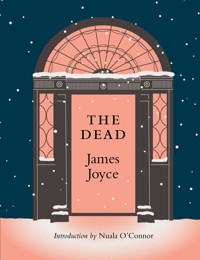
THE DEAD
James Joyce
With a new introduction by Nuala O’Connor
THE DEAD
This edition published in 2025 by
New Island Books
Glenshesk House
10 Richview Office Park
Clonskeagh
Dublin D14 V8C4
Republic of Ireland
newisland.ie
Copyright © 1967 by The Estate of James Joyce
Introduction copyright © 2025 Nuala O’Connor
The right of James Joyce to be identified as the author of this work has been asserted in accordance with the provisions of the Copyright and Related Rights Act, 2000.
Print ISBN: 978-1-83594-030-3
eBook ISBN: 978-1-83594-031-0
All rights reserved. The material in this publication is protected by copyright law. Except as may be permitted by law, no part of the material may be reproduced (including by storage in a retrieval system) or transmitted in any form or by any means; adapted; rented or lent without the written permission of the copyright owners.
This book is a work of fiction. Names, characters, businesses, organisations, places and events are either the product of the author’s imagination or are used fictitiously. Any resemblance to actual persons, living or dead, events or locales is entirely coincidental.
First published in 1914. This version of the text, following the punctuation and spelling of the first edition as well as Joyce’s preference for the long dash for dialogue and introducing sixty-five of Joyce’s own corrections, was established by Robert Scholes in 1967, assisted by Joan C. Scholes and Richard Ellmann.
British Library Cataloguing in Publication Data. A CIP catalogue record for this book is available from the British Library. Product safety queries can be addressed to New Island Books at the above postal address or at [email protected].
Cover design by Niall McCormack, hitone.ie
New Island Books is a member of Publishing Ireland.
CONTENTS
ABOUT THE AUTHORS
INTRODUCTIONby Nuala O’Connor
THE DEAD
ABOUT THE AUTHORS
James Joyce (1882–1941) was an Irish novelist, short-story writer and poet. He is best known for the influential modernist novels Ulysses (1922) and Finnegans Wake (1939) as well as the masterful short story collection Dubliners (1914). Though he spent most of his adult life in Paris, Zurich and Trieste, his birthplace of Dublin was the setting for all of his major fictional works.
Nuala O’Connor (b. 1970) is the author of six short-story collections, five poetry collections and six novels including the bestselling Nora (2021), about James Joyce’s wife Nora Barnacle, which was chosen as One Dublin One Book in 2022. She has won many prizes for her short fiction including the 2022 Irish Book Awards/writing.ie Short Story of the Year. Her work has also been nominated for numerous prizes including the Edge Hill Short Story Prize, the Kerry Group Irish Novel of the Year Award and the International Dublin Literary Award. She lives in County Galway with her family. nualaoconnor.com
INTRODUCTION
Nuala O’Connor
‘The Dead’ is a story of encounters between, mostly, one man – Gabriel Conroy – and, mostly, women. A circular story, that begins and ends with the same words – ‘the dead’ – it holds in its circumference questions of money, class, religion, Irish conviviality, music, family, alcoholism, mortality and the complexities of love. That James Joyce wrote it in his early twenties, when he worked in a Roman bank, adds to the wonder around the story, a masterpiece in the context of his short fiction. It is the work of a young mind, yes, but one that is deep, knowing and empathic; one that was looking back at the impoverished country he had left behind, with both longing and frustration. In this frantically detailed story, we find a paean to female generosity and care, things that Joyce both worshipped, and benefitted from, hugely. He knew he wanted to honour those attributes, and he also knew that his short fiction collection Dubliners needed a story about Irish hospitality to round out the grim realities of the other pieces in the manuscript. ‘The Dead’, a glorious, deep, wintery work, and the longest story in the collection, was his answer.
From the moment the reader enters the house of the Morkan sisters on Ushers Island, on Dublin’s quays, they are pulled from January snow into the warmth of a straitened, but giving, household. The modest ladies within – ‘the Three Graces’, as Gabriel styles them – work hard but are short on money. Still, they provide a lavish, quality-laden table for their guests. On his arrival to his relatives’ house, Gabriel Conroy immediately makes himself known to the reader: he is bombastic but generous, well-meaning but fumblingly inappropriate, conceited but thoughtful. He doesn’t have the tenderness of a Leopold Bloom, but he is getting there and will yet learn to be more considerate of the people he likes and loves.
Fictional worlds remain static in their contours while the reader evolves and, hopefully, matures. When we return to a text over and over across the years, we often find new things to love and understand there. For a long time, I was highly irritated by Gabriel Conroy, by his self-importance and swagger, his centring of himself and his needs. But now, as an older, more compassionate adult, I am better able to detect and acknowledge the softness behind Gabriel’s bravado and nervousness in the face of the important speech he will later deliver at his aunts’ Women’s Christmas party. I see his social awkwardness and bluff as part of the need for him to do right by his beloved relatives; I can acknowledge his willingness to eventually recognise and understand that everyone has as rich and complex a relationship with themselves and their past as Gabriel has himself. His epiphany may come late, but it is sincere, and it’s to his credit that he has it at all.
Still, I’d be lying if I said that Gabriel’s micromanagement and misunderstanding of the people around him doesn’t still prickle me as the story unfolds. He is a man who gets easily rucked, he’s even irritated by the floor that glitters with beeswax under the chandelier. He resents his cousin Mary Jane’s choice of music because it has ‘no melody for him’. Gabriel is that egregious thing to most women – a righteous, moany mansplainer who likes everything his way. I sometimes wonder whether male readers find Gabriel as basically disconcerting in the early parts of ‘The Dead’ as I do; if they are irked by his conceit and insensitivity, or might idolatry of Joyce himself extend to unadulterated worship of all of his male characters?
The women in ‘The Dead’ have the measure of Gabriel and of the world of men they move through. They may like, love and respect Mr Conroy but they are not afraid to unsettle him, and he gets a land, not once with young Lily’s bitterness about men, but again with Molly Ivors’ teasing, and finally with his wife Gretta’s revelations. Gabriel is arrested, too, by realisations about his aunts’ great ages and mortality, and by the private, inner world of Gretta. Over and again, Gabriel is a man affronted and upended, a man proud of his vast learning but with, until now, little true empathy with, or deep understanding of, others.
Nowadays, for me, giving Gabriel the benefit of the doubt feels necessary – his nerves are at him, as we used to say in Ireland; he is anxious, as we might say today, because he reveres his aunts and wants to do right by them. There is emotion, vulnerability and need in that want. He also adores his wife and his fascination with her – much like James Joyce’s with Nora Barnacle – is absolute. And this January night, Gabriel opens himself to learning and compassion and, for this reader, that comes across as admirable.
James Joyce drank for social courage. Though we may think of him as a gregarious rabblerouser he was, in fact, not comfortable in the community whirl. He was a family man – was most at home at home, and we can see this quality in Gabriel as soon as he arrives to his aunts’ house – he’s in a decidedly I’d-rather-not-be-here mood. Throughout the story his push-me-pull-you feelings surface – he arrives late, blaming Gretta’s slow dressing preparations, but is that the whole truth? Was Gabriel reluctant to come out on this cold night, despite his love for his old aunts and cousin? He moves crabbily through the Ushers Island rooms, pondering and peppering about his upcoming speech. Gabriel really wants to exit the house on the quays and escape into the wintry night, thinking, ‘How pleasant it would be to walk out alone, first along by the river and then through the park! The snow would be lying on the branches of the trees and forming a bright cap on the top of the Wellington Monument. How much more pleasant it would be there than at the supper-table!’. It is hard not to conjure the tender, nervy and sensitive James Joyce in this wish to be elsewhere for, often, he did not enjoy the pressing needs of society.
In ‘The Dead’, Gabriel does not like being called a West Briton and feels embarrassed and oppositional in the face of Nationalist Molly Ivors’ warm jousting, which Gabriel frames as an ‘unpleasant incident’. For a polyglot, and a man obsessed by words, Joyce’s lack of engagement with the Irish language has always struck me as odd. Being anti-violence, he was no fan of the Fenian movement, but one might have expected him to be pro-language revival for the sake of Irish culture as a whole. He has Gabriel testily state to Molly ‘Irish is not my language’, and perhaps that is Joyce’s own defensiveness, he felt persecuted by Ireland, let down by the country, sometimes with good reason.
On this Little Christmas night, badness comes faster to Gabriel Conroy than goodness. When Mrs Malins tries to engage him in small-talk, Gabriel is still distracted by Molly’s ‘heckling’ and by her ‘rabbit’s eyes’. He is unkind in this personal way often, styling his aunts ‘ignorant old women’ though, to be fair, he praises their diligence and selflessness too. He speaks moodily to Gretta while disgruntled by Molly, and overwhelmed by Mrs Malins’ chatter, and remains cranky, self-focussed and almost belligerent throughout the party. But he is self-aware, too, and somewhat fair – or at least he strives to be – clapping loudly for Aunt Julia’s singing, and decently offering to escort Molly Ivors home when she opts for an early night.




