


8,00 €
Mehr erfahren.
- Herausgeber: Giuseppe Guarino
- Kategorie: Religion und Spiritualität
- Sprache: Englisch
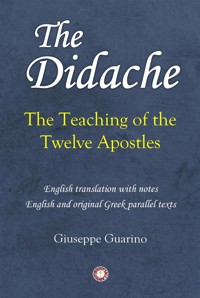
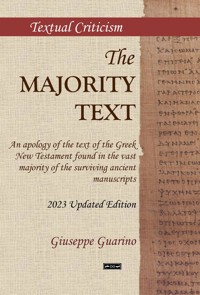
The “Didache,” also known as "The Teaching of the Twelve Apostles," is an ancient Christian text that was likely arranged in its present form in the early second century AD, although the exact date is debated among scholars.
The doctrine of the Didache is that of the early Church, simple formulas and a vivid Jewish flavor in a lot of statements.
It was considered an important text in the early Christian church, and was widely circulated and used alongside the canonical New Testament texts in some regions.
Giuseppe is author of many books, articles and Bible studies. You will find them on Amazon, Barnes and Noble, Lulu.com and on his official website www.giuseppeguarino.com
Das E-Book können Sie in Legimi-Apps oder einer beliebigen App lesen, die das folgende Format unterstützen:
Veröffentlichungsjahr: 2023
Ähnliche








Respectfully dedicated to
Pastor Andrew Provazek
We share the passion for the Fathers of the Church and I am sure he will enjoy reading this version of the Didache
THE APOSTOLIC FATHERS
THE DIDACHE
The Teaching of the Twelve Apostles
English Translation with notes
English and Greek parallel texts
Giuseppe Guarino
Published by Infinity Books
www.infinitybooksmalta.com
Copyright © 2023 Giuseppe Guarino
All rights reserved
www.giuseppeguarino.com
TABLE OF CONTENTS
Preface, 9
Introduction, 11
The Didache, English Translation, 23
The Didache, Greek and English, 43
J. B. Lightfoot’s translation of the Didache, 75
Preface
After publishing the Epistle of Clement (only its English translation), we present here The Didache, also known as The Teaching or Teaching of the Twelve Apostles.
When I first read it over thirty years ago, I fell in love with it. Since then, I have been dreaming of creating my own edition of this wonderful ancient writing. And now, here it is!
The Didache is shorter than Clement's letter, but it is more technical and contains doctrinal information. In this edition, I have provided both a translation and the Greek text.
While I acknowledge that this text is more suited for study rather than casual reading, I want to emphasize that the purpose of this series of books on the Apostolic Fathers, as well as the numerous Early Church Fathers we have published, is to invite the average Christian and Bible reader to become acquainted with these writings and experience the blessings of understanding how the same faith, diligence, and expectations that we embrace today were also part of the lives of the early Christians.
May God bless your reading and study of this remarkable Christian document.
June 18th, 2023
Giuseppe Guarino
Introduction
The “Didache,” also known as "The Teaching of the Twelve Apostles," is an ancient Christian text that was likely arranged in its present form in the early second century AD, although the exact date is debated among scholars.
“A remarkably wide range of dates, extending from before A.D. 50 to the third century or later, has been proposed for this document.” J.B. Lightfoot, J.R. Harmer, Edited and Revised by M.W. Holmes, The Apostolic Fathers, Second Edition, Baker Book House, p. 247.
I agree with the possible date of A.D. 70 proposed by J. P. Audet. This conclusion will become plausible to the attentive reader of the text.
The doctrine of the Didache is that of the early Church, simple formulas and a vivid Jewish flavor in a lot of statements.
The Didache is a brief manual of moral and ethical teachings, church practice, and instructions on baptism, fasting, prayer, and the Eucharist. It was considered an important text in the early Christian church, and was widely circulated and used alongside the canonical New Testament texts in some regions. Clement of Alexandria gave it much importance.
The text was lost for centuries until it was rediscovered in 1873 by a Greek Orthodox bishop in a library in Istanbul. Since then, numerous translations and commentaries on the Didache have been produced, and it has become an important source for understanding the beliefs and practices of early Christianity.
Manuscripts
Here are some of the manuscripts containing all or part of the Didache:
Codex Hierosolymitanus (A.D. 1056) - Also known as the Jerusalem Codex, this manuscript was discovered in the library of the patriarchate in Jerusalem in 1873. It contains the complete text of the Didache.
Codex Vaticanus Graecus 862 (A.D. 1056) - Also known as the Codex Ottobonianus, this manuscript is located in the Vatican Library and contains the complete text of the Didache.
Codex Parisinus Graecus 451 (A.D. 1070) - This manuscript, located in the National Library of France, contains the complete text of the Didache.
Codex Atheniensis (A.D. 1056) - Also known as the Codex Athous Laura, this manuscript was discovered in 1847 in the monastery of Mount Athos in Greece. It contains the complete text of the Didache.
Codex Upsaliensis (A.D. 1477) - This manuscript, located in the Uppsala University Library in Sweden, contains the complete text of the Didache.
Codex Hierosolymitanus 48 (A.D. 1056) - This manuscript, also known as the "Pseudo-Athanasian Canons," contains a partial copy of the Didache.
Codex Barberini Graecus 336 (A.D. 1056) - This manuscript, located in the Vatican Library, contains a partial copy of the Didache.
There are also several fragments and quotations of the Didache found in other early Christian writings, such as the Apostolic Constitutions, the writings of Clement of Alexandria and Origen.
Variant readings
Variant readings among the manuscripts are relatively minor and in different manuscripts of the Didache, do not significantly affect the overall message and teachings of the Didache. However, they do highlight the challenges involved in reconstructing the original text and understanding its transmission history.
Some manuscripts have a longer version of the prayer (“The Lord’s Prayer”) than others. For example, the Sahidic and Bohairic versions of the Didache have a longer version of the prayer that includes additional clauses, while the Greek and Latin manuscripts have a shorter version.
The Greek and Latin manuscripts have slightly different wordings in their instructions for baptism. For example, some Greek manuscripts use the phrase "pour out" while others use "pour upon" when describing the pouring of water during baptism.
Some manuscripts have a longer version of the eucharistic prayer than others. For example, the Sahidic and Bohairic versions have additional clauses and phrases not found in the Greek and Latin manuscripts.
There are several differences in the wording of the final chapter of the Didache across different manuscripts. For example, some manuscripts have a longer version of the closing prayer, while others have additional phrases or variations in wording in the exhortation to "watch" for the end times.
Biblical quotations or allusions
There are many biblical quotations and allusions in the text of the Didache. We will see them as we dive into its text. Let us see some here.
Didache 1:1
"There are two ways, one of life and one of death, and there is a great difference between the two ways." - Didache 1:1, Matthew 7:13-14
Didache 1:6
Let your alms sweat in your hands, until you know to whom you should give" (Didache 1.6) - possibly based on Deuteronomy 15:7-11.
Didache 2:2
"You shall not murder; you shall not commit adultery; you shall not corrupt boys; you shall not fornicate; you shall not steal; you shall not practice magic; you shall not use potions; you shall not procure [an] abortion, nor destroy a newborn child" (Didache 2:2, based on Matthew 5:21-22, 27-28, and Exodus 20:13-15, 17)
Didache 3:7-8
"For where there is love, there is also fear. Where there is humble speech, there is also hate. Where there is contention, there is also pride; but the patient man is free from pride" (Didache 3:7-8, based on 1 Corinthians 13:4-6 and Proverbs 13:10)
Didache 4:5
"Do not be one who stretches out his hands to receive but withdraws them when it comes to giving" (Didache 4.5) - based on Deuteronomy 15:7-11.
Didache 4:8
"Thou shalt not turn away from him that is in want, but shalt share all things with thy brother, and shalt not say that they are thine own; for if ye are partakers in that which is immortal, how much more in things which are mortal?" (Didache 4:8) - This is an allusion to Acts 2:44-45 and 4:32-35.
Didache 6:2
"For if ye are able to bear the whole yoke of the Lord, ye shall be perfect; but if ye are not able to do this, do what ye are able." (Didache 6:2) - This is an allusion to Jesus' words in Matthew 11:28-30, where he invites people to take his yoke upon them and learn from him.
Didache 7:1
"And concerning baptism, baptize this way: Having first said all these things, baptize into the name of the Father, and of the Son, and of the Holy Spirit, in living water" (Didache 7:1, based on Matthew 28:19)
Didache 8:1
"And let not your fastings be with the hypocrites, for they fast on the second and fifth day of the week; but do ye fast on the fourth and sixth day." (Didache 8:1) - This is a reference to the Pharisees' practice of fasting twice a week, mentioned in Luke 18:12.
Didache 9:2




