


1,99 €
Niedrigster Preis in 30 Tagen: 1,99 €
Niedrigster Preis in 30 Tagen: 1,99 €
Mehr erfahren.
- Herausgeber: DigiCat
- Kategorie: Geisteswissenschaft
- Sprache: Englisch
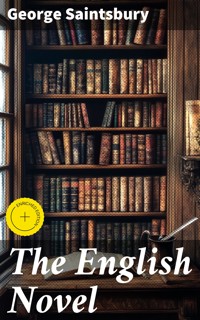
In "The English Novel," George Saintsbury presents a comprehensive exploration of the development of the novel as a literary form in England. With a keen analytical style, Saintsbury examines the evolution of the English novel from its inception in the 18th century to contemporary works in his time, delving into various authors, movements, and narrative techniques. He employs an erudite yet accessible approach, weaving together critical insight and historical context, which makes the work not only informative but also a pleasurable read for scholars and enthusiasts alike. Through detailed analyses of key figures such as Daniel Defoe, Jane Austen, and Charles Dickens, Saintsbury lays bare the stylistic and thematic shifts that have defined English literature's most beloved genre. George Saintsbury, a distinguished scholar and literary critic of the late 19th and early 20th centuries, had a profound love for literature that is palpably reflected in his writing. His breadth of knowledge was shaped by both personal experience and academic pursuits, allowing him to draw upon a diverse array of genres and literary techniques. This work is an extension of his commitment to advocating for the understanding and appreciation of literature as an evolving art form, marking him as a significant figure in literary criticism. I highly recommend Saintsbury's "The English Novel" to anyone with a vested interest in literary history or the development of narrative forms. Rich in insights and elegantly crafted, this book serves not only as an essential reference for scholars but also as an engaging narrative for readers looking to deepen their understanding of one of the most significant literary genres in English literature. In this enriched edition, we have carefully created added value for your reading experience: - A succinct Introduction situates the work's timeless appeal and themes. - The Synopsis outlines the central plot, highlighting key developments without spoiling critical twists. - A detailed Historical Context immerses you in the era's events and influences that shaped the writing. - A thorough Analysis dissects symbols, motifs, and character arcs to unearth underlying meanings. - Reflection questions prompt you to engage personally with the work's messages, connecting them to modern life. - Hand‐picked Memorable Quotes shine a spotlight on moments of literary brilliance. - Interactive footnotes clarify unusual references, historical allusions, and archaic phrases for an effortless, more informed read.
Das E-Book können Sie in Legimi-Apps oder einer beliebigen App lesen, die das folgende Format unterstützen:
Veröffentlichungsjahr: 2022
Ähnliche



The English Novel
Table of Contents
Introduction
At once panoramic and pointed, The English Novel follows the tradition’s central struggle to balance the sheer pleasure of story with the demands of structure and judgment, tracing how modes of romance, realism, and satire renegotiate the claims of incident, character, and style as English prose fiction grows from tentative beginnings into a many-voiced art, and considering how readers’ expectations and writers’ technical choices shape one another in a centuries-long conversation whose energy lies in its frictions—between amusement and analysis, convention and innovation, craftsmanship and spontaneity—a national form becoming itself without ever ceasing to argue about what that self should be.
George Saintsbury’s book is a work of literary history and criticism, written in the early twentieth century by a prominent English critic steeped in the long tradition he surveys. Rather than presenting a fictional narrative, it offers a concise, sequential account of the English novel’s development from its early practitioners through the nineteenth century, with attention to phases, tendencies, and representative achievements. It belongs to the seasoned survey genre that aims to orient intelligent general readers and students, placing major movements in relation to one another while marking out characteristic problems of form, taste, readership, and professional craft.
The reading experience is that of an assured guide leading one through crowded rooms: chapters move briskly, arguments are framed with economy, and judgments are stated plainly, though never mechanically. Saintsbury writes in an essayistic voice that values clarity, range, and a certain frankness of preference. He cares for how a novel is built—sentence by sentence, scene by scene—and for the energy that construction releases. The tone is firm but companionable, inviting readers to weigh examples rather than merely accept a thesis. Without recourse to specialized jargon, he draws distinctions, builds comparisons, and points toward links across periods and kinds.
Several themes anchor the study. It follows the emergence of narrative technique, especially the handling of point of view, time, and character as a functional ensemble. It tracks the shifting relation between romance and realism, asking how imaginative freedom and verisimilitude can productively counterbalance one another. It addresses the interplay of plot architecture and ethical interest, noting when designs clarify and when they constrict. It also stresses continuity and change: how conventions persist, diversify, and sometimes return transformed. Collectively, these themes illuminate the novel as a capacious, adaptive form that refines its tools by testing them in new social and artistic conditions.
Methodically, Saintsbury couples historical sweep with attention to craft. He discusses kinds of novels—adventure, domestic, historical, Gothic—while emphasizing textures of prose, tempo of narration, and the shaping of episodes into coherent wholes. His evaluations hinge on workmanship and effect: whether an author controls material, sustains interest, and attains proportion. He also makes room for lesser-known figures when they clarify a tendency or bridge a change, reminding readers that a tradition is built not only by its most famous names. The result is a map thick with crossroads, where acclaimed landmarks and modest byways together reveal the routes fiction has taken.
For contemporary readers, the book matters as both an introduction and a historical artifact of criticism. It offers a durable framework for thinking about lineage, influence, and technique, helping one see how present-day fiction inherits problems the form has long negotiated. It exemplifies lucid, non-technical criticism that can sharpen attention to structure and style. At the same time, its period vantage invites reflection on canon formation and on how values shift. Reading it alongside current scholarship encourages productive disagreement and reassessment, turning Saintsbury’s confident survey into a starting point for broader, more inclusive conversations about what novels do and why.
Approached as a companion rather than a catechism, The English Novel rewards readers who enjoy watching principles tested by examples and who prefer questions of how over proclamations of what. It does not require specialized knowledge in advance; it builds context as it goes, directing attention to features any engaged reader can observe and evaluate. Its aim is not to exhaust the subject but to give it shape, rhythm, and a set of graspable tools. In this, the book remains an invitation: to read widely, compare patiently, and keep the lively tension between pleasure and design at the center of the enterprise.
Synopsis
George Saintsbury’s The English Novel presents a historical-critical survey of English fiction, outlining how the form consolidates from mixed prose narratives into a distinct art. Opening with definitions and limits, he distinguishes the novel from earlier romance, tale, and allegory, and sets criteria for judging plot, character, and narrative method. He frames his approach as chronological yet comparative, attentive to language, form, and the reader’s experience. The book seeks not to catalogue every writer but to trace decisive strands and exemplary achievements, arguing that the English tradition reveals recurrent tensions between realism and imagination, moral design and entertainment, convention and innovation.
Saintsbury begins with antecedents that prepared the ground: medieval and Renaissance romances, Elizabethan prose experiments, and the prose rhythms sharpened by satire and pamphlet. Figures such as Lyly, Sidney, Greene, and Nashe illustrate how style, dialogue, and incident matured, though long still tethered to romance patterns. Bunyan’s narrative energy shows how sustained storytelling could organize experience around a central journey and character. These pre-novelists, in Saintsbury’s account, test the resources of English prose, moving toward individualized characterization and continuous plot, even as the materials remain mixed. The stage is thus set for a form able to encompass ordinary life without relinquishing narrative allure.
In the eighteenth century, the novel’s foundations are laid with remarkable speed and variety. Defoe advances documentary realism, shaping narratives that simulate lived testimony and practical circumstance. Richardson deepens interiority through epistolary structure, exploring motive, conscience, and social pressure. Fielding counterbalances with an open, comic-epic architecture, integrating plot design, narratorly wit, and generous characterization. Smollett develops itinerant, satiric energies, while Sterne fractures linearity to exhibit playfulness and reflexivity. For Saintsbury, these contributions define the main axes of English fiction—realist detail, moral psychology, structural orchestration, and self-conscious narration—providing models both to imitate and to resist in later developments.
Saintsbury situates later eighteenth-century and early nineteenth-century growth within a broadened field of appetite and tone. Gothic invention supplies atmosphere and suspense, testing decorum and expanding what subjects prose fiction may admit. Parallel to this, the novel of manners cultivates precision of social observation and delicate irony. Jane Austen crystallizes this domestic realism, balancing probability with artful design. With Walter Scott, the historical novel attains breadth, marrying romance movement to conscientious chronicle and national memory. Through such contrasts, Saintsbury underscores the novel’s capacity to mediate between the ordinary and the exceptional, to shape sympathy while disciplining narrative extravagance.
The Victorian middle decades, in Saintsbury’s survey, exhibit amplitude of range and command. Dickens animates a populous social theatre, blending caricatural brilliance with pathos and narrative propulsion. Thackeray refines urbane satire and moral scrutiny across layered society. The Brontë novel intensifies interior passion and the claims of imagination against constraint. Trollope consolidates institutional and domestic continuities, while George Eliot brings philosophical gravity and ethical analysis within a realist framework. Saintsbury traces how serial publication influences pacing and structure, and how omniscient narration reaches a confident maturity, enabling broad canvases that retain coherence of character motive and thematic purpose.
As the century wanes, the field diversifies further. Sensation narratives and intricate plotting, associated with figures like Collins, demonstrate technical ingenuity in managing suspense. Other strands prioritize intellectual subtlety and stylistic compression, as in Meredith, or tragic regional design and impersonal fate, as in Hardy. Adventure, historical reconstruction, and psychological introspection proliferate, testing the limits of decorum and structure. Saintsbury measures these tendencies against earlier exemplars, probing how far experiment may proceed without sacrificing clarity and shapeliness. He notes recurrent debates about the novel’s duties—to instruct, to delight, to represent faithfully—while acknowledging the form’s elastic capacity to absorb competing aims.
The book closes by balancing appraisal with perspective. Rather than announcing final hierarchies, Saintsbury emphasizes continuities: a tradition negotiating realism and romance, private conscience and public scene, artistry and accessibility. He returns to questions of technique—narrative voice, construction, dialogue—and to the ways English prose has furnished the novel with durable resources. The study’s enduring value lies in its mapping of formative achievements and its articulation of standards rooted in attentive reading. Without predicting destinies, it affirms the genre’s resilience and variety, leaving readers with a clarified sense of how English fiction became a central vehicle for representing life in prose.
Historical Context
George Saintsbury wrote The English Novel in late Victorian Britain, when literary history was consolidating as a scholarly pursuit and English literature was gaining institutional footing. Trained at Merton College, Oxford, and active as a journalist-critic for outlets such as the Saturday Review, he later held the University of Edinburgh’s Chair of Rhetoric and English Literature from 1895. His survey emerged from a culture that valued ordered historical synthesis, cataloguing, and canon formation. It addressed an expanding, educated reading public and reflected a moment when British critics sought to define national literary traditions with confidence, breadth, and an emphasis on demonstrable influence and craft.
The book’s backward gaze begins in an era transformed by the lapse of pre-publication licensing in 1695, the growth of the press, and the rise of commercial printing. Coffeehouses, periodicals, and booksellers fostered a secular reading culture that enabled long prose fiction to flourish. Daniel Defoe’s Robinson Crusoe (1719), Samuel Richardson’s Pamela (1740) and Clarissa (1747–48), and Henry Fielding’s Tom Jones (1749) exemplify new possibilities in narrative, characterization, and social observation. Saintsbury situates these writers as foundational, showing how market structures and a widening readership encouraged the novel’s emergence as a distinct and durable literary form.
Eighteenth-century diversification—picaresque energy in Tobias Smollett, digressive experimentation in Laurence Sterne, Gothic romance from Horace Walpole and Ann Radcliffe, and the social-comic finesse of Frances Burney—mapped out competing models. The expansion of circulating libraries and subscription reading created stable outlets for fiction. Within this ferment, Jane Austen’s early nineteenth-century novels refined domestic realism and irony, consolidating techniques of free indirect style and precise social focus. Saintsbury’s historical method highlights continuity across these modes, emphasizing how formal choices arose from identifiable readerships, publishing conventions, and critical debates about morality, decorum, and the uses of imaginative prose.
The Romantic period redirected energies toward history and nation after the Napoleonic Wars, above all through Walter Scott’s historical novel. Beginning with Waverley (1814), Scott established a European vogue for narratives that dramatized the past in accessible prose, influencing authors from Edward Bulwer-Lytton to James Fenimore Cooper. Publishing practices—series formats, authorial branding, and international reprint markets—expanded fiction’s reach. In Saintsbury’s account, Scott’s fusion of romance with historical realism anchors the English novel’s lineage, demonstrating how large-scale social change could be rendered through character, setting, and event without abandoning narrative momentum or stylistic propriety.
Victorian fiction matured inside a commercial ecosystem shaped by serialization in magazines and part-issue publication. Charles Dickens published in Bentley’s Miscellany, Household Words, and All the Year Round; William Makepeace Thackeray edited the Cornhill Magazine. The 1842 Copyright Act and railway bookstalls (notably W. H. Smith) professionalized authorship and distribution, while Mudie’s Select Library steered middle-class tastes. The 1870 Elementary Education Act broadened literacy, diversifying audiences. Saintsbury tracks how these conditions encouraged long, episodic structures, memorable characterization, and moral engagement, positioning Dickens and Thackeray as central to the novel’s reach and its negotiation of entertainment with ethical and social inquiry.
Mid-Victorian fiction diversified into psychological realism (George Eliot), social-problem narratives (Benjamin Disraeli, Charles Kingsley), regional and industrial novels (Elizabeth Gaskell), and sensation fiction (Wilkie Collins, Mary Elizabeth Braddon). Debates about propriety and candour in fiction unfolded against the backdrop of powerful lending libraries that rewarded restraint and punished perceived transgression. Saintsbury appraises these strands within a framework attentive to plot architecture, style, and the balance of incident with analysis. His synoptic treatment clarifies how technical advances in point of view, narrative pacing, and thematic ambition responded to—and were constrained by—institutions regulating access, price, and moral acceptability.
By the fin de siècle, English fiction confronted new currents: French-influenced naturalism (notably via Émile Zola’s reception and English practitioners like George Moore), aestheticism, and New Woman debates. At the same time, the three-volume novel collapsed in 1894 when major lending libraries abandoned it, hastening a shift to single-volume formats and altering economic incentives and length. Saintsbury closes his narrative before high modernist experiment, capturing a transitional threshold. His perspective, formed before Conrad, Woolf, and Joyce, preserves a late Victorian sense of the novel’s lineage, evaluating recent developments against long-standing standards of structure, diction, and narrative purpose.
The English Novel belongs to a late nineteenth-century wave of comprehensive literary histories that sought to codify a national canon while acknowledging European antecedents such as Cervantes and French romance. Written for educated general readers and students, it helped consolidate authors, periods, and genres into a teachable sequence, influencing early university syllabi and public discourse. Its historical scope exemplifies Victorian confidence in orderly genealogy and evaluative criticism grounded in textual features and demonstrable influence. The book thus reflects its era’s assumptions and institutions while offering a durable map of how English fiction evolved under changing markets, tastes, and intellectual pressures.




